Downward
Psalm 118:1-2, 19-29 I Matthew 21:1-11
Pastor Arta Skuja
.
“…The poor cling to their scraps of rags, not realizing that the only way not merely to save their rags but to make them precious is to give them away, with joy and love, to those who need them. Why? Because these rags are the perishable riches of this world’s kingdom. By giving them away, by giving oneself completely — with one’s entire inner world, laying down one’s soul — a person becomes poor in spirit, one of the blessed, for according to the promise of our Savior, the Kingdom of Heaven belongs to such a one. Such a person becomes an heir to the imperishable and eternal riches of the Kingdom — already now, here, upon the earth — gaining immeasurable joy in selfless, self-giving, sacrificial love, and also receiving the freedom and lightness that come from a state in which you are not possessively attached to anything.” (Maria Skobtsova, from the essay “The Poor in Spirit”)
The representatives of the conquering power of Rome, backs straight, girded with sword and armor, move through the occupied territories on the beautiful, muscular, agile horses. They march to entertain themselves, to intimidate, to collect money, to control and subjugate the inhabitants of Jerusalem.
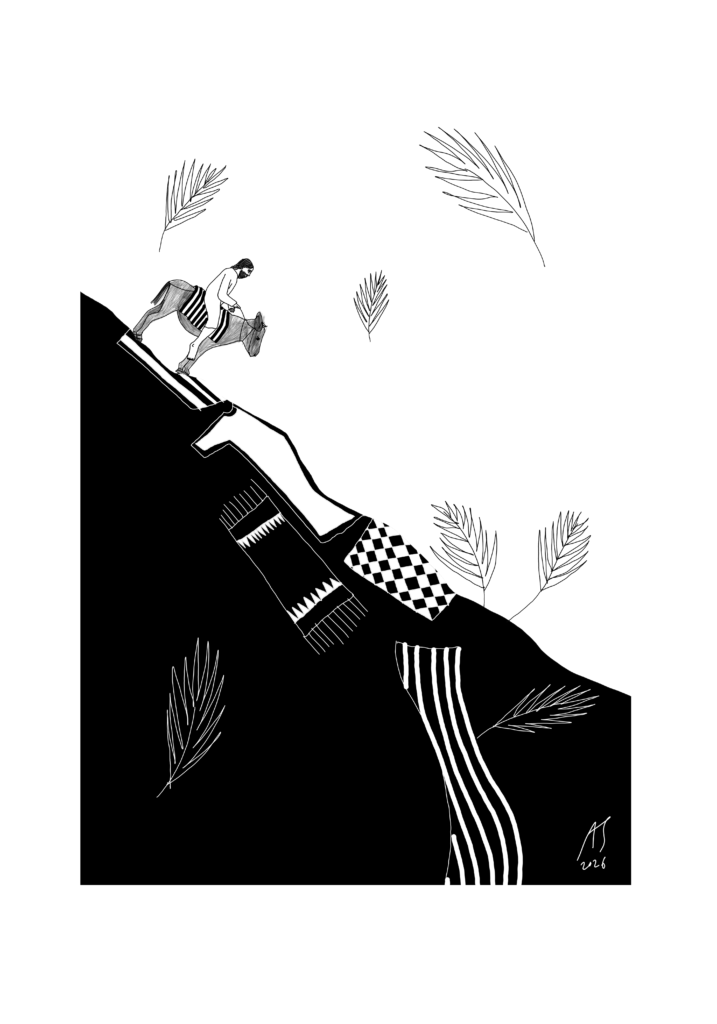
But the Lord needs a donkey. He does not need a glossy-coated, noble horse. One day, when God’s time had come to be fulfilled, Jesus rides into the capital of God’s people, sitting on the back of a young donkey. He does not come alone — with him are friends, followers, joined by an ever-growing crowd of the curious and the captivated.
Jesus is not only humble himself, but through this strange procession and through everything that step by step will be revealed during Holy Week, he becomes the humbled one, the servant of servants. Such is the inverted order of his Kingdom. Although the physical road to Jerusalem leads uphill, Jesus’ way goes downward — to the very lowest, ugliest, and most repellent points. In his reign there is nothing of the Roman lust for power.
Looking from the outside, and across a great distance of time, we might think: oh, you foolish people of Jerusalem, you who awaited the Messiah — a liberator, a king who would be like, yet stronger than, the Roman governors, centurions, and warhorses — where did you get even the slightest grounds to think that your liberator would be like your oppressors? Yes, he overturned the tables of the merchants in the temple, but only a few days later the crowd shouting “Hosanna in the highest!” will hear these words of Jesus: “Put your sword back into its sheath, for all who take the sword will perish by the sword!”
Even now, consciously, but more often unconsciously, we continue to expect that Jesus might after all be like that: a powerful, majestic liberator, a victor, decisive and direct in his favor or in the heat of his wrath. For it is far more comforting to think that God in his omnipotence could, with a single breath or a strong shove of the elbow, take and shatter into dust the destructive forces in the space of our lives, destroy the evil, despotic, and corrupt leaders of nations, halt wars, floods, diseases, want. Jesus, healer and victor, where are You? It seems that not a drop of water has been turned into wine, nor has the blind man regained his sight, nor has the dead been returned to life. Have You abandoned us? Or do we perhaps wander blind, insensitive, unenlightened to what has already begun to be revealed among us?
But why does the miraculous, the supernatural, seem so compelling to us? Perhaps because it does not require us to dismount from our horses? And we do not have to spread out our garments — in our humility and simplicity we do not have to fall to our knees and unroll all that we are and all that we possess? For the eyewitnesses of Jesus’ entry into Jerusalem, they possesed no more than the shirt on their bare bodies. Yes, laying everything down before God can look awkward and pointless, knowing that all of it will be trampled under the feet of the donkey and the other fellow travelers. After such an event, the only shirt one now has is rags. But perhaps it is only with such tatters of cloth, after all the loud cries of “Hosanna” and the waving of palm or pussy-willow branches, that we are able to draw near to the fullest revelation of God’s glory.
Perhaps the “Hosanna!” crowd of Jerusalem was not waiting for the great and mighty at all? Perhaps they — the fed, the given drink, the seeing, the raised up — had already sensed with the ear, the eye, the mind of the heart that everything is altogether different — in an overturned and reversed order, not measured out mathematically and symmetrically — and from this paradox the whole city was then stirred, as we read at the end of the account.
Jesus, sitting on the back of a donkey, leads us nearer to the Kingdom that he began to proclaim after his path of fasting, having fought deep inner battles, having come out of the forty days and forty nights spent in the wilderness, and having walked on foot among his oppressed sisters and brothers during the days allotted to him on earth. Only Jesus will be able to show to the very end that love knows no limit of renunciation. Love conquers even the fear of death. “Learn from me, for I am gentle and humble in heart…”
It is no matter that, once you have found your coin, you, celebrating with the neighbor women, will spend twice as much money — blessed are you who rejoice with a generous joy, for that which was lost has been found! The Kingdom of Heaven will rise again like leavened dough — yes, truly!
Blessed are you if you are not afraid of life’s patches, of want and of wear — share in that too!
Blessed are you who are not afraid of a stinging slap from your adversary, but accept it, standing firmly with both feet on the ground — it will evaporate like mist, if you do not let it spoil within you.
Blessed are you who are not afraid of the climb or the fall downward.
Blessed are you who in your spirit are like translucent gauze, unable to cast a shadow over God’s light, and who say: “Shine through me!”
Blessed are you who kiss and wash the feet of the beggar and for his sake pour out precious oils and tears of compassion — this is not madness, it is the mind of God.
Blessed are you who know that “Hosanna!” will be followed by “crucify him!”, yet you, without turning your eyes away, will be beside those at the crosses of the world to which the way will lead.
Blessed are you who choose to put on the invisible armor of faith and to sit on the back of a little donkey.
From this the whole city will be stirred.
.
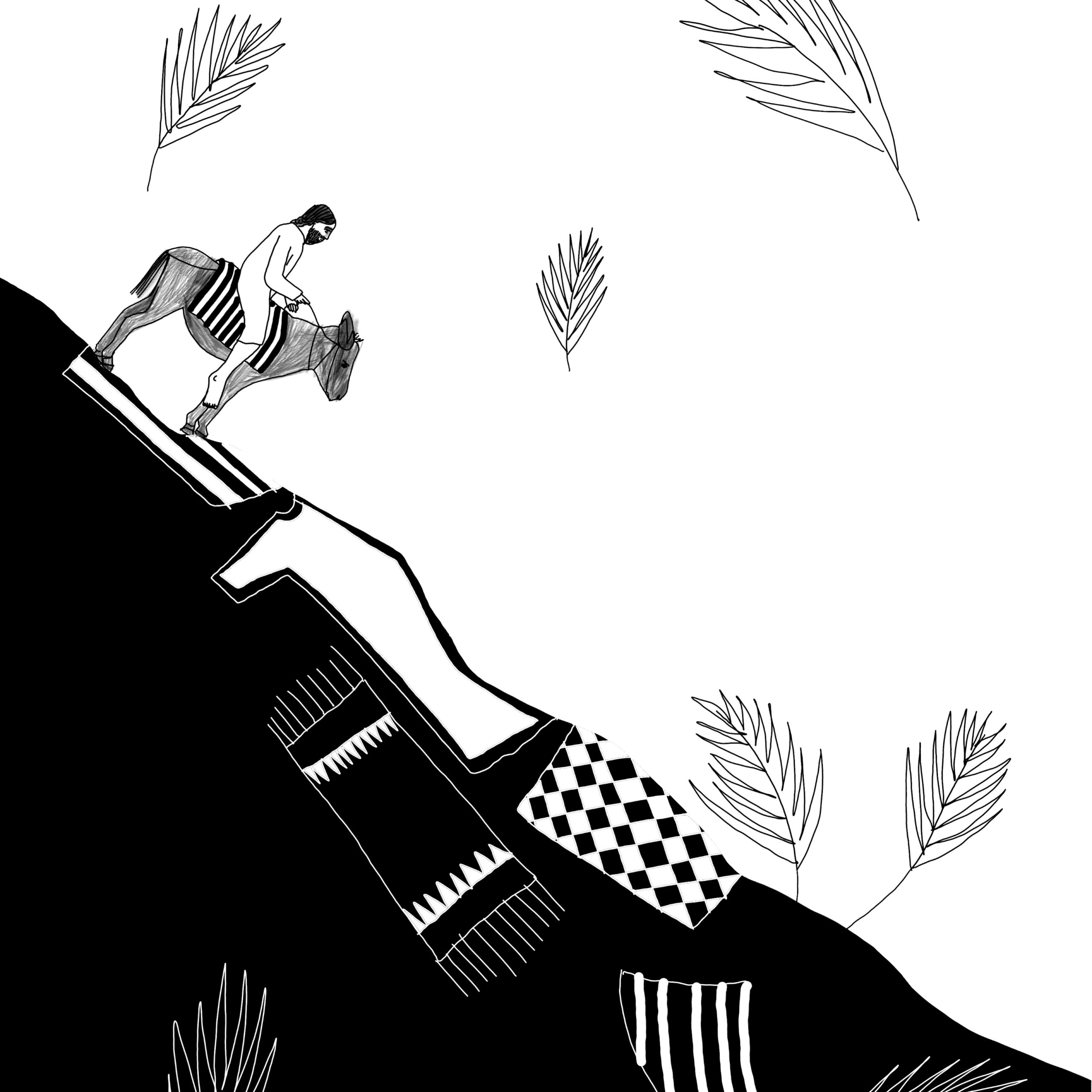
Illustration: Downward, downward. Arta Skuja, 2026