Nicodemus, thank you!
Gen 12:1-4a I Psalm 121 I Rom 4:1-5;13-17 I John 3:1-17
Daina Mežecka, Luther Congregation in Torņakalns
.
Thank you for going to Jesus by night, and for what you asked Him! Jesus’ answers to your questions have meant a great deal to me at various stages of my faith journey over the span of three decades. I have experienced them as the kernel of the good news, as a point of support in moments of confusion, as a storehouse of surprise and mystery. But over the past few weeks I have turned precisely to your questions, pondering and savoring them.
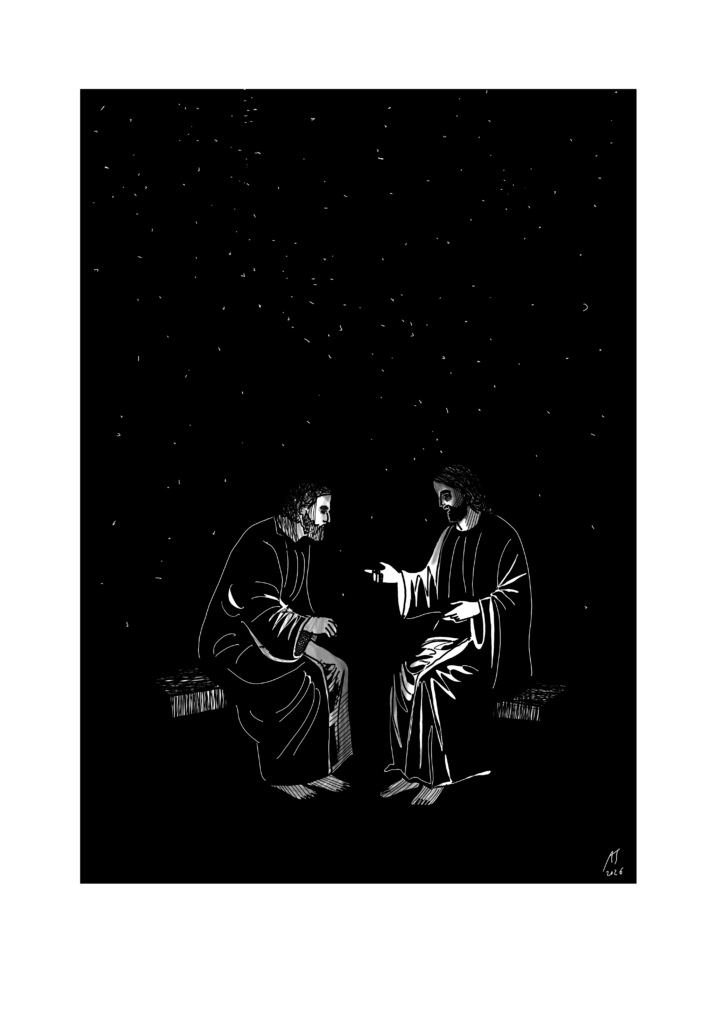
Thank you that you back then overcame the stiffness in your bones, did not give in to the weariness after the day’s work, and set out at the cost of your little nightly ritual and your night’s sleep. Your eyesight, too, was probably no longer as sharp as in your youth, and the darkness surely made it considerably harder to walk along a route unfamiliar in everyday life.
Was it a night you had impatiently awaited after you had one day made the decision to meet Jesus for a conversation alone? Or did these questions begin to gnaw at you so unbearably in the blackness of the night that you got up and went, unable to wait for the morning?
You were not too shy to ask Jesus your rather absurd question: “How can someone be born when they are old? Can they enter a second time into their mother’s womb and be born?” (Jn. 3:4). A rather strange question from the lips of a respected spiritual teacher… And after a moment, as your confusion grew, you did not relent and asked again – now briefly and directly, giving up any guesses of your own: “How can this be?”
Beginning the conversation with Jesus, you addressed him as “rabbi” and affirmed your trust in him as a teacher “who has come from God.” Being a teacher yourself, you saw in him an honorable teacher. You showed him respect also as a man of authority. In your conduct I see openness, the ability to discern God’s inspiration and presence in a colleague who thinks differently. In a preacher whom many of your fellow office-holders treated with suspicion or mixed feelings. Besides, who knows how many such different preachers wandered your land at that time? How did you decide which of them were “come from God” and which – impostors, narcissists, or some other oddballs?
You noticed the paradox in what Jesus said, did not hide your bewilderment, and addressed it directly in your questions. Thus arose a conversation of two teachers that inspires and provokes reflection to this day.
“The wind blows where it wishes. So it is with everyone born of the Spirit” (Jn. 3:8). – I can only guess what followed your conversation. Did other opportunities later arise for you to question Jesus alone? I think you shared what you had heard and your reflections with like-minded people – those scribes with whom together you had come to the conviction that rabbi Jesus had truly “come from God.” What did this stir in them? Did they listen to you? Did your paths later cross with Jesus’ followers? The Christian Holy Scriptures are silent about this. I imagine, nonetheless, that the answers you and your like-minded friends received to your ardent questions did not allow you to keep silent. They prompted you to share with others what Jesus had said and the attitude he expressed. Thus, gradually, unnoticed by the casual passer-by, the impressions of these meetings spread among your fellow people. – Nowadays the mysterious, eye-invisible life of fungi attracts much attention. It turns out that the mycelium grows astonishingly vigorously and spreads intuitively and wisely along the paths of least resistance. Yet the mycelium, being a created thing, is limited in its capacity and “wisdom” (what else to call this “sagacity” in a being that has no brain and no central nervous system?). – How immeasurably more powerful, wiser, and more astonishing, then, is the working of the Spirit of the Creator of all – even though it is invisible to the eye?
Some six years ago, in the difficult time of isolation brought about by the pandemic, the significance of paradoxes in my faith journey began to dawn on me. They were such episodes in deeper conversations that made me stop, surprised, before their contradictoriness and absurdity. At times they produced such uncomfortable, awkward feelings that it became clear to me: from the paradoxical breathes authenticity. It is not an illusory construct created by my mind; it is something unforeseeable, something that comes from outside. My friends not connected with the church, without suspecting it themselves, evoked in me truly stirring reflections on faith. Since that time I pay special attention to the observations and life-wisdom of friends who stand far from the institutional church. – For I have experienced: the Spirit truly blows where it wishes. – And if it wishes, He reveals something to me through church skeptics too, addressing me powerfully and in a different way than in the congregation. The wind of the Spirit blows and does not let me settle comfortably into the hammock of my own notions or of the views of my nearest like-minded fellow churchgoers.
Recently this wind led me onto a road with two impulses like lanterns: the pithy self-description of a friend of mine: “there is no religion gene in me,” and the insight of a friend: “since I have begun to get to know the Bible, the Universe seems even more astonishing to me, who once studied astrophysics.” Both statements, with their directness, have set something stirring in me. I sense in them truthfulness, depth, and longing – similar to your questions, Nicodemus. Where in me is that gnawing urge that does not allow one to wait until morning and already by night drives one to find out the “things of God,” or the truth? – Such a goad tends to produce a sense of discomfort and to lead to the unforeseeable. That is why something in me resists it. Yet getting stuck in the familiar or in the illusion of all-knowing [from time to time] turns out to be even more unbearable.
Just now a new stage of the road has begun again – the yearly journey toward the feast of Christ’s Resurrection. A going toward Him… following Him. I am a little afraid to give myself over to this road, because I sense that there will be much of the unknown in it, dreadfully wondrous. Yet I remind myself that “God sent his Son into the world, not to judge the world, but that the world might be saved through him” (Jn. 3:17), and I take my place among the walkers, follow in His footsteps and yours, Nicodemus, and call out in chorus with you and the other fellow travelers:
“Come, Holy Spirit, come, true God,
Come from heaven, descend!
And grant us those gifts
By which spirit and soul are revived.
Come, Holy Spirit, come, true God!”
.
Illustration: A conversation under cover of night. Arta Skuja, 2026.