A conversation with pastor Anna Galviņa
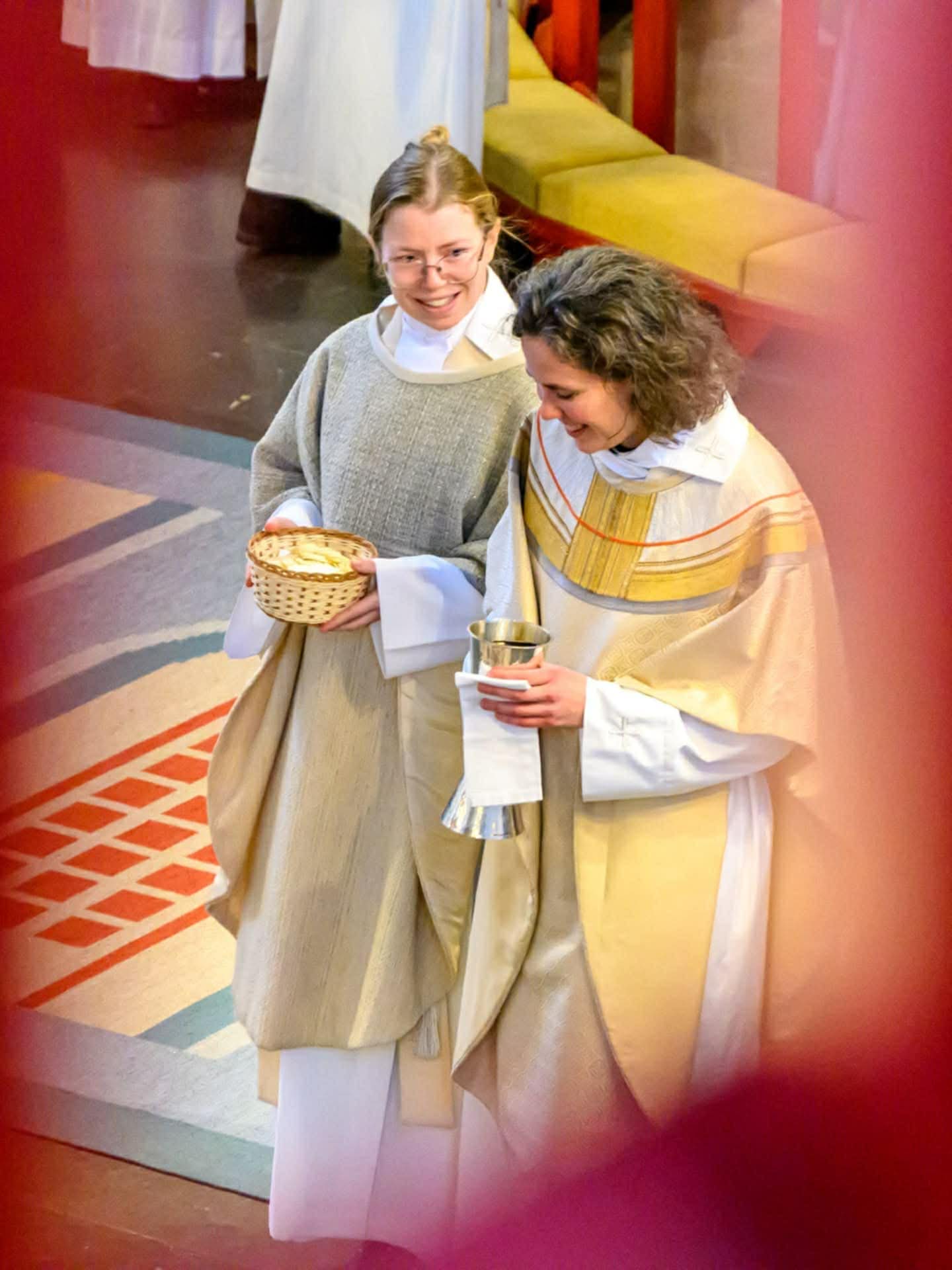
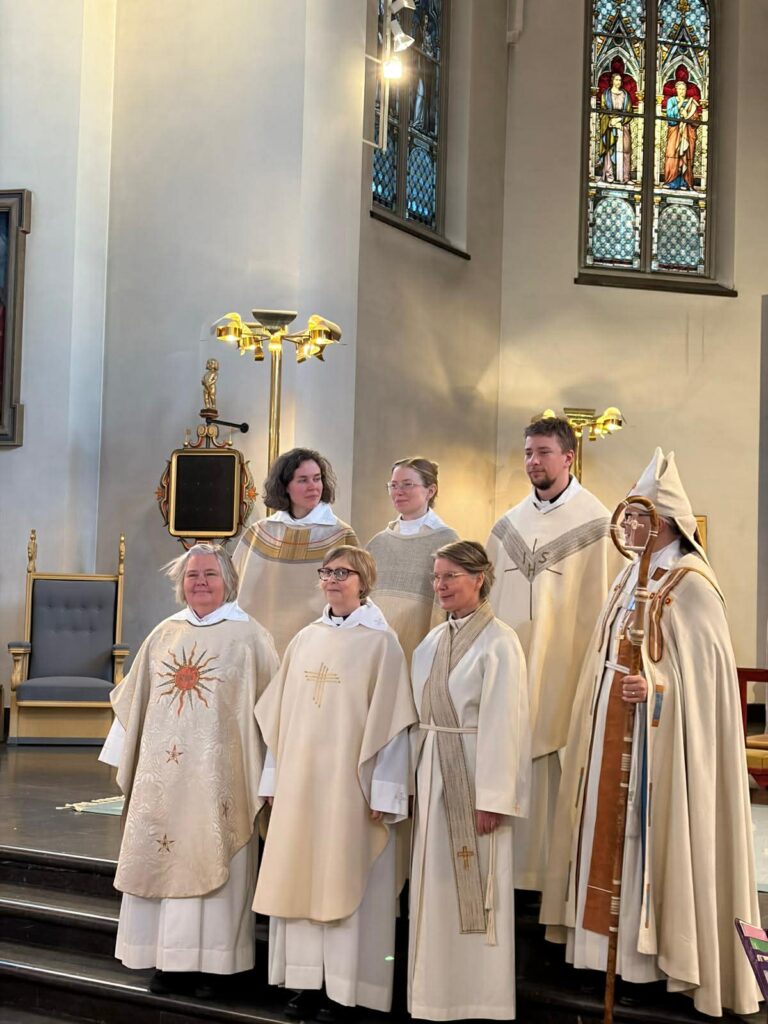
Anna Galviņa is a Latvian who has lived in Sweden for many years now. She is a journalist, an artist, a theologian, and now also a pastor in the Church of Sweden. LLSTA invited Anna for a conversation shortly after her ordination service, which took place on January 25, 2026, in Luleå Cathedral in northern Sweden.
.
LLSTA: A little more than a month has passed since your ordination in the Church of Sweden — are you gradually starting to settle in?
Anna Galviņa: I am only just beginning with the “ordinary worship services.” In the first year of ministry there is a little less of the scheduled things — weddings, funerals, baptisms. Each congregation has its own rhythm, but, on the other hand, I have already worked in the church in various ways for a long time. I started as a cleaner. To a large extent the rhythm of the congregation is familiar to me, and from various sides at that. But what it means to be a pastor in a congregation is an entirely new experience. We are given time to settle in and find our place. Pastors are different, and each one’s path of ministry takes shape differently. At the moment it looks like I will be leading a Bible study group. Of course, there will also be funerals, baptisms, worship services, and everything else — the church does, after all, operate the whole week.
Thinking about the differences, for example in the care of souls — here it does not mean pointing out to a person the path of faith or instructing them on how to put their life in order. Rather, it is an encounter. Yes, a person comes for support, but the emphasis is on listening and being alongside. The task is to listen to the faith of the person who has come and to find in it what will help them see their own way, their own way out and foundation, so that it is easier to cope with life. I think that no one has an easy life at all.
LLSTA: So over time it becomes clear what your place as a pastor is, and then you are allowed to work in it, to express yourself?
Anna: At the education stage we are given an insight into all areas of a pastor’s work, but when you start working, it becomes clear that no pastor has the time and capacity for absolutely all the things of ministry. At first you try out your place. Later, when you have to look for work in congregations, it is already a specific pastor’s place in a specific congregation, and you know what may be lacking there, what is expected of you, and what contribution you can make in this place. Then you look for a place of ministry according to your own vision and the practice that has developed.
LLSTA: Am I right in thinking that the first congregation is assigned?
Anna: Yes, it is assigned for a year. After that you have to look for work just like anyone else.
LLSTA: Where you live, is there a great need for pastors?
Anna: Yes, in the city of Umeå definitely. In general, pastors are not always easy to find. As soon as you get into the interior of the country, into the countryside, it becomes even harder. There the church has a different meaning — it sustains the place, it is a center. There is one church, one shop, one petrol station. The church is a place where people meet, sing in a choir — as it was a hundred years ago.
LLSTA: What is the congregation team you work in like?
Anna: The team is quite large. There are four permanent pastors and educators. The congregation has one deacon who works in the community with people who have fallen into difficulty — these are conversations, social work, integration. There is also a lot of work with institutions, trying to help people stabilize their lives. The congregation I am in at the moment is in a rather exclusive location, and there is less social exclusion here.
LLSTA: Are all generations well represented in your congregation?
Anna: Yes, in one way or another. On Tuesdays there is a conversation evening, where mostly people of the older generation come. There are activities for children. There are Bible study groups, where it is mostly the middle generation. At worship services and shared meals all generations are visible.
LLSTA: You mentioned the Bible studies — will you put your academic knowledge and interest in exegesis to use there?
Anna: In Sweden there is no single standard for what a Bible study group looks like. My experience has shown me that there is a certain format that does not make much sense — coming with commentaries and laying out how everything was and what the text means. The biblical text has various levels, and that, of course, is important. The historical context is significant, but not in order to reinforce one’s own convictions with facts. Rather, it helps to understand that these are situated people in a specific, complex environment. The Bible is not only about God — it is about people’s relationship with God.
In my view, Bible studies are meaningful if they are a conversation. I do not come to educate. People’s interests and level of education differ, and the experience of reading the Bible is also very varied.
It was precisely conversations about biblical texts that helped me understand that I wanted to become a pastor — they were fascinating to me as well. A single conversation can include both abstract ideas that we see in the text and very concrete situations and personal experiences.
LLSTA: What were the important questions for you in the process of your academic studies?
Anna: I wrote about eunuchs in the Gospel of Matthew. In our translation they are “those who have resolved to remain celibate,” in the Swedish translation — “those who have no sex,” but in the English translations there is a diversity of versions. Bible studies become truly interesting where you feel that something “does not fit,” for example because of differences in translation.
I chose a classical historical approach, trying to delve into the historical background and into the sense in which this word could have been used in the environment of that time. I wrote about it in both my bachelor’s and my master’s thesis, and with the master’s thesis I have taken part in a couple of international conferences. I managed to find a perspective that had not really appeared before, and my experience of Latvia, the post-Soviet space, and the diaspora played a large role in that.
Historically, eunuchs were for a long time perceived as a symbol of celibacy. Celibacy practices existed in various groups – especially in cultic communities that we would now call sects. Paul, too, most likely speaks of celibacy as an eschatological ideal. But as for eunuchs, it has already been demonstrated that the meaning of celibacy was attributed to this biblical verse several centuries after the gospel was written.
Other researchers compare eunuchs to present-day queers, but my view was that this is not directly comparable, although in the environment of the Roman Empire there existed, in a sense, what we today would call “gender queer.” Even the Greek understanding of gender is in fact most varied. As for Jewish culture, to which the Christ movement also belonged, in the proto-rabbinic texts eight categories of gender can be found, and those who are neither men nor women are not morally condemned, even if the rabbis discuss exactly how the norms of the law apply to them. Eunuchs would be one of these categories, although in this particular case one may question whether it is really a gender that is being spoken of. The strict division into men (free male persons, with power and a certain understanding of the morality of masculinity), women (the wives of these men), and all the rest, who in principle are not people at all (slaves and others in subjection), is one of the basic features of the rape culture of the Roman occupiers.
The Gospel of Matthew was written in Syria — not by the elite and not for the elite, who perhaps were the only ones to whom that strict separation of masculinity and femininity also mattered, because it had to do with power. Matthew’s community were those subjected by the Roman Empire. From the perspective of gender, the Romans had a rape culture that could be compared to the most brutal manifestations of the Russian army.
If we read the Gospel of Matthew as a text that resists the Roman system, then the word “eunuch” acquires meaning at the crossroads of power, society, and norms. It becomes a symbol of resistance to Roman gender norms. To a certain extent it can be compared to queer politics — to the transformation of the experience of oppression into a positive symbol.
LLSTA: Are liberation theologies significant in your process of theologizing?
Anna: Liberation theology is very significant to me, but it is a complex field that can also become dangerous. It is important to be aware of trauma, but the danger begins the moment the narrative of trauma starts to be exploited, with oneself becoming the oppressor.
I also wrote about the book of Jonah — it can be read as a trauma narrative that reveals a person’s complex struggle with themselves, when they have to deal with a painful experience in relation to the historical oppressor, Nineveh. Jonah is angry at God for the deliverance. The value of this story is in the disclosure of the struggle with oneself, as a victim. The danger lies in how to see the essence and even the beauty of the symbol of suffering, without turning it into an instrument in one’s own hands.
LLSTA: Essentially this comes down to the question — does liberation concern only me, or is it a broader, even eschatological, category?
Anna: Yes, in my faith it is a systematically theological thought. If we think of the story of Creation, where God creates time and space, fills it with life and free will — if God is love, then he fills this space with love and wishes to be in relationship. The human being is created in the image and likeness of God, but perhaps this does not apply only to the human being.
It is important to be aware of our connection with God and with all of creation. The divine reflection is our ability to create out of free will and to recognize the free will of another. When God creates more than one human being, it becomes a space of relationship — something more than competition for resources. My theological thinking comes not only from theologians, but also from contemporary philosophers, whom I read as theology.
LLSTA: What is your process of writing a sermon?
Anna: I read the text, look at commentaries on the historical context, but then I run the text through myself. Running — five kilometers — helps me think. It is not a process that happens only at the desk. I jot down notes on my phone, then edit them and discard the unnecessary ideas, until I feel a kind of “human nerve” that cannot be learned in formal studies. It is found in conversations, in living alongside the person you are talking with. My sermon text is usually written out, but I should probably learn to improvise more. There is still that desk-writer nature in me, too. Poems written in my youth taught me that every formulation matters. One has to learn to read a text as if you were not reading it.
LLSTA: I assume that your academic work takes place in English or Swedish, and church work — in Swedish. What is left for the Latvian language?
Anna: At a certain point you begin to think and dream in three languages. Moreover, I try to read the news in Russian as well, so as not to forget the language. I still have an interest in Latvian literature — I follow publications, I buy poetry in Latvia. At home and at work we speak Swedish.
I am afraid that, creatively, I can no longer formulate thoughts as well in Latvian, because the nuances of word meanings are very important. Yet a powerful experience was at the Uppsala conference last March, when for the first time in twenty years I heard the phrase in Latvian: “The blood of Christ shed for you.” I simply began to cry. The second time it happened was at my ordination service, when I said these words in Latvian to a person close to me.

LLSTA: What is the dynamic of a family of two pastors like? Do you have theological conversations?
Anna: Theological conversations have been there from the very beginning — even while cooking porridge. During our studies it was a little funny, because Kima wanted to help me and to teach me how to do it more easily, but I told her not to interfere, because it is my process. Now it is easier — we can exchange experiences.
I like that our theological ideas and liturgical taste differ. I like small, simple liturgies, for example the Wednesday evening Masses with Taizé songs. Kima, on the other hand, loves a proper liturgy; she also sings very well and “carries” the singing. We have common points of contact in terms of spirituality, too — the sense of God in nature, a belonging to the land at a deep level, which is also connected to the Sami way of perceiving things.
LLSTA: Is the church at present consciously expanding the space for the Sami?
Anna: Yes, the space is being consciously expanded. We spoke with Bishop Åsa Nyström about why and how we do this. It is very easy to become normative and to start defining Sami-ness by the standards of the majority church — that would be wrong.
LLSTA: How does this reconciliation take place on the church’s part?
Anna: It began with the church’s initiative to become aware of its role. An enormous study was financed — an anthology around a thousand pages long — on relations with the Sami in Sweden’s history. Now, building on this work, educational programs are being introduced in the congregations.
The former Archbishop Antje Jackelén has officially apologized in the context of a worship service, adding that the descendants of the Sami are not necessarily obliged to accept this apology. The question is how to do it for real, rather than merely allotting a certain space within one’s territory.
LLSTA: What are you thinking about theologically at the moment?
Anna: It is complicated. Preaching from the pulpit, conviction is unavoidable, although it is not my main mission. In my clergy environment one of the important things is the attempt to understand the processes taking place in the world — for example, the rise of postliberalism. To understand it, one has to delve into political philosophy.
The church sometimes builds trenches and a closed environment around itself, with its own rules of the game. It is important to resist the view that human rights are merely an opinion — human rights are not an opinion. In the Church of Sweden the spectrum is very broad, and I greatly value this diversity. But the moment you find yourself in an environment where it becomes problematic, it is hard at the same time to see the value in diversity and to understand that I do not want to live in a world where I can dictate the rules, while also being aware that there are processes in which danger lies hidden.
LLSTA: Where do you see this danger?
Anna: I see it in the church’s setting itself apart from, or in opposition to, the world. Neither ontologically nor epistemologically is it possible to separate oneself from the world. Yet the image of the “secular” or “profane” apostate is constructed. In each environment the reasons differ, but at the moment this is accumulating here too.
It is dangerous, because a colonial way of thinking appears — that you look upon the world as an object of your activity, where you are the subject and the world around you is the object. If I hear a member of the clergy say that the world is coming to an end because people have fallen away from the church and do not heed its rules, then in essence this means: “I do not rule over the world, and that is an enormous tragedy.” That seems dangerous to me.
LLSTA: Do you see these tendencies gaining strength?
Anna: Yes, they have been intensifying for some time now. It is hard to refrain from direct criticism, seeing how this affects the church and people. Philosophically we speak of the decline of postmodernism, but often this is a misunderstanding of what these ideas actually are.
On the social level the question is about not losing motivation — the motivation to act for the sake of another person’s freedom, being aware of how greatly we depend on one another. Our ability to survive is not based on competition or on the exploitation of resources.
In the Swedish parliament, too, a rightward direction, populism, is visible. Ideas appear that one can expel immigrants who have lived here for decades — not for criminal offenses, but simply just because. It seems to me that there we are going dangerously far — if the motivation to save a person’s life is based only on their usefulness. That is why it is important to preserve a human perspective and to find a way to the other person.
LLSTA: The Church of Sweden is already looking for its second digital-environment pastor — what do you think about that?
Anna: The digital environment is the media environment in which we live. The church’s digital content is not just advertising — it is a space of communication. What matters is to orient oneself in it meaningfully, not chasing the quality of rage bait, but publishing content with depth and a clear stance.
Each congregation already has its own digital platform that communicates what the church is. The problem arises with the unofficial “pastors” — often young men who take on the role of preacher in the spirit of Andrew Tate or Jordan Peterson. Digitalization makes these ideas global and amplifies their influence. That is why the creation of the Church’s official content is strategically important — to show that Christianity cannot be reduced to radical, oversimplified formulations.
LLSTA: And in conclusion?
Anna: My main guiding principle is to see the church not as a place where a person has to come and prove that they have earned love, but as a place that reveals to them that they are already loved.
.
The newly ordained pastor Anna Galviņa was interviewed by Arta Skuja, LLSTA