

See, now is the time of God’s favor, see, now is the day of salvation
pastor, bishop emerita Jāna Jēruma-Grīnberga
For Christ’s sake we plead – receive this reconciliation with God!
Him who knew no sin he made to be sin for our sake, so that in him we might become the righteousness of God.
As we work together with him, we urge you not to be those who have received God’s grace in vain. For he says:
in the time of my favor I heard you
and on the day of salvation I came to your aid.
See, now is the time of God’s favor, see, now is the day of salvation.
2 Corinthians 5:20b-6:2

Ash Wednesday – the beginning of the season of Lent; so it is written in the Church calendar. The liturgical color for this day is violet, or even black. Often on this day we read the words from the book of the prophet Joel:
“the day of the Lord is coming – it is near!
A day of darkness and gloom,
a day of clouds and mist
spreading like blackness over the mountains.”
If we have gone to a worship service on Ash Wednesday, we are invited to receive the sign of the cross on the forehead, marked with ashes. As we receive this sign, we hear the words from the book of Genesis
“dust (or speck) you are, and to dust (specks) you shall return!”
In essence, the impression of this could be dreadful. Everything gray, black, menacing: it is as if Verdi’s grand, terrifying “Dies irae, dies illa” from the Requiem sounds in our ears. Perhaps it is no wonder, then, that this evening’s worship service is truly not one that many people attend. The emphasis in the liturgy is also on sin, on each one of us’s personal sinfulness, and that too is not as appealing as, say, the message of light of Christmas Eve.
In many churches, including the Evangelical Lutheran Church of Latvia, the Ash Wednesday service includes a long confession of sins, in which we acknowledge our sins and transgressions not merely with the usual words (for example, “We confess to You our sins and transgressions, by which we have sinned in thoughts, words, and deeds, and by which we have deserved Your severity and punishment”). In the ordinary Sunday confession there are only these general words; on Ash Wednesday, by contrast, we are invited to look into ourselves, and the words we say prompt us to think about how varied our possible sins are. We confess our pride, hypocrisy, and impatience; anger and envy; our inability to confess our faith in everyday life; evil thoughts, indifference toward injustice and cruelty; but also our failure to reckon with God’s creation – its squandering and pollution. Taking part in this prayer, we are confronted with sin in many, if not all, of its manifestations; and not infrequently we realize that there is some part of this litany that applies very directly and unmistakably to ourselves. Perhaps we suddenly realize that we truly have “neglected prayer and worship,” or have given in to “prejudice and arrogance toward those who are not the same as we are.”
To be honest, it is not easy either for the pastor to lead this confession prayer or for the worshiper to take part in it. For it is the prayer of the whole congregation – throughout we say “we” have sinned in one way or another, and the congregation responds – “we acknowledge it, Lord, and repent.” Thus every person who takes part in this confession does so not only in their own name, and not only in the name of the congregation present, but in the name of all God’s children. It is a moment when we can truly humble ourselves from the heart before God and look into our soul with open eyes, hiding nothing either from God or from ourselves.
But we do not remain there, in this place of sorrow and repentance. For Ash Wednesday is an opportunity to confess our transgressions and sins truly and without sparing ourselves; but even more it is an opportunity to be freed from these sins, and to begin a new road – one that will lead from ashes to the water of life.
“See, now is the time of God’s favor, see, now is the day of salvation” – these words from 2 Corinthians we also read or hear on Ash Wednesday. This is the day when we are invited for a moment to stop in the valley of ashes and darkness, but then to go on from there. With Ash Wednesday nothing ends – quite the opposite! From this confession and forgiveness, with the cross of ashes on our forehead (it will still be there, even when we wipe it off with a handkerchief!), we go ever closer to Easter and to new life in the love of Christ.
The American poet Alan J. Hommerding expresses it this way:
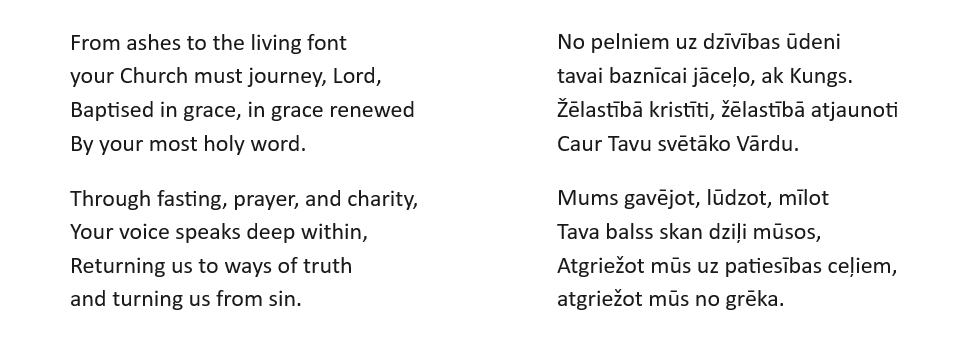
I wish for each of us, in this season of Lent, to return from sin to the paths of truth; at Easter to quench our thirst with the water of life and to journey on with Christ, led by him, set free in his grace.
Verdi. Requiem: IIa. Dies irae https://youtu.be/WQi4tzGjYe4
From Ashes to the Living Font https://youtu.be/u3YGg70Yk8A?si=lEJRi3uUe_jOrvZ7
Illustration: Ash Wednesday. Arta Skuja, 2026