
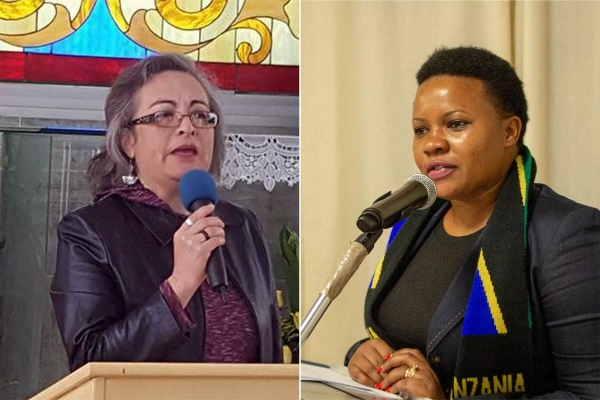
LWF delegates at the UN commission session speak about changing patriarchal practices in Mexico and Tanzania
“We must be prophets of freedom and justice, even if social norms are difficult to change,” urged Pastor Dr. Angela del Consuelo Trejo Haager, a member of the Lutheran World Federation (LWF) delegation, at the 65th session of the United Nations Commission on the Status of Women (CSW), which took place from 15 to 26 March.
Trejo, who was one of the first women to be ordained in theMexican Lutheran Church, spoke at an online event about how to challenge and change the social norms that prevent gender equality from being achieved. She is a professor of feminist biblical hermeneutics, gender theology, and church history, and looked back on women’s struggle for the right to vote.
The 17 March event was organized by the LWF in cooperation with Alliance, Islamic World Relief, Side by Side, the National Council of Churches, Christian Aid, Religions for Peace and All Africa Conference of Churches. It was one of the many parallel events supported by the non-governmental organizations participating in CSW65 and focused on the full and effective participation of women and their decision-making in public life.
Challenging the patriarchal discourse
Dr. Trejo, coordinator of the LWF gender justice network for Latin America and the Caribbean, noted that the struggle for women’s right to vote in Mexico began in the late 19th and early 20th centuries, but women were first able to go to the polls only in the federal elections of July 1955. Even then, many restrictions were imposed on women voters, who had to “heed the advice of their husbands” and always carry out their “household duties” before participating in social or political institutions.
Since that time, Mexican women have continued to challenge such “patriarchal discourse” in order to “raise their voices loud and clear to denounce injustice” and to claim their place in public discourse. They have shown that it is possible to change social norms, Trejo said, but there is still “much work to be done as women of faith” to promote gender justice in their country, which has one of the highest rates of femicide in the world.
Another LWF delegate who participated in the online event was Faustina Nillan, National Director for Women’s and Children’s Affairs of the Evangelical Lutheran Church in Tanzania and Tanzania coordinator of the Side by Side movement for gender equality. She spoke about how to challenge and change deeply rooted social norms, such as female genital mutilation (FGM), which still affects one in 10 women in her country.
To ensure the full participation of women in leadership positions and decision-making, it is important to end female genital mutilation and to dispel the myth surrounding this practice. Faustina Nillan, National Director for Women’s and Children’s Affairs of the Evangelical Lutheran Church in Tanzania and Tanzania coordinator of the Side by Side movement for gender equality
This traditional practice, which is regarded as “an integral part of the culture,” creates “significant barriers to health and development, especially for adolescent girls and women in general,” she noted. “Stepping up action to end FGM and to dispel the myth associated with this practice is very important in order to ensure the full participation of women in leadership and decision-making,” she said.
After examining the root causes of this practice, Nillan spoke about ways to support survivors and to change attitudes in order to promote the implementation of anti-FGM legislation. In her country, initiatives include introducing alternative rites of passage for girls, providing alternative sources of income for FGM practitioners, increasing support for community awareness programs, and providing information in the media so that the voices of marginalized communities can be heard.
The participants agreed that, in order to change patriarchal norms, it is important to build effective partnerships between women and men, especially between members of different faith groups, who together represent more than eighty percent of the world’s population. Mousumi Saikia, Islamic Relief Worldwide partnerships and program development manager, emphasized that religious leaders have “reserves of trust within their communities” and can become “advocates for change” by listening to the critical voices of those who have endured gender-based violence and by mobilizing communities to protect all women and girls.
LWF/P. Hitchen
The Lutheran World Federation is participating in the CSW with a delegation of more than seventy members from more than 30 countries, representing the voices of women and men who serve as advocates for gender justice in various parts of the world. The representatives, coordinated by the Lutheran Office for World Community in New York, speak with government delegations and participate in many public events in cooperation with ecumenical and interfaith partners.
NEW YORK, USA/GENEVA
23.03.2021.
Source: Lutheran World Federation news
Photo: from a private archive, Doug Hostetter, LWF