
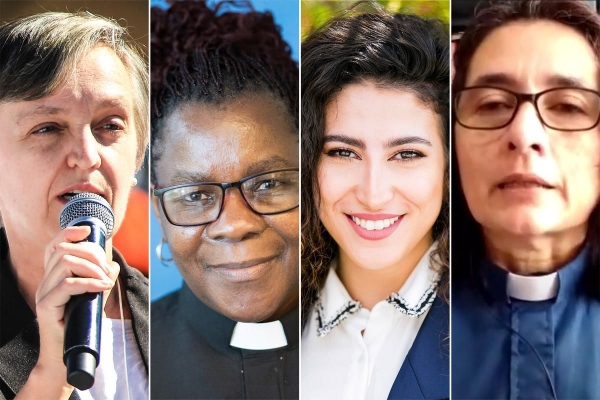
Lutheran gender justice advocates at CSW65 call on churches to support women and girls
From ancient Greek mythology to 21st-century politics, women’s voices are regularly silenced, suppressed, and excluded from the public space. Today, churches and religious organizations bear responsibility for challenging persistent patriarchal attitudes and actions by becoming a driving force for change at both the state and community levels.
Such an urgent call was issued by gender justice advocates from Brazil, Zimbabwe, Palestine, and Colombia, who took part in a panel discussion at the United Nations Commission on the Status of Women (CSW). The 16 March event “Mighty women: toward a better future” was organized by the Lutheran World Federation (LWF) and the Evangelical Lutheran Church in America (ELCA). The LWF has a large delegation at CSW65, which focuses on women’s participation in public life, ending gender-based violence, and supporting women and girls.
Among them was Rev. Dr. Marcia Blasi (Evangelical Church of the Lutheran Confession in Brazil (ECLCB)), the new head of the LWF program “Gender Justice and Women’s Empowerment”. A professor of theology and coordinator of the gender and religion program at Faculdades EST in the city of São Leopoldo, she noted that over the past year there have been attacks on women’s rights in Brazil. Conservative churches, she said, have “allied themselves” with populist politicians in order to restore “the old-fashioned narrative that puts women in their place, in subjugation”.
Often, “feminism and gender are portrayed as evil [..], but our hope comes from reading the Bible together”. Rev. Dr. Marcia Blasi, the new LWF program “Gender Justice and Women’s Empowerment”
Blasi said that “theological institutions and progressive churches are called to speak out” and to “create new narratives, inviting women to read the Bible from a feminist perspective” in a contemporary context. She noted that during the COVID-19 pandemic her church supported a campaign for a “home without violence”, which provides a helpline and free seminars to help combat domestic violence. Often, “feminism and gender are portrayed as evil,” she said, but “our hope comes from reading the Bible together”.
Rev. Elitha Moyo, gender justice coordinator of the Evangelical Lutheran Church in Zimbabwe (ELCZ), insisted that churches must challenge government policy and give women “a deeper understanding of the Scriptures”. She pointed out that “even those outside the church will quote the Bible” in order to reinforce gender stereotypes. She said that the ELCZ supports women in various ways, as well as educating them, helping them acquire skills for earning a livelihood, and offering advice “on how to deal with cases of abuse using the existing support systems”.
Defending interests and helping to adapt
Moyo, head of the national women’s coalition of Zimbabwe, said that “we always ask questions about women and land ownership”, because “only a few women have been able to benefit from the land reform program”. Although the government has put forward a new Land Act, she said that “most, if not all, rural women in Zimbabwe have no access to information and have no idea how to do anything”. “The church,” she pointed out, “is present in the most remote places and can help interpret these laws.”
The Palestinian representative Tamar Haddad, a student at California Lutheran University and author of the book “The Future of Palestine: How Discrimination Hinders Change”, spoke about the persistent problem of honor killings in her region. Noting that last year approximately 90 women were murdered in Jordan and Palestine for “damaging the family’s reputation”, she said that her book was inspired by a friend who had been the victim of one such honor killing.
Haddad, who also designs and implements leadership development projects, spoke about the vital support she had received from the ELCA International Women Leaders program and from her church, the Evangelical Lutheran Church in Jordan and the Holy Land. “My country is very religious,” she said, “so churches play a very, very important role in ending the oppression and suffering of women.”
Building self-confidence
The fourth participant, who emphasized the church’s vital role in changing the “entrenched patterns of patriarchy”, was Liria Preciado, a pastor of the Evangelical Lutheran Church in Colombia. She emphasized her church’s work in accompanying women, adolescents, and children, seeking to “reduce the distances between men and women” in order to lessen gender-based violence.
She said that patriarchal narratives have diminished women’s faith in themselves. Therefore, an essential part of her work is to “build self-confidence”, teaching them that they are both “loved by God and valuable members of society”. At the same time, she insisted that the church must support vocational education and call on the government to create jobs for women.
Together, all of them emphasized that the post-pandemic period can provide an important opportunity to shape new cultural narratives and to empower women to take leadership roles at all levels of the church and society. “As Lutherans,” said the moderator Dr. Mary Streufert, ELCA Justice for Women director, “we believe that God creates and calls all people to participate in public life and not to be subjected to violence.
NEW YORK, USA/GENEVA
17.03.2021.
Source: Lutheran World Federation news Photo: LWF/Johanan Celine Valeriano; LWF/Albin Hillert; Private; IELCO