
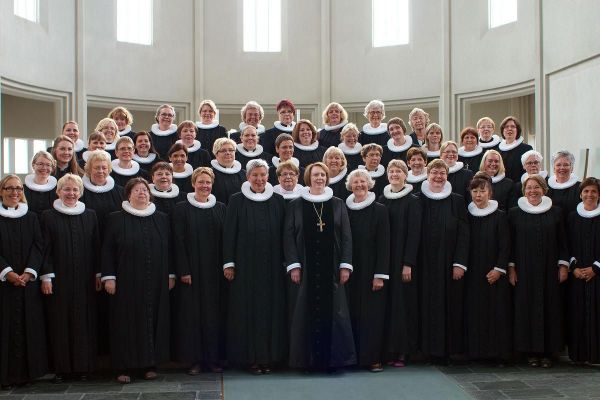
A Nordic church fulfills the LWF’s commitment to supporting women and young people in leadership
Hólar, Iceland / Geneva
(Lutheran World Information) – The Evangelical Lutheran Church of Iceland takes gender justice seriously and takes pride in offering women equal opportunities in the workplace. In the most recent elections to the General Synod, or Kirkjuþing, the church’s highest legislative body, with 12 clergy and 17 lay representatives, both groups had a female majority for the first time.
This might not sound too unusual in a country where a woman first became president and which has been at the forefront of the World Economic Forum’s gender equality reports for the past nine years. But over the last three and a half decades this Nordic church has been working internally to ensure that opportunities for women in ministry do not lag behind those of broader society.
Bishop Solveig Lára Guðmundsdóttir heads the Diocese of Hólar in the far north of the country. She says that her church has “encouraged congregations to maintain quotas of 40 percent men and 40 percent women” in leadership ever since the Lutheran World Federation (LWF) formulated its gender equality policy at its Seventh Assembly in Budapest back in 1984.
“But when we attended the (LWF’s twelfth) Assembly in Windhoek in 2017,” she continued, “we were reminded that in our churches we must implement them at all levels.”
When the General Synod convened in the autumn of 2017, she emphasized the need to take this message seriously, formulating a proposal to implement this policy at all levels of church leadership. It was adopted along with a second proposal to include at least 20 percent young people in leadership positions, which likewise aligns with the LWF’s quota principles.
During the synod elections in the spring of 2018, voters were reminded of this policy, and a female majority was elected for the first time. The Synod, in turn, elects the church’s highest executive body, the Church Council, or Kirkjuráð, which now has two female and two male delegates alongside the Bishop of Iceland (currently a woman), who functions as the council’s president.
Forty percent of clergy are women
Guðmundsdóttir, who was one of the first women ordained in her church, notes that attitudes have changed considerably since the 1980s, when people were not convinced of the need to introduce gender quotas. She says that “now everyone agrees that it is necessary.”
She recalls that in 1983, when she was ordained, there were only five other women pastors, “so in those days it was quite unusual, but now women make up almost 40 percent of the clergy, so the situation has changed dramatically.” She adds that “in congregations and councils throughout the country we have equal quotas for men and women.”
Speaking about the proposal to appoint more young people to leadership positions, Guðmundsdóttir notes that these goals have not yet been reached and that only one woman under the age of thirty was elected to the General Synod. Once again, she says, there is a need to change the mindset, because “people do not see it as a necessary thing” and disagree, on the grounds that young people “have no experience.”
“I believe that the church needs the views of young people so that we can truly understand what is happening in society,” Bishop Solveig Lára Guðmundsdóttir, head of the Diocese of Hólar.
But Bishop Guðmundsdóttir insists: “I think the church needs the views of young people so that we can truly understand what is happening in society.” Today’s young people are “the church leaders of the future,” she says, “so we really need their perspective at all levels of the church.”
She emphasizes that the LWF’s leadership on these issues was “very valuable” to the Church of Iceland, because people were able to understand how to try to follow its direction and implement its policy. “That is why it is good for us, when putting young people forward,” she concludes, “that we can say it is LWF policy.”
Rev. Judith VanOsdol, director of the LWF’s Gender Justice and Women’s Empowerment program, adds that: “Church leadership must listen deeply and reflect the astonishing diversity of a growing, mission-oriented church. How exciting it is to witness the realization of this inclusive vision of leadership in the Church of Iceland.”
Source: Lutheran World Federation
Photo: LWF/A. Danielsson
Photo caption: Photo: Icelandic women pastors and bishops after the consecration of Rev. Agnes Sigurðardóttir (front row, seventh from the right) as Bishop of Iceland in 2012. Fifth from the left in the front row is Bishop Guðmundsdóttir.