
The Evangelical Lutheran Church of Saxony commits to follow up on the report of the 12th LWF Assembly
(Lutheran World Information Center) – The Evangelical Lutheran Church of Saxony (ELCS) has for the first time promulgated a law that recognizes gender equality as a fundamental issue in the formation of the church’s leadership institutions.
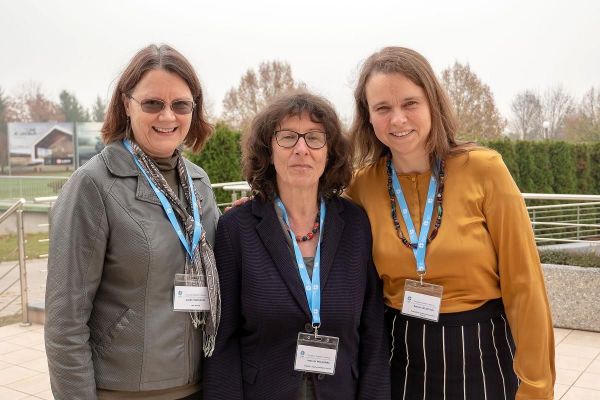
“In my view, this is an extremely important step,” notes Bettina Westfeld, speaking about the decision of the ELCS autumn Synod. Westfeld is a member of the Council of the Lutheran World Federation (LWF) and vice-president of the ELCS Synod.
Participation based on gender equality is a fundamental goal in the formation of the church’s leadership institutions. As an LWF member, the ELCS is committed to achieving this goal, – states the Evangelical Lutheran Church of Saxony.
The amendments to the law read as follows: “Attention must be paid to the fair nomination of candidates based on gender equality, and likewise in the selection of officials or co-opted members.” As the reason for these changes, the proposal states that: “In May 2017, at the 12th LWF Assembly in Windhoek, it was decided that participation based on gender equality is a fundamental goal in the formation of the church’s leadership institutions. As an LWF member, the ELCS is committed to achieving this goal.”
A framework for practical action
This year, during the autumn session, the ELCS Synod decided to establish a working group to outline an action plan “for the participation of women and men in the church’s ministries and functions.” Katharina Wallrabe explains: “It is important for us to deal with this problem on the basis of Christianity and theology.” She is responsible for equal opportunities in her church and the regional coordinator for the LWF Women in Church and Society (WICAS) network in the Central Western Europe region.
The working group is made up of three men and four women, who come from the volunteer training academy, the church policy office, the ELCS Synod, the youth work office, parish educators, the legal department and the equal opportunities office.
“The report of the twelfth LWF Assembly calls for the full participation of all people in their different contexts. We consider it full of encouragement, and we are interested in bringing it into the ELCS,” Wallrabe asserts.
“So far the working group has sought ways to define this goal and implement it as church policy,” says Wallrabe. “The first step was to examine the regulations of other churches of the Evangelical Church in Germany (EKD) and LWF member churches. It became apparent that some churches have enshrined this goal in their constitution or basic order document and have promulgated church laws to implement it.” There already exist laws that prescribe achieving gender equality in committees and leadership institutions, and they provide a framework for practical action. In the second step, says Wallrabe, the working group is studying methods that make it possible to ensure that the equal opportunity guidelines are implemented in the appointment of committees, in personnel work and in pedagogical activities.
The goal is to draw up a draft action plan that would promote the participation of women and men in the church’s ministry and functions, and to present it to the ELCS administration on 8 March 2019.
The LWF gender quota since 1984
The LWF has actively advocated for the equal participation of women and men since 1952 and introduced a 40 percent gender quota in 1984, which applied to all its committees and leadership institutions. Speaking about what has changed because of this approach and how she assesses the LWF’s work, Westfeld says: “When it is ensured that women and men come together in making decisions that affect the global communion, it influences the decisions – simply because women’s voices are heard and play a certain role in the decision-making processes.”
Rev. Judith VanOsdol, executive director of the LWF’s program for gender justice and the promotion of women’s rights, is currently inspired by the processes taking place in the Church of Saxony. She points to another resolution adopted at the 12th Assembly, which calls on member churches to implement the actions set out in the LWF Gender Justice Policy document.
The new LWF strategy for 2019–2024 likewise addresses the issue of gender equality. “We are planning to hold a WICAS European conference in 2019, where the new LWF strategy and working with it from the WICAS perspective will be presented,” says VanOsdol. “We will think about it, also keeping in mind the new European populist movements, which might want to halt the progress already achieved in promoting gender equality.
The next important steps for the ELCS will likewise be taken in 2019. To mark the 100th anniversary of the first time German women exercised their right to vote, the church’s women’s office, in cooperation with the person responsible for equal opportunities, is planning a seminar entitled: “Search! Women as candidates for the church’s leadership institutions,” with the witty subtitle “ladies’ choice.”
Dresden, Germany/Geneva
| 29./11./2018.
Source: The Lutheran World Federation