
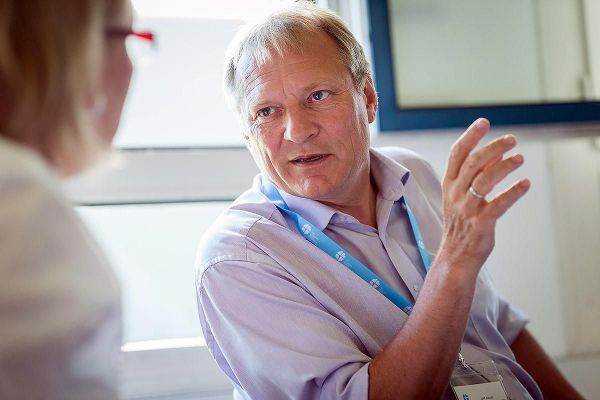
Voices from the communion: Council member Bishop Henrik Stubkjær
(Lutheran World Information Centre – LWI) Henrik Stubkjær’s (56) conversation with LWI about the challenges that the church faces while living in a secularized society, and about new platforms for the church’s diaconal work.
Since 2014, Stubkjær has been bishop of the Diocese of Viborg (359,000 members) – one of the eleven dioceses of the Evangelical Lutheran Church in Denmark (4.4 million members). Before that, from 2005 to 2014, he served as general secretary of “DanChurchAid” (a Danish humanitarian aid organization).
The Evangelical Lutheran Church in Denmark, sometimes called the Church of Denmark, the People’s Church or the National Church, is the state church of Denmark. The reigning monarch, Queen Margrethe II of Denmark, is the highest secular authority in the church. Each bishop has theological authority over his or her diocese. The church has no archbishop. As of 1 January 2017, it had 76% of the Danish population as members.
Bishop Stubkjær, last year in Windhoek, during the 12th Assembly of the Lutheran World Federation (LWF), delegates of the Evangelical Lutheran Church in Denmark raised themes arising from two resolutions: the “Resolution on strategic priorities and the revitalization of the church” and the “Resolution on the church living in context and the role of its mission”. What concerns prompted these calls?
In Denmark, in the Nordic region and in other European countries, we are experiencing significant changes due to secularization, post-secular trends and other social and demographic factors. By drawing attention to these concerns within the LWF communion, we are beginning a broader discussion of these themes.
In connection with this, we need well-grounded theological research. We ask ourselves: what could we do to preserve hope in the church? We probably need a new strategy for mission and for the essence of the church in its diaconal aspect.
I truly hope that the LWF will follow up on these resolutions and create platforms to reflect on the changes that we are experiencing.
Could you tell us more about the changes in the Danish church? How is the church perceived in your society?
On the one hand, we can say that there is a strong bond between the church and society. According to official statistics, as of January 2017, almost 80% of Danes belong to the Danish church. The proportion of members ranges from 58% in the Diocese of Copenhagen to 85% in the Diocese of Viborg; it has been stable and is declining slowly, by less than 1% a year. Most young people attend confirmation classes, and about two-thirds of couples marry in church.
On the other hand, one of our greatest challenges is to tell people that we matter as a church. Many people are members of the church, but the church is not really a part of their lives. Only a small number attend Sunday services. Their attitude is that the church should be available when it is needed.
One could even argue that secularization in Denmark has gone so far that people no longer hold a grievance against the church. They think it is interesting. Twenty years ago, the opposition to the church was much greater.
Where and in what way can the church be relevant?
In Danish society, many people are genuinely under stress and experience great pressure: you have to be better or faster all the time. For many, this ends with sick leave. The underlying logic is that you are what you do or produce – it is your performance that is valued.
As a church, we say something else – you are created, you are loved by God, you are never alone. The main part of your identity has been given to you. I think people in Denmark need to know: you are more than your performance. You are set free by God’s grace.
Do you address people in new ways in the light of these insights?
In my diocese, we have developed eight visions, one of which is “to seize opportunities”.
In the past, mission within Denmark itself has not been a priority. Now we need a new way of thinking. Our pastors have begun to reach out to young parents who belong to the church, visiting them and inviting them to baptize their children, also answering all their questions about it. Members of the church who do not come to be baptized say that they want their children to choose for themselves when they are grown up enough. So this kind of mission is quite unusual.
For young people, to whom the church is largely invisible, we have established a new, internet-based counselling project. They can call or join a chat and talk with a pastor. The response is so enormous that we cannot keep up. The use of the internet marked the church becoming relevant to these young people.
Diaconia is a theme that is very familiar to you. What changes and what challenges do you see in Denmark?
Local politicians see the great pressure being placed on both the economy and the social systems. One example: our hospital system has changed. Hospitals were centralized into so-called super-hospitals, while the small hospitals were closed. As a result, the time that patients spend in hospital has decreased – on average to eighteen hours.
This means that people are sent home from the hospital too early. It is a parallel, massive decentralization of the system. Instead of receiving care in a hospital, people now lie in their own beds at home. Often they have no one to look after them or to provide the food they need each day.
Now the politicians expect the church to visit these people and take on the task of serving their needs. I believe that this opens up a new platform for us in being church. Added to this are also the problems associated with growing loneliness, which affects not only city dwellers but also people in rural areas.
Diaconal work in Denmark has, up to now, been concentrated in large diaconal organizations. I think we are now experiencing a transition. Diaconal work will be concentrated in the neighbourhood care of congregations.
So you see that in the 21st century the gospel has become relevant again?
Twenty years ago, the intellectual elite declared that this was the twilight of religion and the churches. But they misread the signs. People, on the contrary, realized that spirituality is an important part of life.
We thought that society could cope with all the social challenges, but we realized that the lack of economic resources left the most vulnerable part of society neglected and gave rise to a new need for diaconal assistance.
For the churches of Europe, this is indeed a time of challenges. But at the same time it is also a time of opportunities. People who live in a society where a high level of competition is often felt truly need to hear the liberating message of the gospel: you are loved by God, even before you achieve anything. Other people are not rivals, but neighbours.
“For the churches of Europe, this is indeed a time of challenges. But at the same time it is also a time of opportunities.”
Bishop Henrik Stubkjær, Evangelical Lutheran Church in Denmark
The gospel has an important message for the world in the face of growing social exclusion and the gap between the global North and South. Likewise, we who believe that the world is created by God have a duty to pay heightened attention to climate change.
The content of the gospel is just as relevant as ever. We only have to be aware of it and act in accordance with it.Source: Lutheran World Federation news
Photo: LWF/Albin Hillert