
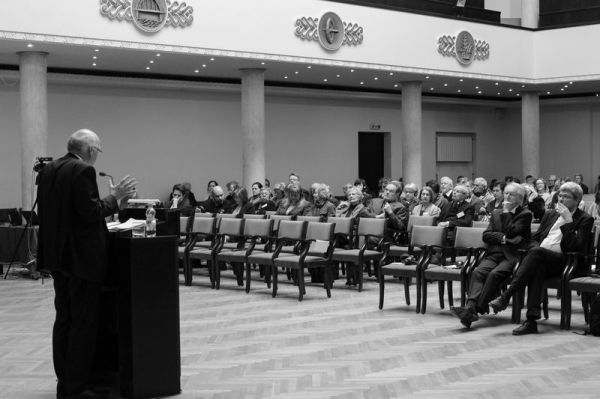
On 17 March 2017, an international and interdisciplinary conference dedicated to the 500th anniversary of the Reformation, “The Reformation in the Modern World”, took place on the premises of the University of Latvia.
The conference was opened by the Rector of the University of Latvia, Prof. Dr. Indriķis Muižnieks. Speeches were given by Markus Schoch, pastor of the German Evangelical Lutheran Church in Latvia, Michael Roth, Minister of State for European Affairs at the German Federal Foreign Office, and Dace Melbārde, Minister of Culture of Latvia.
In the first panel discussion, entitled “Freedom and Boundaries – the Impulses of the Reformation in the Search for European Core Values”, presentations were given by Dr. Luise Schorn-Schütte, professor at the Goethe University Frankfurt am Main, Dr. Gustavs Strenga, researcher at the National Library of Latvia, and Eduards Liniņš, representative of Latvian Radio. Dr. Artis Pabriks, Member of the European Parliament and former Minister of Foreign Affairs and of Defence of Latvia, spoke via video address from Brussels. The discussion was moderated by Assoc. Prof. Dr. Andris Levāns of the Faculty of History and Philosophy of the University of Latvia.

Luise Schorn-Schütte’s presentation focused on the significance of the Reformation at the time, in the present day, and on political culture in the 16th century.
The historian began her presentation with the thesis that the core of the Reformation was theological, yet the consequences of the Reformation were political. Luther himself was apolitical; he was not interested in and not well-versed in politics. The theology of “Sola ..” shook people’s conceptions of their relationship with the Creator. The potential of a direct relationship with God created in believers the conviction that they needed neither a Council, nor a pope, nor priests. Such a paradigm shift in thinking made it possible to stand up for political reforms.
In 16th-century Riga, the citizens were ready to actively take up the ideas of the Reformation. In Riga, merchants in the guilds were already debating who would be citizens and what the rights of citizens would be. Thus the so-called congregational reformation took place – the congregation itself elects its own pastor (and also dismisses him), as opposed to the appointment of a priest “from above”.
Likewise, among the nobility in the diets there were discussions about the influence of the emperor and the right of co-decision (in the lands of the old Reich, the peasants too demanded rights for themselves; in Latvia, however, there was no such phenomenon).

“Sola Scriptura” brought the Reformation into education as never before. Representatives of both sexes – women and men – had the opportunity to receive an education. Gymnasiums and universities were founded [this thesis was later disputed by UL professor Gvido Straube in his address in one of the working groups].
The abolition of the privileges of the clergy was replaced by the idea of the right of every Christian to serve.
A paradigm shift in views took place in political culture – princes who resisted the emperor appealed to conscience.
The processes following the Reformation fostered language, education, the ability to write and to read, and the culture of national languages: in Latvia the Bible was translated and read in Latvian, theology came to be discussed and debated in the language of the people rather than in Latin, which only a few knew. The pastor’s house became a place of education. Later, the national movement was closely connected with the Reformation.
Dr. Gustavs Strenga, researcher at the National Library of Latvia, emphasized that the census carried out in the Russian Empire in the 19th century (1897) revealed that in the territories influenced by Protestantism, 90-97% of adults could read. In the territory of Latgale, this was only 50% of the inhabitants.
Eduards Liniņš, representative of Latvian Radio, reported that the National Electronic Mass Media Council (NEPLP), together with the staff of Latvian Radio, conducted a survey which found that public media in Latvia lag behind the Church in terms of trustworthiness by only a couple of percent. This means that in Latvia society listens to the words of the Church.
Eduards Liniņš also mentioned that the outcome of the Reformation was not too carefree for the Baltic; the consequence was the Livonian War.
Liniņš likened the figure of Martin Luther to a typical media personality in whom society would take great interest even today: Luther was unknown to anyone, came from the provinces, yet he made use of the opportunities created by Gutenberg to print and disseminate his ideas. Luther had his own “Instagram” – he was depicted in paintings and portraits. Luther carried spiritual content, being a vivid, even scandalous personality. One could say that the reformer’s mode of action was “Twitter-like” and “blogger-like” – Luther formulated his ideas briefly and clearly. The dissemination of information, both 500 years ago and today, brings profit, and it brought profit to those who printed and reprinted Luther’s works. To disseminate ideas successfully, a social network is needed. Luther had one (a network of humanists) – people who took up and carried further the ideas of the Reformation.
In the second panel discussion, entitled “Who Are We? Identities and the Reformation”, addresses were given by Dr. Wilfried Härle, professor emeritus of the University of Heidelberg, Archbishop Jānis Vanags of the Evangelical Lutheran Church of Latvia, Bishop Gerhard Ulrich, the leading bishop of the United Evangelical Lutheran Church of Germany and bishop of the North German Evangelical Lutheran Church, and Assoc. Prof. Dr. Ralfs Kokins of the Faculty of Theology of the University of Latvia. The discussion was moderated by Juris Cālītis, lecturer at the Faculty of Theology of the University of Latvia and pastor.

Professor Härle began his presentation with the assertion that Luther’s Reformation was not interpreted as the founding of a new church. The Reformation understood itself as a renewal of Christian teaching.
Luther not only spoke out critically against the Church of his time; he called for a return to the foundations of the Christian faith. The Reformation, in Härle’s view, shaped the identity of the Lutheran Church, which is an orientation towards the Gospel of Jesus Christ, under the influence of which Luther formulated the four “Sola” (only):
In first place, Christ alone, who is the foundation of the Church and of believers. Scripture alone – this is the source and the norm that we find in the Gospel. The text is what we must use in theological discussions, not some other sources. The work of God’s grace alone – Rom 3:21 – this was Luther’s favourite scriptural passage on grace. Faith alone – a person draws near to God by faith in the heart, not by works. Luther held that one must speak radically about evil, sin and forgiveness, adding that this insight also plays a great role in modern psychoanalysis.
Luther likewise stressed the importance of education, that both boys and girls must go to learn. For this reason, compulsory school attendance was introduced in the period after the Reformation.
In conclusion, Härle added that under the influence of the Reformation the structure of the Church was also changed; namely, according to Luther’s views, responsibility for the structure of the Church was to be taken on by all Christians.

Archbishop Jānis Vanags of the ELCL emphasized the role of the Reformation in the formation of the nation and in identity. Under the influence of the Reformation, Lutheran congregations and also Moravian congregations began to form in Latvia, in Vidzeme. Hence one may say that Christian values are Latvian values. During the period of the national awakening, too, the Lutheran Church was at the centre of society. Unfortunately, that is no longer the case; the ELCL is regarded as an alternative church. Yet this does not trouble the Church, in Archbishop Vanags’ opinion; it is biblical, for of John the Baptist it is said that all Judea came to him to be baptized and to repent of their sins, because he was different.
The German bishop Gerhard Ulrich offers a different emphasis for the conversation about the Reformation, the thesis that there is a path of seeking and that both the personal and the national are always in a process of seeking.
Every identity needs points of reference in order that freedoms may be realized – so says Ulrich. Freedom is the central object towards which one must strive. Lutheranism, in its insight about striving towards freedom, is grounded in the Bible.

The bishop cites his own life story as an example of the insight about a process of seeking. Gerhard Ulrich was baptized in the Lutheran Church, yet after some time he decided to leave it. As time went on, Ulrich returned to God, because in Christ he found the greatest treasure. The German bishop believes that Luther, in writing about freedom, expressed his dislike of the existing church order, which presented itself as the one with the final word. This preaching of freedom later produced a great reflex in society. For each and every person has received dignity from God. This is the root of equality – equality between men and women, the rich and the poor. This freedom, for which Luther stood, must be ensured in the Church. Of course, there is no freedom without obligation, for without obligations and commitments freedom turns into arbitrariness. Sometimes a boundary also protects us. Europe is built on diversity, but that does not mean arbitrariness. One hears Western Europe called liberal. That is not quite so. Western culture arose from several cultures acting upon one another – Greek, Roman, Islamic and others. Gerhard Ulrich believes that Europe is rather a place of reconciliation. And our present-day culture, too, is built on this reconciliation – reconciliation between nations. That is why Lutheran identity in Europe is the building of networks, the building of bridges, the securing of peace. The cornerstone is Jesus Christ.
PHOTO: Ilze Stikāne, UL FT
Aļesja Lavrinoviča