
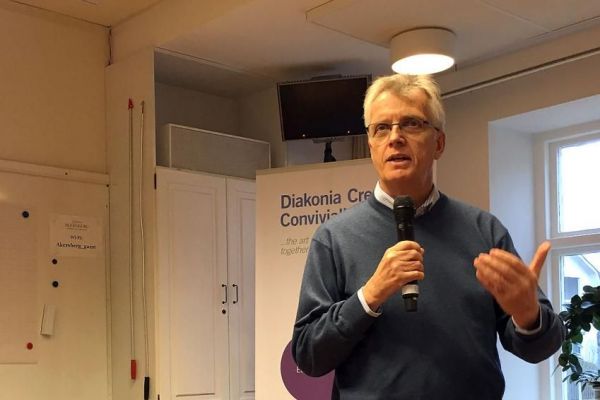
The LWF General Secretary addresses delegates from European member churches at the pre-assembly
Höör, Sweden/Geneva 03/02/2017
        “With a passion for the church and the world – that is how we understand ourselves as a global church communion,” said Rev. Dr. Martin Junge, LWF General Secretary, in his address to the European pre-assembly in Höör, Sweden.

        In his presentation he introduced the history and identity of the LWF “as a communion of Christ that lives and works together for justice, peace and reconciliation in the world”.
Founded to alleviate suffering
        The General Secretary told the gathering of pre-assembly delegates that the central calling of the LWF when it was founded in 1947 was to bring churches together to alleviate suffering and to serve refugees and displaced people.


“The LWF was founded as a response to faith's call for churches to come together, to overcome a violent past and to work for reconciliation by addressing human suffering – to act on behalf of refugees and families.”

        He added that, seeing the consequences of the Second World War, “Lutheran churches wanted to be more than churches in separate countries; they wanted to come together to bear witness to God's transforming love. The first calling of the LWF was to serve people”.

        Referring to the joint statement by the LWF, ACT Alliance and the World Council of Churches that was made public earlier this week, Junge said that there is no doubt that refugees fleeing war must be protected. This protection of the most vulnerable is a moral duty that is now enshrined in binding international law. He also recalled that a refugee is a refugee and, as such, has the right to protection regardless of his or her religious conviction.
Learning from women and young people
        Speaking about the journey of the Lutheran communion through the years, the General Secretary particularly noted the contribution of young people and women. “Young people and women and their inclusion in our journey have been a blessing,” he said. The LWF has a policy of including at least 40% men and women and 20% young people in its governing bodies.

        He said that this position has broadened the communion's perspectives. The presence of young people as active participants has provided a deeper understanding of several issues. “Thanks to the contribution of young people, we focus sharply on climate injustice as a question of intergenerational justice,” he stressed, expressing gratitude for the leadership of young global reformers in the work of the LWF.

        Through several Assembly decisions, the LWF member churches have committed to move towards the full inclusion of women in ordained ministry. It is a journey that continues. Aware of the various contexts and particular challenges that may arise, the communion does not look away from the goal. Noting this, the General Secretary also said that sharing stories of women's leadership is an integral part of commemorating the Reformation anniversary.


“These celebrations offer a wonderful opportunity not only to tell the stories of the men of the Lutheran church and the Reformation (his-stories), but also the stories of women (her-stories): stories about women and their contribution to the witness of the LWF member churches and the Lutheran communion as such.”


        The agenda of the pre-assembly hosted by the Church of Sweden included discussions about the challenges facing Europe and the role of the churches, the themes of the Assembly, an introduction to Namibia and its churches, and the further preparatory work for the 12th LWF Assembly in Namibia in May of this year.
Source: https://www.lutheranworld.org