
“But as for me, it is good to be near God..” (Ps 73:28)
Dear sisters, dear brothers in Christ,
With joy I greet you in this new year, which awaits us with every opportunity to bear witness to God’s love and care for every person and all creation.
“It is good to be near God” – says the 2014 motto. Yes, truly, it is good!
Yet we know how easy it is to lose the sense of God’s presence in our world and in our lives, especially when it seems that life is overtaken by things that are at odds with the knowledge of what God brings into the world: justice, peace, reconciliation through Jesus Christ.
This Christ-centered focus, however, helps us to continue to trust that God’s nearness is not our work, but God’s. It is God who addresses us – constantly, persistently, insistently – and creates that nearness in which we can only rejoice. May this promise carry us all as we enter 2014!
At the LWF Communion Office we look back on 2013 with gratitude. We are grateful for the support that member churches and partners have given us in so many ways, to enable the LWF to continue working and bearing witness together as a communion of churches. And there is indeed good reason to celebrate, giving thanks to God for all that we have managed to accomplish by working together.
We work together – LWF leaders from all over the world met at many local, regional and global meetings and consultations on capacity building in member churches, Lutheran identity, sustainability, theological education, diakonia and many other issues. The very fact that we come together and work together is, for me, a powerful witness at a time when fragmentation and withdrawal seem to be the fundamental tendencies.
We are faithful to nurturing theological identity – the Lutheran Theological Education Network (LUTEN) was launched in 2013 to support collaboration in the field of theological education throughout the communion.
We choose dialogue – LWF member churches continue to discern their views at the local, national and regional level on issues that potentially divide them. I am grateful that, as a communion of churches, we can look back on a year in which, even while wrestling with differences and differing theological perspectives, we remain faithful and do not reject one another, but continue to receive God’s Word together as having been fully revealed to us in Jesus Christ.
We believe that religion builds bridges – the LWF Council issued the document “Welcoming the Stranger: Affirmations for Faith Leaders”, a code of conduct for religious leaders for work with and for refugees. The LWF is a co-author of this document together with the United Nations High Commissioner for Refugees. Later the LWF Department for World Service also held a joint seminar with international Islamic humanitarian organizations in Amman, Jordan, exploring how people of faith can work together to meet human needs.
We continue to serve those who suffer – in September, together with a group of LWF vice-presidents and Council members, I visited people in northern Namibia and southern Angola, who were severely affected by drought. We were all deeply moved by the desperate situation in the region and by the response of our member churches. At the same time, we look with gratitude at how the LWF member churches responded to the appeal of Namibia and Angola, and how their substantial donations are now helping people with their basic needs.
We uphold our ecumenical commitment – the Lutheran-Roman Catholic Commission on Unity published the report “From Conflict to Communion – Lutheran-Catholic Common Commemoration of the Reformation in 2017”, which the LWF Council adopted unanimously. This is the first ever attempt by both traditions to describe the history of the Reformation at a global level, tracing the development of the Reformation from its beginning to the definition of theological issues today. This report offers a solid foundation for the joint preparation of the 500th anniversary celebrations of the Reformation at the local and global level.
We intentionally include young people – the Network of Young Reformers has been launched. The program will bring together young people from across the communion to prepare for the Reformation celebrations. Young people offer us a unique perspective – to reflect on how our Lutheran church is always being reformed and always reforming. Can Lutheran churches take part in such reflection without involving young people? In the LWF we say: “No!” – and we have launched this network in order to bring together, possibly, around 10,000 young people from all over the world!
We care about justice in relationships – the LWF adopted the Gender Justice Policy document as a continuation of the LWF’s commitment to issues of justice, including justice in relationships between men and women. The gender justice policy is offered as an instrument to support member churches as they address it in their own context.
We appreciate the expressions of the Reformation that have taken place all over the world – the LWF Council accepted an invitation from the Namibian member churches to hold the federation’s 2017 assembly in Windhoek. With this decision the LWF Council wanted to underscore that today the Reformation truly has a remarkable standing and that it has many centers and expressions all over the world. The assembly will be historic, yet with a view to the future; the celebration will coincide with the anniversary of the Reformation. We have much of value to strive toward!
I could give many more examples, and they would all lead to the same fundamental vision – gratitude to God, who has been so present and life-giving that our path as a communion has been secured, inspired and guided. Thanks be to God, who by His presence has created closeness among us as churches and with our neighbors and all creation in their suffering.
We greet 2014 with hope in God’s presence on our further journeys. We eagerly want to discover what God will do among us and in this world in the time to come. Truly it is good to be near God!
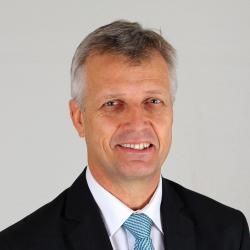
Rev. Martin Junge,
LWF General Secretary
Photo: The Lutheran World Federation
Translated from English by Ieva Puriņa, Mag.Theol., LELBāL deaconess
Proofreader Mag. Theol. Milda Klampe