
A conversation with Dr. Kristīna Ēce about her doctoral dissertation, defended this spring, “The first women missionaries from Courland and Livonia – their contribution to the understanding of women’s role in church and society from 1896 to 1926.”
LLSTA: You begin your research with the very first women missionaries, at the end of the 19th century. What is the background and context? How does the opportunity for mission work arise for them, and what is their motivation?
Kristīna Ēce: Actually it is hard to say, because there is a lack of material to understand, let’s say, why Hildegarde Procela suddenly decided and left; there is nowhere any material to confirm that she experienced, I don’t know, some kind of lightning strike or something like that, that she understood, and that’s it, off I go now! I think they could have heard about such an opportunity, because elsewhere it was already happening – England and America were sending women missionaries quite a bit earlier.
In the mid-19th century, the Leipzig Mission worked in India and there the question arose about women, how to reach women? They began to see that men could not reach them, that women were needed for this. I understand that the Leipzig Mission was one of the first to begin talking about there being a need for women in mission.
That is in the context of the Lutheran church?
K.E. Yes, precisely in that context. Where there are English and American missionaries, there are Anglicans, there are Methodists. But I looked specifically at the Lutherans, because the Lutherans were the first, apart from the Catholics, to send people into mission from the territory of Latvia. The Baptists were still being persecuted at that time, and accordingly, before that, there is no evidence that the Moravian congregations sent anyone from Latvia.
Courland and Livonia had the best contact with Leipzig, which was therefore also the first place to start looking. The first woman missionary from Latvia is Hildegarde Procela, and so the Leipzig Mission began sending women and she left. That was in 1896, some five or six years after the first women had even gone anywhere at all. She had surely heard that someone was going somewhere, and I think it seemed interesting, exciting to her. She does not have a particular conversion story with something singular and vivid. Auguste Vietnieka and Lilija Otīlija Grīviņa have such a story. Hildegarde simply says, yes, I have always believed, I have always followed God. And now, here – following, she went off to India.
Where were they prepared for the mission path?
K.E. The men, because they were ordained – as missionaries, ordained ministers, they already had a theological degree, and in Leipzig they learned some basic things. They could actually go straight to Leipzig and study there at the theological seminary. They studied for four years – a specific educational program, including languages and much else, and then at the end they were ordained. The women, neither in the Leipzig Mission nor in the Barmen Mission, the two oldest German missions that I examined, had any formal training. It was roughly like this – so you come to Leipzig, get to know us, get to know how we work here, take a look at what language the people there speak, and bon voyage! Three, four months. And that’s it.
Were they sent as a supplement to the male missionaries?
K.E. Not really. They were sent as teachers. That was also the premise, yes, that these men are ministers, and so they have their own ministry. Sunday school or a real school, a boarding school, that would then be the women’s responsibility, especially teaching the younger children.
In effect, the task of evangelizing is, anyway, left to the man?
K.E. Yes, of course. But it is the woman who draws in other women. They went as teachers and taught both general-education subjects and, of course, Bible study, so in that sense evangelization also took place there with the children and women. Women evangelize women, if men cannot get to them.
So it turns out that the basis of evangelization is in fact these women’s personal experience of God, rather than some kind of academic theological knowledge?
K.E. Yes, definitely.
And where was all this reflected – did they have diaries, did they have to write reports?
K.E. Reports, yes. But you know how it is with reports – they are selective, you write what is needed. Or what you are proud of. You don’t write – everything is bad. Maybe you write, everything is bad, but with God’s help everything turned out well for me, and now everything is good.
Unfortunately there are no diaries; the more personal letters exist mostly for Anna Irbe.
Hildegarde left Latvia in 1917, she remained unmarried. She lived with her sister, who was also unmarried. So whatever remained after her is not to be found. She returned to Latvia, but when she left Latvia for Germany, she did not afterward maintain contact with Latvia.
The most promising in this regard seemed to be Elizabete Zēzemane, who was an ordained deaconess. After her ministry she went off to Germany and lived in a convent; there I found some archival materials, but unfortunately, again, there is no diary. Which is, of course, a pity, because diaries would be the ones in which everything is told more honestly, what happens and how, but, well, unfortunately there are none.
About Grīviņa it is known that she came back to Latvia, then married, they had a child, but during the war the child perished. So there too that whole family line came to an end. Perhaps there are some distant relatives.
In that sense there is the most material for Anna Irbe. Also the journal “Ārmisija” (Foreign Mission), where, of course, the whole account is already edited. If she sent something to her father, the bad parts or personal matters were taken out. When I was in England, I brought back to the LELB archive some 50 letters that she had written to Violet Steven. The letters are written in English, by hand. It would be interesting to read them. They were written already after she had finished her ministry but was still living in India. So, well, that again could be interesting, new, as-yet-unseen material, but for now I have not had time to read them.
In some way you have nevertheless been able to reconstruct these personalities?
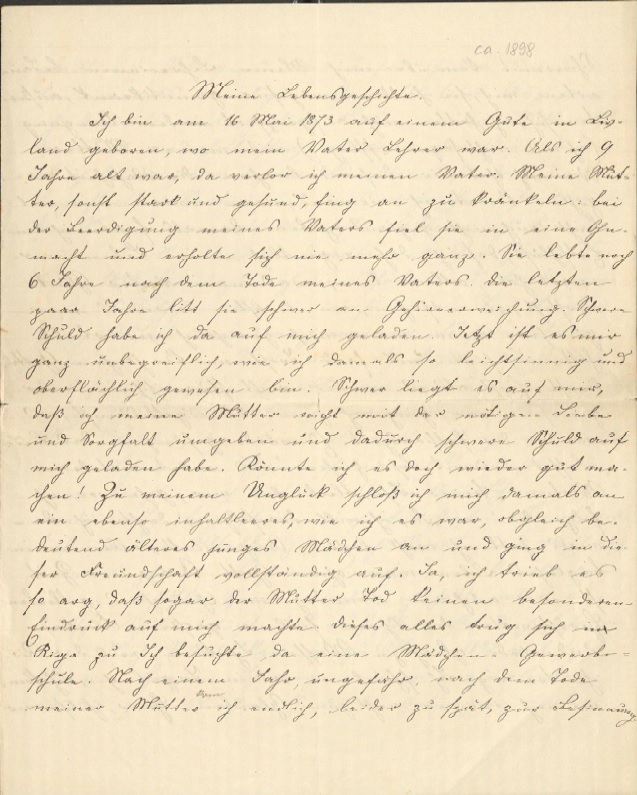
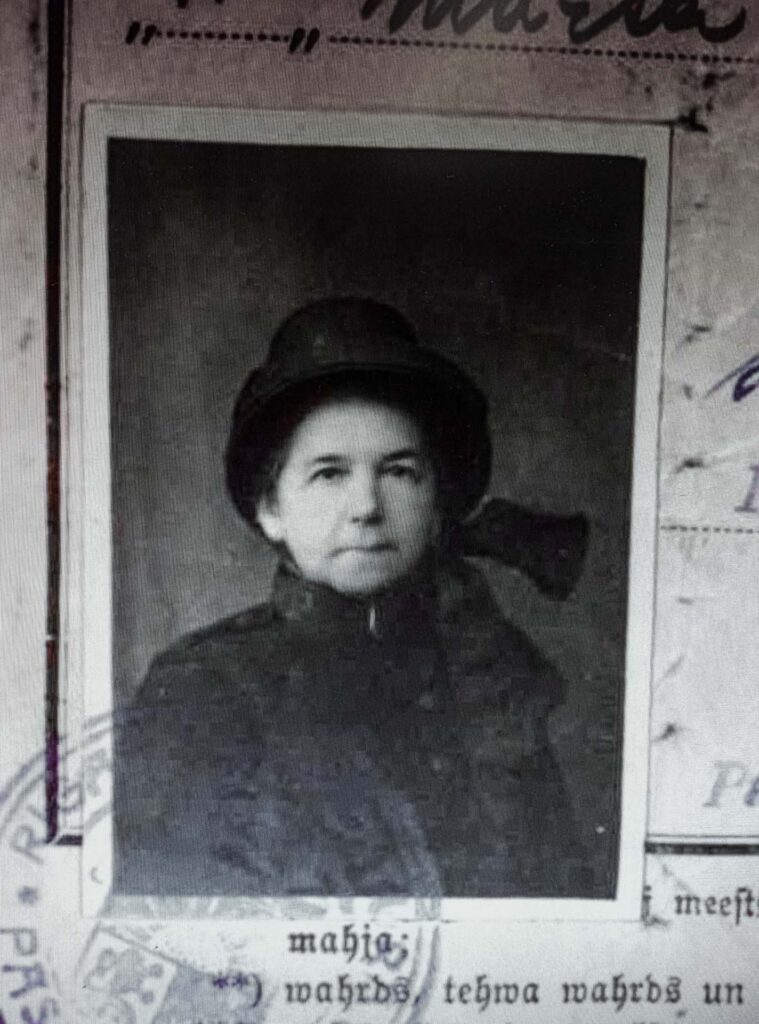
K.E. Well, a little. My favorite heroine is Auguste Vietnieka, a feisty lady. She comes from Viļķene, from the Limbaži area. Her father was a parish-school teacher, but her father died when she was nine. With a teacher, just as with a minister – the minister is no longer there, then you have to say goodbye to the minister’s house. They had to move out of the teacher’s apartment. They moved to Riga and then she started hanging around bars and that sort of thing. Her mother also died when Auguste was 14. You have to live, you have to struggle.
At some point, at one moment, she gets such a strong sense of guilt – what am I doing, everything is bad, my mother is dying and I am hanging around bars. With that sense of guilt Auguste does not really know what to do. Her brother, who was older than her and worked as a teacher in Reval, says to Auguste, come to me. The other ladies had finished good gymnasiums, they immediately had the right to be home tutors, but Auguste did not manage to attend a good gymnasium. Still, her brother says, study! Pass the home-tutor exam, you’ll have a better life! Those who had attended the good gymnasiums could take the home-tutor exam in the language in which they had studied. So Hildegarde and Elizabete did it in German. Lilija Otīlija Grīviņa, because she studied at the gymnasium in Russian, took the exam in Russian. Auguste had studied at a German vocational school in Riga, but if you take that exam externally, the state language for you is “po russki” (in Russian). But she does not know it, and then for two or three years she struggled until she learned it. She also wrote in her memoirs that it was terribly hard and complicated. In the end she passed that exam and could become a home tutor. The places to which both Hildegarde and Auguste go are among the Volga Germans, where there are German colonies. There Auguste met the minister Albērs, who, as it were, steered her in the right direction. And he told her – Christ is the one who forgives you, all right, you cannot turn back the past, but, look, here you have forgiveness. That gives her such freedom and awareness that now something has to be done. And then her first thought is – I’ll go to Siberia to the children of the penal-labor convicts, because something surely has to be done. That minister says to her – wait, if you want to serve, how about foreign mission? She says, yes, all right.
In the end, Auguste ended up on mission in Indonesia. From Indonesia a leave was planned once every 10 years. Indonesia is at the other end of the world; you have got as far as India, and then you still have about as much again before you get there further on, so she already knew that she was going for many years.
She is such a capable lady, everything went well, but there is a superior there who is very patriarchal and unpleasant. She was given the task of setting up a school in the village. Auguste says, all right, I’ll go and do it. You have to convince people, explain why a school is needed, and, of course, also preach the message of the Gospel. At first she writes – here the children run away and the parents hide them. No school, nothing will come of it there, but after three months the parents begin to trust her. She manages to set up those schools, everything happens and everything is good. The superior calls her back to the main mission center and says, well, actually I didn’t expect that you would manage anything, that was just to test you and prove that you can’t do it. A quarrel broke out, such that Auguste almost had to go back. Well, how is it, if the leadership does not respect me, what can I do. The minister there on the spot has such a terribly strange, hierarchical premise. You can’t tell whether the local minister thought it up, or whether it was the premise of the whole Barmen Mission, but the hierarchy was such that the sister missionaries, who had devoted themselves to God, if they come together for a prayer meeting, then they themselves cannot lead it; a minister is needed. If there is no minister, then someone from the congregation elders is needed; if there is also no congregation elder, well, then any man at all. Auguste was one of those who said, hold on, this doesn’t work, it can’t be like that, because they are consecrated and yet educated, but then any man from the village is better? She had a couple more like-minded companions, ones with whom they fought there together. The conflict was such that, of course, if she had been somewhere closer to Europe, then she probably would have come back, but Indonesia is far enough away. She nevertheless had to set those relations right, and then Auguste in the end also stayed until the leave year, served those 10 years. After that she no longer complained about that superior. Auguste led and served in other schools.
When Auguste came back, it turned out she was seriously ill. It is not mentioned exactly what was wrong, but the doctor gives her three months to live. That’s it – life over, mission over. And what does Auguste come up with? What could one do in three months? I’ll go to a Bible school in Germany, I’ll do some studying! She goes, and God miraculously heals her completely, as if nothing had been the matter. And she says – all right, I’m alive, what next? She realized that she would not go back to Indonesia, because her heart was right here, on the spot. For a while she served in Pskov. She worked as a teacher, but with mission in mind. When the First World War began, she sort of disappears and you can’t tell what is happening to her. In the end it turns out she has made her way to England, because she had decided that a war was starting in Europe, so what should I do – I’ll go to England to improve my English. Auguste ends up in England and there she gets to know the Salvation Army, just like that, on the street. The Salvation Army is preaching something, and suddenly she hears it, it speaks to her again. She says, I have found my tribe. She undergoes training. Usually, when a person came in from outside, they finished that course and were given the first, lowest officer rank, but Auguste, because she already had mission experience, is granted the next rank. She was sent in various directions, to various places. As far as one can tell, Auguste was for a while in Finland, in Czechia, and here and there. In 1923 it is decided that Latvia should also have a Salvation Army, and she is one of those who, because Auguste speaks the local language, is sent here. Yes, and it is a completely different career. I think that for a person who is used to going and doing, the Salvation Army, with the fact that a woman has so many opportunities, that she can be a minister, serve and do, suited her. In keeping with her character. In the Salvation Army such equality is written into the very foundations. That is also why Auguste said – my tribe, and there she stayed.
Is there also any evidence that Auguste preached?
K.E. When I had almost finished writing my dissertation, freshly digitized sources appeared on periodika.lv. I found two little articles by her in the Salvation Army magazine “Kara sauciens” (The War Cry).
Until then I did not even know the date of her death, because the last letters I had from the archive were that she went off to Pskov as a teacher. When the Soviet authorities entered Latvia in 1940, she is one of those who, in the name of the Salvation Army, write a petition to Augusts Kirhenšteins: “Please, allow the Salvation Army to operate, because we only do works of mercy…” But, of course, who is interested in that? She gets into trouble with the KGB, there are interrogations, but she stays in Latvia. In 1944, when the Soviet authorities come back, she realizes that things will not be good. One part of the Salvation Army sisters moved to Germany, Auguste too. In Berlin she serves for several more months, until everything collapses there as well. In 1945 she ends up in a filtration camp, it is not clear why. Probably the name Salvation Army, perhaps someone did not understand what kind of army it was. When she got out of the filtration camp, she ended up in Sweden and lived there for a while, but at the very end of her life she nevertheless ended up back in England.
Auguste was officially already retired, but she continued to work with young people, helped to coordinate youth work and something else. She died in 1952 in London.
These women missionaries are fascinating. The more stories we tell, the more we know, and this is only the very top layer. About each one there is still much that could be researched and analyzed, and questions that could be asked. The dissertation was meant generally to show that they even exist, and that they also set those processes in motion.
What can we learn from these women?
K.E. They could be an inspiration to any woman, any man – they say, I believe in God, but what does that mean further, if you believe? How does it manifest? Do you do anything with it? Do you love your neighbor? A calling can reveal itself in very different ways. Sometimes, it seems to me, people wait for some one thing, one kind of calling. But for Hildegarde nothing very special happened, she simply at one moment decided, I will do this. For Auguste it was meeting the right person, this minister. For Lilija, reading a particular book about the martyrs of China. It was not anything easy – to read, oh, people died there and now I’ll go there, but after serious prayers she arrived at such an answer. For both Elizabete and Anna Irbe it revealed itself more as being in the right place, at the right time, where they hear that missionaries are being sought. For each one that calling is different, but if you have heard it and you respond, then go further.
They teach us – to look broadly, to look outside the box and to respond to the calling, to dare!
Kristīna tells LSM about her doctoral dissertation “The first women missionaries from Courland and Livonia – their contribution to the understanding of women’s role in church and society from 1896 to 1926”:https://www.lsm.lv/raksts/dzive–stils/vesture/30.03.2025-loti-drosmigas-sievietes-tapis-petijums-par-pirmajam-misionarem-no-latvijas.a593459/
The entries prepared by Kristīna in the National Encyclopedia about Latvia’s women missionaries: https://enciklopedija.lv/meklet/autors/450719
Arta Skuja spoke with Kristīna Ēce