
Nicole Uzans is a priest in the Anglican Church of Canada and currently serves in a university-town congregation in Nova Scotia. Since 2000, the lead pastors of St. John’s congregation have been women, and Nicole continues not only this line, but is also a second-generation priest in her own family. Nicole is an artist, writer and a good storyteller; the contemplative path plays a large role in her life.
The roots of Nicole’s father’s family are in Latvia, and her lineage is connected with the “Mitten Jette” well known to many in Latvia – Jette Užāne, who knitted wondrously beautiful mittens and was a sensitive observer of life and people, as evidenced by her diaries. Each pair of Jette’s mittens held some special story, event, person. Something of Jette’s creativity and poeticness, and of the scenic serenity of Latvia, Nicole carries within herself and continues to nurture on the other side of the ocean.
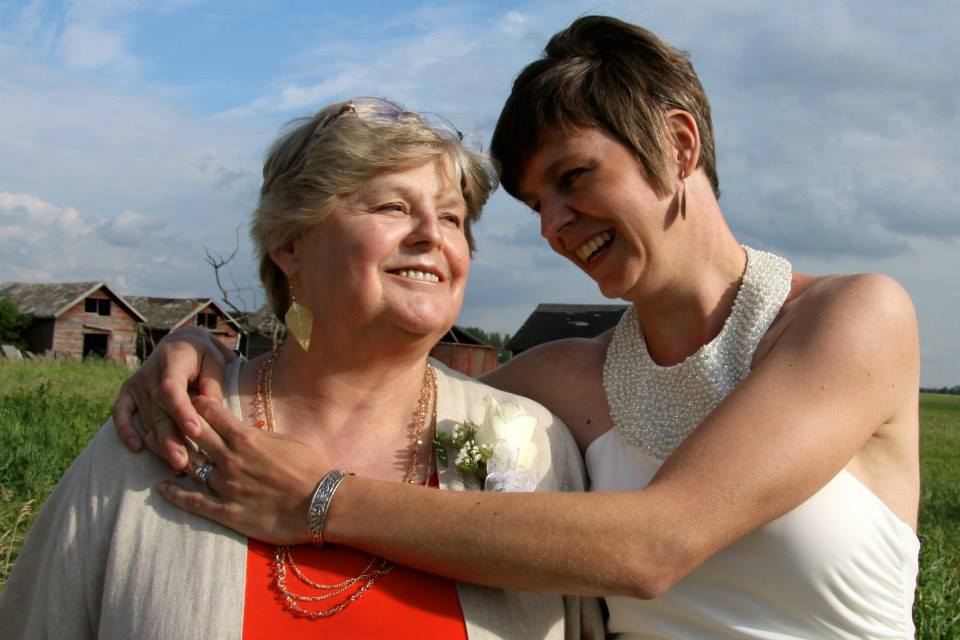
photo from Nicole Uzans’s personal archive
Nicole Uzans: I have to say that in a way I am embarrassed that I do not know my family tree better, but the connection with Jette is such that she is the sister of my godmother Velta. I remember that, growing up, I heard about Jette, saw books and, of course, saw mittens. I heard it said that Jette would sit and, while knitting, not even look – her fingers simply hovered, and suddenly there was already a pair of mittens in her hands! It was only after years that I understood that she is a national treasure in Latvia.
An interesting story was knitted together – during the Soviet era, my godmother tried to send packages with various Western goods to Latvia, many of them practical things. She sent good yarn, but balls of yarn were not allowed to be sent, so she knitted these giant skirts, and she knew that if they reached Latvia through the post, then the recipient would be able to unravel these skirts and knit beautiful things anew.
When I was in Latvia in 2017, I went to Jette’s resting place. It was very special, because they were also about to bury my godmother there, and now she has been repatriated there.
My father had one sister; they left Latvia when my father was only three years old, and emigrating by way of Sweden, they settled in Canada. My grandfather died long before I was born, so here in Canada there was only a small little family with a few relative ties.
Most of the Latvians in our family did not have children, so we were quite a small handful of people, who seemed to me rather old and a little out of touch, but with a deep history. Many family stories were not told, yet I remember one very special moment.
Last June [in 2023] my mother died, and one of the things she has left me as an inheritance is her diary. In the early 1990s my mother was ordained in the Anglican Church of Canada. When she retired, she went back through her diaries and notes to assess her path to ordination, and she rewrote important moments, insights and stories from that time, the late 1980s and early 1990s, when she was discerning her calling.
Interestingly, the last entry she had rewritten was from Easter Sunday of 1993. I was fifteen years old then. It was the first time we heard my godmother Velta tell about her escape from Latvia. When she left Latvia, Velta was seventeen years old. She was on a Red Cross ship [on the way to Germany] when, out at sea, the Russians bombed them. The ship sank within an hour.
I remember so clearly her account of how, as the ship was sinking, people had to climb down one ladder, and next to it was a rescue ship, and one had to climb up a ladder onto the other ship, and she, being 17 years old, simply leapt from one ladder to the other. Such courage and hutzpah [here: self-assurance] she had. But another thing I clearly remember from her account was Velta’s memory of how, looking now from the deck of the rescue ship, she saw a woman carrying a child up the ladder; the woman lost her grip, and the child fell into the sea. I remember my godmother saying that she had not even been able to cry over it.
Even when I was fifteen years old, I sensed that in this moment, when she told us this story buried deep in her heart, something very important was happening. For my godmother, this voyage was like a baptism. She was given a new life, but so much was taken away before it could begin. For my mother, this experience of taking part in the telling of Velta’s sacred story, at the family table, was part of her path of priestly discernment. My mother became an outstanding storyteller in her sermons and a pastor who truly welcomed everyone at God’s table. She knew that stories connect us and help us share emotional experiences for which we otherwise lack language or other means of expression.
In my youth I did not think I would become a pastor; I did not even have any interest in it. I wanted to be an artist, a poet, a writer and an adventurer, and I have done all of that. Then there was a series of transitions in my life, and through art I felt an ever-stronger calling to work with people. That does not always happen with artists; rather the opposite. Yet for me, sharing in the creative process with others turned out to be a great gain. Thanks to several opportunities and events, in this work I encountered spirituality and art that connected with prayer and healing, and gradually drew me closer to the church.
At about 30 years of age I understood that the time had come to settle down. I asked the church a question – can it be a place of creativity for me? Because I really did not know that. I had some internship opportunities in the church, and I was surprised that in a fairly traditional church I could be myself. Since my ordination, I have discovered that in this work there are various opportunities to be creative. To be in touch with life, to be in touch with the individual lives of people, and that I find endlessly creative.
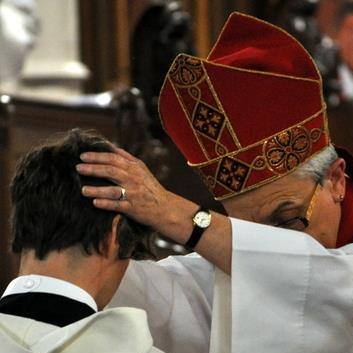
photo from Nicole Uzans’s personal archive
What are the creative expressions in your current life? Is preaching a form of art and a practice of creative writing, or do you also manage to write other kinds of works?
Nicole: Right now preaching is my main form of writing. I know there are many preachers who preach without notes, and from time to time I do that too, but I truly appreciate the spiritual process that takes place around preaching. It begins with preparation – simply being with the Holy Scriptures in daily life and events. And then comes the hard work, sitting down to write something. Since I have a good sense of language, I love poetic expression – how words play with one another, or, for example, how changing the way something is said creates a new meaning. While writing, I listen to the words, because I do not always have in my head the words and thoughts I want to say. It seems to me to be more like an abstract painting – constantly responding to what is happening before my eyes. I always trust that if I feel a small impulse, then I must let it write itself out and then see where it can take me. Writing sermons is a very creative process.
Then, while preaching, there is this being together with people, and it is a multisensory engagement – there is eye contact and a kind of electricity forms between people’s bodies in the space. The other part of the process that I have observed is that on a Sunday afternoon the sermon I have already preached often speaks to me. After everyone has gone home and I have had my lunch, I often go for a walk or ride my bicycle and repeat to myself part of what I said, and it is precisely then that I do my deepest heart-listening. That prepares me to begin this whole process anew with the next week’s readings. I love this spiritual process, and I love that it is a requirement in my work in the church. It is a real gift to me, and it is a profound way of forming a connection with other people.
Writing a sermon is in itself a personal spiritual practice that is very organic and meaningful for you – what advice would you like to share?
Nicole: There is no single method by which I work every week, but usually, preparing to preach, I reread the Bible story in my own words. I may include this retelling in the sermon, because some stories are so familiar that we no longer simply hear them. Some are so strange that we do not know what they might be telling us. But stories are meant to be experienced – with wonder, delight, confusion, bewilderment, disgust or other feelings. So I try to let the stories speak for themselves.
When I was younger, it seemed to me that I did not understand the Holy Scriptures well enough to explain them. I made the mistake of thinking that I had to work out a whole theological system before I could say anything at all. Now I believe that telling is more important than explaining, because God is the chief storyteller. So I offer a few thoughts and images to set people’s imagination and personal discernment in motion. Within myself I maintain a readiness to be surprised. When people say to me: “Today’s sermon was so wonderful!” my question is: “What did you hear?” I have learned that I can never predict what people have heard. There is what I think I expressed, but I never know what someone has perceived and how it is connected with their life. Such conversations have helped me, as a preacher, to relax. I am not the only one responsible; I am somewhere in a conversation with God and the people who are here, beside me.
You mentioned the connection between the great stories of God and our life and stories. What are the great stories right now that speak into everyday life?
Nicole: Right now, while it is still the Easter season, in my morning prayer time I slowly read the Book of Acts and return to the stories of the early Church. What speaks to me is that it has never been easy, and that God has always been ready to work with difficult people. These two things seem very useful to me, working in a congregation and simply living together with other people. It seems that for many people life is quite hard right now, and we can feel disappointed, so this larger story helps – a story of a deep and beautiful, God-inspired community for which nothing was ever easy, yet wonderful things happened, people met and were connected in unbelievable combinations.
One of the phrases I hold on to is – I can do anything, but I cannot do everything. Something of this sense of limits I see reflected in the Holy Scriptures as well. In the early Christian church there was an astonishing power and enthusiasm, and there were also moments when there was a very clear direction – now you go there! And on the way they went into still-unknown adventures together with companions who were at times frightening. These were not people who were guided only by individual choice, and they were not oriented toward simple and pleasant answers or things, but, perhaps by telling one another these stories, they increasingly perceived that through all of this something very good was unfolding, and that gives me hope in this time, when in our communities, in our nations, or between our nations, there is not much hope and unity. Sometimes small surprises can have a greater meaning than we suspect.
How has your mother inspired the path of being a pastor – did you have the opportunity to watch her, hear her, see how she preached and ministered? Did she write her sermons, or was she rather a person who had in her heart the conviction that the Spirit is with her, and that was enough to go and speak?
Nicole: That is the biggest difference between the two of us! My mother very rarely wrote out the whole sermon. She had notes in front of her. Preaching is not an easy thing, and I remember how on Saturday evenings she would sit at her desk and say: “I just need some story!” She would go to bed only when she had finally thought of something, as if saying, there is something I can hold on to, and tomorrow I will have something to say.
A Buddhist friend, having learned that my mother is also a pastor, said: “That’s a priestly lineage, after all!” And that seemed so beautiful to me. It has come to my mind more precisely after her death, but also before that, that we are like Elijah and Elisha. Such an inheritance can seem excessively large, and for many years, when my mother and I appeared together at church events, people would say: “Oh, you’re Lina’s daughter!” I was her daughter. And when she gradually prepared to retire and took on a more supportive role, my mother was thrilled the first time it happened that we were together at a meeting and someone said: “Oh, you’re Nicole’s mother!”
While she was still alive, a beautiful “handing over of the mantle”* took place. Our relationship also changed over the years. I was studying at university and was a young adult when my mother was most actively engaged in church ministry, but we reconnected, and she was surprised when I began to feel the pull of a priestly calling. It became a real point of connection for us, at times almost too great a one. I learned to be careful when asking her opinion or advice, because, consciously or unconsciously, she could be very influential. We both worked with that, and at the end of her life we could very honestly say that we had also become deep spiritual friends.
One of the aspects that I introduced my mother to is the interplay between the physical body and our spiritual life. That was not something she was particularly ready for or comfortable with, but she observed how it manifested in my life, and she learned much from it. Over the years she became a much gentler mentor.
I remember a Sunday sermon in which we talked about how, no matter our age, we can look at other people and think: “Oh, I want to be like that person when I grow up!” That Sunday my mother was in the church pew too. Afterward we went to lunch and continued to talk about it. Who do you want to be when you grow up? And she said: “When I grow up, I want to be like Nicole Uzans.” And it seemed to me as if some invisible circle was joining together, and we had been a source of inspiration for one another.
Holding on to this line of pastors, I understand that it is not that we take something that was important to a predecessor and then continue to do it – no, not at all like that; yet there is an influence that weaves back and forth between people from generation to generation, and whether it happens within one’s own family or within the wide family of God, it can be so beautiful.
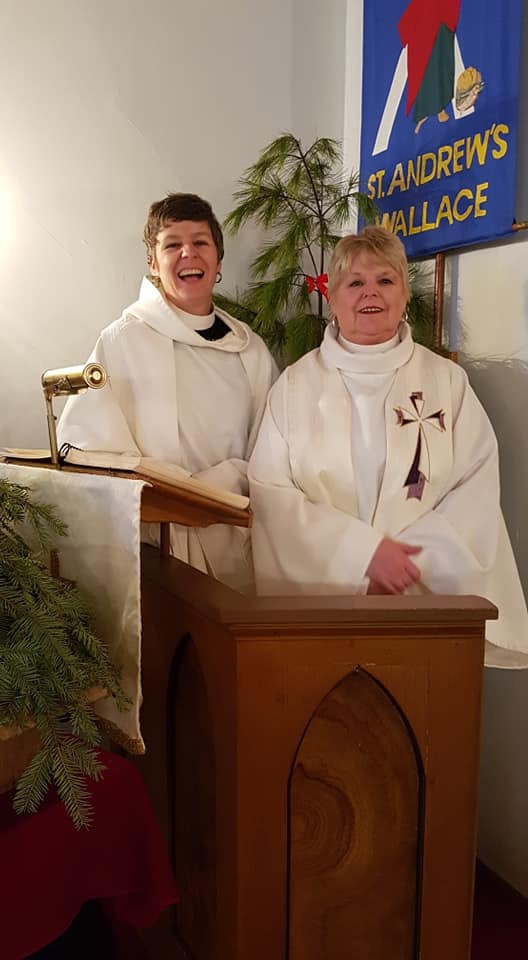
photo from Nicole Uzans’s personal archive
The Church itself needs deep spiritual formation. It seems that the Church is most alive where people are in living contact with God, and in the Anglican Church tradition that has not always been something people have expressed as important, even in our spiritual and religious life.
I see that this is precisely what draws people to the Church – the sense that it is a truly living place where a spiritual connection with God, with oneself and with others is cultivated. And if that is not there, then there really is no reason to be associated with the Church.
What is needed for such a “living place” to be and to happen? What are the aspects of living theology that people and the Church should explore more deeply?
Nicole: I think one of the elements is that there must be leadership that prays together with the community. Sometimes in my training I heard mentors and teachers say that during the Sunday liturgy they cannot really pray. They are too much in their leader role for it to also be their service. What was said stayed strongly in my memory, because that is not my experience. If the leader is not capable of worshiping in what is happening, people will perceive it, and the leader will be estranged from the community.
I truly believe that we can be a unified community of worship. It requires mercy from individual people. It can mean that there are elements of the liturgy, parts of the liturgical year, hymns, etc., that do not really speak to me personally, that are not appealing, but part of my and our identity is shared, and the service is not an act of self-expression; it is a practice of belonging and becoming.
Once again – it is an artistic, creative process, and I cannot allow myself to follow only what is written in a book; no, I have to be much more inside the concrete moment. I feel that even if I work alone on creating a liturgy, I am working in a community – present are those who in ancient times prayed these prayers, those who wrote them; they are all in the space together with me. It is very important that the leaders enjoy the nourishment of the service that they themselves prepare and share with others.
I am still surprised that there are generations of churchgoers who tend to leave the Church inside the church building. When they go out of the house of God, the rest of life is somehow separated from the church.
Speaking as a leader, one of my most important works of ministry is to be an ordinary person outside the church, in the surrounding environment. It is the capacity to truly be together with one another, in various outfits, so that people see me, for example, when I go on a hike in my rain gear. Or those touching moments when I see people in a hospital gown and their families in tracksuits and baseball caps, gathering around the hospital bed. To be truly real with people and to connect that with our spiritual community – that is an especially important element.
What we are doing right now in our town, and in this area we have had a good past, is cooperation with community groups, and we support these groups more than they support the church. That is one of the paths to connection and spiritual deepening. It is not always necessary for people to come to church in order to participate, but we as a church can find ways to support and celebrate what is happening. And to be in those places where we clearly see the imprint of God’s presence long before church people appear there. Here, in this town community, it is happening around the founding and operation of a hospice, which, by its very nature, is very sacred work. Perhaps the health department would not phrase it that way, but I see the holiness without hesitation. Another example – we have a community oven here; it is an outdoor, wood-fired pizza oven where people gather to cook and eat together. It has become my favorite place in town, because I see all our sacred stories reflected there, and it is easy to show up in these places, and we have begun to build close connections between these organizations, so that the church now supports the community oven in such a way that through it we are nourished and strengthened.
One of my greatest joys in congregational ministry is to take part, together with others, in study groups and discussions. A recent example of this is when I offered teaching about communion and the Eucharist as the feeding of the community of Jesus. We had a group of ten people. I began our conversation by saying that you already know this topic, but set it aside for a moment. Think and offer the rest of us a story about a time when you came together for a good meal, not because of recipes or a fancy menu, but a story that calls to mind a good feast together with others. Going around the circle, you could feel and see how people went ever deeper into the storytelling, because each story was deeply personally meaningful, and, hearing from others, other memories and associations arose, and in the end we had a wonderful collection of stories, all of which reflected part of what it means to be in communion. The opportunity for each person to be the storyteller is so important in the spiritual formation of the community and of each of its members.
I hope that, by offering myself as an example, who every Sunday morning, week after week, speaks about the Holy Scriptures and about life, I will show others that they too can speak about sacred things. That is one of the main goals of my preaching – to help people speak about holy things. I really do not mind whether people leave church with more knowledge or new information, but I would be very glad if they left with the feeling that they are more able to speak with others about holy things. It is a great danger we are facing right now, that people do not feel comfortable speaking with others about their faith. Even if faith is deeply, deeply meaningful to them, their own family may not know it or may not understand this connection.
We know that the people closest to us are sometimes the ones who most powerfully pass faith on to us. I am a living example of that; it is not for nothing that my mother and I have this line of ministry. I know that it shapes our lives when others share their faith. I want to give people tools and an example of how, and that, it can happen in conversational language, in a natural and down-to-earth way.
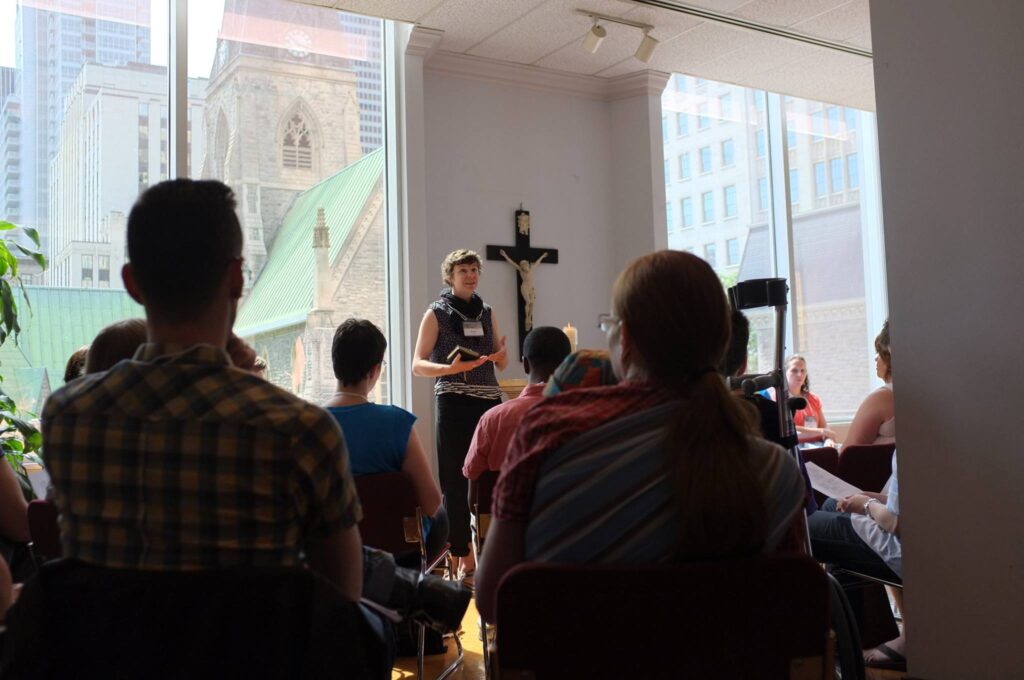
photo from Nicole Uzans’s personal archive
May I ask you to tell us about the spiritual practice of pilgrimages?
Nicole: I remember how a friend told about how he had gone on a pilgrimage and still had about 20 km ahead of him that day. The person he was walking with asked a question, and my friend’s first reaction was – well, that is a very long story! And then he paused and realized – I have time to tell a long story, and they walked together for about an hour and unhurriedly worked through the story, and how it surprised each of them.
When you walk shoulder to shoulder and heart beside heart, you are both facing in the same direction, and sometimes words flow more freely. Just as our feet on a pilgrimage path lead us to places we have not been before, so too can words shared together do this. It is possible that a pilgrim catches themselves saying – I don’t know why I am telling you this, or, I have never told anyone this before. As a leader of pilgrimages, sometimes at the end of the day I would see people enter the dining hall, and something in their facial expression let me understand that, walking the path together, they had shared something deep.
In 2014 someone from the Atlantic School of Theology (Atlantic School of Theology, Halifax) was trying out organizing a “Camino Nova Scotia.” It was a 10-day hike along an old, abandoned railway; accommodation was organized in local churches, and I signed up right away.
It was a good hike, and in the following years I began to work with this professor and soon started leading my own pilgrimages. Usually the pilgrimages were five days long and took place relatively locally. The people who most often walked them were those who had come to a transitional period in their lives. Something in life was changing – they had left a job or retired, an important person had died. These are moments when identity changes and one needed to set out on the road in order to understand – who am I now? That was a common feature that I observed among people. Usually it was a combination of people who want to be alone and are ready to learn from others as they walk. When we started, usually the first thing to be voiced was: “I need to spend some time alone.” And at the end of the hike people said that the most memorable and meaningful part of their journey was the community they had formed together with other pilgrims.
In North America we have ancient traditions and even a mystique surrounding people who go on solo journeys into uninhabited places, and that has its place, but a pilgrimage is something else. It is traveling together with others and usually traveling along a route that thousands of people have already walked before. Still, in this collective experience we find something that is uniquely our own.
For years I resisted the idea of the Camino de Santiago; I thought – everyone goes to Spain, but I won’t go. Then there was an interesting moment in 2019; I had been working in a small congregation unit. It was five small churches, in tiny little communities in the northern part of the province, and I began to feel that I was becoming more and more negative, and that God was urging me to step away from formal ministry, which surprised me enormously, but seemed a very true and faithful message. When I left this ministry, the first thing I did was a walk 800 km in length across the north of Spain, and I discovered that what I had just described had happened — it was a pilgrimage that was deeply my own and that was shaped by other people in ways I could not even have imagined.
photo from Nicole Uzans’s personal archive
We often use the metaphor that life is a pilgrimage or life is a journey. How do you experience life?
Nicole: I will shift the metaphor from the journey to the river. This is just a line from John O’Donohue: “I would love to live like a river flows, carried by the surprise of its own unfolding.”
That is my metaphor for life. Water is always moving, so the river expresses something about a journey. How do rivers come to be where they are? Often they find the path of least resistance. Why do rivers flow in winding curves? It is because that was the path that was opened before the river as it flowed onward. The river is a component of the landscape and nourishes everything around it, yet the river is constantly in motion, so the river can always surprise itself. That gives me both a sense of vibrancy and a sense of purpose about my life.
The journey metaphor can seem very individual – that it is only me and my backpack, and I go off alone on my way, but the river is a steady component of the landscape, sustaining everything around it while at the same time being in constant motion. Yes, I would gladly live as a river flows, carried by the surprise of its own unfolding.
It seems that something essential has not yet been said?
Nicole: One of the things I have not yet spoken about clearly is the importance of the contemplative path in my personal life and in the life of the Church. The contemplative path is hard to define. When I speak of it, I mean a particular stance – to listen to God in all things, to listen deeply from within, to listen to the still, small voice of God. To walk patiently with oneself and others. And there is no need to force our way forward.
Discovering friends on the path of contemplative spirituality, I feel ever more assured, both as a person and as a pastor. It is very easy to get carried away with all sorts of worries and anxiety about the state we and the world are in; it is also very easy to become proud and conceited if I become too intellectual or too political, or get carried away with activism, so the aspects of contemplative awareness and contemplative prayer have saved, and save anew, my ministry.
When I see people seeking, turning to the Church or other spiritual communities, I think there is something deeply attractive in a peaceful silence and in a growing trust in the goodness that makes the world turn. Learning to trust God deeply has, ironically, led me to a very active ministry, but I can only do it if I stand firmly on the ground together with other contemplative friends, with my own prayer practices, and with moments when I am away, whether that happens on a pilgrimage or in other moments of life.
It is important to be together with people who listen from the Spirit, who listen to God for the sake of that other person, and not to react quickly but to let the person who wishes to say something speak for a few minutes, and then for everyone to be silent before anyone gives an answer. That is very different from the debates and discussions in the “church world.” Such opportunities to be heard so deeply are rare, and in such a situation of listening, certain themes and threads will inevitably arise that will unite people, and it becomes an experience of attention to God and of attentiveness to the ways of God’s movement and action, not only in each individual life, but also through all of our lives.
Many people, on encountering some contemplative community, finally feel at home. They finally feel that they are not anxious or out of place in what they are and what they do, but experience the promise of unity that comes through the recognition of God, recognizing one another as well. Right now I would not want to live any other way; what could be better?
***
John O’Donohue (1956-2008) was an Irish poet and philosopher, known for several collections of prayers and poetry and for texts on Celtic spirituality and the experiences of human life.
“I would love to live like a river flows,
Carried by the surprise of its own unfolding.”
About the Mitten Jette
https://www.retv.lv/raksts/dzivais-cimds-cesu-muzeja-izstade
https://www.lsm.lv/raksts/dzive–stils/cilvekstasti/jette-uzane-dzivesstasts-kas-iedvesmo.a156950
Elijah and Elisha 1 Kings 19:13; 2 Kings 2:12-14
Nicole Uzans’s congregation
https://www.stjohnsanglicanchurchwolfville.ca/
Interview and transcription: Arta Skuja