
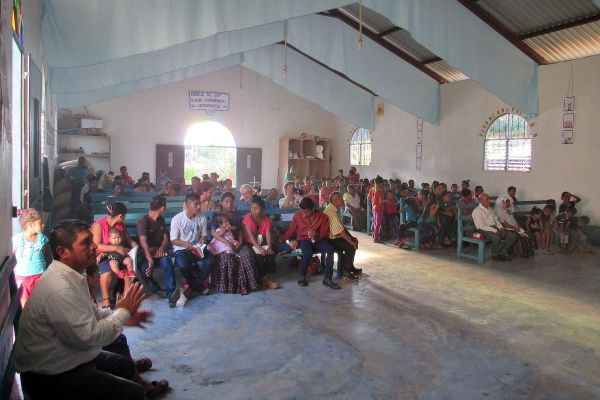
“We are glad to share God’s good news”
(Lutheran World Information Center) – As a small church made up mainly of indigenous people, it is important for the Augustinian Lutheran Church of Guatemala to address the problems of education, peace and justice, because they are relevant to many marginalized groups in the country. This is a simple but firm foundation for the church’s ministry, says ALCG president Rev. Karen Castillo Echeverría.
“Education sets people free. Our ministry is based on education. When people learn about their human rights, the Bible, God and His grace, they change. People grow to know God first as grace and not as a God who punishes people,” she explains.
“We are glad that we can share God’s good news, share the God of peace, love and grace – in a country that traditionally believes in a God of punishment and revenge,” says Castillo. “We show that there is a God who is within us, not in heaven, a God of peace and justice.”
The majority of ALCG congregations consist of people of the Q’eqchi’ people or other ethnic groups, or those who returned to Guatemala after six years of civil war. After the end of the war in 1996, the Lutheran church accompanied the returnees to the settlement areas allocated by the state. In 1998 mission work began in the village of Esmeralda, in the Dolores municipality of the Petén department. Soon another fourteen congregations were founded.
Alongside differences of culture and language, the ALCG’s work also involves the challenge of integrating those who fled because of the civil war. For example, those who sought refuge in Mexico have largely lost their Guatemalan identity and, on returning home, were not taught how to survive. “Guatemala lived in conflict for thirty-six years before the peace agreement was signed. Was that the end? No, it wasn’t. Peace has to be fostered, because no one taught us how to live in peace,” Castillo added.
Membership in the LWF increases visibility
During its 2018 meeting, the LWF Council accepted the church as the newest member of the global communion. This grants the ALCG recognition of its status as a Lutheran church, Castillo recalls.
With 3,000 members, the ALCG is a small church in a country of seventeen million inhabitants, and it is hard to notice. “We also lack resources, and our people are not sufficiently well educated. Alongside our work with indigenous people and women, it looks like digging a deep pit.”
“Belonging to a larger organization strengthens our Lutheran identity, especially in indigenous communities that are located far away. In this way the church’s ministry in God’s service over twenty-nine years is recognized, which gives the church a greater presence and recognition before the government and the surrounding society.”
“Belonging to a larger organization strengthens our Lutheran identity, especially in indigenous communities that are located far away. In this way the church’s ministry in God’s service over twenty-nine years is recognized, which gives the church a greater presence and recognition before the government and the surrounding society,” says Rev. Karen Castillo Echeverría.
The church has to defend itself against accusations from other denominations – that the Lutheran church does not exist, because Lutheranism is not widely known in Guatemala. The lack of recognition is heightened by the fact that the church’s president is a woman. Women pastors are not often encountered in Guatemala.
“Now our presence is visible in a society where such people – the indigenous, the poor, the uneducated and the outcast – are invisible. Our position is to be kind rather than to fight back, to show only love and to be kind.”
A strong emphasis on education
The ALCG began its pastoral and social work with people living in the outlying suburbs of Guatemala City. A strong emphasis on education permeates all of its ministry.
“We like to teach. Through communication and support, people can discover that they can seek God themselves, that they are valuable,” says Castillo.
In 1993 the church founded a primary school in the city’s La Isla district. Three years later it opened a second school in Mirador, Boca del Monte, for children aged four to fifteen.
Other important areas of ministry are the development of leadership skills, work with women, the introduction of primary health care and work with volunteer medical workers, Sunday school and primary school, musical education, as well as the establishment of relationships with synods and individual churches. At the church’s Milagro center, young indigenous women learn skills that will allow them to be self-sufficient without the need to marry young.
As pastoral work grows in rural areas among indigenous young people and young families, the ALCG fosters the ability of the indigenous Maya-Q’eqchi’ to rediscover faith. The Lutheran church has supported youth leaders in various activities, especially those whose native language is Maya-Q’eqchi’.
Guatemala City, Guatemala/Geneva
| 16./11./2018.
Source: The Lutheran World Federation