
Geneva, Switzerland: 18.06.2020.
Lutheran church leaders advocate for the protection of displaced persons
Churches and faith communities must actively support refugees. Every action counts. This is the call of Lutheran church leaders around the world on World Refugee Day. “In solidarity with refugees and migrants, we obey the Lord’s call to welcome them in and to serve them,” says the presiding bishop of the Evangelical Lutheran Church in America (USA), Elizabeth Eaton, who is also the vice-president of the Lutheran World Federation for North America.
“It astonishes me again and again to see how poor African countries take in millions of refugees,” adds the bishop of the Evangelical Lutheran Church in Bavaria, Germany, Heinrich Bedford-Strohm. “When I see how rich European countries struggle to house a few thousand, I am ashamed of my continent.”
We must not neglect vulnerable population groups
World Refugee Day, marked every year on 20 June, raises awareness of the situation of forcibly displaced persons. This includes refugees who have crossed their country’s border to flee from war or a great catastrophe, as well as internally displaced people, asylum seekers, stateless persons, and persons returning to their country of residence.
“The headlines are not made up of the information that there are currently almost 80 million refugees and internally displaced people who were forced to leave their homes,” says Maria Immonen, director of the LWF World Service. This is the largest number ever recorded, having grown almost twofold – from the 41 million people recorded in 2010.
“The displacement crisis on a global scale is increasingly growing and worsening. We as a worldwide family cannot neglect these vulnerable, traumatized, and fragile population groups. Even on matters of COVID-19, these people not only experience this time severely, but they must be included in all of the countries’ response measures globally, in order to ensure that we stop the spread of the pandemic.”
Since its founding in 1947, during the European refugee crisis after the Second World War, work with refugees and displaced people has been at the center of the Lutheran World Federation’s mission. Today, the LWF serves 2.25 million people in 25 countries through its humanitarian and development arm, ‘World Service’.
“The displacement crisis on a global scale is increasingly growing and worsening. We as a worldwide family cannot neglect these vulnerable, traumatized, and fragile population groups.”
Maria Immonen, director of the LWF World Service.
Religious communities play a “key role”
The Lutheran World Federation World Service supports refugees from Venezuela, Myanmar, Syria, South Sudan, and internally displaced people in Iraq and Colombia. The LWF is the largest faith-based organization that is an implementing partner of the United Nations High Commissioner for Refugees (UNHCR), providing humanitarian assistance to people living in refugee camps such as Kakuma, Dadaab, Northern Uganda, Zaatari, and Cox’s Bazar, among others.
“Religious leaders, faith-based organizations, and faith communities can play a key role in integrating refugees into their communities, reducing conflicts, and supporting those who have lost everything,” says the executive director of the LWF Public Theology and Interreligious Relations program, Rev. Dr. Sivin Kit.
“During the current Covid-19 pandemic, the World Health Organization has reached out to faith-based organizations such as the LWF to share essential information and guidance that people in faith communities would more readily heed directly, rather than from other sources. Member churches throughout the LWF communion have continued to provide pastoral and spiritual support in emergency situations, as well as to advocate for the needs of vulnerable populations.”
Photo:
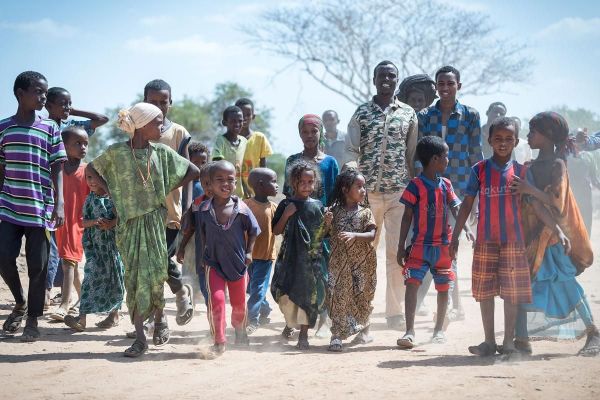
Internally displaced residents, members of the Oromo ethnic group, walk through the Burka Dare internally displaced people’s settlement in Ethiopia. Photo: LWF/ Albin Hillert
Source: The Lutheran World Federation
Take part, too: