
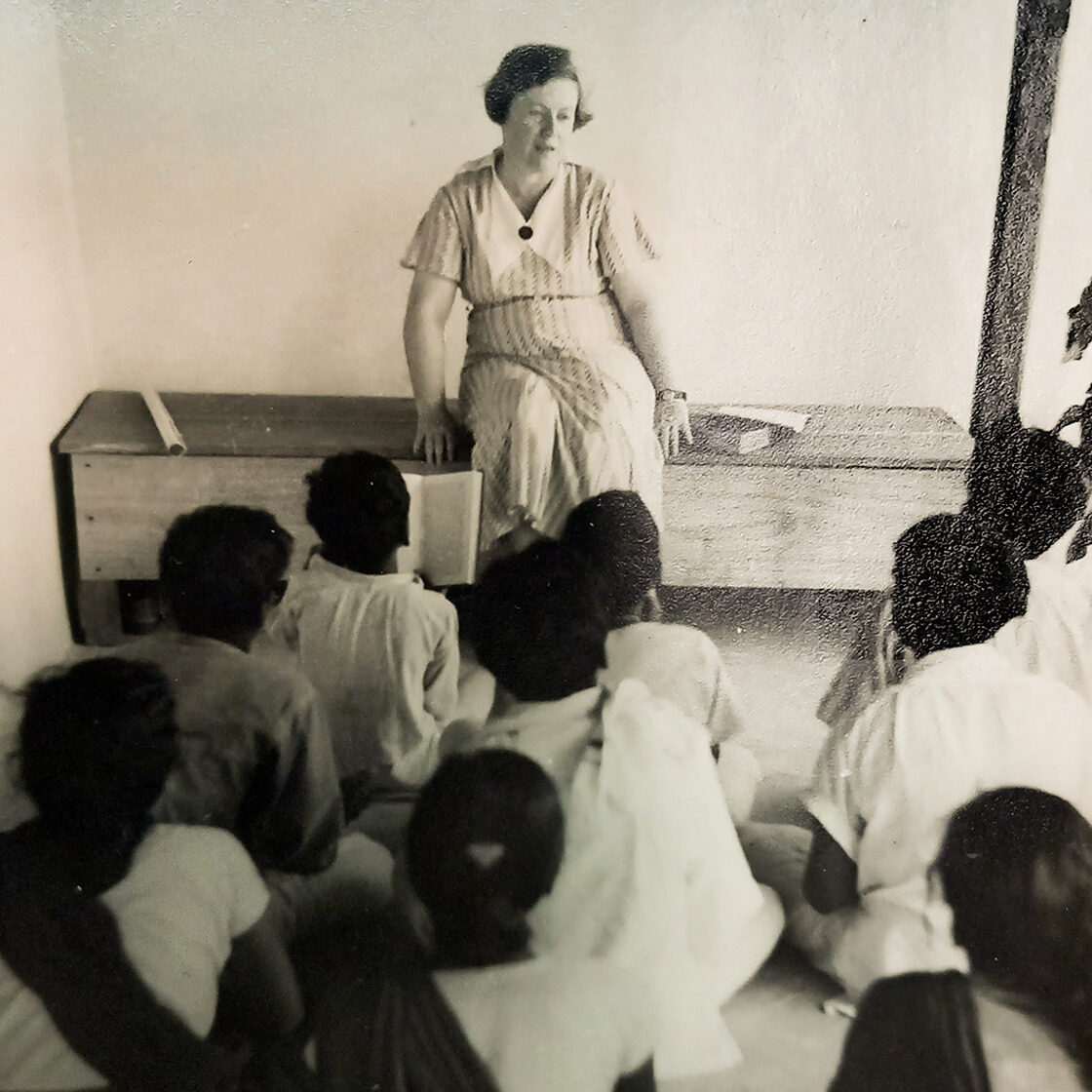
Deacon Vija Klīve’s paper on Anna Irbe at the conference “Witnesses of Faith.” Tukums, 4 December 2013
(Deacon Vija Klīve’s conference paper on Anna Irbe. English translation below — please scroll down.)
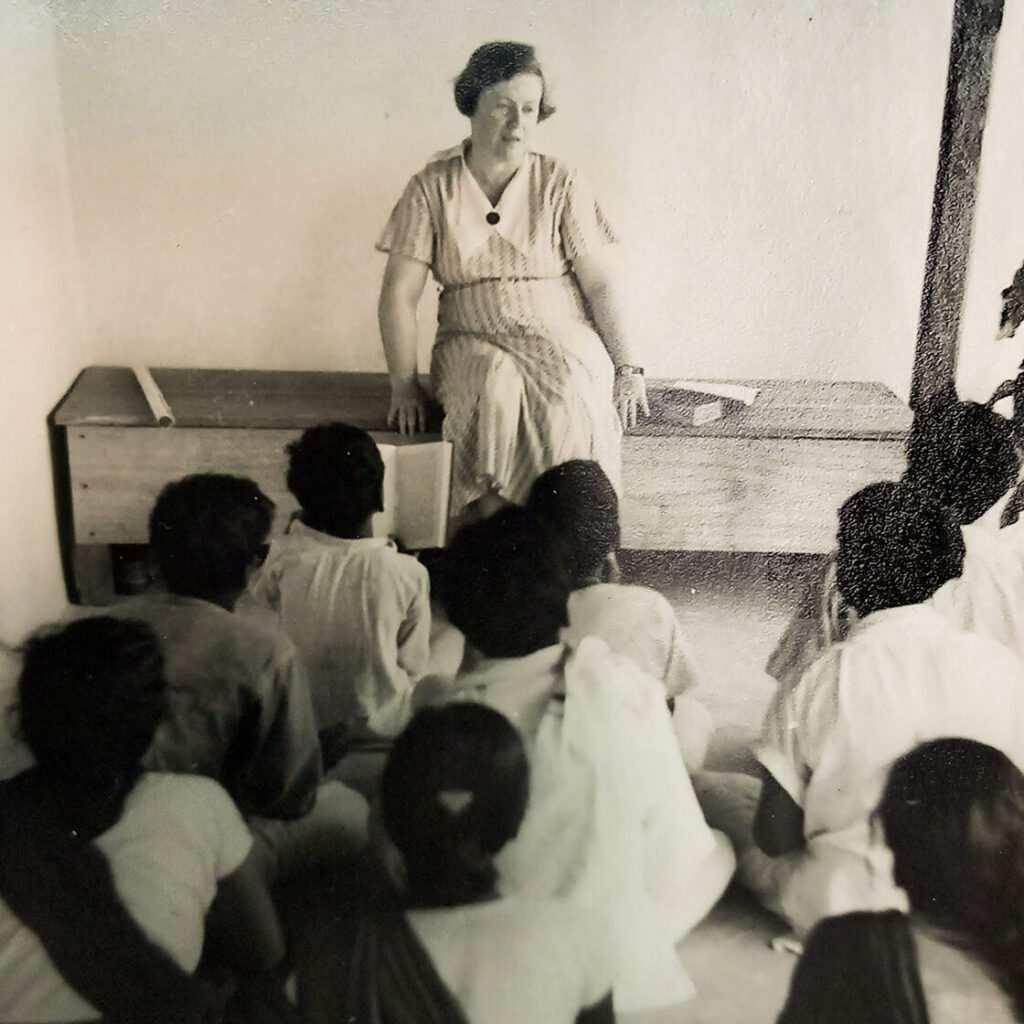
In her 2005 address at the anniversary conference of our Latvian Lutheran Women Theologians’ Association, the Indian Violeta Stephen described the missionary Anna Irbe as a woman “who was ahead of her time.” What other woman in the 1920s and 1930s was so enterprising, courageous, and focused that she could, practically single-handedly, build in the heart of India a village of mercy devoted to God for education, charity, and healing? What other woman during those years, or even later, was the planner, builder, and administrator of such an institution — responsible for a primary school, a widows’ shelter, the work of a medical assistant, spiritual activities, and practical agricultural work?
One might say that among Latvian Lutherans Anna Irbe is a legend, but for certain reasons — the efforts of fifty years of Soviet occupation to suppress the history of the Latvian church — this legend has for years been practically forgotten, at least here in Latvia. With the restoration of Latvia’s free state, interest in this remarkable, devout woman has appeared once again.
A brief account of Anna Irbe’s life usually consists of the following facts: Anna Irbe was born in Dzērbene in 1890 into the family of the then pastor, later bishop, Kārlis Irbe; in 1925 she travelled by ship to India as a missionary, worked under the auspices of the Swedish church mission with women and children, and in 1933 founded the independent mission institution named “Karunāgarapuri,” working together with the local Tamil church pastor G. Stephen. When contact with Latvia was severed in connection with the Second World War, the mission institution came into the hands of the Swedish mission and was later taken over by the Tamil Lutheran Church. Anna Irbe retired, went to live in her house in Coonoor, in the Nilgiri Hills, and raised Pastor Stephen’s five children. She died in 1973 in Tirupattur, in a Swedish hospital, and was buried in the hospital cemetery.
But what made Anna Irbe the person she was? It seems to me that, in order to answer this question, one must return to the very beginnings and to the years of Anna Irbe’s youth. What were the formative forces and events in Anna Irbe’s life that prepared her for the greatest calling of her life in India? Here I have taken the liberty of using information and texts from two sources, written both by Violeta Stephen, who regarded Anna Irbe as her dear “Granny,” and by Ģirts Pētersons in his Bachelor’s thesis on Anna Irbe at the Faculty of Theology (1995).
Anna Irbe was born on 19 September 1890 in Dzērbene, into the family of the local pastor Kārlis Irbe. Her sister Marija was born three years later, but died as early as 1926. Anna was baptized and confirmed in the Dzērbene church. She attended and completed the local school and lived in the conditions of a small rural village. At the age of twenty-two Anna went to study in Geneva, in order to train as a nurse, but the outbreak of the First World War did not allow her to complete her studies. As the war reached Latvia, the Irbe family moved to the Caucasus, where her father owned a house and land at a beautiful resort. In the Caucasus Anna married a wealthy Russian nobleman, Kaļitajev. In the family sons Kirill (also called Kirik) and Viktor were born. Only a few weeks after Viktor’s birth, the events of the revolution began in Russia, which under communist leadership soon developed into the extermination of aristocrats as “enemies of the people.” At that time a typhus epidemic was raging in the Caucasus. Anna’s husband did not live to see the communists enter the Caucasus, for he suddenly died of typhus. As Anna later acknowledged — God in His mercy had taken her husband before he could experience an even more terrible death at the hands of the “Reds.” The younger child, Viktor, also fell ill with typhus and soon died. Anna, together with her sister Marija and her son Kirill, set out for Moscow, where her father was at that time, helping Latvian refugees. Both her sister and Kirill also fell ill with typhus.
In her memoirs Anna acknowledged that this was the most critical moment of her life. And it was then that she truly understood that the only help and the only thing to seek is to be found in God, and that everything that happens and will happen is according to His will.
In order to protect her own life and that of her son, she spoke Latvian to the persecutors who had entered, for she hoped that, as foreigners, they would not be harmed. She regarded it as a sign of God’s grace that little Kirill did not betray them by speaking Russian, for he lay in a fever and could not utter a word.
During this extraordinarily difficult time of trial, when disease and famine raged, Anna Irbe learned to survive on nothing but wild herbs or a few vegetables, to do heavy agricultural work, to tend cattle… She learned much that later proved useful in the work of a missionary in India, where at times conditions were similar. Anna Irbe later wrote: “Living just as the poor did, I learned to rely solely on God’s guidance. Living with the Cossacks, I was quite happy. In such wild places people are very much in need of one another. When I returned to Latvia, everything was entirely different — it seemed there was no room in the heart to be dependent on God. It is not easy to live in this environment.”
The road to Moscow was long and full of dangers, but with the help of Turkish sailors they nevertheless managed to get there. In Moscow, too, there was violence and insecurity. Anna Irbe was even wounded in a shootout. During this time her mother died in Moscow. In Moscow Anna worked for several years, helping a total of about 23 Latvian families to escape and return to their homeland. Often she had to risk her life and hide those whom the communists wanted to settle scores with, including — her own son. To protect him, Anna placed him in an orphanage in which she herself worked.
At last Anna and Kirill, together with a larger group of orphans, managed to return to Latvia only in the early 1920s. Even that was not easy to do.
In Latvia she lived with her father, who in 1922 became the first bishop of the Evangelical Lutheran Church of Latvia, and she carried out her father’s clerical and household work. At that time her father was also the director of the Church Gymnasium (now the Riga English Gymnasium) and lived in a cottage on the school grounds. In connection with his installation in the office of bishop, the Archbishop of Sweden, Dr. Nathan Söderblom, visited Riga and also consecrated the new bishop. Clergy from various denominations and from several countries were guests at the bishop’s cottage. Relations between the Latvian and Swedish churches grew closer, and the Foreign Mission worker of the Church of Sweden, Dr. Johannes Sandegren, who was afterward elected bishop of the Tamil Lutheran Church of India, also stopped in Riga. Sandegren spoke about the Swedish church’s mission in India and about how greatly women were needed who would work with Indian women and children, for, owing to Indian customs, male missionaries had no real access to the women. Listening to this, Anna spoke simple, fateful words: “Take me!”
When in the spring of 1924 Bishop Kārlis Irbe consecrated his eldest daughter Anna as a missionary in the Old St. Gertrude’s Church in Riga, he said: “Thirty-seven years ago I stood just as you do at the altar; the hardships are already known to you … I am not afraid that you might shrink from hardships; I am afraid that you might lose your spiritual strength and patience at the moment when the results of mission work are not noticeable.” That same year the Mission Board of the Church of Sweden sent Anna Irbe to English-language and missionary courses in England, and in October she sailed with her son Kirill to India, where, after studies of the Tamil language, she was given work in the Swedish mission field in the city of Mayuram, and after three months in the city of Coimbatore.
In her first period in India she worked in orphanages, directed the Coimbatore boys’ school with its boarding house, and the work of women’s evangelization — the so-called Bible women (Biblewomen) — that is what the missionaries called the local Christian women who, under the guidance of the missionaries, visited the zenanas (women’s quarters) and taught the basics of the Christian faith to those of their non-Christian sisters who wished to learn them.
Working with children and women, and seeing what the local needs were, Anna Irbe began to cherish a dream. As early as 30 June 1928 she wrote in a letter from India: “We want to open a boarding house in some village, take in children aged 6 to 12, and raise them not for city life but for rural life. We shall see whether God will give us the necessary means.” After some time she coordinated this plan of action with the Swedish mission pastor Sandegren. And so a plan arose for the creation of her own independent mission work center, which would be supported by the congregations of the Evangelical Lutheran Church of Latvia. In this plan she was also ready to invest her own money. She wrote: “I shall try to save up enough personal money to buy 5 acres of fertile land. Then I shall ask the Swedish mission to lend me money to build 6 huts for the pupils, one more hut for myself, another for a woman teacher, a shelter for the school, and a small church. The mission can withhold a few rupees each month from my salary until the expenses are covered. In such a newly built village there will live about 60 children and 6 widows. …. This could be the cornerstone of a future Latvian mission in India.”
After seven years of service Anna Irbe returned to Latvia for a year-long furlough. She stayed with her father and travelled all around Latvia, visiting Lutheran congregations and turning to other sponsors in order to obtain the means to realize her dream of a Latvian mission station in India.
Returning to India, to the familiar district of the city of Coimbatore, Anna carefully searched for a plot of land in the countryside, for she deliberately wanted to build the institution in the countryside, for the sake of the children’s upbringing and education. One of her aims was: to combat the poverty and uncleanliness of the Indians with a very effective system of education and work training from the very earliest age, so that in their time free from lessons the children would not be weaned away from the land and physical labor, as happens in an urban environment. Anna was concerned about the fate of Indian widows, the sick, and other people in distress, and therefore it was intended to offer kind help to everyone who needed it. In the district around Coimbatore, which was a cotton plantation district, among 53 other locations Anna found a suitable place: rural land with a good well. The land there was fertile, for, unlike the surrounding countryside, there was water both for drinking and for irrigating the fields. Anna bought 16 acres of land and, with her helpers, began to build a few little houses, or huts.
The mission station was opened on 5 March 1933 with a large procession in which, singing hymns, a cross with a wreath was carried up a small hill. The cross was placed on a stone base. The director of the Swedish mission, Frikholm, gave the place the name Karunāgarapuri, and Bishop Sandegren gave the blessing. What does Karunāgarapuri mean? It is the place where merciful hands dwell.
Already in the first year the Tamil pastor Stephen and his wife, fourth-generation Christians, joined Anna Irbe. Pastor Stephen had just obtained his B.D. degree, and it was his first year of ministry.
During Anna’s time of activity, trees began to be planted, including bananas, mangoes, and coconuts. She and Pastor Stephen supervised the construction. As the years passed, a mission building was built, where the missionary Irbe lived, a parsonage, where Pastor Stephen lived with his wife and later also the children, five in all. A school building was built, at one end of which was an altar room, separated by wooden doors during school lessons, but open for devotions at 6:30 in the morning and in the evening. A dispensary was set up (in English – dispensary), a house for children — at that time only for boys, a widows’ home, Karunei-Illam, and a house for old people such as, for example, Isaac, who lived here for years, getting about on all fours. A barn was built for the livestock, with which they worked to plow the fields and to raise the necessary food for the entire mission. In its heyday Karunāgarapuri had more than ten cows, a fish pond, fruit gardens, and vegetable and grain fields that sustained the community. Violeta Stephen recalled that “on the farm there were some fifty or a hundred hens, mango trees in the orchard, as well as an abundance of butter and yogurt produced within the community.” Anna Irbe’s wonderful organizational abilities helped to run the activities of this many-sided “Latvian village” successfully.
At the entrance to the mission institution there were (and still are!) two stone pillars, on whose semicircular arch were the words: “Love your neighbor as yourself.” Anna Irbe was able to draw helpers to her for the work of evangelization and social assistance. She continued and developed further contacts with the Swedish missionaries, who together with her, over the course of several years, created a Christian center which — as Violeta Stephen writes — became a beacon and a refuge both for the inhabitants of the surrounding area and also for missionaries, bishops, pastors, and city dwellers. Anna’s dream of a village, a Latvian village, had been fulfilled.” Out of the ministry of Anna Irbe and others, 10 congregations grew up in the villages of the workers of the surrounding cotton plantations.
Much can be said about Anna Irbe, for she corresponded regularly with the Foreign Mission secretary of the Evangelical Lutheran Church of Latvia, Pastor Roberts Feldmanis, and her letters appeared in a special bulletin called “Ārmisija” (Foreign Mission). Feldmanis himself visited the missionary Irbe in India when he came in 1938/1939 for an international conference in Madras. At that time he took many photographs, which are now kept in the Archive of the Evangelical Lutheran Church of Latvia.
A little about Anna Irbe’s legacy, or the continuation of her work. Although she retired after the end of the Second World War, she was not without work. As I said earlier, her long-time co-worker was the Tamil Lutheran pastor G. Stephen, and the head of the Karunāgarapuri school was his wife Mabel. They had five children. Anna Irbe very naturally became the children’s caretaker and practically a member of the family. The children called her “Omīti” (Granny). Perhaps her greatest influence was precisely on the eldest daughter, Violeta, when she was studying at a teachers’ college in Madras.
When Latvian Lutherans in the West began to think about renewing contacts with India and providing assistance, and after consultation with Anna Irbe, it was Anna who recommended her companion Pastor Stephen as the new leader of the work. The second phase of the Latvian foreign mission began. Around that time the missionary Anna Irbe died in the Swedish mission hospital in Tirupattur and was buried in the hospital cemetery. Violeta writes: “For many years she had kept a jar with soil from Latvia, and these grains of earth, according to her wishes, were scattered over her grave on 13 February 1973.”
Inspired by his association with the Latvian missionary, Stephen founded in another place in Tamil Nadu a mission institution called Karuneipuri — with a children’s boarding school, a widows’ home, a weaving workshop, with livestock and vegetable fields, and energetically, among 53 other places, began evangelistic and social work in the nearest villages. To carry out the work, Stephen took on evangelists and practical workers.
Pastor G. Stephen himself went to his rest in God in 1995. And then, feeling God’s calling and a duty toward her “Granny” and her father, the leadership of the work was taken over by Violeta Stephen, who soon retired from her teaching work in England and was able to devote all her time to the Foreign Mission field in India. As the years have passed, there have been changes in the content and scope of the work, but Violeta, honoring the memory of her Granny, holds to a firm resolve to “show Christian love through social action.”
Sources:
- Pētersons, Ģirts. Latvia’s First Missionary Anna Irbe, Her Life and Work. Bachelor’s thesis, Faculty of Theology, University of Latvia, Riga, 1995.
- Stephen, Violeta. Missionary Anna Irbe – A Woman Ahead of Her Time. Ceļš: Theological and Cultural-Historical Journal of the Faculty of Theology, University of Latvia, No. 57, Riga 2006. Also online: www.sieviesuordinacija.lv/docs/1092/Vesture/AnnaIrbe-cels57.pdf.
ANNA IRBE
Vija Klīve
In her address at the 2005 anniversary conference of the Latvian Lutheran Women Theologians’ Association, the Indian theologian Violeta Stephen described the missionary Anna Irbe as a woman “ahead of her time.” What other woman in the 1920s and 1930s was so enterprising, courageous, and focused that she could almost single-handedly establish, in the heart of India, a village devoted to mercy, education, charity, and healing in the service of God? What other woman during those years—or even later—served simultaneously as planner, builder, administrator of a primary school, caretaker of a widows’ shelter, medical assistant, organizer of spiritual activities, and supervisor of practical agricultural work?
It may be said that among Latvian Lutherans Anna Irbe has become a legend. Yet, for understandable reasons—namely the fifty years of Soviet occupation and its systematic suppression of Latvian church history—this legend remained virtually forgotten for many years, at least in Latvia itself. With the restoration of Latvia’s independence, renewed interest has emerged in this remarkable and deeply devout woman.
A brief account of Anna Irbe’s life usually includes the following facts: Anna Irbe was born in Dzērbene in 1890 into the family of the pastor, later bishop, Kārlis Irbe. In 1925 she travelled by ship to India as a missionary, where she worked under the auspices of the Swedish Church Mission among women and children. In 1933 she established an independent mission institution called Karunāgarapuri, where she worked together with the local Tamil Lutheran pastor G. Stephen. When contact with Latvia was severed during the Second World War, the mission came under Swedish missionary administration and was later transferred to the Tamil Lutheran Church. After retiring, Anna Irbe settled in her own house in Coonoor in the Nilgiri Hills, where she helped raise Pastor Stephen’s five children. She died in 1973 in Tirupattur, in a Swedish mission hospital, and was buried in the hospital cemetery.
Yet what shaped Anna Irbe into the person she became? To answer this question, one must return to the very beginning and to the years of her youth. What formative influences and events prepared her for her life’s greatest calling in India? In this paper I have drawn upon two principal sources: the writings of Violeta Stephen, who regarded Anna Irbe as her beloved “Grandmother,” and Ģirts Pētersons’ Bachelor’s thesis on Anna Irbe, completed at the Faculty of Theology in 1995.
Anna Irbe was born on 19 September 1890 in Dzērbene, into the family of the local pastor Kārlis Irbe. Her sister Marija was born three years later, but died in 1926. Anna was baptized and confirmed in the Dzērbene church. She attended and completed the local school and grew up in the environment of a small rural village.
At the age of twenty-two Anna travelled to Geneva to study nursing, but the outbreak of the First World War prevented her from completing her studies. As the war reached Latvia, the Irbe family moved to the Caucasus, where her father owned a house and land in a beautiful resort area. There Anna married a wealthy Russian landowner named Kaļitajev. Their sons Kirill (also called Kirik) and Viktor were born there.
Only a few weeks after Viktor’s birth, revolutionary events erupted in Russia and soon developed into a communist campaign of extermination against the aristocracy as “enemies of the people.” At the same time, a typhus epidemic ravaged the Caucasus. Anna’s husband did not live to witness the communist advance into the region, as he suddenly died of typhus. Anna later reflected that God, in His mercy, had taken her husband before he could suffer an even more terrible death at the hands of the “Reds.” Her younger son Viktor also contracted typhus and soon died.
Together with her sister Marija and her son Kirill, Anna travelled to Moscow, where her father was then assisting Latvian refugees. Both her sister and Kirill also fell ill with typhus.
In her memoirs Anna described this as the most critical moment of her life. It was then that she fully realized that true help and hope could be found only in God, and that everything which happened and would happen was according to His will.
In order to protect her own life and that of her son, she spoke Latvian to the persecutors who entered their dwelling, hoping that they would spare them as foreigners. She regarded it as a sign of God’s grace that little Kirill, delirious with fever, did not betray them by speaking Russian.
During this extraordinarily difficult time of disease and famine, Anna Irbe learned to survive on wild herbs and small amounts of vegetables, to perform heavy agricultural labor, and to care for cattle. She acquired many of the practical skills that later proved essential in her missionary work in India, where living conditions were often similarly harsh. Anna later wrote:
“Living as the poor lived, I learned to rely solely upon God’s guidance. Living among the Cossacks, I was truly happy. In such wild places people desperately need one another. When I returned to Latvia, everything was entirely different—it seemed that there was no room in people’s hearts for dependence upon God. It is not easy to live in such an environment.”
The journey to Moscow was long and perilous, but with the help of Turkish sailors they eventually succeeded in reaching the city. Yet Moscow itself was marked by violence and insecurity. Anna Irbe was even wounded during a shooting incident. During this period her mother died in Moscow.
For several years Anna worked in Moscow helping approximately twenty-three Latvian families escape and return to their homeland. Often she had to risk her own life by hiding those whom the communists sought to eliminate, including her own son. To protect him, she placed him in an orphanage where she herself worked.
Finally, in the early 1920s, Anna and Kirill succeeded in returning to Latvia together with a larger group of orphans. Even this was not easy to accomplish.
Back in Latvia she lived with her father, who in 1922 became the first bishop of the Evangelical Lutheran Church of Latvia. Anna assisted him with administrative and household responsibilities. At that time Bishop Irbe also served as director of the Church Gymnasium (today the Riga English Gymnasium) and lived in a cottage on the school grounds.
On the occasion of his consecration as bishop, the Archbishop of Sweden, Dr. Nathan Söderblom, visited Riga and personally consecrated the new bishop. Clergy from various denominations and countries frequently visited the bishop’s residence. Relations between the Latvian and Swedish churches became increasingly close, and among the visitors was Dr. Johannes Sandegren, a representative of the Swedish Church Mission, who was later elected bishop of the Tamil Lutheran Church in India.
Sandegren spoke about the Swedish mission in India and emphasized the urgent need for women missionaries to work among Indian women and children, since prevailing customs prevented male missionaries from gaining access to women. Listening to him, Anna uttered the simple yet fateful words: “Take me.”
When Bishop Kārlis Irbe consecrated his eldest daughter Anna as a missionary in St. Gertrude’s Old Church in Riga in the spring of 1924, he said:
“Thirty-seven years ago I stood before the altar just as you do now. Hardships are already known to you… I do not fear that you will shrink from difficulties; I fear only that you may lose your spiritual strength and patience when the fruits of missionary work are not immediately visible.”
That same year the Mission Board of the Swedish Church sent Anna Irbe to England for English-language and missionary training. In October she sailed to India together with her son Kirill. After studying Tamil, she was assigned to work in the Swedish mission field in the city of Mayuram, and after three months was transferred to Coimbatore.
During her first years in India she worked in orphanages, directed the boys’ boarding school in Coimbatore, and supervised women’s evangelistic work. These “Bible women,” as missionaries called them, were local Christian women who visited the zenanas—women’s quarters—and taught interested non-Christian women the foundations of the Christian faith.
Working among women and children and witnessing local conditions, Anna Irbe gradually began to nurture a dream. Already on 30 June 1928 she wrote from India:
“We wish to open a boarding school in a village, receiving children from six to twelve years of age and educating them not for city life but for rural life. We shall see whether God grants us the necessary means.”
After some time she discussed this plan with Pastor Sandegren of the Swedish Mission. Gradually the vision emerged of creating an independent missionary center supported by congregations of the Evangelical Lutheran Church of Latvia. Anna herself was prepared to invest her own money in the undertaking. She wrote:
“I shall try to save enough personal funds to purchase five acres of fertile land. Then I shall ask the Swedish Mission to lend me money to build six huts for students, one hut for myself, another for a teacher, a shelter for the school, and a small church. The Mission may deduct a few rupees each month from my salary until the expenses are covered. In this newly built village there would live approximately sixty children and six widows… It could become the cornerstone of a future Latvian mission in India.”
After seven years of service Anna Irbe returned to Latvia for a year-long furlough. She stayed with her father and travelled throughout Latvia visiting Lutheran congregations and approaching sponsors in order to raise support for her dream of a Latvian mission station in India.
Upon her return to India and the familiar region of Coimbatore, Anna carefully searched for suitable rural land, since she intentionally wished to establish the institution in the countryside for the sake of children’s upbringing and education. One of her aims was to combat poverty and unsanitary conditions through an effective system of education and vocational training beginning in childhood, so that children would not lose their connection to the land and physical labor, as often happened in urban environments.
Anna was deeply concerned for widows, the sick, and other vulnerable persons, and therefore the mission was intended to provide compassionate assistance to all in need. In the cotton plantation district around Coimbatore, among fifty-three possible locations, Anna discovered a suitable site: farmland with a good well. The land was fertile because, unlike the surrounding terrain, it possessed sufficient water both for drinking and irrigation. Anna purchased sixteen acres of land and, together with her assistants, began constructing several small houses.
The mission station was officially opened on 5 March 1933 with a large procession during which, while singing hymns, participants carried a cross crowned with a wreath to a small hill. The cross was placed upon a stone base. Frikholm, director of the Swedish Mission, gave the place the name Karunāgarapuri, and Bishop Sandegren pronounced the blessing. The name means “the place where merciful hands dwell.”
Already during the first year Pastor Stephen and his wife joined Anna Irbe. They were fourth-generation Christians, and Pastor Stephen had only recently received his Bachelor of Divinity degree; this was his first year of ministry.
During Anna’s years of service, trees were planted, including banana, mango, and coconut trees. Together with Pastor Stephen she supervised the construction work. Over time the mission complex expanded to include the missionary residence where Irbe herself lived, a parsonage for Pastor Stephen and his family, a school building with an altar space separated by wooden doors during classes but opened for worship at 6:30 each morning and evening, a dispensary, a home for boys, a widows’ residence called Karunei-Illam, and a shelter for elderly people such as Isaac, who had moved on all fours for many years.
Barns were built for cattle used in plowing the fields and producing food for the entire mission. At its height Karunāgarapuri possessed more than ten cows, fish ponds, orchards, vegetable gardens, and grain fields that sustained the community. Violeta Stephen later recalled:
“There were perhaps fifty or one hundred chickens on the farm, mango trees in the orchard, and an abundance of butter and yogurt produced within the community.”
Anna Irbe’s remarkable organizational abilities enabled her successfully to manage the activities of this multifaceted “Latvian village.”
At the entrance to the mission stood—and still stand—two stone pillars bearing the words: “Love your neighbor as yourself.” Anna Irbe was able to attract co-workers for evangelistic and social ministry. She maintained and expanded cooperation with Swedish missionaries, and together over the years they created a Christian center which, as Violeta Stephen writes, became “a beacon and a refuge” not only for local inhabitants but also for missionaries, bishops, pastors, and visitors from the city. Anna’s dream of a village—a Latvian village—had been fulfilled. From the ministry of Anna Irbe and her co-workers ten congregations eventually emerged among the neighboring cotton plantation communities.
Much can be said about Anna Irbe because she maintained regular correspondence with the secretary of the Latvian Church’s Foreign Mission, Pastor Roberts Feldmanis. Her letters were published in the special bulletin Ārmisija (“Foreign Mission”). Feldmanis himself visited Irbe in India in 1938–1939 while attending an international conference in Madras. During his visit he took many photographs, which are now preserved in the archives of the Evangelical Lutheran Church of Latvia.
A few words should also be said about Anna Irbe’s legacy and the continuation of her work. Although she retired after the Second World War, she was by no means inactive. As mentioned earlier, her long-time co-worker was the Tamil Lutheran pastor G. Stephen, whose wife Mabel served as principal of the Karunāgarapuri school. They had five children, and Anna Irbe naturally became their caretaker and practically a member of the family. The children called her “Omīti” (“Granny”).
Perhaps her greatest influence was upon the eldest daughter, Violeta, especially during the latter’s studies at a teachers’ college in Madras.
When Latvian Lutherans in the West later sought to renew contact with India and resume support for missionary work there, Anna Irbe herself recommended Pastor Stephen as the new leader of the mission. Thus began the second phase of Latvian foreign mission work in India.
Around this same time Anna Irbe died in the Swedish mission hospital in Tirupattur and was buried in the hospital cemetery. Violeta writes:
“For many years she had kept a small jar filled with soil from Latvia, and according to her wishes these grains of earth were scattered over her grave on 13 February 1973.”
Inspired by his association with the Latvian missionary, Pastor Stephen later founded another mission institution elsewhere in Tamil Nadu called Karuneipuri, which included a boarding school for children, a widows’ residence, a weaving workshop, livestock, and agricultural fields. From there he energetically carried out evangelistic and social work in the surrounding villages, assisted by evangelists and practical workers.
Pastor G. Stephen himself entered into eternal rest in 1995. Feeling both a divine calling and a responsibility toward her “Granny” and her father, Violeta Stephen then assumed leadership of the mission. Soon afterward she retired from her teaching position in England and devoted herself fully to the missionary field in India.
Over the years the content and scope of the work have changed, yet Violeta, honoring the memory of her “Granny,” has remained firmly committed to “demonstrating Christian love through social action.”
Sources
- Pētersons, Ģirts. Latvia’s First Missionary Anna Irbe: Her Life and Work. Bachelor’s Thesis, Faculty of Theology, University of Latvia, Riga, 1995.
- Stephen, Violeta. “Missionary Anna Irbe – A Woman Ahead of Her Time.” Ceļš: Theological and Cultural-Historical Journal of the Faculty of Theology, University of Latvia, No. 57, Riga, 2006. Also available online.