

Holy nakedness, or the joy of confession
Gen 2:15-17; 3:1-7 I Psalm 32 I Rom 5:12-19 I Matthew 4:1-11
Zane Butnāre, theologian
Blessed is the one whose transgressions are forgiven, whose sins are covered,
blessed is the one to whom the Lord does not impute guilt,
in whose spirit there is no deceit!
As long as I did not confess, my bones wasted away –
I groaned all day long!
Heavily your hand lay upon me,
my strength withered in the summer heat!
I confessed my sin
and did not hide my guilt,
I said: I will confess my transgressions to the Lord!
Then you forgave the guilt of my sin.
(Ps 32:1-5)

The season of Lent has begun – a period in the Church’s liturgical year when we are invited to grow outwardly quiet, to turn away from worldly noise, and to look more deeply into the space of our heart. Yet this silence is not an end in itself or some superficial search for peace. Lent is a time of truth, when, coming before God, we more clearly see our sinfulness, the various consequences of our choices, the unresolved tangles that cry out for healing. The meaning of this season gradually reveals itself in the interconnection of silence and the cry: we grow quiet outwardly so as finally to hear the inner cry. In the silence, that which the daily routine and haste smother becomes audible – the voice of our conscience, our wounds, and the longing for reconciliation with God, with ourselves, and with the world. From this inner cry of the soul, confession is born – not as a forced duty, but as a search for truth and grace, as a yearning for life and renewal.
In Psalm 32, David shares his personal experience, showing how the silencing and hiding of sin gnaws away at a person inwardly. Guilt is not simply emotional discomfort; it becomes a destructive force for a person’s spiritual as well as physical reality. The turning point in the experience David describes is confession and repentance, immediately followed by God’s forgiveness. Immediately! Not after lengthy assessment or once it has been earned. God’s grace covers sins in an instant after confession and repentance.
Yes, confession is a turning point in the relationship between a person and God. Without it, the full restoration of this relationship is not possible, and we walk about as if lost in a fog, as if groping, as if searching, perhaps, for some other, less painful solution, yet there is none. It is a threshold that must be crossed. A threshold from inner insecurity and the torment of a guilty conscience to trust in God’s promise and His immeasurable love. Confession is an act of truth, in which a person stops living in illusions about themselves, abandons their defense mechanisms, and steps into the light, acknowledging their responsibility before God. God’s forgiveness is not only the erasing of guilt; it creates a foundation for the future. Confession is thus the beginning of the restoration of the relationship; it is an inner alignment with reality, as Psalm 32 shows – it is a passage from inner disintegration to liberating forgiveness and joy. Confession restores a person’s identity. They are no longer the one who fears and hides, but the one who is acknowledged and accepted, whose sins are not denied but forgiven. The person again stands before God, and God says: “I will instruct you and show you the way; I will give counsel – my eye is upon you!” (Ps 32:8) It is also important that the psalm warns against remaining hard-hearted: “Do not be like the horse, like the mule, which have no understanding, which must be curbed with bit and bridle.” (Ps 32:9) Confession is not a mechanical ritual and forced submission, but openness and the ability to be inwardly bared, completely open before God, as far as a person is able to see themselves. It is not humiliation and self-abasement, but liberation and voluntary trust. A person is called to obey not out of fear, but for the sake of the relationship, for the sake of love.
Thus the season of Lent is not a closing in on oneself, but a time to be courageous – to take a stand in truth and to trust in God’s grace. Psalm 32 reminds us that blessed is not the one who is without guilt, but the one “whose transgressions are forgiven, whose sins are covered.” Blessed are forgiven sinners, not perfect people. The blessedness of which the psalmist speaks is not an achievement, but a gift – it is closeness with God. It is born in the moment when a person ceases to be silent, acknowledges their guilt, and experiences that the one “who trusts in the Lord is surrounded by his grace” (Ps 32:10b). From this forgiveness joy grows – not the kind the world can give, but the kind that arises from a true and deep relationship with God. Therefore the psalm concludes with an invitation: “Rejoice in the Lord and be glad, you righteous, and sing for joy, all you who are pure in heart!” (Ps 32:11)
May this season of Lent become for us a road to a pure heart and to a deeper relationship with God, may it bring peace, joy, and renewal, which are born of His grace!
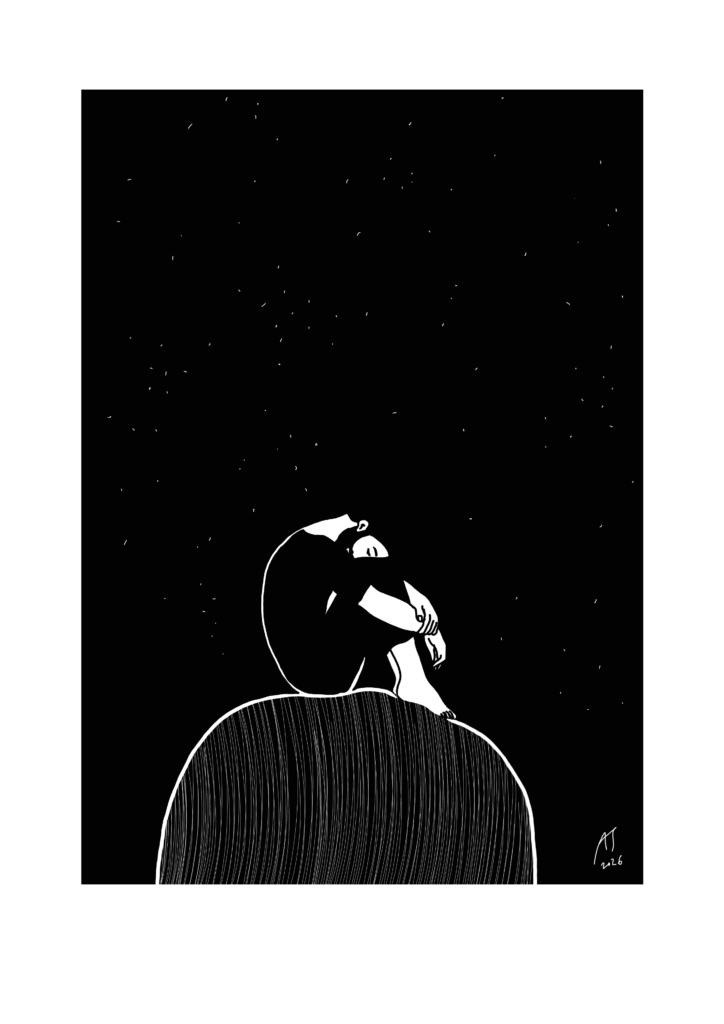
Illustration: Jesus in the wilderness. Arta Skuja, 2026.