


May I ask you to introduce yourself and tell us how your interest in women in the gospel texts came about.
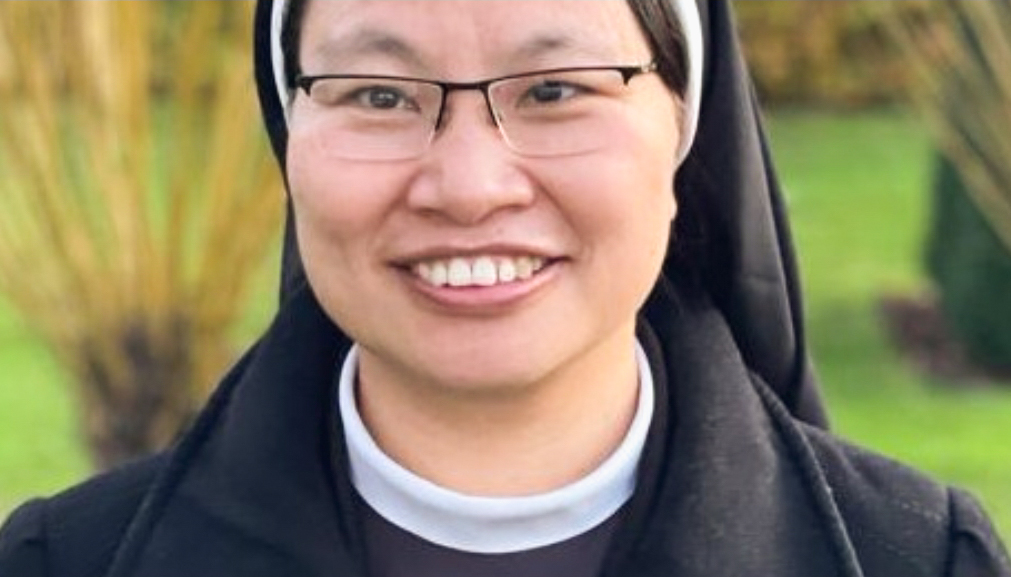
Sister Lizbeth: My name is Sister Lizbeth. I am a member of India’s first indigenous religious congregation – the Mother of Carmel community. Several years ago I came to Europe to complete a research master’s degree in Biblical studies, and I became increasingly interested in the female figures in the Bible. My birthday is on March 8, International Women’s Day, and perhaps it is a coincidence, or perhaps not, that I feel an inner calling to do something precisely for the good of women. At first I thought I would work with the synoptic gospels, because there are more female figures there, but one day on the street I met a professor who asked me, why not something from the texts of John or Paul? I said – that is a good idea, let me think about it. My superiors agreed, giving me a free choice of topic, because there are no other sisters in the community who devote themselves to biblical studies. Back then, in my master’s studies, I worked on Martha’s confession of faith in John 11.
In my further research, however, I no longer worked on the confession of faith, but on the figure of Martha herself. What I discovered about Martha’s confession of faith in the Gospel of John and Peter’s confession of faith in the synoptic gospels is what most scholars also recognize, namely, that in the Gospel of John, Peter’s confession of faith is replaced by Martha’s confession of faith.
Can we continue about your life story and your belonging to the first indigenous religious community in India?
Returning to my story, I belong to a religious congregation founded in 1886 in the south of the country, in Kerala, by an Indian priest, and now we have about 6,500 sisters. It has a Carmelite charism, and we live a semi-contemplative life – devoting half of our time to prayer, meditation and similar practices, but the other part of the time we are active in society, and our main mission is the inclusion and care of women and children. We run schools, we have hospitals and social centers.
The sisters run schools attended by both girls and boys, but we pay special attention precisely to the girls. We also run HIV centers for women and children affected by this disease. Before this, I was a teacher. I studied the natural sciences and at a boarding school taught about 30 high-school girls. Then I was sent to obtain a more serious religious education, so that I could support these students on their spiritual path as well. I obtained a bachelor’s degree in theology, then a master’s degree, and now also a doctoral degree.
What is the religious landscape like in your native northeastern part of India?
Sr. Lizbeth: In Nagaland, Meghalaya and Mizoram, Christianity is dominant; most widespread is Protestantism, because those were the first missionaries to arrive in the northeast. Among ourselves, Protestants and Catholics have a very good dialogue and fellowship, especially when we have some significant event, a feast; then we all come together and help one another.
What was your arrival in Europe like — was it easy to continue your religious calling in a secular society?
Sr. Lizbeth: On arriving, I at first experienced culture shock, and I saw many things I had not yet encountered in my own culture. The good thing is that I adapt easily, so it was not so hard for me. I am here, to a large extent, because of my professors, who support me a great deal. As a result, the studies were also not particularly difficult, and I have learned much for life. People here, even though they do not go to church, are very polite, and wherever we go, they always seem ready to help. There is individualism too, of course, but people are very open to what is different.
Coming from the northeastern part of the country, I have to say that we are quite different from others in India – our appearance, culture and food – other Indians do not consider us to be real Indians. Such incidents and discrimination as there are at home do not exist here. Perhaps because in Europe we all belong to so many nationalities.
What are the reasons for discrimination in India?
Sr. Lizbeth: It is because we really do look very different. And people ask – are you from China, Japan, the Philippines, Korea? Of course, because of our physical appearance, we are different. Personally, I have not experienced being treated as a foreigner, but in general it is a regular experience for my fellow countrymen – that we, in our own land, are treated as aliens.
What are your observations about the place of women in society and in the church in Europe?
Sr. Lizbeth: As a general observation, it seems to me that women are more respected and have greater opportunities to work in the church or, in principle, in any position. I think there are things that still need to be improved, but, compared with India and other parts of the world, women have it quite good here.
Each culture has its own specifics. In my culture, women do not have the right to inherit. But, compared with other parts of India, women are treated better, because we can freely leave the home and be in the company of men. We can sit next to any person on the bus. Being out of the home after 6 p.m., or even at night, is also nothing terrible for women. Elsewhere in India I have seen that women are separated from men – they sit on opposite sides of the bus or the church. In other parts of India I have personally experienced men’s harassment, improper touching, but in my province such things are very rare. The only problem I see is that women do not have the right to inherit family property, and all property goes to the family’s sons, not the daughters. Since it is a cultural matter, change will take a long time.
The title of your doctoral work is “The Difference Between Women and Men in the Gospel of John.” What kind of differences are emphasized, found? Are they differences in the way Jesus addresses women, from the perspective of the gospel’s author?
Sr. Lizbeth: My main research question and focus is on what the evangelist says directly, and concludes indirectly, about the difference between men and women, as well as how Jesus’ attitude toward men and women differs when they come to him for healing or for some other purpose.
There is much research on the text of the Gospel of John indicating that women in this gospel are far more noticeable, in contrast to the synoptic texts. The women of the Gospel of John are more prominent and are given equal opportunities, together with men, to participate actively and to shape the life of the community. Mary Magdalene is a witness of Jesus’ resurrection; in other gospel texts we see that Peter is the one who first sees the risen Jesus. In the Gospel of John, Martha gives a confession of faith, just as Peter does in the synoptic texts.
Going deeper, I noticed that there is a research gap in trying to show what, and what kind of, difference there is between women and men in the Gospel of John. Of course, there are studies showing that in the Gospel of John women are paired with men – as I already mentioned – Martha and Peter, or Mary Magdalene and Peter, or other disciples. There are also contrasting pairings, for example, Nicodemus and then the Samaritan woman. And we see that the Samaritan woman is more open and more capable of perceiving and communicating with Jesus.
But what about the differences between women and men in the Gospel of John? It is precisely this aspect that has been little studied in the Gospel of John, so the focus of my research is the question of whether there are texts in the Gospel of John in which the women described differ from the men; whether there are any gender-related terms that draw attention to the differences between women and men? I researched and discovered that in the Gospel of John there are three places where the difference between women and men is very noticeable. One of them is Jn 4:27. There we read that the disciples have returned and are shocked to see Jesus speaking with a woman. They undoubtedly had questions, but they did not openly ask them. The evangelist does not clearly state why the disciples were astonished to see Jesus speaking with a woman. I tried to analyze this in the context of chapter 4 of the Gospel of John. At the beginning of the narrative the woman is presented as someone who comes to draw water from a well, and that is a typical woman’s task. At first she is portrayed as a woman doing something usual for a woman; then she, as a Samaritan, is contrasted with Jesus – a Jewish man. Further on, the conversation between them divides into two parts. The first part begins with “give me to drink” – Jesus asks a woman. Give me something to drink: this request and duty connects the woman with her typical role – to give a drink and to draw water. Then, in the second part of the dialogue, Jesus tells her to go and call her husband. In a patriarchal society it is characteristic to connect a woman with a man. Later the Samaritan woman’s identity is no longer emphasized, and she is addressed simply as a woman.
In this narrative there are thirteen uses of the word “woman.” We can marvel at this – the evangelist could simply have said: Jesus said to the woman; she said to Jesus, using the third person, but the author uses the address “woman” 13 times. In 4:21 Jesus addresses her with the word: (γύναι (gynai)) “Woman!” and in 4:27 the climax is reached, when the disciples encounter Jesus in conversation with the woman. The woman here is emphasized as a conversation partner. Then, beginning with 4:28, a change occurs and the emphasis shifts – from the woman to the disciple. The woman leaves the drawn water and goes to the village to call people to come and see Jesus. Her words lead people to Jesus. This shows her discipleship as a woman. We see two changes – at first the emphasis shifts from ethnic identity (7-9) to the woman’s identity (11); and the second change, where the emphasis shifts from the woman to the woman as disciple. Here her calling parallels the calling of the first disciple in John 1:35-51. First a person comes to faith in Jesus and gains personal experience, and those who have such personal experience also lead other people to Jesus.
The second aspect I examine is the vocative gynai – woman! In the Gospel of John this form of address is used in conversation with three women. Jesus addresses his mother, the Samaritan woman and Mary Magdalene. Jesus addresses his mother as gynai twice: 2:4 and 19:26. Many studies are an attempt to solve the riddle – why does Jesus address his mother as woman rather than calling her his mother? Scholarly discussions often rest on a single question, namely, whether this form of address is polite or disrespectful. About the use of gynai in the Gospel of John there is not a single extensive study.
I discovered that whenever Jesus addresses a woman using this form of address, a contrast always forms in the narrative between women and men. For example, in chapter 2 of the Gospel of John we see that Jesus’ mother is a contrast to the steward who oversees the wedding. As steward, this person should have known when the wine ran out, but here we read that it is Jesus’ mother who pays special attention to what is happening around her, and she informs Jesus and asks him to do something in this crisis situation. Only when the water has already been turned into wine does the steward come to taste the wine. There is a difference between Jesus’ mother’s attentiveness and the steward, who is not particularly aware of what is happening around him. It is a difference, a contrast between men and women. Jesus’ mother can also be contrasted with the disciples. Jesus and his disciples were invited to the wedding together with his mother. But these disciples were present at the very beginning, and make their presence known again only at the end of the narrative, and begin to believe because of the sign. Jesus’ mother, in turn, is present from the beginning of the narrative to the end. If the disciples are always together with Jesus, then it should have been precisely they who came to Jesus and told him what he should do, and they should have believed in his ability to perform any sign. It is Jesus’ mother who takes the initiative to ask Jesus to perform a miracle, so that His glory might be revealed and people might begin to believe.
In Jn 4:21 the Samaritan woman is also addressed with the word gynai. Here we see a contrast between the disciples and the Samaritan woman. This woman is very open, and she is shown as an equal partner in dialogue in her conversation with Jesus. She does not get stuck in her thoughts; she asks direct questions, and when Jesus tells her to bring her husband, she does not carry out the demand to bring her spouse. When she has doubts about the living water Jesus offers, she wonders how he can get water without a bucket; the woman asks critical questions and continues to reflect. She is very free in her conversation. Jesus looks at her as an equal conversation partner. But the disciples, as we also see in the narrative, do not have sufficient openness to converse with Jesus. They see Jesus speaking with a woman and are shocked, yet none of them dared to ask Jesus questions; instead they talked among themselves and asked why he was doing this, but they could not openly and directly ask Jesus himself. Later, when the disciples invite Jesus to eat and say: eat, rabbi! He answers that he already has food. The disciples again talked among themselves and wondered who had brought him food.
It seems that the distance between them is greater than between Jesus and the Samaritan woman?
Sr. Lizbeth: Yes, and there is a great contrast – the woman is freer and more open toward and with Jesus, and asks critical questions, but with the disciples a kind of distance is observable, and they do not have the courage to openly ask Jesus questions.
The freedom and courage that Jesus’ mother has in the story at Cana, does the Samaritan woman have it too?
Sr. Lizbeth: I call it women’s agency (women’s agency) — the ability to speak, to be free, open and to be themselves, doing and being who they are, and, yes, the women of the Gospel of John show their agency in interacting with Jesus, being real and not pretending to be someone else.
Can it be said that these are the same principles observable in the story of Martha and Mary?
Sr. Lizbeth: Yes, and the same is true in chapter 20 of the Gospel of John with Mary Magdalene. Mary Magdalene comes to the tomb and, although she does not see Jesus’ body, she stands there and asks: where have you laid him? The disciples also came to the tomb, but they see that the tomb is empty, and they go back. They do not stay there and take no initiative to find out where Jesus’ body is. Mary stays; she weeps. She sees an angel, and the angel also calls her in the vocative, woman!, and then, when she meets the risen Jesus, he does the same. So, yes, here too we can perceive that same contrast between men and women.
You mentioned that there are discussions about the intonation of gynai, that it can also be a disrespectful way of approaching someone; what, then, are your conclusions?
Sr. Lizbeth: I would say that it is not a disrespectful way in which Jesus approaches a woman and uses the word gynai; rather, it has a deep theological meaning. When he approaches her, the woman is addressed, her attention is drawn precisely as a woman, for example, as when I would call you – madam, or use your personal name. We can imagine that this address takes place in a situation where there are other people around; for example, in the Gospel of John, Jesus’ mother is not alone when she is addressed, and the mother’s attention is immediately drawn to Jesus. The emphasis is placed on a particular identity, and the woman is singled out from the crowd. And her identity as a particular woman is highlighted, and the attention of the person addressed is directed toward Jesus.
Whenever Jesus uses the address gynai, it is a preparation for Jesus’ self-revelation. Then the woman’s attention is connected, from an ordinary, concrete life situation, with a divine revelation. In chapter 2 of the Gospel of John, the material cares – water and wine – are connected with Jesus’ hour. In Jn 4:21 the woman’s attention to water is directed toward worship in Spirit and in truth. In Jn 20:15, the attention of Mary Magdalene, who is searching for a dead body, is drawn to the risen Jesus standing before her. There is always a shift of focus from something concrete in physical life to something revealing in a spiritual sense.
A much deeper meaning is revealed. The evangelist says nothing specific, but the more we reflect and study and go deeper, the more theological meaning we can perceive in the gospel. Another thing is that the women addressed with the calling gynai have a significant place in Jesus’ hour; in the Gospel of John the hour refers to Jesus’ suffering, death and resurrection. These women have a central role in it.
If it were a different culture and time, would Jesus have called these women by name?
Sr. Lizbeth: We know that Jesus calls Mary Magdalene “woman,” and the first time Jesus calls her with the word gynai, she does not recognize Jesus, so she thought she had met the gardener, but the second time, when Jesus calls her Mary, she answers him, “rabbuni.” There is a question I ask myself – when a person is called by their personal name, is there some deeper revelation given to this person? Or, for the other women who are addressed with the vocative gynai, is it the same?
The inability to recognize Jesus, situations of this kind are not characteristic only of Mary Magdalene, but also of other disciples, for example, in chapter 21 they could not recognize Jesus. It is possible that Jesus’ appearance had changed after the resurrection. Another explanation is that Mary was completely engaged in searching for the dead body and did not expect to find anything else, or that tears blurred her eyes and she was therefore unable to recognize Jesus.
What I tried to say in my dissertation is that the recipient of the revelation who is addressed, provided this person is open enough to receive it, can receive Jesus’ self-revelation fully, yet each revelation happens gradually. Jesus’ self-revelation is not revealed to the person addressed in a single go, but happens sequentially, step by step. In my view, the more open we are, the more something is revealed. The Samaritan woman first recognizes Jesus as an ordinary Jewish man, then she shows a little more respect and calls him kyrie – lord. After a while, when Jesus tells her about her past, the Samaritan woman suddenly says: you are a prophet! Then, when Jesus has spoken about worship in spirit, she has begun to recognize the outlines of the promised messiah, and here we see this gradual revelation and recognition: from an ordinary Jew to a prophet and to the Messiah. In Mary Magdalene’s case, she recognized Jesus as an ordinary man, the gardener, then her teacher, and then as the risen Lord.
In the Gospel of John, are similar self-revelations of Jesus given to men as well?
Sr. Lizbeth: With them it is very different. In the text nothing is explicitly said about such revelations given to men. In chapter 2 of the Gospel of John there is a sentence about the sign that Jesus performed and which the disciples believed. In chapter 4 of John the women receive a gradual revelation of Jesus, but the male disciples, no – about a revelation given to them there is not a word.
Can we assume that the decisive thing is that women, in general, are more open?
Sr. Lizbeth: Yes, that is one of my discoveries – women’s agency. They are more open and use their agency to speak and interact, as well as to form a dialogue. And it is because of this openness, this responsiveness, that they receive Jesus’ revelation.
What about the synoptic texts; does something similar happen there?
Sr. Lizbeth: In the synoptic gospels there is Jesus’ revelation as savior in the story of the bleeding woman, who comes to him to be healed. She recognizes Jesus as her savior, because he has healed her of a serious illness, but there are no other kinds of revelation. In John this idea is more developed. In the synoptic texts the revelation is not as deep as that which, together with the women, we can witness in the Gospel of John.
Does this change anything in how the authorship of the Gospel of John is thought about? Why are women represented so differently in this text?
Sr. Lizbeth: In the synoptic gospels women do not speak. The evangelist who writes, for example, about the bleeding woman does not give the woman a place to speak in her own voice, but the author retells her words. The woman does not speak directly with Jesus, but in her thoughts she does, and the evangelist as it were reads her thoughts, yet she herself does not say it. For the author of the Gospel of John it is altogether different. There we see a relationship – one to one.
Can we say that the author of the Gospel of John is a feminist?
Sr. Lizbeth: (laughs) Yes, compared with the synoptics, the author of the Gospel of John regards women very positively. Most likely the Gospel of John was written later than the synoptic texts, and perhaps because the influence of women’s participation in the Christian community was so significant that in the text they are recognized and highlighted for their work, drawing an altogether different kind of attention to them.
Does this indirectly attest that women in the early Christian community were markedly active and significant, and that the author of the Gospel of John wants to underline this?
Sr. Lizbeth: Yes, I think it is so. The author of the Gospel of John gives us a more complete picture of the community of that time. Most of what we read comes from the male perspective, which is why some scholars tend to say that the author of the Gospel of John must be a woman, and sometimes I believe it (laughs); well, if not a woman, then a bit of a feminist!
What is the impact of these insights on current theology, on ecclesiology?
Sr. Lizbeth: I am fascinated by the female figures of the Gospel of John, because they are truly real. These women speak when and what they want, and follow their hearts. I think the most important lesson we can draw today from the women described in the Gospel of John is to let women be themselves. Give women equal rights and opportunities to participate actively in the life of society. Equality is not uniformity, where women would have to do the same as men, but when we speak of equality, then we must understand that the matter is about fostering and valuing diversity. The difference between men and women cannot exist for the sake of discriminating against women or men in society, but rather to give everyone equal opportunities in society and community. The women of the Gospel of John were given the right to practice their agency, to be themselves, and we see that many women have a central role in Jesus’ life, and if they give something good to Jesus, then it means they are doing something very good for the community. The Gospel of John is theologically very rich, and perhaps that is precisely because women have such great significance in it.
The women in the text of the Gospel of John are more liberated than the men, yet what we often see in the church and in society is that women, in order to function in the patriarchal system, are constantly adapting, although in truth this gospel is an example that calls all of us to a different level of authenticity.
Sr. Lizbeth: Exactly! In my research I speak about how Jesus liberates women. In a patriarchal culture, women are daughters, sisters, wives, mothers – their identity is formed in relation to a man. In chapter 4 of the Gospel of John, Jesus initially also points to the identification of the woman through a man, calling the Samaritan woman to summon her husband, but in the continuation of the narrative Jesus calls her “woman” – she is recognized as a woman in her own right. She is freed from the connection with a man and is respected. The further conversation and revelation take place with her as an independent woman.
In my research I also work with other passages of the Holy Scriptures, and one passage is 1 Tim. 2:12-13, in which the author forbids women to have authority over men. Women may neither teach nor otherwise be visible, and they must simply keep silent. The reason – simply because God created man before woman, and the woman is the disobedient one, the transgressor. The author of the letter to Timothy returns to the Genesis creation story, trying to explain the reason why women should not do this or that, because the first-created is the man. This position is problematic, because in Gen 2, the second creation narrative, the creation of the human is ambiguous. We see in 2:7 – a human is created who is sexually undifferentiated; it is simply a human. The sexual division of adam – man and woman happens after 2:18. The first thought of sexual differentiation is observable only when God says that it is not good for adam – the human to be alone, so let us make a partner, a helper. Then the woman is made from a rib, from the side of the human. The word “woman” (lə·’iš·šāh ) appears in Gen 2:22, but “man” (‘îš) in 2:23. Man and woman in the text are revealed side by side only in 2:23. The text does not clearly state how the sexual differentiation from adam took place, which is why modern scholars do not say that man was created before woman, and reading Genesis carefully, we cannot claim that first man is created and then woman.
What can we conclude from Timothy’s words?
Sr. Lizbeth: It is evident that Timothy is based on the text of Genesis chapter 2, but today it is not possible for us to tell the author of the letter to Timothy – You are mistaken! Yet according to the findings of modern research, he is mistaken. In the letter to Timothy we see a clear separation of men and women, and the only clearly discernible reason is that it is assumed that man was created before woman, which is why women should keep silent. In other places in the Gospel of John, indirect references to sexual difference are also observable, but no reason is indicated as to why woman is perceived differently from man.
In the first creation story, in the creation of the human, we observe the equality and likeness of the persons in the image of God, without chronological sequence. And in the second story, Genesis chapter 2, the first human is created without sexual differentiation; that happens later. Most scholars agree that this narrative is not an attempt to show that one is superior to the other, but rather emphasizes mutual likeness – adam comes from the earth. Isha comes from ish, namely, the woman from the side of the man, and that rather indicates mutual unity and interaction, and the fact that they are side by side with one another. It is not the case that God created men to rule over women; all of that happens later. There are primary differences, which are biological differences, that which makes a woman or a man, and secondary differences, which are differences based on cultural demands and social norms, but these can change. Most of the differences that stand out between women and men in the Gospel of John and in other biblical texts are secondary differences. Women are treated differently and are discriminated against on the basis of societal norms and cultural expectations. It must be noted, however, that in the Gospel of John women’s agency is great compared with other texts.
Is a positive feminist theology easier to construct based precisely on the text of the Gospel of John?
Sr. Lizbeth: One of the questions I have been asked in connection with my research is why I do not use a feminist perspective and method. To that I answer that I work with the text-critical method, because, in my view, it is a more convincing way to arrive, as a result, at a feminist position.
As a Bible exegete, I wanted to focus on the text; what the text says and what is not said in it. That was my main intention and focus – direct references and indirect conclusions about men and women.
You are soon going back to India; how could this liberating message be conveyed to the women you will minister to?
Sr. Lizbeth: If we want to see change, it is not enough for me to speak only with women. If I want to foster change in women’s lives, I have to speak both with women and with men. First of all, so that everyone understands how we are different, and how to respect one another. In my culture, earlier we saw only women carrying water, but when I am at home, I encourage all my nieces and nephews to go and do it together. Change happens slowly. I see how little boys and girls go together to the stream to bring water. The division of roles should not be fixed, but we cannot do everything quickly, only by going step by step.
I am happy that sometimes I have the opportunity to speak in church and to preach. In my area, Mass does not take place every Sunday. On a daily basis the congregation and the services are led by the local catechist. When I or other religious sisters are at home, or visiting somewhere on holidays, we are asked to address the congregation with a message, and we have the opportunity to speak both with men and with women. Alongside the gospel message, I tend to give practical illustrations as well, of how to grow in respect for women and how to address the theme of violence in the family. With small things and over time, we can bring about change.
Do men show respect to a woman preacher?
Sr. Lizbeth: In my culture there is great respect for religious sisters, so whatever they say is given great attention. I have, for example, a classmate from high-school days; he is married, and sometimes his wife calls me, and she says that her husband listens only to me and to his younger brother. So, if there is something difficult that she has to discuss with her husband, she calls me for help. That is an example of the respect I receive in my community.
In the Indian church, a consecrated woman perhaps has greater authority than is the case in Europe?
Sr. Lizbeth: Yes, that may be true, because we really are shown great respect, and our words have a great influence. I very much hope that part of my future ministry will be teaching and preaching. So far I have had opportunities to lead retreats for students, and also for men’s and women’s religious congregations, and that is a wonderful platform to positively influence various processes.
How does your research resonate in your personal life of faith?
Sr. Lizbeth: Many women spend about 80-90% of their time trying to please others, trying to meet the demands of society, culture or family members. But these women of the Gospel of John allow me to be myself and to live that way. If we as women live being truly who we are, authentic in our essence, then we can give so much. If I love myself as I am, then I can accept others, accept others’ limitations and weaknesses, because I know who I am. That is one of the most important things. It is very exhausting to live in accordance with the demands of society and culture, but when we try to live in accordance with what our heart says, then I think we live our life fully and can give our contribution more completely, without trying to show others what we are not. Be true to yourself! People think that when a woman is emancipated, she will be unable to respect others and will violate others’ rights, but that is not at all so. If I know who I am, then I am truly emancipated, I respect myself and others. And then no one has anything to fear.
…
Publications by the theologian Lizbeth Materou Ashe:
Ashe, M., Bieringer, R. (sup.), Ibita, M.M. (cosup.) (2024). The Difference Between Women and Men in the Gospel of John: A Literary-Critical Analysis in Light of John 4:27, the Vocative Gynai, and Women’s Agency in John 11:1–46. (dissertation still being prepared for publication)
Ashe, M. (2024). The Emphasis on Women as Women in the Use of the Vocative γύναι in John. Annali di Storia dell’Esegesi.
Ashe, M. (2023). Universal, Not Particular: A Study of μετὰ γυναικός in John 4,27. BIBLICA.
Ashe, M. (2023). THE MYTH OF DZÜLIAMOSÜROU: The Origin of Humankind in Poumai/Mao Naga Tradition and Its Implications. Vidyajyoti Journal of Theological Reflection, 87 (6), 424-439.
Ashe, M. (2020). Sara Parks. Gender in the Rhetoric of Jesus: Women in Q. Lanham/Boulder/New York/London: Lexington/Fortress, 2019. ISBN 978-1-9787-0198-4. Review by Ashe Materou, KU Leuven. Reviews of Biblical and Early Christian Studies (RBECS).
Interview, translation and transcription: Arta Skuja