
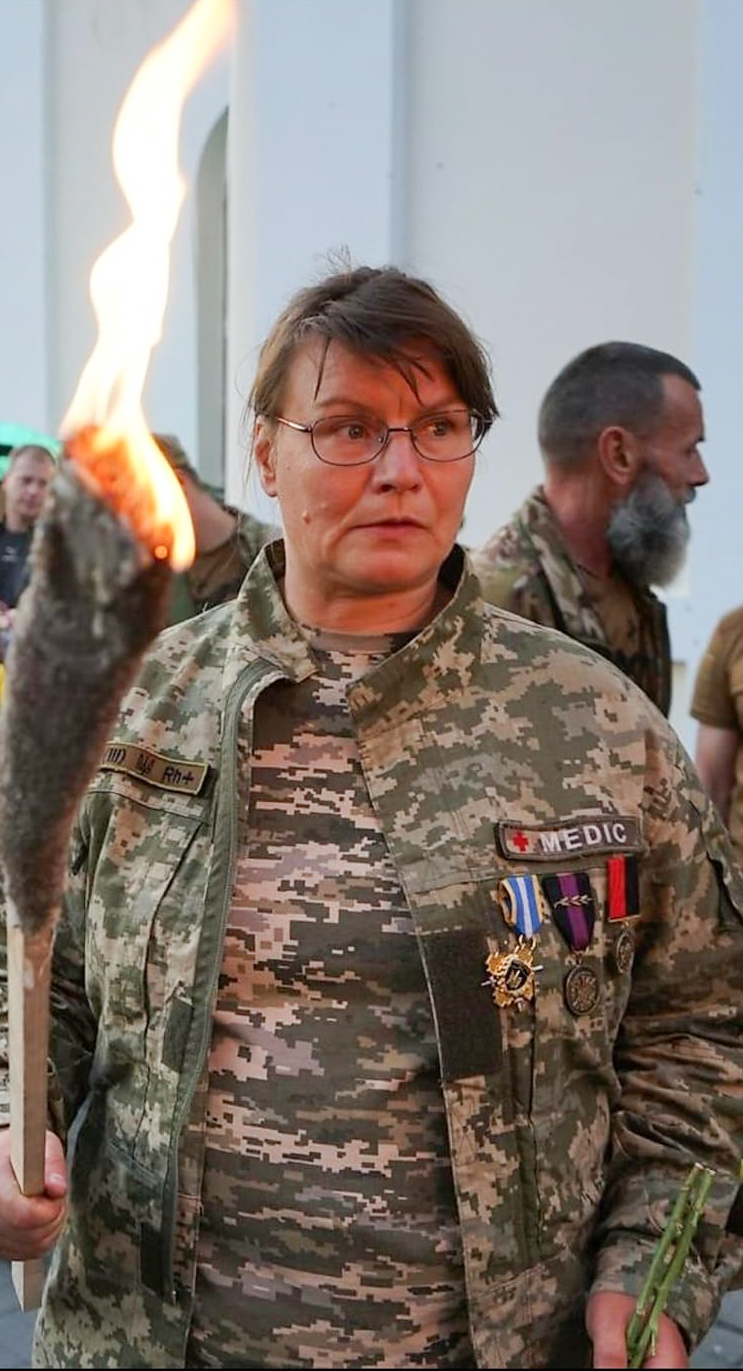
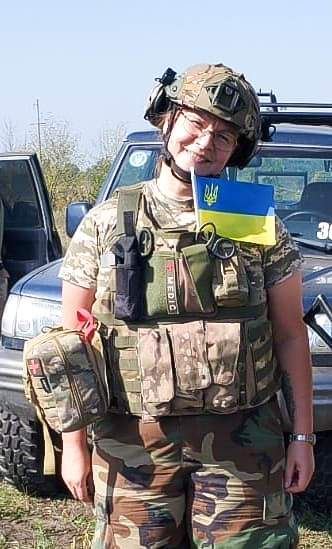
Sarmīte Cīrule is a woman rich in faith and experience, courageous and direct. Her life is bound up with medicine, theology and history. Since October 2022 she has served as a medic on the Ukrainian front. LLSTA invited Sarmīte to a conversation during the Advent season, when she did not yet know that, after only a short while, thanks to the high regard and the votes of the public, she would be named this year’s European of the Year in Latvia. In the conversation Sarmīte talks about experiencing God’s calling in her life, about how she ended up in Ukraine, and about the reflections that war stirs up.
Tell me, where have we reached you by phone?
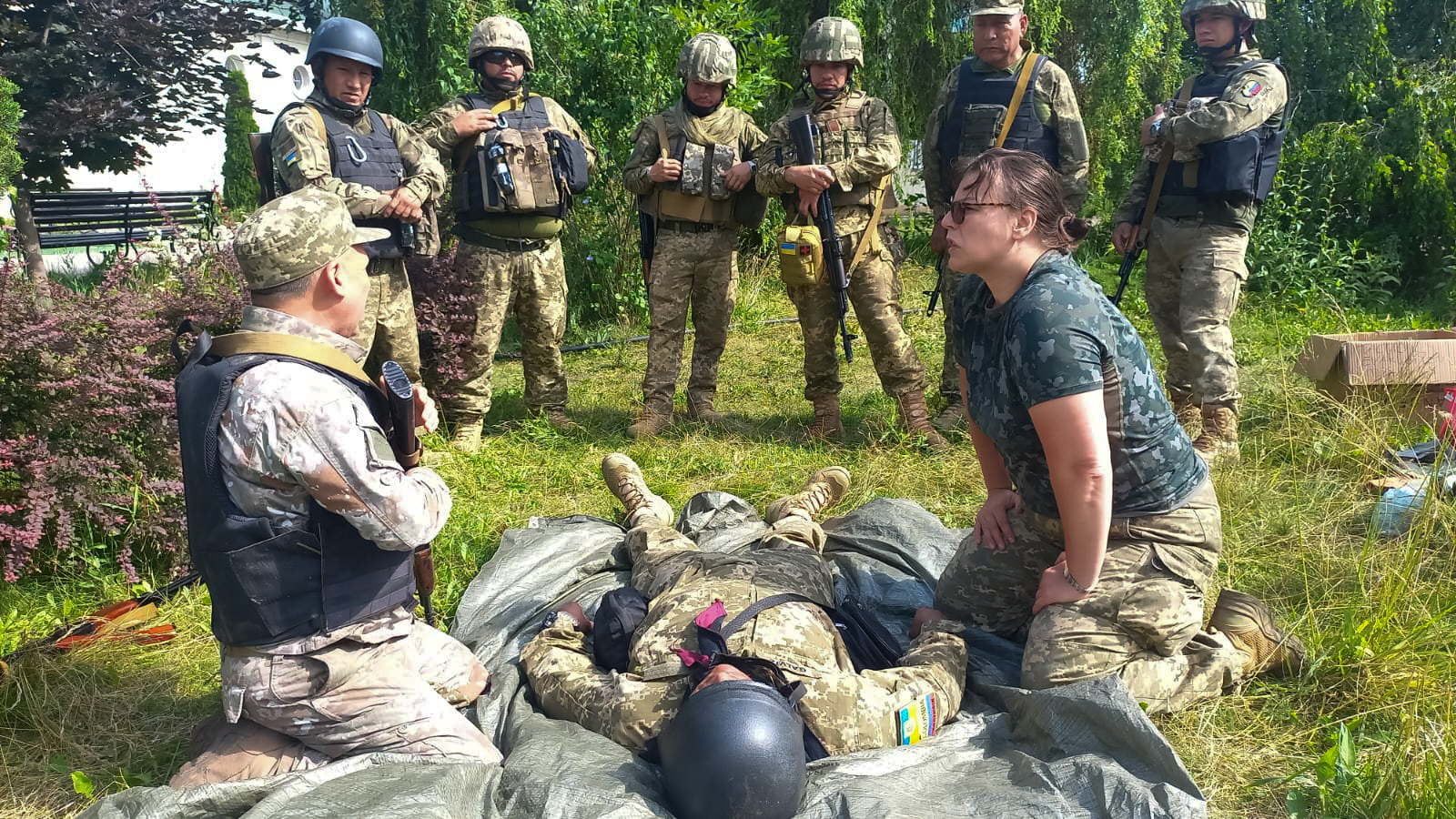
Sarmīte Cīrule: You’ve reached me at the front. Today is busy, as usual. Of course, there are days that are calmer. Right now I’m waiting for a young man who has a concussion. They just brought him in from the trenches. I’ll have to give him some medicine. We can talk freely for now, but once he arrives, there’ll be a little pause.
How long have you been at the front? You yourself also needed treatment for a while, didn’t you?
S. C. I came to Ukraine on 24 September 2022. I’ve been at the front itself since 16 October 2022.
I had several concussions and traumatic brain injuries. The first was on 30 December [2022], that one you can’t forget. The others were in a milder form, but I still had to get treatment anyway.
What is your daily life like? You can’t possibly be ready every day for everything you have to face, can you?
S. C. Every day is completely unpredictable, but within that unpredictability there is also its own order. If I’m out on the evacuation vehicles, then truly nothing can be predicted. First of all, whether you’ll even stay alive yourself. Even here at the base there are air strikes, but here that predictability is a little greater. I don’t know how the day will unfold, but there is a deliberate routine and order, so that the head at least works somehow. But the thing is, if a person is in their right place — not, let’s say, to put it crudely, that God has sent me, because I don’t know whether I can say that — but being in your right place, you can do all of it. It’s more problematic if a person is doing something for the sake of certain goals. For example, for financial goals. Maybe they want to prove something to themselves or to the whole world, or maybe it’s because of ambition. There are all sorts of guys and girls here, and all sorts of reasons why they’re at the front. For me it comes from pure conscience. I don’t have to prove anything to anyone. Rather, there’s distress over what Putin is doing, and then you have to try to help the Ukrainians — that’s a matter of conscience. And of course, the second thing is faith in the Holy Trinity. War is the place where you can best see what a person is, what they believe in. There are no impostors here.
Was it self-evident that you would go to the front? How did you end up where you are now?
S. C. My first decision was already back in 2014, when the war began. At that time I was working as a doctor on a ship. To work on land I would have had to retrain again, but that’s not something I do. Now my life is more bound up with theology and history, but medicine has always been in the background, and I don’t want to lose it.
It was natural, there were no questions, and those who know me didn’t ask whether I would go, but — when I would go. Already in 2014 I wanted to go as a medic, but back then we still weren’t allowed to. The law didn’t permit it. I tried to send humanitarian aid, but now, when there is a full-scale escalation, I am here. In the first months there was no clarity about whether the war would come to Latvia too. But since it continues in Ukraine, I had to arrange a way to get there. At first I still couldn’t, because at that time I was working in a hospital in Riga in the Covid ward, but that was good training for me.
I have worked in various countries around the world. One such piece of training was also working on a ship, where we had various scenarios that formed the foundation for what to do and how to survive in critical situations. Of course, being in a real war is different, but still, the foundation is there somewhere underneath. On the ship, 142 people were in my care.
What has the course of your life been, God’s calling and prompting? How has your life taken shape?
S. C. I come from a completely non-believing family. God was never spoken of. I am a child of Soviet times. When the years of the Awakening came and the churches were open, people went running and humanitarian aid was being brought in… I come from the countryside. I studied at the Aloja Auseklis Secondary School and there I saw those members of the Soviet Communist Party — how they ran around with their little red flags. When the Awakening began, all those old women and old men with their flags, only now with different ones — red-white-red flags and with a little Auseklis star stuck on — went running to church. To me it seemed like terrible hypocrisy. I was 14 or 15 years old and I grew up fast.
At the age of 11, the father of my younger sister died, and perhaps my whole life, from the very beginning, in order to survive, taught me to read people. As a small child I disliked hypocrisy and lying. And I thought, what church is this? I saw how they grabbed humanitarian aid in big sacks, and that same gossiping. And then they go to church and believe so terribly much in God! There was a woman who dealt in witchcraft and fortune-telling, who also told me about God, but I proudly said that I would never fall to my knees before God, that I would never pray to him. It seemed very humiliating to me. I didn’t believe in what isn’t there. I didn’t believe in fairy tales. I was a little grown-up with a very serious attitude toward life.
During the Awakening I was studying, perhaps already in the 7th grade or later, and I had a classmate. She was also a Pioneer, but she was somehow different. She didn’t mock the other children. The rest of us went wild and fought, taunted one another, but she never did that. She was composed and kind-hearted, completely different. One time she started telling me about God, about Jesus. I didn’t understand much, but something in my heart changed. And it changed precisely because of her. I thought, well then, there must be something to it! That evening I went home, stood in my room and said: “God, my friend Ramona says that you exist, but I don’t believe in you. If you exist, then show yourself in a way that I’ll understand that you exist!” The heavens didn’t open, there were no bolts of lightning through the air, no coarse man’s voice from the heavens saying: “I am God!” — but something happened in my heart and something changed. Although I am pragmatic, I was also a very sensitive child and I took everything very much to heart — I cried, I rejoiced, I empathised. Out in the countryside I even had a cemetery for insects.
My friend gave me little booklets and a children’s Bible. I remember that I washed my hands and placed those little books on the bed. I myself knelt on the floor, because I believed that this was something bright and special, that I wasn’t even worthy to sit down beside them and read. I truly believed, my heart was moved, but I said to God: “Listen, there’s terrible hypocrisy out there. I’m not going to church.” And I didn’t go. Later, after various — also tragic — events in life, I prayed and others prayed for me, and you could see completely clearly that it was God who had done everything in my life.
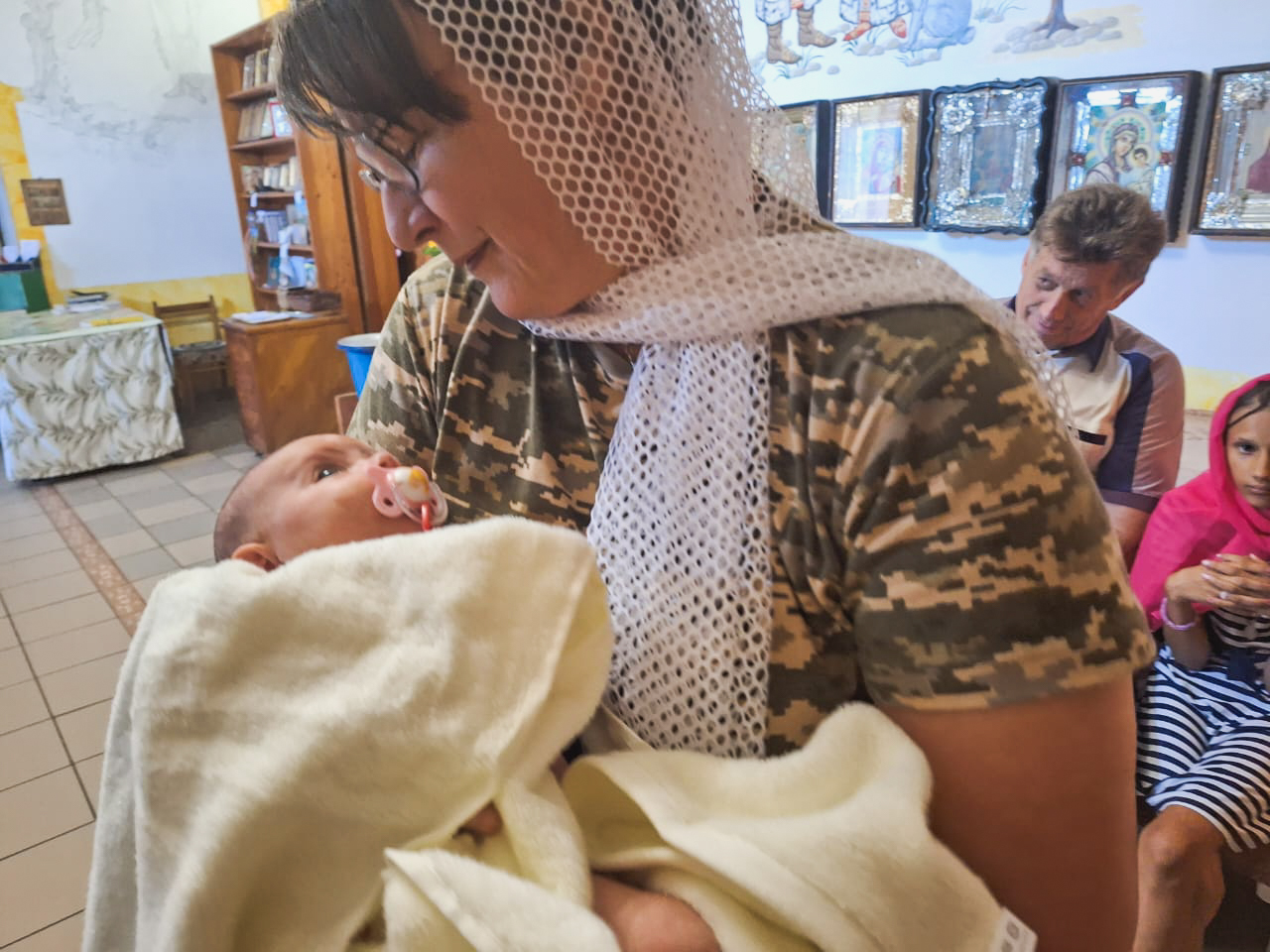
At the age of 16 I moved to Riga. I studied at evening school and worked at “Vīķi” as an orderly, and I wanted to study to become a nurse. I ended up in various congregations. One of the points I want to highlight is the congregation that raised me. It is the only congregation where I truly felt it was as Jesus says — when I was thirsty, you gave me to drink. It was the Riga International Congregation — missionaries and Latvians. There people saw that I didn’t have winter boots, that my shoes were worn through, and they simply said: “Let’s go to the market. I’ll buy you shoes.” In that congregation I truly came to know what God’s love is. I came to know what human love is too, and what it ought to be like. It was great growth.
I was also in the charismatic movement, and now too I count myself among charismatic people. I preached. I completed Youth With A Mission’s “School of Christ’s Disciples,” I was active there until 1998, and after that, until 2004, I was with the Sisters of Mother Teresa. Later I went to Ireland and lived there as well.
Your life story shows that you see Christianity as an activity, as a verb rather than a noun?
S. C. Of course, of course. And in truth, if you ask how things are in life now, then I would say it’s now like a closed circle. First I trained in medicine, but Christianity has gone along with everything.
There have been all sorts of struggles and questions for God, and it hasn’t always been beautiful and rosy. I speak frankly with God and I always say honestly how I feel. All kinds of words have been hurled in God’s direction. And if someone told me that this is disrespectful, I would say, well, excuse me, each of us has our own relationship and understanding. God is not the one who condemns, and he sees very well what we are like.
Then I went to study theology, because academic knowledge is necessary; later I studied history. Yes, and it seems that the circle is being filled in and has closed. Medicine, theology and history are the things I need, and the whole of it — everything that has shaped me in life — has prepared me so that I can now be here.
When you encounter wounded soldiers, often at a critical point in life, do the fundamental, existential questions about life and death visit you? Do you think about injustice, about enemies? What are the categories you think in when you come face to face with the fragility of life?
S. C. At a critical moment I don’t think about the existence of God. In that moment I think about how to keep a soldier alive, how to stop the bleeding, how to get him as quickly as possible to where he needs to be taken. The existential questions come when we’re back at the base, and when the soldiers are angry. There are all sorts of soldiers here, and the Ukrainians especially have a sense of injustice and anger. I too sometimes feel anger, but not the kind that destroys — rather the kind that drives you forward. For me, those existential questions were already encountered over the course of my life, working in medicine.
The biggest questions came while working in the Covid ward. For almost two years I worked actively and acutely, beyond my own strength. Sometimes there was despair and the question — how can it be that there are four people in a ward, all of similar age, but two of them die. Either all four have a chance of surviving, or none of them has a chance of surviving. At the very beginning, people were simply being mown down… You could say it’s fate, God’s will, but I don’t know.
Do you see God’s presence in everything?
S. C. No! (laughs) I often see Satan’s presence! On 23 December last year [in 2022] we were transporting a severely wounded soldier, and they were bombing heavily. I shout to the little driver: “Drive faster, drive faster!” He says: “I’m already driving!” We’re flying along, no joke. I can’t even remember whether I prayed to God. I only thought, let us stay alive. Afterwards I prayed and gave thanks. It has happened that they shoot at the evacuation vehicles and I’m standing in a shed, in the doorway, and I say: “God, I’m ready. I’m ready.” But I think he [God] wouldn’t be happy if I went there, because then I’d bring order to the place (laughs). It’s more advantageous for him that I’m here.
What is it like to live close to death? How has your relationship with death changed?
S. C. The saddest thing about death is that I will never meet that person again. They say there are no irreplaceable people, but that’s the worst kind of nonsense. You can’t replace a person. Our commander was wounded, and how he was missed! There are specific people who can do a specific thing, and now they are missed, because that person is no longer here. For me as a Christian, sometimes it’s like this — enough of all these horrors of the earth! I have been through various tragic circumstances and have had these existential questions myself, and the cry: “I can’t do this anymore, I want to come home to you, God!” I have wept my soul out. But afterwards it’s like this — Sarmīte, but you can do this and that, and that… If I were killed, I would be angry and would ask God, why did you do this, why did you allow me to be killed? There are many things that each of us can do and then can no longer do. During Covid, the attitude toward death was sometimes — well, so what, an old person died. But wait, that old person could have lived. Yes, they have illnesses and problems, but with their medicines they could still have lived. That old person is someone’s grandmother, that old person is someone’s mum or dad, or grandad. The person could have contributed.
For me, for example, my father has died and I have no one to turn to. I would certainly want to ask my father something, and he would surely have taught me something, but he’s gone. And that’s what death is — that this person is no longer here. Perhaps some works have been left behind; for example, my dad and mum loved each other, and that’s why I exist. I am their testament. But I miss the living person whom I can ask. The only thing I can do is pray to God. After all, I don’t know where my father is — in heaven or wherever. I can pray to God for my father and say that I hope everything is all right with him, that he is with God. And say: “God, then you be a father to me!” On the question of death — yesterday, for example, I gave great thanks and praise, and I say to God: “Who else am I to turn to, God, if not to you, in the midst of all this evil?”
God has given us all kinds of talents. God surely knows what our character is like, and that is exactly why we can do something specific. We are created not to live for some specific purpose, but — I want to believe that I am in this world because, being specifically the way I am, I can do something and cannot do something else.
While I was in the hospital, my battalion’s head medic said, we’re glad you’re back, because only you can manage the Colombians (laughs). And that helps. Not to become conceited and proud: “See, they can’t manage without me!” But the awareness of why I have to be here. God has entrusted this to me.
When the soldiers head off to the trenches, we try to pray together. Quietly I also pray for the Ukrainians. I have help and support groups that are with me, also Ukrainians who are very much in Christ. I know they won’t say that they’ll pray for me but then not pray at all, because I know they do pray. In my support group there are Christians and non-Christians, and I don’t have to explain — they simply understand that it’s hard, and they pray. Afterwards I write to tell them what happened. It’s an encouragement to them as well, a kind of reference point.
In the conditions of war, do you see that people touch on the question of God more? Or perhaps you see anger and the questions about where this God even is?
S. C. Those who have been active in their faith — not the kind who were merely baptised at birth, but those who live out their faith — they are sorrowful. With the Colombians, when one of their friends is killed, then we cry together, worship God together and embrace one another. You don’t need much. There is greater anger among the Ukrainians, because it is their land. Not for a single moment have I felt this — why does God allow it? I know that guys have told me, forgive me, I don’t believe in God, I never have believed, and I’m an atheist. I say, if you’re an atheist, then you have to believe in God anyway (laughs).
What does it mean to you to be noticed, to be recognised?
S. C. The most interesting thing is that I usually know nothing about such things, unless someone happens to tell me by accident. For example, now about the European of the Year in Latvia, that I’ve been nominated. I knew nothing about it. An acquaintance I haven’t spoken to in years congratulates me. She’s already congratulating me on the award, and I say, what award? She had misunderstood and thought the award had already been given. Last year I was “Medic of the Year,” which was a big surprise to me, but thank you for the recognition.
I just quietly came here and serve, do my little job, help. On social media I try not to read the comments, but sometimes I do read them. There, for example, people say I came here to earn money. I don’t manage to earn money — in fact I’m in the red, if you tally up the hours and the work I do. Doing this in Latvia, I would earn more. The expenses here are very high, and I’m one of those people who also invests in my own platoon. If I had no money at all, then I couldn’t help either myself or the platoon.
When people ask me, Sarmīte, well, what should we send you? Then I say that I don’t need anything. I’d rather send something to you back home. Of course, there are things you can’t buy in Ukraine, and there’s also the question of how often I even get to a shop here. There have been periods when I couldn’t leave this territory for almost half a year. I have the base and the evacuation vehicles. I go off to transport some wounded man, and there’s no time for any shop there. And the shops that do exist there only have certain things anyway.
I humbly do my work, and what is there to boast about? It is pleasant, of course, that there’s recognition, because the sacrifice is being made after all. To serve is your choice, and to serve also means to work beyond your own strength and abilities. I bear such a sacrifice.
When I was in the hospital, I talked with a doctor and we became friends, and we kept up our correspondence. One of my paramedics was killed; he fell in battle. I told the commander, that’s it, I’m going to the trenches, but he absolutely won’t allow it and says that my task is here, that my war is here. You are the platoon’s head combat medic, and your duty is here. When I was wounded, 140 soldiers were left without a medic. That is very serious. Yes, and that doctor I talked with — I asked her, but how is my life more important than the life of a Ukrainian lad who has been killed? She told me simply and calmly — you are here, your life must be preserved, so that afterwards you can tell the world about the horrors that are happening here. That is your value — you come, you see, you work, you serve, you help us, and afterwards you can tell others about those horrors.
Through that I have become much more accommodating toward journalists. Recognition in Latvia is growing. And here too there are other support groups, and then it happens that they want to send something specifically addressed to me. They send it because they trust that what they donated — be it a little or a lot — will be distributed honestly, and that’s how it is. It won’t be sold off or squandered. So, on the one hand, thank you for valuing and recognising me, because in that way I can help Ukraine more. It’s not because they see me there, but I am “for” it if it can help Ukraine. I am a clay vessel that can be used.
You mentioned that you can be a witness who will later be able to tell others about the horrors of war — do you think about the end of the war, about what you’ll be able to tell people? And what should we be thinking about now, and what should we hear?
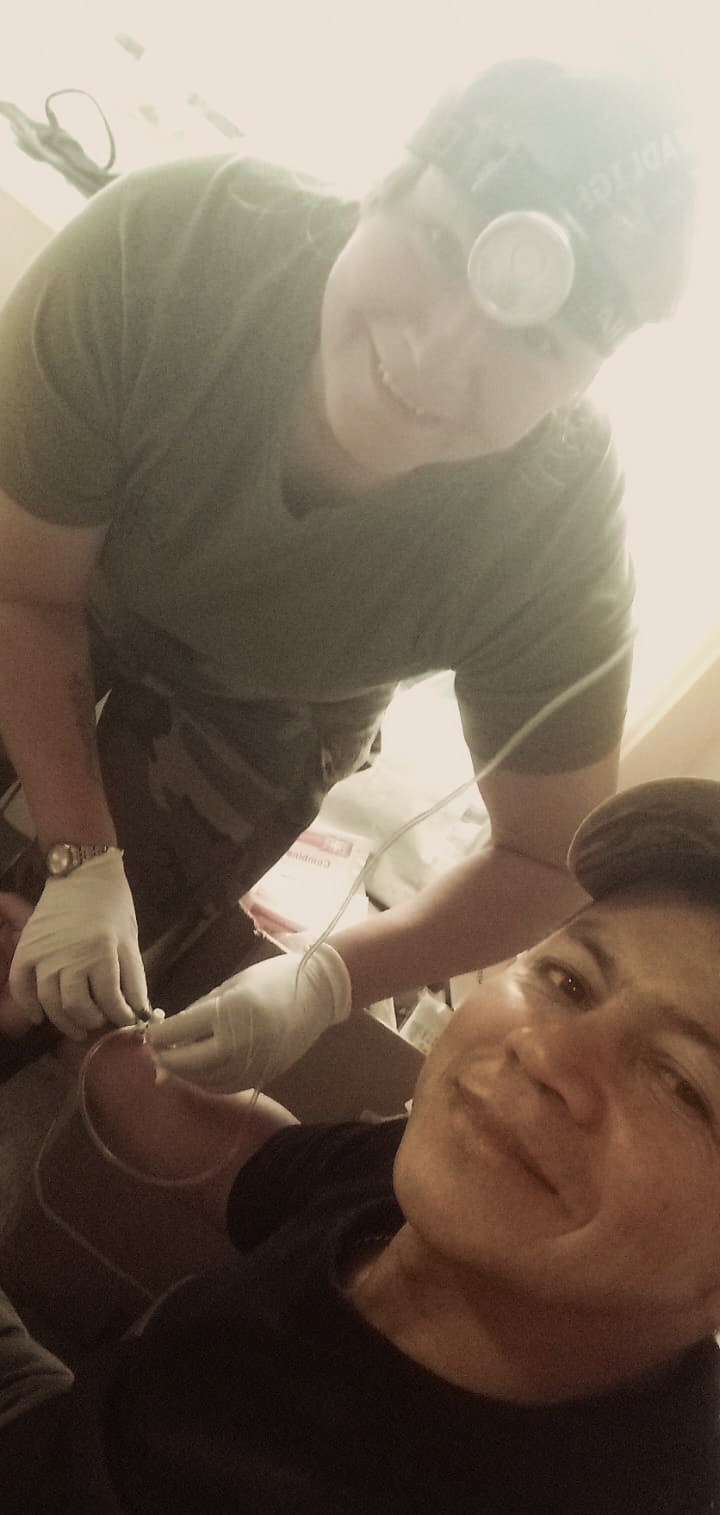
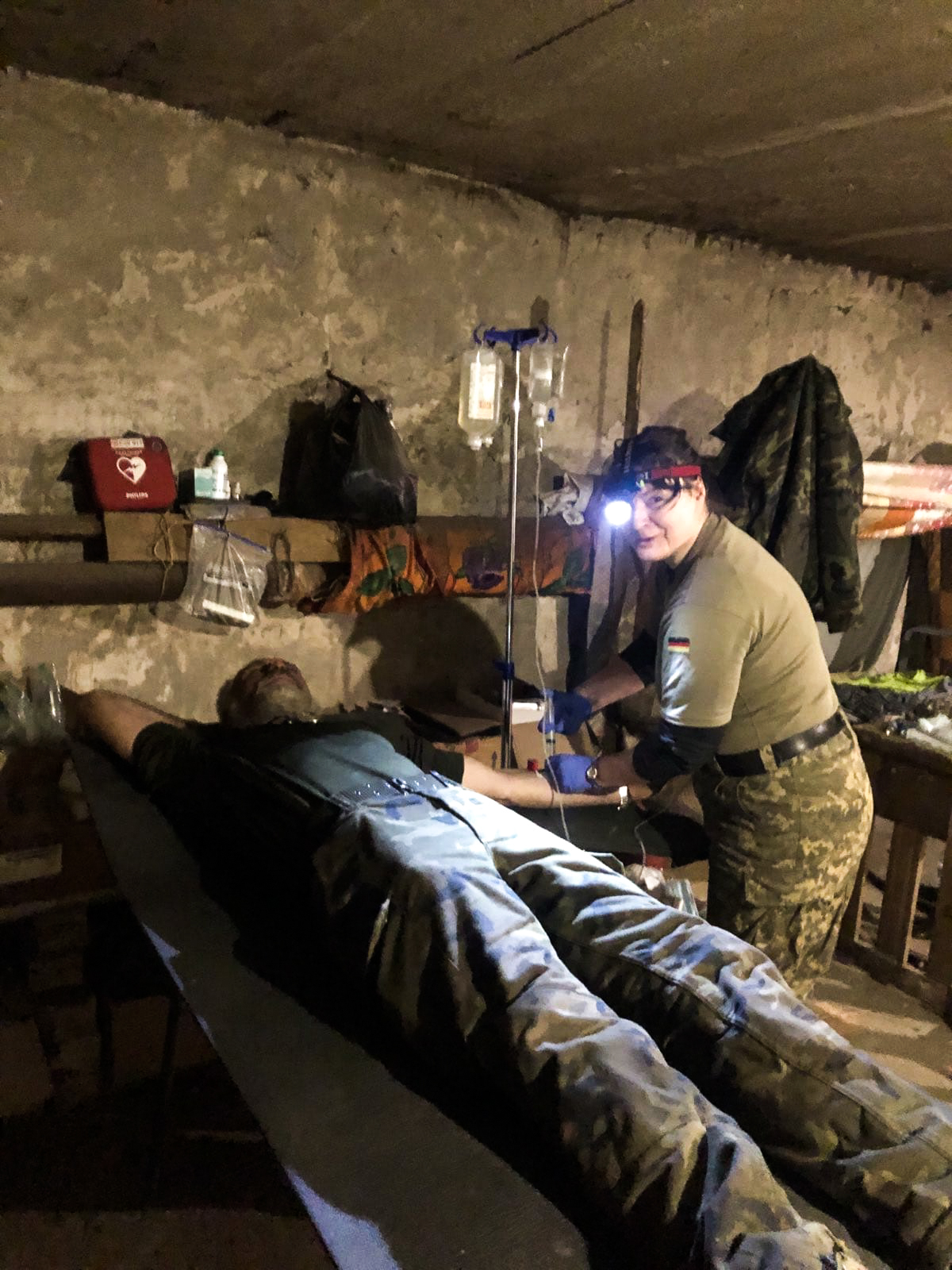
S. C. There must be a war tribunal. Criminals — whether they have been Ukrainians who collaborated with the Russian Federation, or the Russian Federation as a state. The criminals must receive their punishment, because the war has to end. And it would be good if it had already ended yesterday. The sacrifice Ukraine is making is great. For example, today I set up an IV line for a young man, and I give him the paper that’s needed if he has to get to a hospital or, later, when he returns to civilian life. He says, but I don’t need that form, because I’m going to be killed. He is a very good soldier and is aware of the danger, aware of the trenches, the fighting and the logistics, of how quickly it’s possible to help and to act. So, if you hear about Bakhmut and Avdiivka, then there it truly is hell. He says that drones — kamikaze drones — flew at his position alone 20 times, and then there was all the rest of the artillery on top of that.
I’d like to speak and knock on the doors of important people in Europe about supplying weapons, because Ukraine has to win, because otherwise the other dark powers will be emboldened to attack — Iran, North Korea, China and whoever else rises up there. Russia won’t stop with Ukraine; we know well, as the heirs of the USSR, what Russia’s politics are.
If there are tribunals, I will very gladly speak about war crimes. Everything seems horrific, utter madness — it’s the 21st century, after all, humanity has developed so far, and there have been so many wars, but we haven’t gotten anywhere. One part likes to attack, and to the others it’s all the same, “not my pig, not my field” — it isn’t happening to me, it’s somewhere far away in Ukraine. I’m comfortable in my home — I have a car, an apartment, a house and holidays. Because of the war there is an enormous rise in prices all over the world, and cheap living is over. The ordinary person suffers from it. So to say that it doesn’t affect me is a bitter delusion, because it affects us all. That, too, is a matter of conscience.
When the war ends, we will also have to start thinking about forgiveness and reconciliation, we will have to find anew a way to build bridges to one another, we will have to think about how to be neighbours — what do you think about that as a theologian?
S. C. I am not a diplomat or a diplomatic person. When I see injustice, I am not the kind of person who smooths things over, because I am not a person of compromise. In my view, compromise doesn’t work, because one side or both are left as the losers — it’s like walking on thin ice. As for forgiveness — there has to be a very great love of God there, because in human terms it can’t be done. For me it can be done, because my family isn’t here, my home isn’t here, my homeland isn’t here. For me it’s different; I can say that I forgive. I can say: “God, I forgive them.” For me it’s much easier, but even then, it is very hard. The heart aches and it feels as if it will leap out through the chest — sometimes there are such emotions. But you can’t sink into it.
What do you do so as not to sink into it?
S. C. Then you have to go home. When you can’t bear it emotionally, then you have to go home. Everyone is in pain. A wonderful soldier was just killed. I go into the office where the commanders are, and I see the grief that’s in them, but they won’t show that they’re in pain, because they are commanders. We soldiers can all sit and cry, and the men cry too. Their hearts weep from the pain. In the post-Soviet mindset it’s still hard to show emotions, but the Colombians, the Argentinians, the Spaniards — they have been taught to show emotion and they cry freely. It’s easier for them; there’s less bitterness. But I also have soldiers who say that they practically have no emotions left anymore — they have no fear, sometimes with a sense of doom. A person who has the Holy Trinity is different.
How do you personally experience the Holy Trinity during this time?
S. C. I experience the power of the Holy Spirit. In the holy blood of Jesus Christ I am protected, washed clean. God my Father and Lord is my protector. God is my rock. That is the Holy Trinity. If you experience that power, then life bubbles up there. Nothing can be separated within the Holy Trinity, and it is nothing dry or unreachable or superficial.
Do you experience that power every day, and does it let you keep moving forward?
S. C. No, the energy isn’t like that every day. With God I have a normal relationship — I am alive and there is life in me. Strength and life, yes, but I also have weariness; but then I sleep a bit at night, pray, and admit — that’s it, I can’t do any more, and then strength comes from somewhere. Often it’s the case that there’s no wisdom about what to do, and then I say: “Please help me, God, I need wisdom!” And suddenly, like a little drawer, a memory processor, something in the brain opens up and wisdom appears (laughs).
So you move from one such moment to the next?
S. C. Yes. I notice small, tiny things, and those small, tiny things bring joy. Out of many small things, great things are formed (joyfully).
What brought you joy today?
S. C. I examined a soldier who was wounded, who has a concussion but no traumatic brain injury. Yesterday he was desperately calling and calling over the radio, and no one responded. In desperation he says: “Is there anyone here at all?” I say to him: “Yes, I can hear you!” He comes to my office and cries, and says thank you. I tell him that I had the feeling he was like someone in the desert, like Jesus in the desert, crying out. He says, no, to me you were like God — thank you for responding. He cries and I have tears too. We both have tears, and joy, and we embrace. That gives great strength to go on. Humanity. To be human and to remain human in tragic circumstances.
Sometimes I swear and shout, because there’s no other way (laughs). Then I say: “Oh, God, forgive me, but it was necessary!” (laughs)
What is your platoon like, and what are your duties toward them? Are you also a spiritual support for those you’re alongside, not only healing their wounded bodies?
S. C. It has happened that I go to the commander and see that he too is in a moment of weakness. Then I realise that I can’t get anything from him. It has happened that people turn to me, but I have no one to turn to. It’s good that I have a support group in Latvia. Family, good friends. You have to watch whom to tell what to, and whom it’s better not to tell anything.
In the platoon I’m like a mum, because there are very young lads here, there are 23-to-25-year-olds. One soldier says to me, oh, mum! I say, what do you mean, mum! He says, but my mum is 10 years younger than you! (laughs) I say: “All right, all right!”
I’m also responsible for the quality of the food, and for making sure they don’t freeze. That’s why, whenever people ask about sending things, I always say to send hand and foot warmers, because those go very quickly.
Our platoon is 150 people. Of course, there are also civilians and soldiers from other platoons and battalions who drop in on me. There’s also cooperation at the battalion level. I’m popular! (laughs) And when they catch sight of me, they don’t turn their heads away and bolt for cover! There are soldiers who have to sleep and rest, and to do what I’ve told them, but if they haven’t done it, then those are the ones who bolt for cover so they don’t catch it from me! After all, I can see who has taken their medicine and who says nothing helps them. After a while I happen to go into his quarters and I look — it’s full of medicine! Then they quietly lower their little eyes. I say, next time you’ll get it with a stick! He says — deal! And next time he doesn’t come! (laughs) He shows up another time. There’s all sorts! It also happens that they don’t trust me — well, what would you, a little woman, understand about any of it. Then I read them “the riot act” and explain, and then you can see, ah, well, yes, this one does understand! (laughs)
Daily life and many situations tend to be hard and dark — what is it that keeps you holding on to joy?
S. C. There are bright days too. It’s not as if there are wounded every day. It’s not as if there are people killed every day. A soldier comes in with a wound. And I say to him, but look, you’ve only got a piece of shrapnel in your leg, your leg hasn’t been torn off. It’s only shrapnel — that’s actually very good! Given the situation you were in, that is very good — and he looks at it from the other side. The life-hardening that I have, also from working in medicine, I would say it’s not artificial optimism, but the assessment of risk situations and the awareness of what could have happened and what did happen. It has happened to me that later, after some situation, my hands and legs tremble. From time to time I think back on how we were blown up. I don’t know how we stayed alive. Also, riding with the medics, with the evacuation vehicle, artillery was fired at us, the whole vehicle shook completely, but they didn’t hit us.
I had leave and I stayed at one local Pentecostal congregation. I stayed with them; there at the church it’s like a little guesthouse — a bedroom, a little kitchen, a reception room. I stayed there; I didn’t even go to the bistro, because there are, after all, locals who direct the air strikes. And then they bomb the cafés. The soldiers do have more funding, a soldier goes to a shop, someone reports it, and then they pound that shop. I want to preserve my life, and I don’t needlessly tug the tomcat by the whiskers. If it’s possible to avoid something, then I gladly avoid it — that’s risk management. I try to walk around in a flak jacket and a combat helmet wherever it’s possible, to preserve my life. Not because I think I’ll be killed, but rather because of the fact that I could do something, but then I’d be gone. The responsibility is great. The responsibility also gives strength and joy. That’s the way I am — maybe a bit off-kilter.
Do you think about returning to Latvia?
S. C. I can leave for Latvia at any moment, but my responsibility is great. The battalion’s chief commander says, Semī, we can’t even imagine our platoon without you. I have been here for more than a year now, after all, and I’ve grown together with my platoon. At first it was very hard. The standards, the understanding — hard. There were snot and tears, and I thought, what’s the point of this? Slowly, slowly it all settled down and is now fine. I should return on 31 January 2025, because I have to finish writing my master’s thesis in history.
There’s still time!
S. C. Well, yes! But I hope that by then the war will already be over.
God grant it!
S. C. From your mouth to God’s ear!
You know what gives me peace? The fact that Satan can’t be everywhere at once. His workers are all over the place, but he can’t be everywhere, and that gives me enormous joy, a sense of well-being. But God is omnipresent. And all-knowing. Sometimes I’m embarrassed that he’s all-knowing (laughs).
Various memories also give me joy. The Estonians and Latvians organised these mobile saunas. A vehicle-mounted mobile sauna, a washing machine, a shower. We have air strikes, and there I am in the little sauna, lying down on the bench. Those air strikes are horrendous! I lie there naked and think, if they hit that little sauna now, I’ll fly up into the air naked together with all those hot stones — now that would be quite a sight! And from time to time I recall those thoughts, and it simply makes me laugh.
One time there were jet planes overhead, and I don’t even know whether they were Russians or Ukrainians — it all happens so fast. You hold your breath, your mouth falls open, and then you think, maybe put on a helmet? But you can’t get to the helmet right away — but, you see, you still think, maybe put it on. If it’s an aviation bomb, then come off it, what good is your helmet! Then I thought, hold on — but if they were Russians, they’d first fire a missile and only then fly over, so it’s probably Ukrainians. It turned out to be two Ukrainian jet planes. I was trembling, shaking, it was horrendous. I thought, that’s it, this is the last minute. In that moment all you can do is hold your breath, and your mouth simply falls open, and I sit there frozen, unable even to think. From time to time I recall it, I sit and laugh. Especially in moments of despair. Maybe it’s a defence mechanism of the psyche. When something tragic happens, then what comes to mind is the funny part.
You have to be ready at all times for practically anything?
S. C. Yes, that’s how it is. At the back of your mind you have to be ready at all times, and there’s a bit of stress. And I’ve never relaxed. I’m a little “on edge.” Everyone has their own thing. Everyone has their own talents and their own place to act, and there, no one can do anything with what we’ve been given other than that. That’s why it’s easier that way.
What do you want to say to us, who sit calmly in the comfort of our homes?
S. C. Sit! Sit in the comfort of your home, seriously! I have no objection at all, but pray for us! Bear that sacrifice through prayer. Evil cannot last forever. There are very many times when some grenade hasn’t gone off and we stayed alive. I don’t know how we stayed alive, because that house is no longer there. When they dragged us away — because I myself was already in some other reality, overjoyed and my head in euphoria, since the explosion that was 3 metres from me was dreadful. It’s no joke. I was sitting in the kitchen and the walls are gone. When they took us away, and after the next explosions, that house is no longer there, but we are alive. So, if you’re comfortable, then stay there and, if you can share your comfort — say, financially — then share it or pray. We need weapons, but those aren’t arranged by “the ordinary Latvian” sitting at home. Even in comfort, what’s needed is at least the understanding that we need weapons, because a war can’t be resolved any other way. You can look for a diplomatic way, but how is it possible to talk with Putin? As long as he has the physical advantage both in weapons and in people, only God — and he alone — can intervene. If the head of the Russian Orthodox Church preaches in church that
Ukrainians must be killed, that it is a great blessing, and that weapons come from God, and so on — if the church preaches that… of course, I can say he’s a KGB man, because that’s what he is and he is not from God, but here it is an official church that preaches this to the people of Russia. If they say that killing Ukrainians is right, that it is God’s work, then there must be a counterforce. We must pray.
In the old days, when I was in “Youth With A Mission,” the Protestant churches talked more than they acted. You can criticise Mother Teresa for exactly how her work and care for people were carried out, but still, that practical side is something I very much miss. What I missed was that you don’t only talk about God’s love, but help practically. Where there is poverty — there you have to help! You can’t just sit comfortably and talk, yet be unable to set up a soup kitchen. For four years in Riga, with the Sisters of Mother Teresa, I went to help in the Catholic church. I played guitar and helped in the soup kitchen, and as a nurse I tended wounds, sent people to the hospital. We put on performances, we did all sorts of things. There were many street children, great poverty. There, life came alive in me. One thing is that we talk about God’s love, about the poor and the rich, but another is that we really help and serve. I can preach, but only if it’s together with the practical. You need theory, academic knowledge is like the hands, but there has to be the practical part. In that sense, I also regard the war as a matter of conscience. I couldn’t do otherwise. My friends also know that I can’t do otherwise. If I see that there’s injustice — and because of that I’ve made quite a few enemies and good friends, because of that attitude, since if there’s injustice and untruth, I’ll say so. I’ll say it in a way that gets understood (laughs)!
(Interview and transcription: Arta Skuja)