
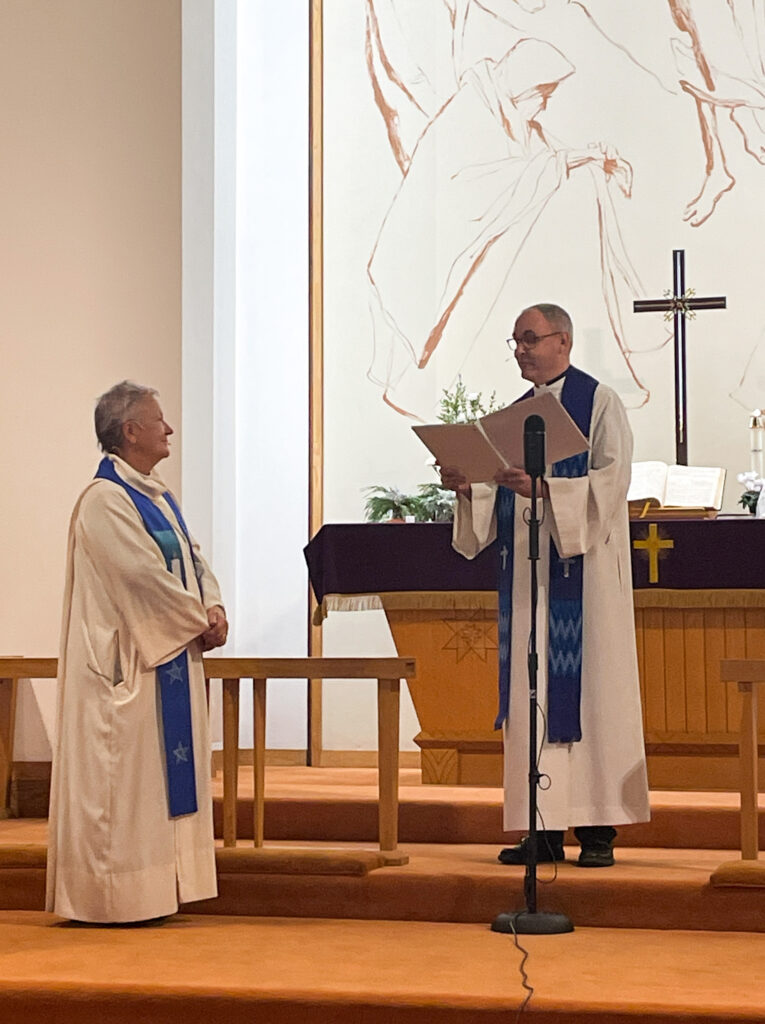
In the picture: minister Ilze Kuplēna-Ewart and minister Dāgs Demandts, at St. Andrew’s church in Toronto, on 10 December 2023.
We congratulate minister Ilze Kuplēna-Ewart on the 40th anniversary of her ministry!
For many years Ilze served in Canada, in St. Andrew’s Latvian Evangelical Lutheran congregation in Toronto (1997-2020), where on 10 December her ordination anniversary service was celebrated. Her ministry began in the London Latvian Lutheran congregation (1984-1988), and continued in Germany – in the Münster, Bielefeld and Osnabrück congregations, where Ilze also worked as a teacher at the Münster Latvian gymnasium (1988-1997).
LLSTA invited minister Ilze to a conversation in which she talks about her life of calling, about significant turning points both in her ministry and in her life of faith.
Ilze Kuplēna-Ewart: The whole anniversary service was according to my wishes, because I usually find it dreadfully uncomfortable to be put in front of people and have all sorts of nice things said about me. It is just like in a restaurant, when some musician comes up and starts playing right at your table, but I simply want to sink into some sort of hole and say, leave me alone! That isn’t the point of it. I was very happy that at the service everything was very simple, and in fact, that my last service was right during Covid. There were no big celebrations, no party, nothing of the kind. At the last service there were six of us in the sanctuary. On the one hand, something was missing; on the other hand, it was a very real moment. Such is life, and such are the conditions in which we are and work, and serve.
What are your reflections on the fact that the transition from the active life of ministry happened precisely at this time?
I.K.E. I was extremely sorry that I couldn’t spend time together with people. It wasn’t possible to be with them. Since I was in St. Andrew’s congregation and led it for 23 years, that is a very long time. It is a process of growing together with the congregation. When I arrived, there were some 1200 – 1300 congregation members. A congregation is like a circle with many rings – some are closer to the centre: those who actively take part and lead; and those who are a little further away and only take part; and those whose connection with the congregation is distant. Over these years all of this has narrowed. With many I had lived through life together, and in those relationships something special forms.
Every year, without exception, I had cases where I had to stand beside parents as they saw off their child; on rare occasions these were grandchildren, but usually middle-aged children, and so, in such moments, when a person is so fragile, then a miracle happens there. You are invited into the person’s very self, into their life, without any partitions or restraints, and there, undoubtedly, a true closeness of soul arises. The relationship becomes something quite different.
It is the same with the care home, where I often went, but couldn’t go [during the Covid pandemic]. Leading a service at a care home, there is no pretence there, you know what is happening here. The person knows who stands before them, and you too know well who stands before you, and the whole dialogue becomes more truthful. All this leads to the fact that I understood that these people, just like me, would have to go through a certain process of grieving, that I am no longer there [in the congregation]. That doesn’t mean that I put myself on some sort of pedestal, but the bonds, at least with some people, have been so essential that you are like one of their kin, and yet they will no longer be able to open their hearts. The opening of the heart does not happen only with words, it does not happen only when you sit down and talk, it happens in that moment when you look at each other, whether you and me, whether that other person is somewhere in the room – in physical or spiritual space.
And what I missed in that whole process, when I left the congregation, was that I couldn’t spend time together with those people and say – you know, it will be all right, it will be all right. Trust, and it will be all right. It will be different, but even now it will be all right, and what has united us, through these adventures and experiences, that will remain. What unites us – one point is you, the other point is me – it will be in your past, which will remain, but that other point now will be in that new person [the minister] whom you will have now.
The second thing is that when you, after a long time of ministry, leave the congregation, you really have to leave it. You have to go away. That is entirely right, because you cannot interfere, you have to let the person who follows take over. You cannot be a shadow that constantly appears there. For more than two years, literally, I kept away from the congregation. This spring I was appointed honorary assistant minister, which means that I can formally do something, if needed. But I think that the fact that I left, and that it had to be cut as if with a knife, that also confused people. They knew that it had to happen, but here is emptiness! That was the shadow side of Covid, and also the fact that people went before God and I couldn’t be present when they passed away.
On the other hand, Covid gave fantastic opportunities. By nature I am a very creative person. I never lack ideas; music and art have always been extremely important to me. I could create such devotions and services that allowed me to step out of one particular frame, and so, it could be fresher and more truthful. I felt that through the telephone I addressed people differently, I addressed that particular person. It was a personal conversation and everything could be much more real, and I could put in pictures, show art.
You have to go away, not only from the office, but also from the congregation. And you have to leave free space for the person who comes in your place. I began to attend a Lutheran congregation in downtown Toronto, and it’s very nice – the minister is gay, a couple of years younger than me, he works part-time, which means that the congregation members also prepare sermons. He ministers two Sundays a month and the congregation [leads] twice a month, and when needed, then I help out too. Those sermons are simply fantastic! Truly one of a kind! You can see that people draw from some deep place within themselves, and these are sermons with real substance. There are no theological thoughts left dangling somewhere or anything of the kind; here is a person for whom that faith marks real life, and that is reflected in what that person says, and with it comes something so fresh and deep that I admire it. The whole world comes there – young, old, transgender people, families, singles – a small but very vital little congregation.
Official ministry has ended, yet it nonetheless continues. Where is God leading you now?
I.K.E. There is an expression in English, smile and wave*, that is now my task. My task is not to come with my wisdom. It was so interesting; precisely on that Sunday after the service there was a coffee table and I was talking with a congregation member who is younger than me. She asked me a similar question, and I said, I am here, ready, with advice. She said, yes, but no one listens to that advice anymore. And I thought, yes, but it all depends – on how you give the advice. Whether you give instructive advice without being asked. Or whether you simply wait, and let the person find the answer themselves. That is why I am engaged in coaching, because I consider that my calling now is to be more like a midwife.
If we think about the classical models of pastoral care – the kerygmatic, the psychological, the hermeneutic – now we are at the point where we help the other person to discover what is already within them. But it is a field in which many of us are still beginners and are feeling our way, perhaps afraid to believe that God speaks with everyone and has already placed something in each person’s heart? From this aspect, what must change, or perhaps need not change, in the work of theologians and ministers?
I.K.E. In Münster I was also a teacher at the Latvian gymnasium, and one of my colleagues was German, and he introduced me to a concept that cannot be directly translated into Latvian, abkanzeln. In Latvian it could be translated as “instructive”, but then one has to think about the word’s origin – it is what happens when one speaks from the pulpit. It can be understood in a figurative sense, but it also describes what can happen when one perceives one’s place and role as if standing in the pulpit. What is the physical space like when you are in the pulpit? You climb up and stand above people. You look at people, and all the people have to raise their heads to look up at you. I think that is a very powerful metaphor. Traditionally, such was the role of the congregation’s minister, the clergyman, and that, to a large extent, was also how the clergy understood themselves – that they are the ones who embody and bear the truth, and pass it on to the rest. Often an instructive tone came along with it. When I was growing up, when I was studying to become a minister, that matter between gospel and law – to a large extent what came along was the law, but the preaching of the gospel has its own mood.
The old St. Andrew’s church in Toronto was a fantastic building. More than 800 people could be seated there – it is a semicircle, and the space determines how the congregation feels itself. A semicircle means that you never sit alone, you always see other people and are part of a strong community. That was the case before me as well, with the ministers Juris Cālītis and Ādolfs Čops. The pulpit there was dreadfully high. Up there was a kind of huge tub, so that you could walk around in it and look at the congregation, and do everything that is necessary, but my Canadian colleagues said that the pulpit there is so high that your nose starts to bleed! Whenever I could, I always preached down below, on the same level as the congregation.
To stand and to be a minister is a miracle. It is a miracle that is bound up with a deep sense of awe. You are not the author, you are the intermediary. Your task is to let the power of the Spirit flow through you to another person, and to work as earnestly as possible to make that path as open as possible. To not let your ego interfere, as far as you can. That is possible.
When we return to the pastoral question, of course, the pastoral relationship is hermeneutic; I think that is the only way. The only real way, because we are all on one and the same level. And those, as it were, last words of Luther: “We are all beggars”, that is how it is. Because I received, in an admirable way, the calling to become a minister only for the Latvian church, only for Latvians, that has been decisive. I have had, to a certain extent, to set myself aside so that it could be realised. I am neither better nor worse, neither wiser nor more foolish than any other person. I have been given this enormous privilege of devoting more time together with God, perhaps more than other people do.
What is this spending of time with God like, are there any specific practices? What has been significant on your path of faith?
I.K.E. Yes, here, in part, I also enter into a personal experience. When I received the calling to serve, my first child had already been born – a little daughter, and I was expecting a second child, my elder son. Then, when I received the calling to the first congregation, which was a year and a half later, I was already expecting a third child. Within not quite four years I had three children. My first son, when he was born, was very ill, he had to be resuscitated. My second son was born – everything was beautiful, a lovely birth, no problems. Then, in my husband’s arms, some twenty minutes later, he stopped breathing.
I relied on the fact that I could do everything, but after six weeks I broke down and had very serious postpartum depression. There was no psychosis, but I could no longer function. I had a very good family doctor, who was also a gynaecologist and delivered all three of our children. I called him, and within a couple of hours he was at our home and took charge. I went to him once a week to spend an hour together and talk things through. He was an interesting person. His mother was Anglican, his father Jewish. The moment came when he said to me, I can no longer help you. You have to start sorting out your relationship with God.
At that time, my husband was working as an ecumenical chaplain at a polytechnic in Oxford, and he had a colleague, a Catholic nun, to whom he mentioned that I was looking for some sort of healing process for myself. She said that the leader of the community offered the Ignatian 19th annotation [the Ignatian retreat in daily life]. I began to go to Sister Dolores. Usually the annotations take 6 months, but I spent a year and a half. It was a turning point in my life. To study theology in Oxford is a very intense academic process. It took me a year and a half, after my studies, before I could begin to read novels. After that I could no longer read anything normally, but then, going through the Ignatian exercises, I began to feel something quite different – about myself. What strongly spoke to me was also the colloquies, these conversations with God. I could choose with whom I spoke – God, Jesus, Mary. I experienced it as something real. Something happens in those moments when you open up, and it remains afterwards too.
Then we were in Germany and I found a fantastic spiritual mother for myself; she was a Benedictine from Ireland and led a convent. I went to her regularly and once a year began to go on eight-day silent retreats. That again was an enormously interesting process, about which there are a number of stories. I was with her in August 1991, when the great coup took place. I was denied any means of communication and I said, well, how am I to know what will happen? She said, I will tell you what you need to know. And so it was. It was fantastic – those convent sisters, more than 40 sisters in the convent, prayed for Latvia every day and came to tell me the news. That compelled me to learn trust, you simply trust. With her I began to go deeper into lectio divina, but I also realised that one has to be very careful, because with lectio divina I had a tendency to force the pace, to try to be in control.
Then, when we came to Canada, I found another spiritual director and understood that my path is contemplation. My time that I spend with God is a kind of unbroken conversation. When I notice that that conversation isn’t happening, that I am not open, that I have let my ego come in, then problems and difficulties arise. In the garden we have set up a bird feeder; when I stand at the window and do the housekeeping, I can stand and watch how the birds come and eat. How they wait in line and very politely wait their turn. We have a kind of dish there in which they can drink and bathe, and likewise they stand honestly in line and wait their turn. It is so good, you feel it within yourself. It is the same with being together with another person. Back when I had those pastoral tasks, to be with someone who is passing into eternity or is distressed, you simply let the space open up. Now it looks quite different, and when someone comes to me for coaching, I cannot say to them, I will pray to God for you, but I simply say – I will hold you in my heart. That is what I do.
And another thing, since I retired, a new field of activity has opened up for me, and that is in Latvian politics; there I am the chairwoman of the council of the Latvian National Alliance in Canada.
How are those tasks going?
I.K.E. Dreadfully interesting! We have now been given the task of revising the statutes. There you have to look at how the whole organisation works – the model, the structure. I have a lovely team. Across all of Canada we found out how people feel, what they think, and now we are beginning the next process, putting together the structure, and I lead that group. That means letting people speak out more. I am a markedly orderly person – meetings have to take place in such a way that everyone is given the chance to speak, so that we get further forward. We were preparing for a meeting, and I said, this meeting will be two hours. And that meeting was two hours and two minutes! I was very proud of myself and my team. It is important work. I know that I am able to lead and I am able to bring it about that people cooperate and listen to one another.
Returning to the 40 years of ministry, are there any significant turning points at which you would like to pause and tell us about them?
I.K.E. I have to say that, from the time when I went through the Ignatian exercises, it has become habitual for me to be open, to look back and constantly reflect, and so, going into retirement, away from ministry in the congregation, there was no great revelation, and also the fact that we are ministers until the grave, that is never taken away. I really think that something ontological happens when you are ordained and grow into your office. There is some kind of process of transformation, which I have also seen in other people.
If I think back to what were the important moments, then there are several fragments. I remember the first funeral, where I saw a person off. It was before my installation in office. I was expecting my third child. As I conducted the service, an old man came up to me with tears in his eyes, and said that you cannot imagine how good it was that I, bidding farewell to my friend, and you stand there and you had hope, in you with the little child, with this new life. I think that it is God’s miracle that such things happen, and I am not the author of it. That was one moment.
The second was when I was a young minister. And, of course, I was very carried away. I had a colleague, rather cynical by nature, and he once reproached me after I had preached. He said to me that Latvians do not wear God on their sleeve. That put a brake on me and I thought, all right. And it made me return to an academic approach. But then, after some longer time, in January 1990 I was invited to give lectures in Riga. That in itself was something. I was speechless that people, crowded close to one another, in a small room, listened to every word that I said. Juris Rubenis told me that I had to come to the Torņakalns church and, in the middle of the week, speak with people. I had never experienced anything like it. Elderly people came up to me, women in headscarves, and kissed my hand. They came and spoke, and gave their testimonies about how God had sustained and protected them. About the cross, about Jesus. From those people on that Wednesday evening in January, I learned that I, as a Latvian, can speak about faith and speak about it openly. We can do it, and how important it is to do it. These are such moments that these fantastic people taught me, those who had been through hell.
Another significant moment was when we moved from Germany to Canada. It is something I have grasped only recently. In Münster we had built ourselves a house, worked for a year and a half with an architect and built a house perfect for our needs. I extremely enjoy working in the garden, and from scratch I laid out and planted a garden. On leaving Germany, I had to give up the church pension. We left the house and everything that we knew. My salary decreased very considerably, and we moved to Canada, and everything had to be started anew. Then I understood what it means – to leave. Give up everything that you have, and follow me! It was the pure calling that we had, to move here. Those 23 years were hard. In the first year my hair fell out from stress, because in the course of one year I saw off 47 people, 2 suicides. And yet, I knew that I had to be here, that we had to be here as a family. That sustained me. That awareness of the calling, and the awareness that the calling, which came out of the blue by the river in Oxford, that the years I spent there, I must not simply give thanks for them and carry on with my own life, but that I have to serve Latvians. That is what sustained me through all those years. Then also the work that continued in Latvia, and the work with women. I could introduce a different kind of spirituality. We led the first retreats in Latvia. I was reminded that I introduced the retreat movement to Latvia; that had completely not occurred to me. I could also teach at the faculty, and that too was lovely. It was painful, having to leave all of that, so that I could serve here in Canada. There is a feeling that God’s blessing has been present the whole time.
What question or thought is on your mind right now?
I.K.E. The person who comes to my mind is Julian of Norwich, who sat in her room and the world came to her. She saw how things repeat themselves. One of the gifts that we are given, living a longer life, is the opportunity to observe events in the world. As a child, I remember the Hungarian uprising, I remember how I heard on the news about nuclear weapons and how powerful a nuclear explosion is. I lived with the thought of what would happen if there were a nuclear war. Then there was Czechoslovakia in 1968. And Margaret Thatcher, and all the nightmare that in Great Britain has not ended and unfortunately continues, and will continue for a long time. But you see that French plus ça change, plus c’est la même chose** – it repeats, it repeats. And we get past it. But you have to work at it.
What I care about today is the climate. In Latvia I care extremely about gender inequality. This whole question of how we may exclude people at all because of their otherness? How may we do that? The church, after all, is the place where the doors have always been open. Always. There is one lovely song in English which says that one should make the table broader and bigger, so that ever more people can sit down around it. I think that for the Church it is a calling to see this – how we can broaden that table and make the doors more open, so that we are open to the world. So that the world understands that we do not have the answers all lined up, but that the answer is always one and the same. The interpretation will differ, and it is so important to work at that today. Set your ego aside, set your “I” aside. We are one family around the table; to that Christ calls us.
*smile and wave: Smile and wave your hand!
**plus ça change, plus c’est la même chose: the more things change, the more they stay the same.
(Interview and transcription: Arta Skuja)