
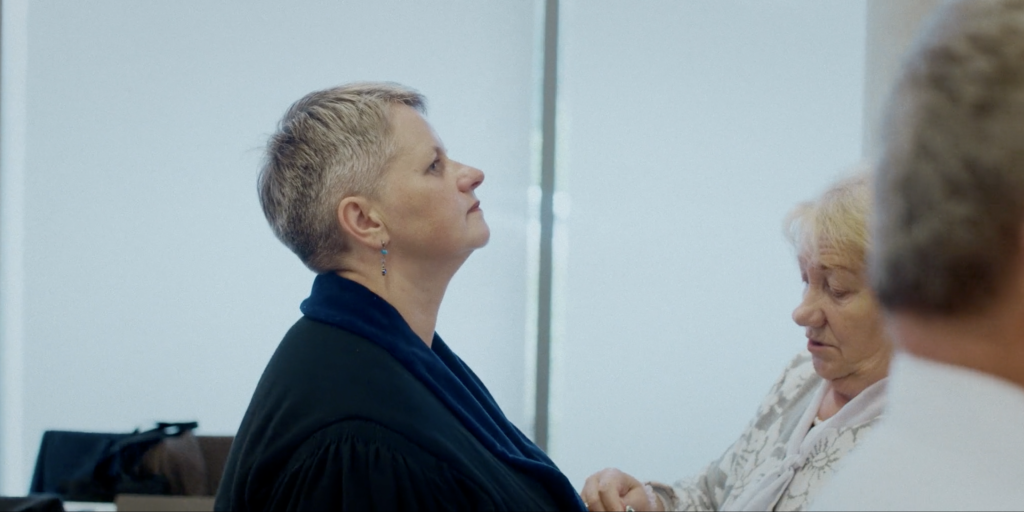
Ahead of the premiere of the documentary film “Svārstības” on 23 February, the LLSTA portal offers a short conversation with the film’s director, Kristīne Briede.
– Could you tell us about the idea behind the film and the guiding motive that prompted you to turn to the question of women’s ordination?
Five years ago I got to know Dace Balode, who is one of the main protagonists of this film. At the time, Dace had made a courageous decision – to leave the LELB and be ordained in the LELBĀL – that was then the name of the former church in exile, now known as LELB Worldwide. Dace was the one who, in broad strokes, introduced me to the history of women’s ordination in Latvia. Back then we began together to interview women who serve or once served in the Lutheran church. All kinds of women – evangelists, women acting as ministers, women ministers who once served, both those who remained and those who emigrated abroad in order to do so. Among them were both women who support the ordination ban in the LELB and women who painfully grieve it. There were also those for whom it had completely changed the course of their lives – one could say even their destiny – and not in every case for the worse. For example, Marika Vidiņa, now passed away, whom the decision not to ordain women, for the sake of survival, “forced” to choose a wholly different path in life, and she became an extraordinarily successful entrepreneur.
In a word, I understood that this is an interesting story, that it is not over, that it is living history, and that it is possible to document it in one way or another.
The idea for the film began with the cinematographer Jānis Šēnbergs and me filming Dace Balode’s ordination in 2018. The church was full there – guests had come from far and wide, from various countries, and it was extraordinarily interesting to observe how many of them were women ministers, how freely they and everyone else behaved, and how normal and warm and friendly it all seemed. Later I began to research further, to look for materials, archives, to meet and speak with various people. I am very grateful to all of them – of course, and especially also to those ministers and laypeople who hold conservative views on this matter and who express full support for the LELB’s stance not to ordain women. The information and opinions they provided gave me the depth of the topic, an understanding of how complex our history, our society, the relationships among its various members, and theology are.
– Is the film “Svārstības” intended as an instrument for bringing public dialogue about the role of women in the church and in society to the fore?
A film is a film. I would like to think that what has been created is cinema as a work of art, and even though it is based on a socially topical problem, I cannot by any means call it an instrument. I would, of course, be happy if, after watching the film, something from the film’s message caught on in people, gave them something to think about, made them look at things from a different point of view, seek out more information, discuss, ask questions.
But I would also be happy if, alongside the storyline, viewers also appreciated the cinematic language used in the film, the shots, the colours, the emotions, the metaphors.
It is up to each church to choose its own direction, its vector, its own values, and that, of course, is the case for the LELB and for any other church as well.
This film is a sufficiently open structure; it does not give answers as to what is the right way and what is the wrong way to do things. Each viewer will read the film’s message according to their own experience, openness, views, and possibly also their belonging to a particular generation, but the idea that guided me in making the film is a call to society to listen to one another, including to those who are pushed aside into the second and third rows, for people to learn to coexist with different views, cultures, and, of course, theological and religious experience as well.
– As the director, do you have a recommendation – with what thoughts should the viewer approach the film?
Right now, before the premiere, I would rather know what their thoughts and feelings will be after watching the film.
– During the work process, were there any turning points, revelations that transformed your previous notions about this topical subject?
With each new conversation and filming, something was added that made the overall picture broader and more complex. There were a great many fluctuations and doubts while making the film. With the archival materials, with the revelations, also while reading the KGB reports in the archive… Beneath the surface there are deep shafts. But it was not the case that there was some turning point that overturned everything completely. Gradually I understood that this film’s point of view would be from the perspective of the serving women. Her-story*. And that is how it remained in the end.
You are warmly invited to watch it!
*Herstory refers to historical narratives from a feminist or a woman’s perspective.