
Una Stroda
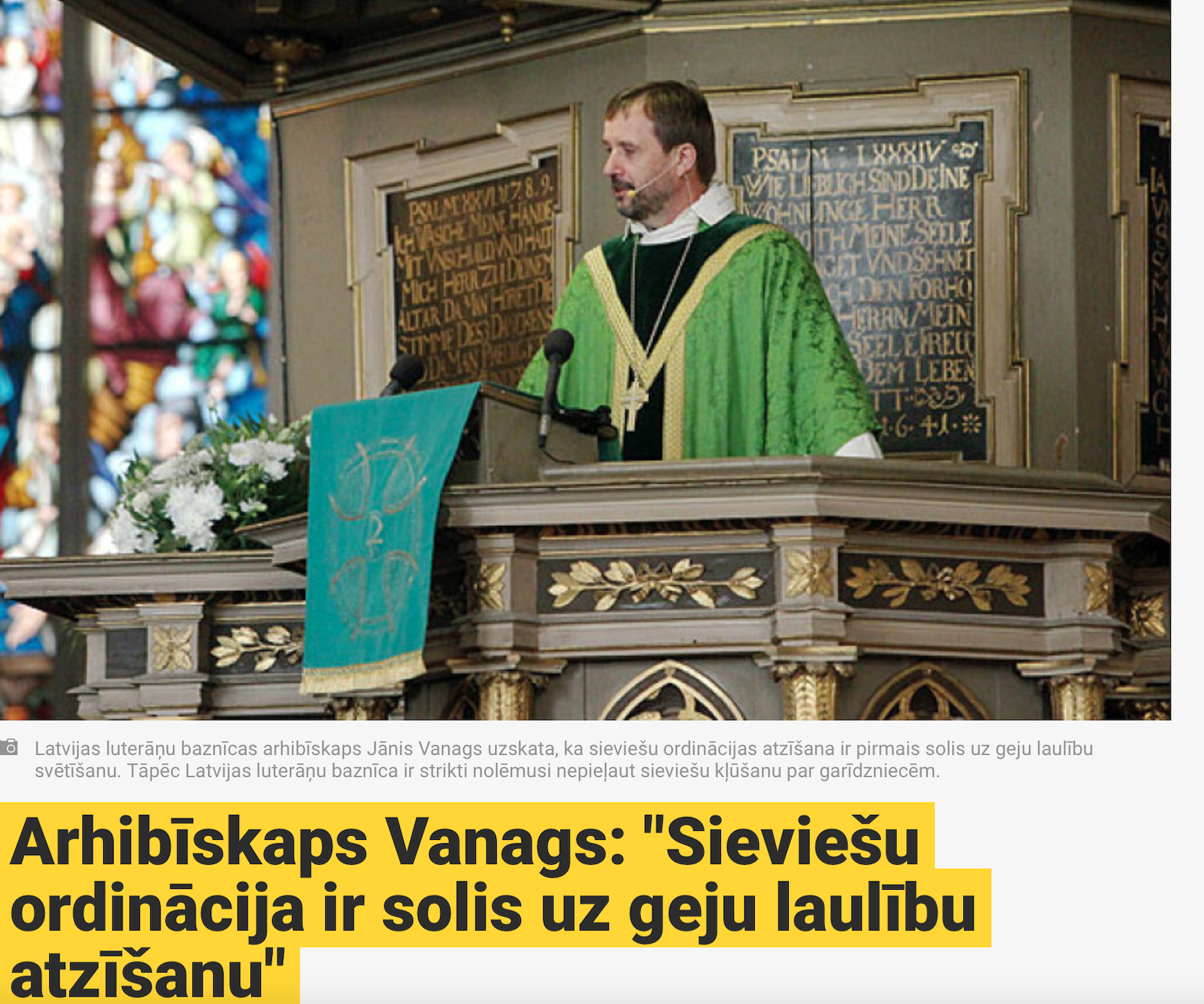
In the mass media, as an answer to the question of why the Evangelical Lutheran Church of Latvia (ELCL) does not ordain women, the claim is periodically voiced that women’s ordination is a step toward recognizing “gay marriage,” because “the method that allowed Western churches to bless same-sex couples followed after women were allowed to be ordained.”[1] According to the conservative theological view represented by the ELCL, women’s ordination contradicts both Scripture and church tradition. My study focuses on the second part of the claim, concerning church tradition, and assesses whether the centuries-long tradition on the question of women’s ordination has truly been consistent and unchanging, and whether departing from it would affect the institution of traditional marriage and lead to the acceptance of same-sex marriage in the church. The aim of this work is to continue the discussion on the question of women’s ordination, and, acknowledging the complexity of the debate, to illuminate the latest arguments in this discussion, thereby fostering further dialogue.
Since the claim that women’s ordination will lead to “gay marriage” is twofold, my study also has two parts: first, it addresses the question of the tradition of women’s ordination, and second, assuming that “gay marriage” is understood to mean non-traditional marriage, it examines the concept of traditional marriage, the tradition of its formation, and the question of whether changes in the church’s attitude toward women’s ordination could potentially lead to the recognition of same-sex marriage.
Explanation of the concept
The concept of “tradition” comes from the Latin word tradere, which means “to hand over, to pass on”: tradition is the understanding, insights, knowledge, way of life, and virtues that are passed down from generation to generation and that have a symbolic or special significance whose origins are to be found in the distant past. By tradition in the general sense, what is usually meant is that which has existed for a long time and recurs regularly. With regard to church tradition, the talk is of the handing down of doctrine and religious practice from generation to generation, and churches that consider that they have received their doctrine and religious practice from Christ, from the apostles, and from authorities recognized by the church, and that they preserve and pass it on to subsequent generations, tend to call themselves “traditional.”[2] The Lutheran Church also adds that it considers the reformers to be authorities and Holy Scripture to be the measure and norm of all things, and therefore doctrines that are not grounded in Scripture are not to be introduced. In the event that the church permits a non-traditional innovation and abandons its previous views in favor of some others, this happens only if the new is recognized as a creative handing-on of apostolic doctrine, rather than being an abandonment of the values of earlier church generations.
Thus, the tradition of ordaining women would have to be grounded in Scripture or at least have existed as an ancient church practice accepted by church authorities. On neither question is there theological consensus. There are ambiguities about the very concept of ordination: in what manner it took place, for which offices, and what was understood by “ordination.”[3] Likewise, the understanding of the aims and traditional functions of ordination also differs: depending on the Christian denomination, ordination means either the administration of the sacraments or the right to teach and preach; today there is an increasing emphasis on the understanding of ordination as ministry.[4] Taking into account the conclusions of New Testament-era scholars and what is known today about the origins of Christianity and the formation and structure of Christian communities, it is questioned whether it is possible to reduce the beginnings of the tradition to a primitive formula whereby pastors, priests, and bishops arose from the twelve apostles, and these would therefore be the beginnings of the tradition of ordination.[5] Likewise, there were no strict restrictions with regard to sex. There is historical evidence that until the 13th century both men and women were “ordained” to various offices in the full sense of the word “ordination” as it was understood at that time: women were abbesses, nuns, deaconesses, bishops, and presbyters.[6] Thus, for more than half of the history of Christianity, “ordination” did not mean the same thing as ordination is understood to mean today, and for that reason alone “ordination” cannot be unambiguously formulated and presented as an ancient church tradition.
Woman in church tradition
However, one can speak of another, historically well-attested church tradition that is directly connected with women’s ordination and in which the church’s position has been quite clear: the church’s attitude toward woman. Historically, only one argument has existed against women’s ordination: woman has an innate ontological defect, and therefore she cannot be ordained.[7] The idea of woman’s inferiority had been formulated long before the beginnings of Christianity by Aristotle: man is by nature a complete, developed, and mature representative of the species, who corresponds to the norm, while woman is defective and inferior, a failed man, and as such a mistake of nature, and therefore she needs to submit to the authority of man.[8] Since the Church Fathers and early Christianity as a whole were influenced by Greek philosophy during the formation of their basic doctrines, theologians for centuries continued to regard the lower status of woman as natural: woman is higher than a slave because she is free, but unlike man she is not created to be actively involved in political and social affairs. For example, Tertullian (155–220) called woman “the devil’s incarnation,” a destroyer of the image of God and the chief culprit in the death of the Son of God; while Origen (184–253), quoting Paul, wrote that “it is not proper for a woman to speak in church, even if she manages to say something holy or excellent, because it would nonetheless come from the mouth of a woman”; and John Chrysostom (347–407) noted that woman’s place is at home by the hearth, because such an order is dictated by man’s ontological superiority over woman.[9]
The theologically most significant period in the church’s attitude toward woman was the 13th century, during which Bonaventure (1221–1274) and Thomas Aquinas (1225–1274) were active.[10] In his statements, Bonaventure pointed to the sacramental symbolism according to which only man has the nature-given capacity to symbolically represent Jesus Christ. This symbolism is based on the creation story, in which God first creates Adam as the first human, and only then creates Eve from Adam’s rib, thus forming a “harmonious order” as a paradigm for the relationship between man and woman. Eve is a symbol of lower reason, weakness, instability, and an inability to perceive divine wisdom directly, and therefore only men can be ordained.[11] Thomas Aquinas, in turn, assessed the question of ordination according to each sex’s capacity to take on leading roles. Answering the question of whether Christ could have entered upon his earthly course as a woman, Thomas Aquinas explains that it would not befit God to take on the form of a woman, because Christ’s mission was to be a teacher, a guide, a leader who leads in battle toward Christ’s victory[12] — all of these tasks fall outside the scope of woman’s activity. Subsequent generations of theologians either simply repeated these arguments as “systematically formulated and widely held Christian views,” or appealed to “folk wisdom” that women are by nature lower-order beings with weaker intellect and unstable emotions.[13] With the Reformation and its particular emphasis on human sinfulness, the motif of the Creation story (Genesis 3) was further highlighted, namely that woman is the temptress and that sin entered the world because of her.[14] Thus, today’s conservative tradition of denying ordination to women is largely based on medieval views and the “folk wisdom” of not ordaining women, which in turn appeals to the Church Fathers, who assumed that the tradition of not ordaining women had existed always and at all times.[15]
The church tradition of ordaining only men is often justified by the fact that Jesus chose twelve apostles, and all were men. Although there were women among his followers and there is sufficient evidence that in other situations Jesus did not submit to patriarchal social norms, the apostles were men. However, the choice of twelve apostles is to be connected not so much with Jesus’s plans to found a future church as an institution, but rather with quite the opposite intentions. Since the beginning of the 20th century, the prevailing view in New Testament-era scholarship has been that Jesus’s contemporaries perceived him not as a Jewish teacher or a revolutionary thinker and activist, but as an apocalyptic prophet who preached the imminent coming of the Kingdom of God. As early as about 150 years before the coming of Christ, the ideas of Jewish apocalyptic eschatology began to spread, based on dualism, an understanding of the Roman Empire as the embodiment of evil, and the expectation of an inevitable final battle anticipated in the near future, in which God would defeat evil, the end of times would arrive, and the Kingdom of God would be established.[16] Jesus and his followers represented precisely this branch of Judaism, as attested, for example, by the Gospel of Mark 9:1: “Truly I tell you, some who are standing here will not taste death before they have seen the Kingdom of God come with power.” The apostle Paul, too, believed that the time promised in Christ had already come and that the second coming was to be expected very soon:[17] “and do this, understanding the present time: the hour has already come for you to wake up from your slumber, because our salvation is nearer now than when we first believed” (Rom. 13:11). In this context, it is easier to understand why Jesus chose twelve disciples who were specifically men. In Jesus’s time, only two of the twelve tribes of Israel remained, but at the same time there existed the hope that, with the eschatological fulfillment and the coming of the Messiah, the original wholeness would be restored, whose manifestation was the twelve tribes of Israel. Thus, by choosing twelve apostles, Jesus proclaims that the eschatological fulfillment of the times is near and that he has come to gather together all twelve tribes of Israel.[18] The symbolism of the twelve apostles has significance only in the Jewish context, at the very beginnings of the Christian movement; as soon as the Christian message began to spread beyond Palestine, this symbol lost its significance and value, and after their deaths the twelve apostles were not replaced by new apostles who would continue the symbolism.[19]
20th-century changes in theology
Thus, the church’s attitude toward woman, from the very beginnings of Christianity, has been dominated by the notion that she is an inferior being with an ontological defect, or even an incomplete, failed man, and that therefore woman cannot be entrusted with the office of pastor. However, around the middle of the 20th century an important theological turning point occurred: the view of woman’s ontological inferiority disappeared, and all the major Christian denominations affirmed that men and women are by their nature morally and intellectually equal.[20] In response to the new theological attitude toward woman, several new theological positions emerged. None of these positions represents the traditional view of woman’s nature that dominated for centuries, because they reject the arguments rooted in the ancient idea of woman’s incompleteness. One of the new theological positions is the conclusion that there are no longer any reasons to deny ordination to women. The second is the Catholic position, which is based on the sacramental principle, grounded in the idea that Jesus chose twelve apostles, and all were men. The third, the conservative Protestant position, now acknowledges that men and women are equal in their nature, yet emphasizes that each sex has its own “role”: according to the order of creation, man’s role is to lead and to be an authority, while woman’s role is to submit.[21] Only men may hold leading positions in the public sphere, while woman’s sphere is the home. Although it is emphasized that the two sexes complement one another, in essence this position presupposes a hierarchy of the sexes. What is interesting is that, even though women and men are equal, and the only difference is their different “roles” in the church, these role-created restrictions apply only to women.[22] Solely because they are women, they are denied certain “roles” reserved for men, while men are denied no roles.
The argument that today, alongside a literal interpretation of Scripture, is most often used to deny ordination to women is grounded in tradition: the modern church cannot ordain women because there exists a centuries-old universal tradition of not ordaining women, and women’s ordination would be an innovation. However, as we see, the tradition has not been continuous, because the understanding of woman as an incomplete, lower-level being changed to a “role” paradigm that attributes characteristic “roles” to each sex. Thus, the thesis of the continuity of the tradition and the appeal to a centuries-long church tradition of not ordaining women is problematic: if a rupture has occurred and new reasons for maintaining the tradition have arisen, it is no longer an ancient tradition but a new one. In this case, the innovation would be not women’s ordination but the church’s new arguments, based on the new understanding of differing sex “roles.” If the traditional reason that did not allow women to be ordained no longer exists, then the conclusion should be that women can be ordained. If the practice still looks the same, but the theology and the reasons for this practice are already different, it is no longer the maintenance of an ancient tradition.
From a conservative point of view, one may object that, even though the tradition was broken, the church’s stance is fundamentally a desire to resist secular developments in society, because adopting them would lead to the liberalization of the church. Although the only innovation would be the refusal to regard woman as an inferior being, there are already countless examples in church history of worldly influence having shaped both the form and the content of the Christian church from the very beginnings. For example, without the worldly means of expression of Greek philosophy, it would not have been possible to formulate Christian doctrine and the creeds. The early church was influenced by the world, adopting a hierarchical structure: from a traveling group of Jesus’s followers it transformed first into a house church that mirrored the extended household typical of the first century, and later began to resemble the Roman familia structure with the paterfamilia as the head of the congregation.
There is also the question of whether the basis for the 20th-century theological turn toward a radically different understanding of woman’s equal nature with man, and the women’s ordination that followed it, was changes in society outside the church, or whether Scripture itself contains a call to equality — or, as Luther formulated it, to the Christian’s freedom from both internal and external captivity. In 1948 the Universal Declaration of Human Rights was adopted, affirming the fundamental rights of every person and the equality of men and women. Sometimes the conservative church interprets the question of women’s ordination as secular pressure to introduce into the church the equality model accepted by society, because otherwise the church will be accused of discrimination and a violation of human rights. The church defends its refusal to submit to societal pressure by pointing out that ordination has nothing to do with equality or fundamental rights. However, although neither man nor woman has a “right” to be ordained, in the case of the non-ordination of women the church denies ordination to a category of people solely because women belong to this category. In arguing its position, the church says that only men can be ordained, owing to something that is specifically characteristic only of men, and women are excluded because of some characteristics specific only to women. Thus, the church discriminates against certain people as a category:[23] men as a category have the right to be ordained in a way that women as a category cannot be ordained.
With regard to ordination, the church does indeed have the right to discriminate against certain groups of people: for example, unbelievers cannot be ordained; children cannot be ordained; in many churches, partners in openly same-sex relationships cannot be ordained. However, in none of these cases does the discrimination occur solely because someone belongs to a certain group, but rather because they have a defect that specifically prevents that individual from being ordained. This defect can be eliminated, and the individual can be ordained: an unbeliever can become a believer, children grow up, and the prohibition on those who are in a relationship with a partner of the same sex does not relate to their belonging to a category but to their behavior, since sexual orientation as such is not an obstacle to ordination. Until the middle of the 20th century, the argument against women’s ordination related precisely to a defect supposedly inherent in woman: lack of intelligence, emotional instability, irrationality, and an inability to take on a leading role. However, today the major denominations have retreated from the view that being a woman is a defect. Women are not discriminated against because they would be unable to teach, preach, provide pastoral counseling, or perform sacramental acts. Women are denied the possibility of being ordained not on the basis of their moral unsuitability or physical incapacity, but solely because they belong to a certain category of people.
Egalitarianism and its influence on theology
The very claim that the ordination of women is a result of various 20th-century movements for equality is also inaccurate from a historical point of view. As early as the 12th and 13th centuries, the Waldensians, who were one of the first reformist movements long before the rise of feminism, were reproached for allowing women to preach.[24] Secular egalitarianism, too, is a movement not of the 20th but of the 19th century: although the ideas of women’s ordination and the social movement for freedom and equality are connected, their origins are to be found not in the 1960s of the 20th century but in the 1860s of the 19th century, after the U.S. Civil War (1861–1865). The emancipation of slaves was followed by heightened social activity in the struggle for women’s rights and the right to vote, and the first to advocate for this were the abolitionists. Nor is there always a connection between women’s ordination and the liberalization of the church: to assume that women’s ordination will lead to “gay marriage” is a post hoc propter hoc or logical fallacy.[25] Liberal Protestantism, whose representatives included, for example, Karl Barth and his Confessing Church, took up a position in opposition to the Nazi-supporting German Christian church, but they would by no means be called supporters of women’s ordination. Likewise, in the 1960s, representatives of theological liberalism advocated against racism and for civil rights, but it does not follow from this that everyone who supports civil rights and is against racism is also theologically liberal. There exist traditional conservative churches that ordain women while at the same time affirming fidelity to church tradition and the authority of Scripture, differing only on the question of women’s ordination, but these churches do not represent liberal Protestantism.[26] Not everyone who supports one of the social changes, for example the abolition of slavery or the fight against Nazism, will necessarily also support all the other manifestations of egalitarianism.
The Lutheran tradition is itself an example of how developments outside the church influence confessional theology and practice: although Martin Luther advocated only for the Christian’s spiritual freedom, subsequent generations of theologians recognized that the Christian’s calling is also to become involved in the worldly struggle against inequality. In his work “On the Freedom of a Christian” (1520), Luther speaks of the inner, spiritual freedom in faith, and later publishes “Against the Murderous, Thieving Hordes of Peasants” (1525), condemning the Peasants’ Wars of 1524–1525, which began under the influence of Luther and the ideas of the Reformation and in which the peasants demanded freedom with political and economic consequences. However, subsequent generations of theologians objected to Luther, emphasizing that from the idea of the Christian’s freedom there also follows the person’s individual, “worldly” freedom, and therefore to be a servant and oppressed is contrary to the Christian faith. Especially since the end of the 19th century, the gospel message has increasingly been understood not only as one that promises personal salvation, but also as a call to the universal freedom and equality of people both before the law and in putting laws into practice.[27] Since the time of the Reformation, Christian thought has retreated from Luther’s understanding of the Christian’s inner freedom and has recognized that the Christian message of freedom and equality applies not only to personal salvation, but also to civil liberties, including racial equality and equality between the sexes. Thus, the movement for equality and equal rights is not secular, but rather an understanding of freedom rooted in the Christian faith. At the foundation of the struggle for women’s ordination is not secular egalitarianism, but the idea of the Christian’s freedom.
The concept of the traditional family in the Old and New Testaments
The view expressed in the claim “women’s ordination will lead to gay marriage” concerns church tradition and its handing-on: both women’s ordination and gay, or non-traditional, marriage would be a departure from the traditional, Scripture-based values of earlier church generations. Thus, alongside the tradition of the non-ordination of women, the question of the traditional family and marriage must also be examined. There exists a widespread general view that Christianity defends traditional values and the traditional family, rooted in the truths contained in Scripture and Christian tradition. However, on a closer examination of Scripture and the history of the formation of Christian tradition, it emerges that, just as in the case of women’s ordination, in the attitude toward and understanding of traditional marriage and family there is also no continuity grounded in Scripture and apostolic tradition. Compared with women’s ordination, for which examples can be found in early Christianity and the Middle Ages, “traditional marriage” is a historically much more recent concept that has no unambiguous justification either in Scripture or in tradition.
In the biblical descriptions of marriage and family there is great diversity. Just as in many other cultures, where the dominant form of marriage has been and is polygamy,[28] which was prohibited in Western Europe only in the 12th century AD,[29] it is also evident from the Old Testament texts that in ancient Israel polygamy,[30] as well as prostitution, was regarded, if not as the norm, then in any case not as something immoral or unlawful. One may object that these are exceptions and a departure from the norm, but in Scripture neither prostitution nor polygamy is condemned by God, by the authors of the texts, or by the other characters in these texts. Abraham and Sarah had what today is called an “open marriage”: thus Abraham first lends Sarah for use by the Egyptian pharaoh (Genesis 12:11–20), then by the Philistine king Abimelech (Genesis 20:2); Sarah lends her maidservant Hagar to Abraham so that she may bear him a child (Genesis 16); Abraham and Sarah’s son Isaac also temporarily lends his wife Rebekah to the same Abimelech (Genesis 26:7); Abraham’s grandson Jacob served Laban for 14 years (Genesis 29) in order to obtain two wives, Leah and Rachel, both of whom later offer Jacob their maidservants, Bilhah and Zilpah, for use and for bearing children. In the Book of Joshua (2:1), Rahab, whom Matthew later includes in Jesus’s genealogy (Matt. 1:5) and whose great-great-great-grandson is King David, is a prostitute, and this was not considered to be anything unlawful, sinful, or shameful. David himself had at least five wives, but nowhere near as many as his son Solomon, who possessed not only 700 wives but also 300 concubines (1 Kings 11:3). In the texts, Solomon’s behavior is condemned, yet not because of the large number of wives, but rather because they mostly came from other lands, as a result of which foreign deities came to Israel and were worshipped. Other Old Testament texts as well, especially the books of Leviticus and Numbers, which contain laws and regulations, do not support the notion of traditional biblical family values, but rather affirm woman as the property of her husband, whose main purpose is to produce offspring.
Did early Christianity and the New Testament era give rise to what today is called the “traditional family”? The gospel texts and Paul’s letters testify that neither Jesus nor Paul call for the formation of new Christian families, but rather for the renunciation of the family in favor of the Kingdom of God. The main reason why the first Christians did not consider the formation of stable family and congregational structures to be important is assumed to be the social and political mood characteristic of this time in Palestine, which lived in expectation of the imminent coming of the Messiah. Jesus’s followers, who saw in him the promised Messiah, hoped for an eschatological event of cosmic scale, the coming of the Kingdom, and radical changes in all spheres of life. These ideas are reflected in the gospels, which describe Jesus criticizing traditional marriage and family:[31] for example, in Lk. 14:26 he called for hating father, mother, wife and children, brothers, sisters, and one’s own life, as well as for abandoning the family in order to follow him. In another episode, Jesus does not even allow one of his followers to bury his father (Matt. 8:21–22), which in ancient Palestine would have been the greatest disgrace and affront to family values.
Traditionally, the texts considered to be the New Testament justification for marriage are those that refer to the formula of the Creation story, “Therefore a man will leave his father and mother and be united to his wife, and they will become one flesh” (Genesis 2:24). The special status of marriage is emphasized by the prohibition of divorce: “Anyone who divorces his wife and marries another commits adultery against her. And if she divorces her husband and marries another, she commits adultery” (Mk. 10:11–12, as well as Matt. 19:7–9 and Lk. 16:18). However, in the context of the idea that Jesus’s followers expected an apocalyptic end of the existing world in the near future, which would bring the Kingdom of God within their own lifetime or very soon, these texts can also be interpreted otherwise, emphasizing not the founding of a family but precisely the prohibition of divorce and remarriage. The only reason for someone to divorce in Jesus’s time would have been the desire to take a new wife. Several authors emphasize that Jesus, and Paul as well, opposed divorce precisely in order to prevent remarriage,[32] because they saw no need for marriage at all. For thousands of years the main purpose of marriage was procreation.[33] Because a human is mortal, the task of marriage was to produce offspring and continue the lineage. Marriage was part of an endless cycle: sex, birth, death, decay.[34] In many religious traditions, the simplest way to break this cycle is known: one must renounce its initial stage, namely sex and sensual pleasure, and therefore asceticism is the most widespread practice in many religions. As John Chrysostom said, “where there is marriage, there is death” (De virginitate, 14.6). Jesus offered a new way to break this cycle — by preaching that the dead would be resurrected. Consequently, in the Kingdom of God marriage and offspring would not be necessary, because both the living and the dead would themselves continue to live, and there would no longer be death and decay. This interpretation is supported by Mk. 12:25, “When the dead rise, they will neither marry nor be given in marriage; but they will be like the angels in heaven,” as well as the parallel texts Matt. 22:30 and Lk. 20:36. This explains the enigmatic reference to angels, since they were understood not only as sexless but also as immortal beings who do not have to think about offspring.
The “traditional family” did not begin in Jesus’s time; quite the opposite: the imminent, inevitable coming of the Kingdom of God rendered marriage as an institution unnecessary. In its place, Jesus called for an alternative, forming a traveling group united by neither kinship nor marriage. His followers and disciples hoped for an immediate coming of the Kingdom and a new world in which God’s power would be realized. Although this was not realized during Jesus’s lifetime, the first Christian congregations still continued to maintain the expectation of the Kingdom, existing as alternative, eschatological communities and formations.
The family in the time of the apostle Paul and early Christianity
Paul’s stance was even more radical: Paul preached that asceticism is the best way to keep the body pure in order to await and experience the resurrection.[35] In 1 Cor. 7:8 Paul expresses the view that, ideally, it would be better for every Christian to remain unmarried, just as Paul himself was, but he concedes that some are too weak and driven by lust, and so it is better for such people to marry. In contrast to the modern church view that one may express one’s sexual desires and lust only within marriage, Paul was concerned less with how to express these sexual urges than with how to suppress and avoid them. In his first letter to the Thessalonians 4:5, Paul formulates that sexual desire is that with which “the pagans, who do not know God, burn,” and therefore it must be part of the world that Christians have left in the past. Paul was certainly not the founder of modern “traditional marriage,” and it was not in his interest to continue the lineage, produce offspring, and found a family. Paul gave preference to celibacy and asceticism over marriage among Christians. Just like the first followers of Jesus, who left the family and joined traveling groups, the Christians of Paul’s time also believed that the Christian community should not support the family but should take its place.[36] Such a view is reflected in the authentic letters of Paul, but in the later letters attributed to Paul, a completely opposite view begins to appear.
With the wider spread of Christian ideas, the formation of new congregations, and the increase in the number of Christians, the content of the Christian message changed, as did the structure of the church. From a community united by messianic hopes, the church transformed into an organized hierarchical formation. In the letters to the Colossians and Ephesians, rules appear concerning the foundations on which both the family and the church are to be based: both are part of the structure of the world and the universe governed by God. Just as God is the head of the church, man is the head of the family, under whose authority are women, children, and slaves. Such a model of the church closely resembled the family model known in the Roman Empire: the head of the family is the paterfamilias, who is not part of the family but rather stands apart from the family and rules over it. Therefore, all the rules apply to women, children, servants, and slaves. Men did not have to know how to behave; they had only to know how to ensure that the rest of the family behaved and observed the rules.[37] Thus, in the course of the formation of church tradition, a tendency is observable from egalitarianism toward a hierarchical structure, which is most evident in the Pastoral Epistles. The peculiarity of this tendency was that the more hierarchical and structured the church became, the smaller the role and value allotted to women.[38] At the same time, this was also a retreat from Jesus’s teaching: all of his activity was directed at challenging the traditional authorities of his time, while the Christians of later times did exactly the opposite, preaching a gospel based on the traditional hierarchical family structure.
Parallel to this model of the church, which was formed on the pattern of the traditional family of the Roman Empire, another tendency also developed: asceticism, the Desert Fathers movement, and the beginnings of monasticism. This created a situation in which, for a certain period of time, two conflicting views existed: one that defended hierarchical “family values,” and another that attached greater importance to asceticism, valuing celibacy above marriage.[39] This conflict reached its culmination with Jovinian (d. 405), an opponent of Christian asceticism: in Jovinian’s view, the institution of marriage is no less important than celibacy, and both are equal paths to God. Such a view — that marriage has value in growth toward God — was declared a heresy, condemned by the most important and influential shapers of Church tradition of that time, such as Jerome, Ambrose, and Augustine. Today it seems strange that those who speak of traditional Christian family values emphasize that they are the true preservers and continuers of Christian tradition, even though in the first centuries of Christianity such a view was deemed a heresy.[40] Likewise, there still exists the myth that the blessing of marriage in church has taken place since the beginnings of the church, yet neither in the Roman Empire nor in the church itself during the first thousand years did such a ritual exist: for a marriage to be considered actually concluded, the informal consent of both parties, upon beginning cohabitation, was sufficient.[41] Only in the 16th century did the Protestants object to the Catholic Church’s position that marriage was of lesser value than celibacy, and they closed the monasteries. However, the Council of Trent (1545–1563) declared the Protestant ideas anathema and continued to highlight the superiority of celibacy over marriage.[42] Thus, in fact, for the greater part of the history of Christianity, the highest value was celibacy, the next level being chastity and abstinence within marriage,[43] and the lowest being the active expression of sexuality between spouses, which today is termed the ideal of the traditional Christian understanding of marriage.
The theologian and New Testament-era scholar Dale Martin (Dale B. Martin) calls this ideology, which modern Christians demand be recognized as the traditional and biblical position, “the idolatry of the family.”[44] Martin points out that, if one truly turns to Scripture and tradition, then it becomes evident that the idea of the “traditional family” is completely contrary to Jesus’s teaching, the views of the gospel authors, Paul, as well as most Christian authorities, Church Fathers, and saints. The thesis of the traditional family and its glorification and worship is not connected with Christian tradition, and reflects a radical and very recent innovation in Christian doctrine and ethics. The ideology of the nuclear family has also been criticized by Karl Barth, who points out that the commandment “love your neighbor,” manifested as love for one’s closest family members, actually means the negation of this commandment, because this love is an “indolent peace of clannish warmth” that simultaneously demonstrates cold indifference toward all others.[45] In Barth’s understanding, Jesus and Paul teach that the church should not be a place where nuclear families gather, but should become a refuge and a family for those who do not have one.
The myth of “traditional marriage”
The myth of the “tradition of Christian marriage” is only part of a broader mythology of the “traditional family.” The historian Stephanie Coontz (Stephanie Coontz) calls it “nostalgia for a past that never was.”[46] Her central thesis is that modern, love-based marriage, as we know it today and as we have named “traditional marriage,” is a product of the Enlightenment and not a tradition thousands of years old. Until the end of the 18th century, marriage was a transaction whose purpose was, for economic and political considerations, to unite two families rather than two individuals.[47] Mutual feelings could be a positive addition, but not a reason to enter into marriage. More important than individual desires and feelings were the necessity of forming ties among several families, gaining new relatives, and producing offspring as a supplement to the labor force. Through marriage, spheres of influence were expanded, new sources of resources were secured, and ties and alliances were formed among previously foreign or hostile groups of people. Until the 18th century, marriage was considered too important an economic and political undertaking to be based solely on the free will of two people, especially if it was founded on something as unstable and irrational as love.
What today is considered “traditional marriage” is described by Bernard Shaw as follows: marriage is an institution that brings together two people who are overcome by one of the most violent, most insane, most delusive, and most transient of passions; they are required to swear that they will both continue to remain in this excited, abnormal, and exhausting condition until death do them part.[48] This tradition — that marriage is a union of two individuals based on love, rather than a contract concluded on the basis of a desire to expand family coalitions and pursue political or economic interests — arose only at the end of the 18th century. The ideas of the Enlightenment highlighted the value of the individual and put forward the theses that everyone is endowed with equal and inalienable rights to life, liberty, and human dignity, and therefore marriage too came to be regarded as an expression of a mutual personal and private relationship. The first step toward the special status of marriage was the denial of celibacy and the closing of monasteries during the Reformation period. Gradually, since the time of the Reformation, the free choice of a partner increasingly began to become a social norm, until, in the Enlightenment era, love became the main reason for marriage.[49] The opponents of this innovation did not believe that a marriage based on feelings could endure for long, and they predicted the collapse of marriage as an institution. The critics held that unions of two people based on feelings would disrupt the social and moral order, and they also worried that if man and woman were equal in marriage, women would begin to demand equal rights for themselves in other spheres of social life as well.[50] The changes in the institution of marriage at the end of the 20th century prove that they were to some extent right.
However, in the 19th century this did not yet happen, because the Enlightenment era was followed by reactionary changes, including a literal interpretation of the idea of the “brotherhood” of all people, applying equality only to men.[51] The testimonies of Queen Victoria’s era and the romantic literature of the 19th century reflect a new family model and new relations between the sexes. In the sphere of marriage, although woman was no longer perceived as a lower being and man as a superior one, the view nonetheless developed that the two are “by nature” so very different that they belong to different spheres: man’s sphere is the active outer world, while woman’s sphere is the home. Women were said to possess a unique moral value that had to be protected from active economic and political upheavals, and therefore she had to avoid the sphere of male activity. Thus, the exclusion of women was no longer because of their inferiority, but supposedly an expression of respect and a recognition of woman’s special talents. Having arisen in the era that followed the Enlightenment, this new theory of the differences between the sexes, according to which men represent the active and the rational, while women represent the human and merciful aspect of life, also postulated that without entering into marriage everyone is incomplete.[52] Only by uniting the two opposites, the two different spheres together in marriage, is a perfect, ideal whole formed.
In historical terms, this radically new view of marriage based on romantic love, which arose with the Enlightenment and acquired its refined form in the 19th century, was characterized from its very beginnings by features of instability that began to haunt it later, especially at the end of the 20th century. The very same qualities that made marriage more acceptable in terms of relationships simultaneously undermined the foundations of marriage as an institution.[53] Since, during the preceding thousands of years, one of the main reasons for marriage was the production of children to continue the lineage and supplement the labor force, changes appeared in the sphere of children’s rights, postulating that children are to be raised rather than used as cheap labor. With the idea of marriage as a union of two compatible people based on love, the question of divorce arose — what is to be done if this harmony no longer exists? And if the quality of the relationship is more important than the economic and political functions of marriage as an institution, is the love of unmarried people less important than a formal marriage maintained for economic considerations? Since only marriage for love came to be regarded as acceptable, with the idea that all other types of marriage are immoral, there arose a need to change the laws so that women who do not find a compatible partner would be allowed to work and support themselves without entering into marriage solely for economic reasons. These and other questions arising from the modern model of marriage were the beginning of later changes in marriage legislation, including the movement for the recognition of same-sex marriage, whose advocates argued that, if marriage is based on love, then there is no reason to reduce it solely to marriage between a man and a woman.
With the Industrial Revolution, the family model changed even further, because the number of women who worked for wages outside the home increased. During this time, the ideas of women’s equality and personal freedom gained ever greater influence, turning into a political movement, and as a result, at the beginning of the 20th century, the system of sex segregation began to falter. Two world wars and the economic depression brought about new changes in the relations between the two sexes, but with the postwar economic boom there followed a unique period that temporarily halted the historical achievements in the sphere of emancipation and created a short-lived new marriage model, which today is perceived as “traditional marriage.” This model was the result of a 150-year-long process in which the ideal had become love-based marriage, man as the breadwinner and woman as the keeper of the hearth. However, the “traditional marriage” model of the Western world of the 1950s did not last long and collapsed in the 1960s and 1970s.[54] The number of working women steadily grew, and changes in political and social life transformed relationships as well. The more women worked outside the home, the more work, rather than the family, became the determinant of woman’s identity. The changes in women’s employment in the 1970s, the rising level of education for women, the civil rights movements, and the wide availability of contraceptives created the ground for changes in the laws that defined marriage as a union of two equal individuals.[55] The civil rights movement, which began as a struggle for equal fundamental human rights regardless of race, prompted thought about marriage too as one of the fundamental human rights, based on the free choice of a partner. Although the laws that were adopted initially addressed only discrimination in marriage with regard to race, these principles underlie the right to same-sex marriage recognized in later legislation.
Contrary to the predictions of the Enlightenment-era critics of marriage, marriage as an institution has not ceased to exist, but its content has changed. Stephanie Coontz compares the processes in the church as an institution and in marriage as an institution: just as the church, having lost the status of the sole official religion in many countries, was able to change and attract people to the church for reasons other than was previously the case, so too marriage, which today people decide to enter for considerations different from those of the past, attracts on new foundations and terms; yet both institutions still retain their significance in society.[56] Marriage today is perceived as an equal partnership that fulfills emotional and sexual desires, and this is the result of a two-century-long process.[57] The new values and social norms that have arisen over the course of two centuries have redefined marriage, and, just like the Industrial Revolution, which determined changes in all spheres of life, this process too is irreversible.
Non-traditional marriage
Thus, the form and model of marriage change along with economic, political, ideological, and social changes. Stephanie Coontz holds that today’s demand for equal status for same-sex marriage is an inevitable result of the earlier revolution in heterosexual marriage, which began with the Enlightenment era and proclaimed love as the foundation of marriage.[58] It is precisely because of these processes that marriage lost its stability: divorce, single-parent families, the cohabitation of unmarried people, and especially the progress in contraception and its impact on sexual relations, marriage, conception, and the bearing of children have changed the role and significance of marriage in society. The very same causes that gave rise to the modern, love-based “traditional family” ultimately also gave rise to the non-traditional one: single-parent families; families without children; cohabitation without marriage; families with children from previous marriages; and also same-sex marriage.
Statements that the ordination of women is a step toward the recognition of gay marriage point to several assumptions: first, that “gay marriage” is a non-traditional form of marriage, opposed to “traditional Christian marriage”; second, that “traditional marriage” is based on stable values, whereas same-sex relationships are based only on feelings; and third, that homosexuality is a sin and the church will not support sin. First, as is evident from the overview of the history of marriage, “traditional marriage” is not traditional — at best it arose in the 19th century; the nuclear family as a generally accepted model took shape only after the Second World War. Until then, the extended household was often considered the traditional family, and until the 12th century polygamy was not unknown in Europe either. Neither Jesus nor Paul defends the traditional family, but quite the opposite — they oppose it, and in later centuries the highest Christian value was asceticism and celibacy, not marriage. Second, “traditional marriage,” as its defenders wish to see it, is based on feelings and love and is an innovation of the modern era. “Traditional marriage” cannot be contrasted with the non-traditional “gay marriage,” which does not result in offspring in the “traditional” way and which, as is often argued, is based “only on feelings” rather than stable values, because in reality this modern “traditional” marriage is itself non-traditional, since it is based on a historically recent phenomenon — feelings as the foundation of marriage. From this point of view, there is no reason to regard one form of modern family as a tradition and another as non-traditional, because both are non-traditional. Just as women’s ordination is not contrary to the ancient tradition, only the new one, so too “gay marriage” is contrary only to the new, modern family tradition, and therefore cannot threaten a nonexistent ancient tradition.
Third, the main argument for the church’s stance against same-sex marriage is that homosexuality is a sin. The ELCL holds that same-sex couples may not be married in church because “the Word of God regards a homosexual way of life as a sin, but sin without its repentance and forgiveness leads to eternal perdition.”[59] The Word of God, which is revealed in the New Testament texts, reflects the traditional views and cultural milieu of Greco-Roman society, in which same-sex sexual relations were regarded as unnatural, but not as sinful. Since woman, as an incomplete being who, by the established order of nature, is lower than man, was expected to submit to man, a situation in which one man submitted to another was seen as unnatural. Paul, in his statements, is comparable with other Greco-Roman authors, including Aristotle, who speak of “unnatural desires,” because by the “natural” order man expresses himself sexually as the one who penetrates, and therefore to be the one who is penetrated is to be regarded as degrading oneself, voluntarily taking on the lower role reserved for women.[60] According to this view, in nature, where everything is subordinated to one another, men are assigned the active role and women the passive one, and therefore the inversion of this hierarchy is unnatural. Paul did not regard as positive any of the worldly desires and passions, including those between spouses,[61] always pointing precisely to the opposite goal — the suppression of any passions, because passions in Paul’s understanding turn one away from Christ.
Another problem with using any biblical texts to condemn homosexuality is that to attribute to Paul a view on sexual identity, whose concept was not known in the Roman Empire of the first century, is an anachronism, because history and its events cannot be assessed from today’s point of view. Neither the authors of the Old Testament nor those of the New Testament had any understanding of “homosexuality” or any sexual orientation — concepts that first appeared at the end of the 19th century and took shape along with the development of the fields of modern psychology and sociology. Here too, just as with regard to women’s ordination, there is no continuous ancient tradition grounded in Scripture. If the concept of “homosexuality” was defined only in the 19th century, then the tradition of interpreting Paul’s words as directed against homosexuality began in the 19th century, and to use passages of Scripture that have a different context, understanding, and worldview means to initiate a new tradition rather than to be grounded in the ancient Christian tradition based on Scripture.
Conclusions
Analyzing the contexts in which the church’s attitude both toward woman and toward same-sex relationships was formed, one can indeed discern a connection between women’s ordination and “gay marriage”: both are part of the ancient view of the completeness of men and the incompleteness of women. Both the earlier church view of woman’s ontological defect, which prevents her from being ordained, and the still-existing notion that homosexuality is “unnatural” and therefore sinful, are fundamentally based on an understanding of a “natural” hierarchy in the structure of the world and the universe, according to which woman, as well as a man who does not correspond to the ideal of manhood, are lower, inferior beings. From this point of view, the ELCL does indeed continue an ancient tradition that other churches have already discontinued. Likewise, one may conclude that the tradition that the church calls continuous has in fact not been continuous. With the emergence of new theological positions affirming that neither woman nor homosexually oriented persons are ontologically incomplete, the church comes forward with a new answer, initiating a new tradition, yet continues to insist that it adheres to an ancient tradition grounded in the apostolic faith. Undeniably, there are passages of Scripture that can be interpreted as a prohibition of women’s ordination and “gay marriage.” However, if one looks from the point of view of tradition, the appeal to an ancient tradition on these questions is problematic. It would be more correct to acknowledge that the ELCL’s stance with regard to non-traditional (women’s) ordination and non-traditional (same-sex) marriage is based on a modern conservative position and interpretation of Scripture, but not on the ancient apostolic church tradition.
References
Beck, James R., Gundry, Stanley N, et al. Two Views on Women in Ministry. Revised Edition. Grand Rapids: Zondervan, 2005.
Cloke, Gillian. This Female Man of God: Women and Spiritual Power in the Patristic Age, 350-450 A. D. London: Routledge, 1995.
Clouse, Bonnidell, and Clouse, Robert G., eds. Women in Ministry. Four Views. Downers Grove: InterVarsity Press, 1989.
Coontz, Stephanie. Marriage, a History. How Love Conquered Marriage. New York: Penguin Books, 2005.
———————-. The Way We Never Were: American Families and the Nostalgia Trap. Revised and updated edition. New York: Basic Books, 2016.
Ehrman, Bart D. Jesus: Apocalyptic Prophet of the New Millennium. Oxford: Oxford University Press, 1999.
Gallaher, John, and Bull, Chris. Perfect Enemies: The Battle Between the Religious Right and the Gay Movement. Updated edition. London: Madison Books, 2001.
Kirk, Geoffrey. Without Precedent. Scripture, Tradition, and the Ordination of Women. Eugene: Wipf & Stock, 2016.
Lehmann, Karl. “Place of Women” in The Church and Women. A Compendium. Ed. by Helmut Moll. San Francisco: Ignatius Press, 1988.
Macy, Gary. The Hidden History of Women’s Ordination. Female Clergy in the Medieval West. Oxford: Oxford University Press, 2008.
—————. “The Ordination of Women in the Early Middle Ages” in Cooke, Bernard, and Macy, Gary, eds. History of Women and Ordination, Vol. 1, The Ordination of Women in a Medieval Context. Lanham: The Scarecrow Press, 2002.
Martin, Dale B. Biblical Truths. The Meaning of Scripture in the Twenty-first Century. New Haven: Yale University Press, 2017.
——————. Sex and the Single Savior. Louisville: Westminster John Knox Press, 2006.
Martin, John Hilary. “The Ordination of Women and the Theologians in the Middle Ages” in Cooke, Bernard, and Macy, Gary, eds. A History of Women and Ordination, Vol. 1, The Ordination of Women in a Medieval Context. Lanham: The Scarecrow Press, 2002.
Muir, Elizabeth Gillan. A Women’s History of the Christian Church: Two Thousand Years of Female Leadership. Toronto: Toronto University Press, 2019.
O’Brien, John. Women’s Ordination in the Catholic Church. Eugene: Cascade Books, 2020.
Pagels, Elaine. Adam, Eve, and the Serpent. New York: Vintage Books, 1989.
Sanday, Peggy Reeves. Female Power and Male Dominance. On the Origins of Sexual Inequality. Cambridge: Cambridge University Press, 1981.
Sayers, Dorothy L. Are Women Human? Astute and Witty Essays on the Role of Women in Society. Grand Rapids: William B. Eerdmans Publishing Company, 1971.
Tucker, Ruth A., and Liefeld, Walter L. Daughters of the Church: Women and Ministry from New Testament Times to the Present. Grand Rapids: Zondervan, 1987.
Wijngaards, John. The Ordination of Women in the Catholic Church. Unmasking a Cuckoo’s Egg Tradition. New York: Continuum, 2001.
Witt, William G. Icons of Christ. A Biblical and Systematic Theology for Women’s Ordination. Baylor University Press, 2020.
[1] “Archbishop Vanags: ‘Women’s ordination is a step toward the recognition of gay marriage’”, https://jauns.lv/raksts/zinas/18352-arhibiskaps-vanags-sieviesu-ordinacija-ir-solis-uz-geju-laulibu-atzisanu
[2] Bonnidell Clouse and Robert G. Clouse (eds.), Women in Ministry. Four Views (Downers Grove: InterVarsity Press, 1989), 26.
[3] James R. Beck, Stanley R. Gundry, et al., Two Views on Women in Ministry, revised edition (Grand Rapids: Zondervan, 2005), 126, 219-223.
[4] Clouse, Women in Ministry, 144.
[5] John O’Brien, Women’s Ordination in the Catholic Church (Eugene: Cascade Books, 2020), 34, 138-190.
[6] Gary Macy, “The Ordination of Women in the Early Middle Ages” in Bernard Cooke and Gary Macy (eds.), History of Women and Ordination, Vol. 1, The Ordination of Women in a Medieval Context (Lanham: The Scarecrow Press, 2002), 6-8. Also Gillian Cloke, This Female Man of God: Women and Spiritual Power in the Patristic Age, 350-450 A. D. (London: Routledge, 1995); Gary Macy, The Hidden History of Women’s Ordination. Female Clergy in the Medieval West (Oxford: Oxford University Press, 2008); Ordained Women in the Early Church: A Documentary History, ed. and transl. by Kevin Madigan and Carolyn Osiek (John Hopkins University Press, 2005); Elizabeth Gillan Muir, A Women’s History of the Christian Church: Two Thousand Years of Female Leadership (Toronto: University of Toronto Press, 2019); Ruth A. Tucker and Walter L. Liefeld, Daughters of the Church: Women and Ministry from New Testament Times to the Present (Grand Rapids: Zondervan, 1987); John Wijngaards, The Ordination of Women in the Catholic Church. Unmasking a Cuckoo’s Egg Tradition, (New York: Continuum, 2001), 139-146.
[7] William G. Witt, Icons of Christ. A Biblical and Systematic Theology for Women’s Ordination (Baylor University Press, 2020), 21; O’Brian, Women’s Ordination, 129-134.
[8] Karl Lehmann, “Place of Women” in Helmut Moll (ed.), The Church and Women. A Compendium (San Francisco: Ignatius Press, 1988), 14.
[9] Witt, Icons of Christ, 21.
[10] A full list of those medieval theologians who expressed their views regarding the role of woman in the church can be found here: Wijngaards, Ordination of Women, 59-67.
[11] John Hilary Martin, “The Ordination of Women and the Theologians in the Middle Ages” in Cooke and Macy, History of Women and Ordination, 60-61.
[12] Ibid., 99.
[13] Ibid., 73-80.
[14] Witt, Icons of Christ, 26.
[15] Martin, “Ordination of Women”, 104.
[16] Bart D. Ehrman, Jesus: Apocalyptic Prophet of the New Millennium (Oxford: Oxford University Press, 1999).
[17] Geoffrey Kirk, Without Precedent. Scripture, Tradition, and the Ordination of Women (Eugene: Wipf & Stock, 2016), 50-51, 64.
[18] Beck, Two Views, 69; Kirk, Without Precedent,42ff; O’Brian, Women’s Ordination, 141; Witt, Icons of Christ, 264ff.
[19] O’Brian, Women’s Ordination, 142.
[20] Witt, Icons of Christ, 29; O’Brian, Women’s Ordination, 138.
[21] Witt, Icons of Christ, 33.
[22] Ibid., 43-44.
[23] Ibid., 15f.
[24] Beck, Two Views, 244.
[25] Witt, Icons of Christ, 12.
[26] Ibid., 15.
[27] Ibid., 13f.
[28] Stephanie Coontz, Marriage, a History. How Love Conquered Marriage (New York: Penguin Books, 2005), 27.
[29] Ibid., 124.
[30] Elaine Pagels, Adam, Eve, and the Serpent (New York: Vintage Books, 1989), 11.
[31] Dale B. Martin, Sex and the Single Savior (Louisville: Westminster John Knox Press, 2006), 104.
[32] Kirk, Without Precedent, 44; Martin, Sex and the Single Savior, 125-147.
[33] Pagels, Adam, Eve, and the Serpent, 11.
[34] Martin, Sex and the Single Savior, 105.
[35] Ibid., 114.
[36] Ibid., 109.
[37] Coontz, Marriage, 79.
[38] O’Brian, Women’s Ordination, 142f.
[39] Martin, Sex and the Single Savior, 116.
[40] Ibid., 18.
[41] Coontz, Marriage, 2.
[42] Ibid., 132ff.
[43] Pagels, Adam, Eve, and the Serpent, 29.
[44] Martin, Sex and the Single Savior, 122.
[45] Karl Barth, Church Dogmatics IV/2, 551, cited after Dale B. Martin, Biblical Truths. The Meaning of Scripture in the Twenty-first Century (New Haven: Yale University Press, 2017), 342.
[46] See Stephanie Coontz, Marriage, and The Way We Never Were: American Families and the Nostalgia Trap, revised and updated edition (New York: Basic Books, 2016).
[47] Coontz, Marriage, 25.
[48] Ibid., 15.
[49] Ibid., 306.
[50] Ibid., 149.
[51] Ibid., 153.
[52] Ibid., 156.
[53] Ibid., 8.
[54] Ibid., 247.
[55] Ibid., 250ff.
[56] Ibid., 280.
[57] Ibid., 306.
[58] Ibid., 274.
[59] Vanags, ibid.
[60] Martin, Sex and the Single Savior, 58.
[61] Ibid., 59.
Image: screenshot from www.jauns.lv