
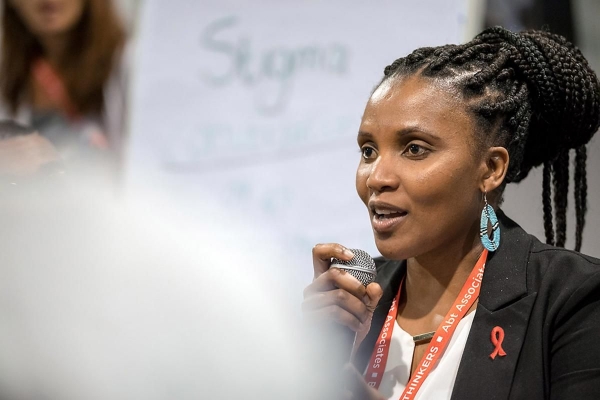
The LWF programme director at the New York office reviews the conclusions of the UN Commission on the Status of Women
A month after the 65th session of the UN Commission on the Status of Women, the work of the Lutheran delegates has only just begun in their home countries. Their task is to monitor, implement and remind their governments of the conclusions adopted by the commission.
“The work at the UN Commission on the Status of Women does not end,” says Christine Mangale, director of the New York Lutheran Office for World Community. “Now the main focus shifts to monitoring at the national level and cooperation with governments. As long as we keep asking questions, they know that we are following up, but otherwise they simply ignore the work.”
After the online meeting of 15-26 March, governments signed the Agreed Conclusions, which are the key document based on the theme of this year’s session: women’s full and effective participation and decision-making in public life. The closing document includes recommendations for specific measures to achieve this goal, ranging from changing discriminatory laws and policies to protecting human rights defenders and increasing young women’s access to education, technology and skills development through mentoring and financial support.
The language of women’s human rights
However, the negotiations did not go easily, and some countries tried to water down the language on women’s rights that had already been agreed upon in previous international negotiations. “This year we hoped that the COVID-19 situation would expose inequality and manifestations of discrimination, but the old battles continued,” says Mangale, who coordinates the Lutheran World Federation (LWF) delegation at the annual sessions of the UN Commission on the Status of Women.
“Some delegations tried to block the mention of women’s human rights defenders, seeing such language as interference in internal affairs or claiming that it was not an issue in their countries,” she notes. “Some even objected to speaking about women with disabilities or indigenous women, and there was no discussion of intimate partner violence in the context of the pandemic,” she continues. “Although there is much evidence and empirical data showing that much of the violence against women and girls is committed by spouses, partners or family members,” she adds, “some countries prefer to regard it as a private rather than a public matter.”
This year, the LWF participants were hindered by the fact that personal meetings with government delegates were not possible. “Usually we meet with them, sit down and ask them to insist on specific issues,” Mangale recounts. The LWF strives to “shape global policy that affects us at the national and local level”, but “how can we make sure that our voice is heard in this huge virtual gathering of more than 10,000 people?” she asks. Another problem for some LWF delegates was the cost of internet connections, which meant that online participation was limited.
“At present, the main task is the implementation of the Agreed Conclusions at the national level,” Mangale emphasizes. “Our delegates must hold governments accountable, ask what they plan to do, how churches can work with them? Otherwise we are only producing fine documents to gather dust in archives,” she concludes.
Nevertheless, the LWF delegation at the 65th session of the UN Commission on the Status of Women was considerably larger than in previous years. Usually about 30 delegates gather in New York, but this year 70 participants attended the online events. “We managed to bring together a diverse group of women and a few men from various churches with rich experience,” says Mangale. “Our ‘World Service Country Program’ colleagues also joined the common humanitarian appeal,” she adds.
Born and raised in Kenya “in a family of very strong women”, Mangale has lived in New York since 2008. The Evangelical Lutheran Church in America provided her with financial support to complete her college education, and since then she has helped shape the LWF’s gender equality work. She is convinced that transformation takes place in local congregations just as much as on the international stage. “Women are the main pillars of our congregations, so here the work takes root through the exchange of stories and experiences,” she says.
“Women can confront barriers to leadership in their communities, they can engage local councillors, take up the office of village elder or become members of parliament and be part of the process of change.”
“At present, the main task is the implementation of the Agreed Conclusions at the national level,” Mangale emphasizes. “Our delegates must hold governments accountable, ask what they plan to do, how churches can work with them? Otherwise we are only producing fine documents to gather dust in archives,” she concludes.
The 2022 session of the UN Commission on the Status of Women will focus on the question of achieving gender equality and the empowerment of women and girls in the context of climate change.
New York, USA/Geneva
| 22/4/2021
Photo: LWF/P. HitchenSource: Lutheran World Federation news