
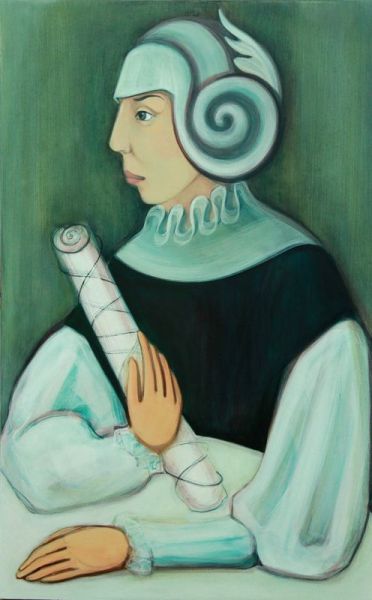
We would like to tell you about one more Reformation woman who lived in Central Germany in the first half of the 16th century. With this we will also conclude our story about the women reformers of Central Germany.
Ursula Weida
Ursula Weida lived from 1510 to 1565.
In the historical archives, Ursula is also known by the following names: Ursula Behm, Ursula Pehem, Ursula von Schöppritz, Ursula Weida, Ursula Weydin, Ursula von Zschöpperitz.
Ursula Weida came from the noble Zschöpperitz (Zschöpperitz) family, who lived in Altenburg and were connected with the princely court (Fürstenhof). Ursula’s father, Heinrich, was a ducal officer. After the death of her mother, Apollonia, Ursula was sent to serve at the Altenburg court (Altenburger Hof). At the court, Ursula obtained an education that was very good even for a 16th-century woman. The pamphlet that Ursula published in 1524 under the title “Wyder das unchristlich schreyben un Lesterbuch des Apts Simon zu Pegaw unnd seyner Brüder ” demonstrates that the young woman was able not only to read and write, but also mastered the art of rhetoric. Ursula wrote such a pamphlet at a time when she was already married to the court (or castle) administrator of Eisenberg, Johann Weyda (Johann Weyda). The office of court administrator was at that time the highest office one could hold in the entire city of Eisenberg and the surrounding 59 districts. Ursula called herself “Schösserin zu Eyssenbergk,” attributing to herself the title of her husband’s office.
In the later years of her marriage, Ursula came into contact with the Reformation. Her husband, by order of the Duke of Saxony, began in 1524 to introduce the Reformation in the Cistercian monastery of Eisenberg. Johann Weyda also had personal contacts with Luther. In his domain he introduced the ideas of the Reformation, for example by releasing the monastery’s inhabitants and marrying off the priests. The new situation also gave women, who until then had been in enclosed educational institutions, the opportunity to take part in spreading the Reformation as readers and authors of writings, publishing small pamphlets. Ursula did precisely that.
Ursula was captivated by Luther’s writings. She also read Luther’s translation of the New Testament. We can tell this from the New Testament quotations she used in her writing. In her pamphlet, Ursula responded to Luther’s work Responsio ad Catharinum, in which he had interpreted 1 Corinthians 7. In addition, Ursula also quoted the prophets of the Old Testament, who challenged the social situation of their time. In 1541, Johann Weyda died. Ursula married the Altenburg nobleman Franz Pehem (Franz Pehem) and again moved to live in Altenburg. There Ursula cared for Pehem’s three children from his first marriage. Ursula became a widow for the second time in 1558 and remained in Altenburg, where she was last recorded in 1566.
In the first half of 1524, a pamphlet written against the Lutheran faith reached Ursula, titled “The Destruction and Ruin of the Land and the People,” which had been signed as author by the Abbot of Pegau, Simon Blich (Pegauer Abbot Simon Blich). Ursula felt that she had to respond publicly to this writing, and she wrote a pamphlet in reply, which was published in the summer of the same year. The material written by a medieval woman did not go unnoticed. Of all the pamphlets that women wrote during the Reformation, the only two responses were written to Ursula Weida’s pamphlet (as we mentioned in earlier articles – in the Middle Ages men did not consider it necessary to respond to a woman’s expressed opinion about anything, especially about theology). Noteworthy is the fact that one of these two responses defends Ursula Weida’s view. The other, written under a pseudonym, argues against the woman’s arguments. Both treatises were published under a pseudonym. The author of the second treatise, who calls himself Henricus PVH, uses the same arguments that had been set out in the original pamphlet “The Destruction and Ruin of the Land and the People,” which was directed against the Lutheran faith and to which Ursula responded. This leads to the conclusion that the anonymous author was most likely one of the circle of the Pegau Abbot Simon Blich.
The reply, “A Response Against the Christian Book,” is directed not only against Ursula Weida, but against women in general – mentioning in particular that women do not follow the Scriptures, which say that they must keep silent and be subject to men. To prove the “wickedness” of women, the author draws on several examples from the Bible, beginning with Eve, Jezebel and ending with Herodias, whose desire to obtain the head of John the Baptist (Matt. 14:1–12) leads the author to conclude that women in general are ungodly.
It is telling that the author had read not only Ursula Weida’s pamphlet, but also the writing of Argula von Grumbach. This indicates that the works written by women were indeed well distributed. The author categorically claims that Luther’s doctrine is the work of Satan, leading people away from the true faith. He accuses the women who defend Luther’s ideas of sexual interests (possibly in connection with the closing of the monasteries). In this context, the author mentions not only the monks who left the monasteries, but also theology students. The reply treatise is written in an unusually sharp tone, even for medieval vocabulary. This only shows how deeply offended the opponents of the Reformation ideas felt.
It is possible that it was precisely the sharp polemical tone of the treatise against Ursula Weida and women in general that motivated someone, signing under the pseudonym Contz Drometers von Niclasshausen, to write an apologetic work, “Apologia Für die Schösserin zu Eysenbergk.” It was certainly not Ursula herself, because the treatise contains different theological nuances. What is interesting is that the author also stands up for women, arguing on the basis of the text of the prophet Joel, chapter 3, that the Spirit is promised to women and that they will prophesy. Mary’s song about social equality is also mentioned, as well as the daughters of Philip, who prophesied (Acts 21:9).
We can conclude that already in the 16th century there were thinkers who supported women who, like Ursula Weida, wrote publications and stood up for the gospel. Ursula Weida quite simply applied to herself Luther’s doctrine of the priesthood of all believers, and therefore found within herself the courage to stand up publicly for the Lutheran faith. Ursula Weida began her pamphlet with the words that she had decided to write, because the Christian Luther does not have time to answer every donkey.
In the painting, Ursula is depicted with her pamphlet. Image: painter Mariana Lepadus
http://www.lepadus-kunst.de/kursevortraege.htm
Read about other Reformation women in our articles below:
Argula von Grumbach: the first woman reformer, a Bible scholar
Reformation women in Central Germany, Part I
Reformation women in Central Germany, Part II
Reformation women in Central Germany, Part III
Reformation women in Central Germany, Part IV
Reformation women in Central Germany, Part V – Anna von Mansfeld
Aļesja Lavrinoviča