
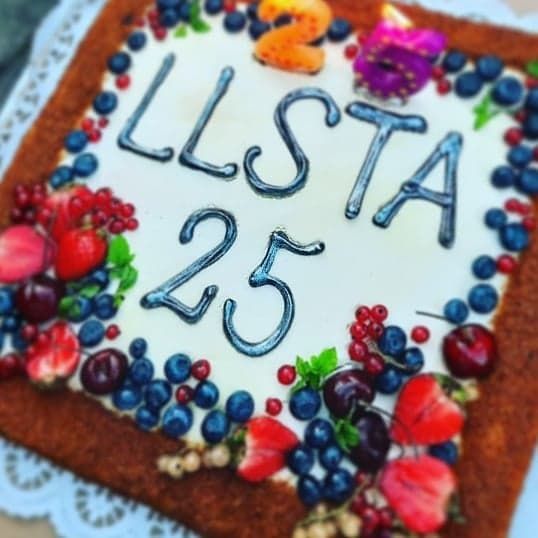
On 17 July of this year, the Latvian Lutheran Women Theologians’ Association marked its 25th anniversary!
The festive worship service and celebration took place in the garden of deacon Vija Klīve, the location of the association’s registered legal address. The founding of the association itself is closely connected with Vija Klīve, because it was precisely 25 years ago that the Latvian Lutheran Women Theologians’ Association was founded at Vija Klīve’s home.

The celebration began with a worship service in the home’s yard, and the liturgy of Holy Communion was led by Pastor Vaira Bitēna, who is one of the first women ordained as pastors in Latvia, and Pastor Dace Balode, who was ordained in the summer of 2018 – though not in the Evangelical Lutheran Church of Latvia, but in the Evangelical Lutheran Church of Latvia Abroad, for service in Latvia.

With the help of modern technology, the worship service was joined by the archbishop of the Evangelical Lutheran Church of Latvia Abroad, Lauma Zušēvica, who congratulated the association on its anniversary, as well as Pastor Indra Skuja-Grīslis, who serves in Canada, Latvian pastor Sandra Rozenberga-Saavedra, who serves in Chile, and also Pastor Austra Reine, an American Latvian, who once proposed the idea of founding the LLSTA. Attending the celebration in person was the dean of the Latvia precinct of the LELBĀL, Kārlis Žols.
Over the course of the evening, theologian Ieva Zeiferte spoke about the beginnings of the LLSTA’s founding, the first years of its work, the challenges, and the enduring hopes for women’s ordination in Latvia. These hopes were the foundation of the LLSTA’s founding in 1995; even though at times they faltered due to resistance and the ignoring of theological dialogue, they have driven the association forward – to educate itself, to develop, to gain a voice in society – both in the person of the LLSTA’s longtime president, advocate for women’s ordination, prison chaplain, and now pastor Rudīte Losāne, and in the person of the dean of the Faculty of Theology of the University of Latvia, New Testament professor, and pastor Dace Balode, who once became the first woman dean at the Faculty of Theology of the University of Latvia, and also in the person of bishop emerita of the Lutheran Church of Great Britain Jāna Jēruma-Grīnberga, who, since returning from Great Britain, served as a chaplain at the Anglican Church in Riga, and who, since the beginning of this year, leads the work of the LLSTA board.
Looking back on the 25 years that have passed, it seems that the road has been hard and thorny; for several women, the LELB’s theological stance of not ordaining women, but most of all the contemptuous and dismissive attitude toward the existing women pastors, has caused pain and left scars. Many Latvian women were forced to leave their homeland and go to serve in other countries. The deacons and evangelists who remained in Latvia were forced to change their specialization, because the doors of the church were closed to women, until at the 2016 Synod women’s ordination in the Evangelical Lutheran Church of Latvia was forbidden altogether.
However, since 2014, three women have been ordained as pastors in Latvia. In 2014 Ieva Puriņa was ordained in Latvia. In 2018 Dace Balode was ordained. In 2019 Rudīte Losāne was ordained. How is this possible? When one door is closed, God opens other doors. He makes a way where there has been no way. All three pastors were ordained in the LELBĀL – the Evangelical Lutheran Church of Latvia Abroad. The LELBĀL is the heir of the pre-war Latvian church, whose leadership – the archbishop with the entire staff of office – emigrated from Latvia when Soviet rule came to Latvia. Throughout all these years the LELBĀL has called itself the Latvian church in exile.

Since Latvia regained its independence in 1991, both Latvian churches conducted dialogue talks about a possible unification into one – the Latvian Lutheran Church. The question of women’s ordination became the main stumbling block when, in 1993, a new archbishop was elected in the Evangelical Lutheran Church of Latvia, who positioned himself against women’s ordination.
The unification still has not taken place. At present the LELBĀL is led by the American Latvian Lauma Zušēvica – a woman archbishop – who supports the LLSTA’s vision and work. In Latvia there is a precinct of the LELBĀL, and the church once driven out by Soviet rule is gradually returning to its homeland. Each time Archbishop Lauma Zušēvica visits Latvia, she meets with women theologians to encourage them to continue the work they have begun. The LLSTA unites around 40 Latvian women theologians.
The 25th anniversary celebration was an event that will long remain in memory – a story that speaks, moves, inspires, prompts reflection, and drives one forward.
The archival material added below offers a small insight into the manner of communication between the LELB archbishop and the LLSTA. As early as 1995, the archbishop did not directly answer the LLSTA’s question about women’s ordination, or, as the LLSTA’s letter asks, about the ordained priesthood. In interviews in the mass media, Jānis Vanags had indeed mentioned that those women who want to serve as pastors may do so outside Latvia. Over the following years, the LELB Consistory, headed by the archbishop, has ignored the LLSTA’s calls for a respectful theological dialogue.


LLSTA editorial team
Photo: LLSTA