
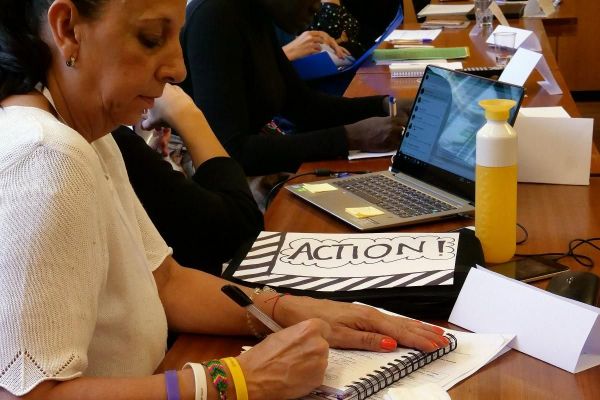
Photo caption: Survivors of sexual violence during armed conflict take part in a three-day training program in Geneva and call for an end to the impunity, stigmatization and silencing associated with these crimes.
Photo: LWF/L. Gillabert
Rape survivors bring a message of resistance and prevention at a film screening in Geneva
Geneva, Switzerland
29.11.2019.
SEMA is a Swahili word that means “to speak out.” It is also the word chosen by an international movement that brings together survivors of rape and sexual violence during armed conflict. Its members demand justice and call for an end to the stigmatization associated with this cruel crime.
On 28 November, a group of women representing the national SEMA networks in the Democratic Republic of the Congo, South Sudan, Uganda, Burundi and Colombia shared personal testimonies at a public event at the University of Geneva. They took part in a panel discussion that followed a screening of a film written, performed and directed by women and men who were raped in the war-torn east of the Congo.
Ed. note: SEMA – a global network of victims and survivors of sexual violence working to end violence during armed conflict (Global Network of Victims and Survivors to End Wartime Sexual Violence – the name in English).
The event, which formed part of a three-day training program for SEMA members, received support from the Lutheran World Federation (LWF) and the Mukwege Foundation, founded by Nobel Peace Prize laureate Dr. Denis Mukwege. The film shows the various ways in which survivors continue to experience the lasting consequences of their devastating physical injuries, as well as psychological and emotional trauma, including loss of livelihood and rejection within family and community. Read the description of the film here.
The LWF and the Mukwege Foundation support survivors
Tatiana, who comes from a small village in the east of the Congo, coordinates the survivors’ network in her country and is one of the co-authors of the film’s screenplay. She also has a role in the film alongside one of her four children, a boy who was born as a result of the rape she experienced. Despite having been so closely involved in the three-week production, she cries every time she watches the film together with her sisters.

“Making the film was the first step toward overcoming the silence and the stigmatization,” says Tatiana. “Many women, but also some men, took part in making the film, because men also suffer from sexual violence in the Congo,” she notes. “It is important to support them, because they are stigmatized even more, but they hide their anger and pain, which destroys our communities.”
Founded only two years ago, the Congo network now includes 3,300 members working in five of the most affected provinces. The goal is to help all survivors gain access to the urgently needed physical and spiritual care, so that they can begin the long process of healing. Some also find the courage to denounce the perpetrators, but impunity and corruption are widespread.
Impunity, corruption, fear
Tatiana explains that another problem is that many survivors are offered “friendly settlements,” such as a few goats, to make them stop demanding justice. “Sometimes families accept this, because they have no trust in the justice system and are afraid of the consequences,” she adds.
Angela, from Colombia, leads the survivors’ network in her country, helping to draw attention to women and to restore their dignity by developing leadership skills. Impunity is a major problem here too. She says that rape cases are often handled with “unimaginable cynicism” and that there is a secret arrangement between criminals and officials of the legal system.
We want everyone to acknowledge that we are not to blame for what has happened to us. – Angela, survivor, activist and director of SEMA’s national network in Colombia
SEMA currently includes members from 21 countries, representing many different cultures, languages and religious traditions. “But we all share one experience, which we live with every day in our bodies, our minds, our communities,” says Angela. “We have to eradicate stigmatization, and we need every kind of support, including physical, emotional and economic. We want everyone to acknowledge that we are not to blame for what has happened to us.
Other survivors are less open about their work or their experience, citing cases in which family members faced threats, harassment or even death in order to stop women from being able to speak out. Many countries still do not recognize rape as a crime and a method of war. “But there will be no peace or reconciliation for us if we do not speak the truth in our own countries,” one of them insisted.
The impact of the curse of sexual violence on relationships between generations is another important concern in the eyes of SEMA members. Just as they seek healing, justice and reparations, they also want to stop the cycle of violence by educating children so that “they understand, in their very DNA, that violence is unacceptable and wrong.” They urge people in all countries and all walks of life to become part of the prevention campaign by spreading this message and supporting their work.
Despite the hardships that survivors experience every day, the film deliberately ends on a hopeful note, with the boy telling his mother that when he grows up he will be good and helpful toward her and toward all women. Rather than focusing on past experience, the foremost wish of these resilient and determined women is to save future generations from the cruelty that they have endured.
Source: The Lutheran World Federation news
Photo: LWF/L. Gillabert