
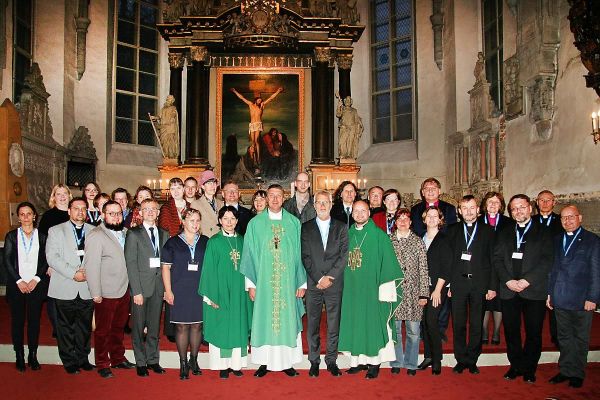
A leaders’ consultation offers opportunities to reflect on contexts, possibilities and hopes
Tallinn, Estonia/Geneva
6.11.2019.
Churches must ensure that the faithful and the church itself are not pushed into privacy behind the walls of the church and away from the public space, said Urmas Viilma, the Lutheran World Federation (LWF) Vice-President for Central and Eastern Europe and Archbishop of the Estonian Evangelical Lutheran Church, who hosted the 2019 meeting of Central and Eastern European church leaders.
“The conference of Central and Eastern European church leaders is especially important, because the churches do not have many opportunities to come together,” says the LWF Europe Regional Secretary, Rev. Dr. Ireneusz Lukas. He added that the region may seem relatively homogeneous at first glance, but the situation in each of the churches and countries is markedly different.
The meeting, titled “Diversity and identity – different gifts, but the same Spirit… (1 Cor. 12:4-6)”, was held from 28 to 30 October in Tallinn, Estonia, and offered space for reflection on the particular situation and challenges, but also on the gifts that the region can share with the rest of Europe and the whole [church] communion.
Lutheran identities
Presentations and discussions about Lutheran confessional identity, diversity and pneumatology (the understanding of the Holy Spirit) were at the center of the meeting. Inspired by the recent conference “We believe in the Holy Spirit: Global Perspectives on Lutheran Identities” in Addis Ababa, Ethiopia, Rev. Anne Burghardt (Estonian Evangelical Lutheran Church) gave a summary of the meeting, which many participants described as inspiring and dynamic.
She referred to the 2015 study The Self-Understanding of the Lutheran Communion, which describes the LWF communion as both a gift and a challenge. Building on this, the meeting’s participants turned to the question “What does it mean to be a Lutheran today?” pneumatologically. The questions gathered in the course of the consultation will become a research instrument for the continuing studies on Lutheran identity.
Connecting these themes with the Central and Eastern European context, Burghardt said: “The fact that our churches have lived under communism has given us the particular heritage of being critical of the usual ecumenical language about peace and justice,” adding that it has often been used dishonestly. The challenge for the region would be to consistently overcome skepticism in order to be able to actively transform society.
Speaking about the inner connection of ecclesiology (the understanding of the church) with pneumatology, she observes that the churches of Central and Eastern Europe place emphasis on personal piety, losing the opportunity to create a community of believers who together form the ecclesia.
A third remark touches on the role of the gifts of the Spirit and the role of the Holy Spirit in Lutheran theology. “When we are able to develop a coherent theology of the gifts of the Spirit, we will be able to live out more fully our Lutheran conviction about the priesthood of all believers,” Burghardt is convinced.
Rev. Dr. Elfriede Dörr (Evangelical Church of the Augsburg Confession in Romania), who also took part in the Addis Ababa conference, praised the ideas presented and encouraged the LWF member churches to bear them in mind when answering the survey questions that the LWF will draw up once the results have been compiled.
Being churches in the public space
The diversity of the LWF member churches in Central and Eastern Europe became clearly visible during a panel discussion devoted to the role of the church in the public space.
Outlining the situation in Poland, a country with a Catholic majority, Bishop Jerzy Samiec (Evangelical Church of the Augsburg Confession in Poland) explained how a minority Lutheran church raises its voice in public debates. “Poland is divided into two camps,” says Samiec. On one side are the conservatives, who are now in power, and on the other side is a diverse opposition. The opposition is convinced that several decisions adopted by the Sejm, the lower house of the Polish parliament, violate Poland’s constitutional order. This situation leads to fierce disputes.
Samiec outlined the church’s dilemma: when must church leaders speak about such events, and when is the church interfering in politics? One criterion is to protect the weakest, often various minorities. Another means is to try to persuade politicians to engage in political debate, rather than remain stuck in disputes, rudeness and slander. Samiec addressed such a proposal to Poland’s President Andrzej Duda, saying that politicians who express mutual hatred have a negative effect on society. The death of Gdańsk Mayor Paweł Adamowicz at the beginning of the year is one of the results of this situation. The final criterion, which must be clearly affirmed, is that to preach the gospel means to preach love. “Aggression and hate speech under the banner of defending the Church of Christ is not Christianity,” Samiec is convinced.
Dr. Klára Tarr Cselovszky (Evangelical Lutheran Church in Hungary) spoke about the careful steps that the small church has taken in the public space since the fall of the Iron Curtain in 1989. Before that, the church had for a long time no presence at all in the public space. “We are building up our presence in the social and educational sphere, maintaining a critical solidarity with the state and society,” says Dr. Cselovszky. “That is why it is very important to be trustworthy and coherent.” However, the problematic questions of the past must be dealt with. For this reason a commission has been set up to analyze cooperation with the state, such as the secret police, during the time of communist rule.
With 34 percent of the population affiliated, the Evangelical Lutheran Church of Latvia forms the largest religious community in the country. Archbishop Jānis Vanags’ fundamental question in this context is “how much should the church involve itself in the political life of society?” His church looks back on repression and persecution during the Soviet era, as a result of which up to 80 percent of the clergy were deported or killed. Since 1987 the movement “Rebirth and Renewal“, to which Vanags belonged, fought for the liberation of the church from Soviet influence. Today the church has access to public space and high recognition in society. This brings new challenges with it – to the point that in 2000 Vanags refused to preach at the 18 November ecumenical service, in protest against corruption among government officials.
Theological education and the calling of pastors
Training pastors is a complex but urgently important task in a region without a single unifying language, with small churches and differing contexts. After a visit to the Theological Institute of Tallinn and presentations on the topic by Rev. Dr. Elfriede Dörr (Evangelical Lutheran Church of the Augsburg Confession in Romania), Dr. Jerzy Samiec (Evangelical Church of the Augsburg Confession in Poland) and Anton Tikhomirov (Union of Evangelical Lutheran Churches in Russia and Other States), participants discussed possibilities for closer cooperation within the region and with other partners, as well as new digital training technologies.
During the final session, in a summary of the Tallinn meeting, Archbishop Viilma emphasized that all churches in the region must open up and make use of all the gifts of the Holy Spirit. Speaking about the role of the church in the public space, Bishop Dr. Tamás Fabiny (Evangelical Lutheran Church in Hungary) said that “churches must always be present, but should speak only when it is necessary.” He also emphasized the role and importance of communication networks for minority churches, which “remain an important tool for building bridges across completely different contexts.” LWF Council member Vera Tkach (Union of Evangelical Lutheran Churches in Russia and Other States) emphasized the importance of the Central and Eastern European meeting – where the specific problems that are relevant across the whole region can be told and discussed.