

Aļesja Lavrinoviča, editor of the LLSTA website, talks with Zilgme Eglīte, a Lutheran pastor in the Church of Sweden. We are at Zilgme’s home. Outside there are horses, dogs, hens, roosters, the Swedish countryside and snow. You can only reach the nearest town by car.
Have you ever heard reproaches about being a woman and not being allowed to do something?
No. At first it was a little unusual for me to get used to the fact that absolutely no one had any doubts or questions about my being a woman and a pastor – it is taken for granted. It is not at all something that could be debated. I am a pastor, and that’s that. Especially when I started work in a small rural village and I was the person who lived there and was their pastor. It mattered to them. “You are our pastor, and that’s that. It’s wonderful that you have come to us and will now care for us.”
Do you remember your studies in Riga? What was the atmosphere like?
I began my studies in 1990. The first year was at the Theological Seminary. After that, two courses were combined and we became part of the Faculty of Theology and automatically ended up in the second year of the Faculty of Theology. We were the first graduating class of the restored Faculty of Theology in 1993.
How were you received there? You are a woman, and what are you doing in the Faculty of Theology?
No one came after me personally. During our studies there were often discussions – both for and against. I know that many women experienced people saying something to them personally to make them give up the idea of a pastoral career. But I did not particularly experience that myself.
There was one incident, though, when a professor, Mr. Feldmanis, once came up to me between lectures at the Theological Seminary and said in a kind of sepulchral voice: “Girls, come to your senses!” That this was not girls’ mission.
«But in that year of 1993, he [Archbishop Vanags] represented the minority view that a woman cannot be a pastor.»
And Akmentiņš, the first dean of the restored Faculty of Theology?
Akmentiņš had nothing against it. None of the other lecturers said anything either.
At that time it had not yet become a standard or a norm. It became the norm much later, when [Archbishop] Vanags, with his Theological Institute, fostered an appropriate environment and invited lecturers who were against women pastors. But when we began our studies, women were admitted. There were several of us women in the course, and all of us were studying with the intention of becoming pastors. It was nothing hidden or forbidden. Akmentiņš’s vice-dean was Juris Rubenis, who was also not against women. Then there were also lecturers such as Pauls Žibeiks and a few others from the old days, who came from the old, liberal Latvian school of theology. So you could say that for the majority of the lecturers (around 80%) it was a normal thing for women to become pastors in the Lutheran church.
There were a few, including Feldmanis and Vanags (who began giving lectures himself), who were conservatives. But at that time, while Jānis Vanags was not yet a bishop, he did not say anything loudly against women.
As theology students at that time, we often served in congregations. There was a brotherhood among us, and we supported one another. When I began studying theology, I also often worked on the side – I played the organ on Sundays and led services. I have led a service together with Pastor Vanags, a Cemetery Festival, and I have played as an organist together with him. Cooperating in that way and at the same time being a theology student studying to become a pastor, he never commented that I should not be allowed to do something or that I should not become a pastor. Jānis Vanags demonstrated his attitude later, when he was elected bishop. Only then, when he was elected, did he say that he was against it. He had said that it was against his conscience to ordain women, but that he would not forbid the existing women pastors from serving and would also try to find a solution for those theology students who wished to become pastors, so that they could be ordained. He simply would not do it himself, but he had nothing against another bishop doing it. Such was J. Vanags’s position at that moment and for several more years afterward.
And then he gathered more and more like-minded people around himself and consolidated his position, educating and training new pastors in his new Theological Seminary with the support of lecturers from the Missouri [Synod] and the German conservative church – pastors who all adhere to this line. But in that year of 1993, he represented the minority view that a woman cannot be a pastor.
Why did you choose to study theology?
It all began with the fact that I did not grow up in a Christian family. And my parents never talked about it at all. At home we had albums with photographs of how things had been in the old days. And I saw beautiful pictures where my grandmother had been confirmed, girls standing in white dresses. And my mother’s sister had been confirmed, again girls in white dresses. My mother had not been confirmed. My mother was born after the war, in Soviet times, which is probably why she was no longer confirmed. But my grandmother and my mother’s older sister had been confirmed. I always thought that I too would want to be confirmed when I turned 18. When I turned 18, I went to Torņakalns Church, where there was Pastor Gailītis, who was not yet archbishop then but only a parish pastor. I told him that I wanted to be confirmed. At that time Christian literature was also not available. Only afterward, with a great deal of searching, did I find my first Bible and begin to read. I went to Pastor Gailītis and said that I wanted to know more, read more, learn more. I had heard that you could attend the Theological Seminary as an auditor. And I asked the pastor whether I could come and listen as an auditor. To which he replied, why didn’t I study for real instead of going as an auditor. That was on the one hand. On the other hand, it was the attitude and mood in the Luther congregation that prevailed in [Pastor] Gailītis’s time, that I wanted to do anything in the church: whether to play the organ, work with children or wash the floor, or step up to the pulpit and preach, and lead the service, because there were few workers and a shortage of pastors. In the congregation led by Gailītis, there was no discussion at all about whether a woman could or could not. It was taken for granted.
And why did I go to church at all and want to be confirmed? I saw it as an alternative culture to the existing Soviet culture in which we grew up. I also saw that in 1988 groups began to meet in Torņakalns, for example the Green Movement – the Environmental Protection Club, and the Latvian National Independence Movement. That was still at a time when most people were afraid to express their political views, and the church was the place where brave people gathered, who met and were not afraid that there might again be repressions and deportations to Siberia. There were people there who had different values, faith, courage, the courage to change things. People did not come to church in crowds; back then there were small handfuls. Those who were there were very friendly and warm among themselves, thinking of others. That is why I wanted to be in the church – one that is brave, where people are friendly toward one another, where they care for those whom society had neglected. That was the church I wanted to be in, and to be a pastor.
Was there a moment when you decided that yes, I will become a pastor, this will be my calling, my work?
Yes. In that year of 1988 a lot happened – new organizations and parties were founded, as well as youth movements, including the scouts. I joined the scouts. When you join the scouts, you make a promise – to serve your homeland and God. Before I made this promise, I had to spend a whole day alone and reflect on this promise. For me it was a special time of reflection. The very idea of making a promise to serve God was something special for me. And that is how I understood it – to take part in the life of the congregation and to become a pastor is part of what I want to do in my life.
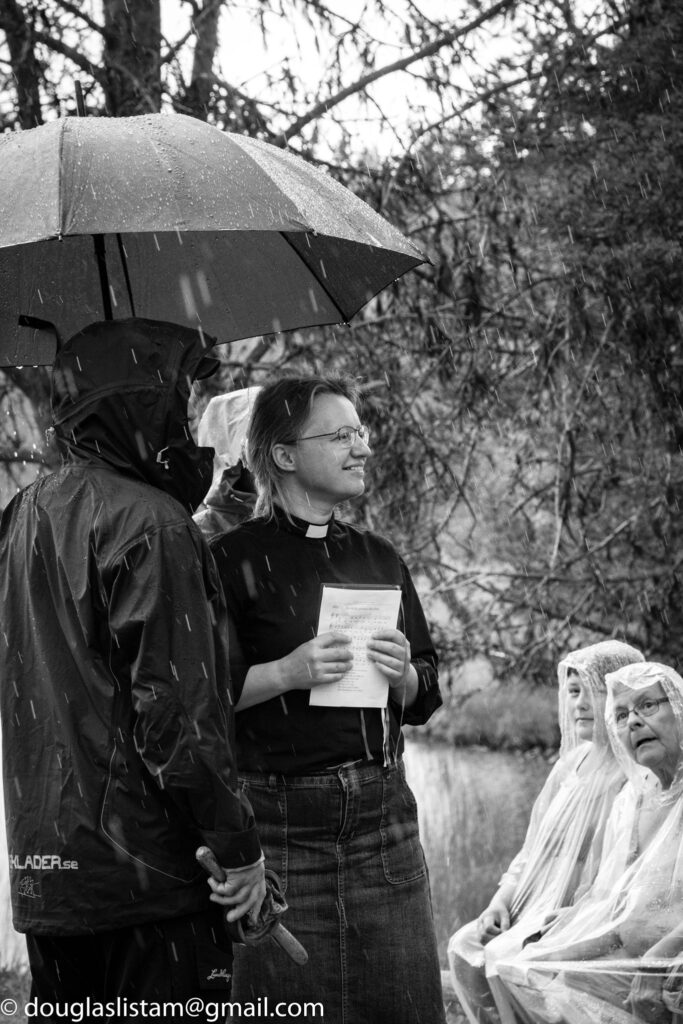
Photo: Pastor Zilgme Eglīte in Sweden
Why did you decide to go specifically to Sweden?
I was ready to go anywhere, but I had a small child, and that tied me a little more to Latvia. That is why I did not go to America, where I had thought of going to work in a Latvian congregation.
Going to Sweden happened almost by chance, or perhaps it was God’s guidance. In Latvia I worked at all sorts of things, not things connected with faith or the church or theology. And I also worked with Swedes when Latvia was preparing to join the European Union in 2004. I worked, for example, with Swedes from customs, who helped Latvian customs set up joint computer systems. In that way my contact with Swedes began, along with an interest in learning the Swedish language. With this working group, which had Latvians and Swedes in it, we traveled to northern Sweden, to the city of Luleå, to get to know how they work there. And at the same time I had the idea of whether, in Luleå in northern Sweden, I could establish contact with some representative of the Church of Sweden and perhaps talk about the possibility of eventually going to Sweden to work. And that is what happened. That is how my contacts arose specifically with the Church of Sweden. It was much closer to Latvia than America.
Tell us about the Lutherans in Sweden. What is their faith like? Do they have faith? Here in Latvia people talk about Scandinavians as secular, liberal and apostates from the Christian faith. What are the people you work with like?
Swedes themselves know and say that, according to statistics, Sweden is one of the most secular countries in the world. What is peculiar in Sweden is that there are very many people belonging to the church who pay the church levy, because it is paid through the tax system. So formally, on paper, those who pay the tax to the Church of Sweden are perhaps 60–70% of Sweden’s population. But that membership is mostly only on paper. Mostly because their parents belonged to the church. You cannot judge the number of active believers by that; there are far fewer. For Swedes the church is also a tradition, because in the past everyone who was born in Sweden was automatically a member of the Church of Sweden. At school they taught Christian doctrine, chorales, hymns. Almost everyone knew how to sing the hymns.
Those who come to services and congregational activities are believers. The tradition from the past is felt. It may be that some are not expressly believers, but they consider the church’s tradition to be important, so they want to support the work the church does by paying the tax to it. The Church of Sweden has a high ceiling – so as to include as many people as possible and to be more open to all.
Then there are different opinions at different levels of the church. There are the official opinions expressed by the archbishop, then the bishops and pastors, the congregation members. There is quite a big difference there. That great diversity is allowed. But there are core principles, first of all that more important than anything is God’s love, that God loves everyone, does not discriminate, and we proclaim such a faith. Second, that we try not to discriminate, neither by gender nor by anything else. And it makes no difference whether it is about women or men as pastors, or, for example, whether homosexual couples can marry or the like. The church’s official policy is inclusive. That does not mean that all congregation members always like it. The congregation members are very diverse.
What is the attitude toward the Bible? Toward a literal understanding of the Bible?
I have to say that there is no very strong tradition of Bible reading here. It can almost be compared to how it is in the Catholic Church. Not so many people read the Bible. Even the sermon and what the pastor says is more important than the biblical text itself.
What, in your view, has contributed to the position of the Evangelical Lutheran Church of Latvia being what it is now, compared with the time when you studied theology?
That the church has become more conservative? I think it is fear of what is different and the belief that, by preserving only the most conservative approach, we will preserve the church.
It is hard to say what exactly, because there are certain groups of people who have shaped this policy, while there are many who thought differently.
You mentioned that Jānis Vanags’s view of women pastors was a minority opinion; now it turns out that that minority has become the majority, because the others were silenced, or how?
The others are silenced, and Jānis Vanags has led the church very consistently so that pastors who are conservative are ordained and supported in their careers. Also changes in the whole [pastoral] education system. Because in the 1990s the idea was that the Faculty of Theology would train pastors. One turning point that Jānis Vanags made, once elected to the office of archbishop, was that he declared that no, the education obtained at the Faculty of Theology was no good, because it was supposedly too independent of the church, not subject to its influence. And he made changes.
In which year? In 1993 or 1994?
In the mid-nineties, when the Luther Academy was being formed. In 1993 and 1994 the Faculty of Theology was still the institution that trained the church’s pastors.
The Luther Academy was formed precisely so that the church itself could strictly determine what education future pastors receive, and also select the candidates. Because at a state university any students can be admitted, whereas at a church seminary you can require a recommendation from a pastor, so that the person is a faithful, regular congregation member and the like. It was a deliberate policy of ensuring that all clergy, all pastors, are selected: so that there would be no women there, so that those who think the way [the archbishop] wants would be formed there, educated the way he wants. This has been a period of about 25 years. Over the last 25 years all pastors have been trained only in this way, independent of the university, in a theological institute belonging to the church.
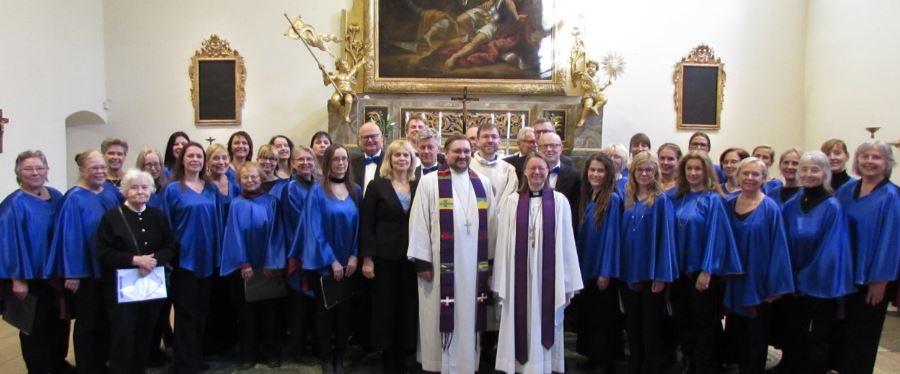
Photo: LELBĀL Synod, 18 March 2018. Dean Kārlis Žols of the Latvian district of the LELBĀL, Dean Zilgme Eglīte, Pastor Dr. Normunds Kamergrauzis together with the Stockholm Latvian choir. In front – choir conductor Sandra Leja Bojsten.
You work as a Lutheran pastor in Sweden. What is your everyday life as a pastor like? Is it just the Sunday sermon?
The Sunday sermon is only part of what we do. There are several of us pastors who lead the Sunday services, so we do not have to work every Sunday. On Sunday we have services in two churches – one pastor then travels to both churches, and the next Sunday the other travels to both. Apart from Sundays, all sorts of activities also take place during the week, because most of the congregation members we work with come to various sessions, conversation groups, or to drink tea and talk on various days of the week. For example, on Wednesdays older people have the chance to gather at the parish house, then we hold a prayer, sing and they eat lunch together. On Thursdays there is a Bible study group where those who want to read, discuss and learn something more gather. There is also a group attended by people who are interested in reading and discussing precisely those biblical texts that will be preached on Sunday in church. This gives people the chance to familiarize themselves with these biblical texts, and also lets the pastor hear what the congregation members think about these passages of Scripture. Then there is the work with confirmands – the work goes on throughout the year, almost every week. Various topics from the Bible are also discussed, understanding what exactly is relevant for young people. There are also discussions about love, sex, drugs. With such things the pastor is occupied from Monday to Friday.
In the Church of Sweden there is a different way in which we work with baptisms, confirmations and funerals. Here, if there is a funeral, a baptism or a wedding, the pastor meets with the family well in advance and discusses what will be done, what it means. If, for example, it is a baptism, then they discuss with the parents why they want to baptize, what it means to be a congregation member, what it means on the church’s part that the child is received in baptism in the church. All the practical actions are discussed, the whole service is gone through – what will happen, so that people know. We try to involve the family and the godparents in the baptismal service; they may read a biblical text. The parents may read a prayer of thanksgiving for having received their child. Perhaps one of the family members wishes to sing a song or recite a poem. We support such things, so that the service is personal to the particular family. If there is a funeral, then the pastor meets with the family, discusses the life of the deceased, how the funeral service will proceed, what music will be played, what chorales will be sung. Such a conversation has two purposes – on the one hand, to learn as much as possible about the deceased so that the service corresponds to the kind of person they were, and on the other, to give an opportunity for the care of souls for the grieving relatives – to talk, to express their thoughts and feelings about what has happened.
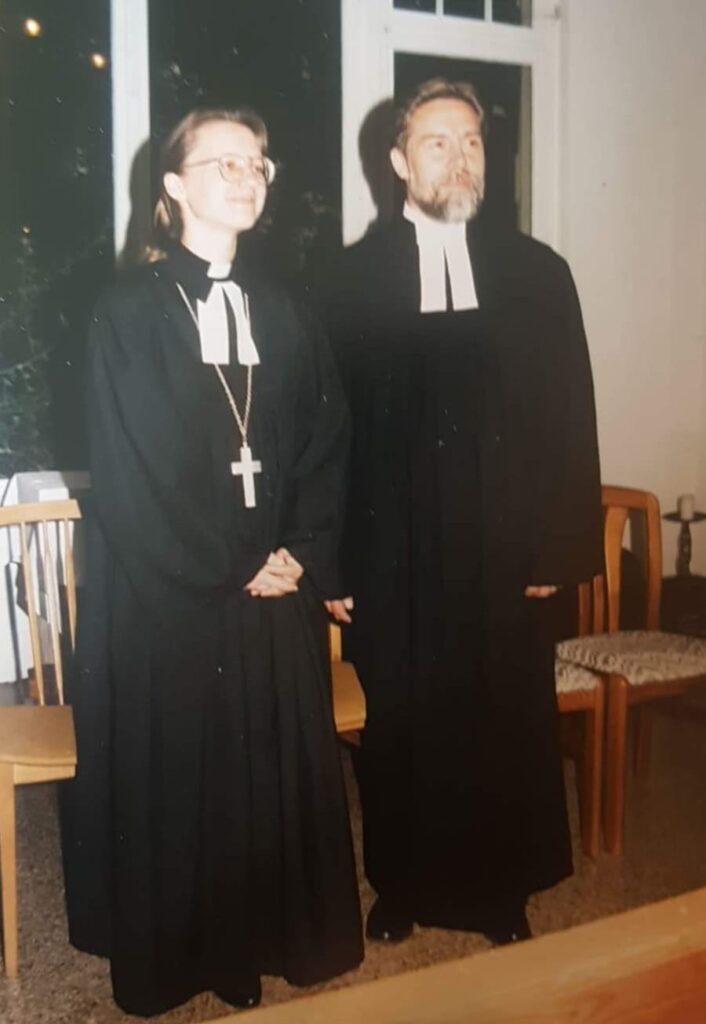
Photo: The ordination of Zilgme Eglīte and Pāvils Brūvers in 1995 (in Germany)
In Sweden there is currently a law that funerals must take place no later than a month after the time of death. In the past there was a longer period. Now a month is set. Swedes then are also in no hurry and prepare for the funeral for a long time. Most funerals take place about three weeks after the time of death. It is not like in Latvia, where funerals usually take place within a week or sooner. This also has to do with the high-quality equipment that is available in Sweden. Cremation is also very widespread nowadays. About nine out of ten people are cremated. A tradition is beginning to appear where the cremation takes place first and then a farewell service with the urn takes place in the church or chapel, because then it is easier to gather everyone for the funeral. Family members often travel from very distant places.
Is there work with immigrants?
Each congregation can decide for itself, assessing how many refugees or newcomers there are in it. Many congregations hold a “language café,” which newcomers can attend and practice speaking together with Swedes. In our congregation there is a workshop in which newcomer women also take part, including women from Islamic countries (if we work with newcomers, we do not discriminate by faith). As is known, Muslim women often cannot spend time together with men; there has to be a separate space where only women work. In such a workshop, women can come and practice sewing and do handicrafts. In this way we also work with the group of newcomers who have the greatest difficulty finding work and settling in Sweden. Through this workshop they have both a place to go and practice speaking Swedish, and also a place to work, to make something.
Before your ministry in Sweden, you ministered in Belgium with the Latvian diaspora. How did that work unfold?
One thing is to organize and hold a service. Another thing is to maintain contacts, to get to know the Latvians who arrive. Often they are not the kind who will immediately go to church, but they are glad to meet, to speak Latvian and to talk, say, about the difficulties they face in their new country of residence. In this way the congregation has the chance to organize meetings for these people, to give them the opportunity to meet, to be together, and also to offer to come to services, to get involved in the life of the congregation. If they wish, also to baptize their children. In order to reach Latvian-speaking families with children, we also organized children’s services.
What could you advise or wish for those women in Latvia who have studied theology, who have even been ordained as deaconesses, appointed as evangelists or chaplains, and also those girls who study theology and realize that no future in the church awaits them?
First of all, I admire them, all these girls, because it is courage, daring! Secondly, there is a risk of being overcome by disappointment and bitterness when a person sees that the church will not accept them as they are. The church will try to assign them a certain place where they cannot express their calling and their talents. Then there is a risk that a person becomes disappointed in herself or loses her self-confidence.
I am also glad for all the girls and women who go abroad – both to Latvian congregations and to others – and become pastors there. Because then it can be done in an environment where no one disputes whether a woman is even allowed to do it or not.
I hope that times will change. Perhaps the church will change. Perhaps the LELBĀL will gradually grow more in Latvia and the LELB will shrink. But the contemporary problem of Latvian society (and of any society in general) is secularization and how the church responds to it. And nowadays new ways have to be found for the church to continue to exist. This is a challenge both for more liberal and for more fundamentalist churches, but perhaps the question is not liberalism or fundamentalism, but something else: how to reach people to get involved? How to talk about faith?
If you had had the opportunity to be a pastor in Latvia, would you have taken it?
Yes, that was my goal from the start. And going somewhere else was only plan B, but first and foremost in Latvia, by all means.