
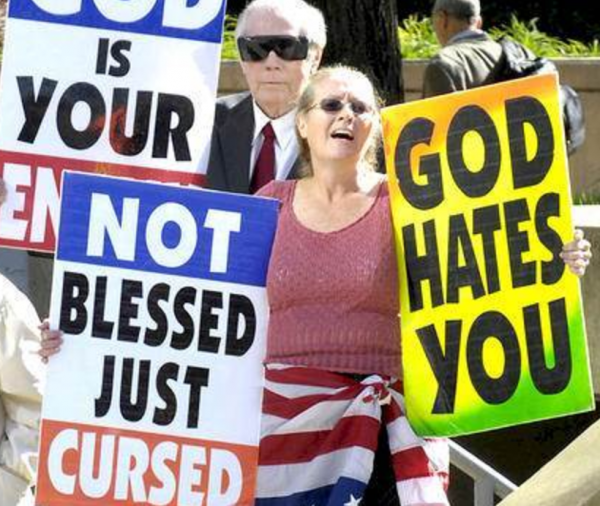
Protestant fundamentalism in the USA
The concept
“Fundamentalism” is a frequently contested concept, and very different phenomena are designated by the same word (e.g., the militant organization Hezbollah and the pacifist Amish community (Amisch))[1].
The word “fundamentalism” is nowadays used in connection with various phenomena, but it first appeared at the beginning of the 20th century in the English-speaking part of the world in connection with a specific series of writings, “The Fundamentals. A Testimony to the Truth” (The Fundamentals. A Testimony to the Truth) (USA 1910–1915)[2]. It was mentioned in 1920 in the Baptist newspaper “Watchman Examiner” (Watchman Examiner), where C. L. Law (LeeLaw)[3] sought to designate the conservative movement in American Protestantism whose stance was set out in this series of pamphlets[4].
Shortly thereafter the publishers of these writings founded the World’s Christian Fundamentals Association (1919), and so the concept of “fundamentalism” was at first associated with this kind of American Protestant Christianity[5].
It was, however, used less in a religious-theological connection and more to designate a social movement (especially – after the First World War), known in connection with Prohibition legislation. Its greatest achievement was the prohibition of the teaching of Darwin’s theory of evolution in schools in many US states.[6]
The word “fundamentalism” nowadays often has a negative connotation, but originally it was a self-designation with a positive meaning (“The Fundamentals”).
From the American Protestant context this concept was transferred also to other, similar phenomena in the contexts of other cultures and histories (e.g., to Islam)[7].
In the scholarly literature, alongside the term “fundamentalism” one finds “integrism” or “integralism” – referring to the Catholic variant of fundamentalism – the anti-modernist movement in the Catholic Church at the turn of the 19th/20th centuries[8], which on many points coincides with US Protestant fundamentalism (except for the “interests of hierocratic power”)[9].
Later the concept of “fundamentalism” has been used:
1) in the field of politics (especially when speaking of the Green Party, or the alternative green movement, also of Marxism)[10] – for forms of thinking, political concepts, and modes of conduct that are regarded as “civilization-critical positions in Western industrial society”[11];
2) when speaking of the religious-political “Islamism” in Iran in the 1970s (Khomeini), later also elsewhere, which was marked by an emphasis on the absolute truth of the sacred texts and their decisive role in all spheres of life, and by the union of religion and politics (with religious laws and rules determining political legislation and public life)[12];
3) in the religious field, designating the anti-modern or conservative currents in various religions[13];
4) the critical rationalists (H. Albert, K. Popper) in the 1960s used this word against those who believed that “in every field of inquiry there may be only one true theory, which must be incontrovertibly proven” (especially against logical positivism)[14].
Protestant fundamentalism in the USA
Its emergence and its factors
It should be noted that fundamentalism as a historical movement existed even before the emergence of this concept. As E. Geldbach notes, it formed in several Protestant denominations after the crisis created by the Civil War (1861–1865) and “is not identifiable with any one church, but is observable as a coalition, or an association with a particular purpose (Zweckverband)”[15]. A fundamentalist way of thinking, though without this name, but with the features of this movement, also existed earlier.
Early fundamentalism formed in the cities of the US east coast (and not in the countryside, as a contrast of urban Enlightenment thinking against rural traditionalism). In essence it had the function of a theory of knowledge, emphasizing the factuality of the Bible (a store house of facts), its authority, and its scientific correctness.[16]
The American Protestants of that time were confronted with two kinds of challenges: the necessity of responding to the worsened moral situation, on the one hand, and the modernization of religion resulting from modernism (pluralism, liberal theology), on the other.[17] Fundamentalism was “a religious movement that sought to identify and to resist everything that threatened to overthrow the old-style faith of the gospel”[18].
The reasons for the organization and mobilization of fundamentalism as a religious-theological movement of traditionalist Protestants were three parallel processes, each calling several articles of faith into question:
- A change in the perception of the world under the influence of Darwinism and Nietzsche’s relativism of the world.
- Historical-philological biblical criticism.
- The emphasis on the social dimension of the Christian message and the necessity of social reforms. (The Social Gospel (Social Gospel) as a reaction to social problems resulting from industrialization and urbanization)[19].
1. Modernism. The theory of evolution. Liberal theology
Darwinism overturned the notion of the world that had prevailed until then. It placed the biblical creation story, and with it the literal interpretation of the Bible, under a question mark (Social Darwinism even justified poverty and exploitation). Atheistic ideologies took shape[20].
In the 1870s the greater part of American scientists had accepted Darwin’s theory of evolution. (It was accepted quickly because it accorded with the prevailing American ideas of progress and development.) Yet evolutionary biology turned out to be a challenge to biblical religion: “Educated persons were forced to admit that Genesis (and thus any biblical text) does not contain [correct] factual information”[21]. This created a sense of contradiction and discord between the two views’ claims to “the right to truth not only with respect to information about the beginnings of life, but also between the reasoning methods of science and of biblical religion”. As a result, many acknowledged that the scientific method is a more reliable approach to factual knowledge, while continuing to recognize the value of the Bible as a source of moral instruction and spiritual guidance[22].
In defending the inerrancy of the Bible, the fundamentalists fought against Darwinism and developed creationism (see the chapter “Creationism”)[23].
Among the Protestants there were sharp disputes over the historical and philological criticism of the Bible. Some theologians took into account the new discoveries and standards of science; others remained with the traditional thinking and understanding[24].
Between 1880 and 1925 the cultural influence of liberal Protestantism reached its culmination. With the rapid development of the natural and social sciences, it “was preparing to enter the progressive era, where reason and faith would unite”, seeing “God’s providential Spirit at work in cultural progress all around”. The opposite reaction to this was fundamentalism. Standing against the general “scientific mood, they fought for the inerrancy of the biblical texts”[25] and for the necessity “to separate from the raging apostasies in secular culture and instead to remain faithful to the fundamentals of the biblical faith”[26].
In the last two decades of the 19th century, the natural and social sciences, biblical scholarship, and a growing awareness of cultures beyond Western civilization influenced American society. Together they created a new intellectual climate that strengthened the tendencies toward rationalism, secularism, and humanism that had been present in American thought since the Enlightenment[27].
The new biblical scholarship endangered its authority. As professors at seminaries and universities used historically and literarily critical methods to study the Bible, a notion of it took shape as “a work of many authors who collected, edited, and arranged their source materials according to their own, historically influenced, concepts of religious truth”[28]. In this way modern scholarship made it impossible to regard the Bible as “a revelation of God given once and for all”. Instead it was now understood as “a collection of ancient mythical writings whose original purpose was to testify to the author’s personal faith and not to convey factual information”[29]. A certain influence also came from acquaintance with other, non-Judeo-Christian cultures.
Thus a new and more relative understanding of morality and religious truth entered American intellectual thought[30].
The challenge of that time was the concord or contradiction between the modern world and religious faith. Liberal (or progressive) Protestant theology in the 19th century “turned the science of evolution into an exciting metaphor for God’s presence and activity in the world. The progressive evolution of life was seen as perfect testimony to the immanence of God’s providential Spirit”[31].
For example, L. Abbott (Abbott) understood God as “the necessary postulate for the evolutionary movement of life”[32] and believed that “the foundation of spiritual faith is neither in the church nor in the Bible, but in the spiritual consciousness of man”[33]. Developing further, liberal theology in some cases distanced itself from the Judeo-Christian tradition, bordering on pantheism.
Therefore in modernism a “serious threat to religious orthodoxy” was perceived – less in its secular manifestations than in its influence on the churches themselves[34].
2. Society
Modernism was not only an intellectual change; it also affected the social and cultural sphere[35].
The 19th century was characterized by the importance and significance of religion in society, even though the state and religious institutions were separated.[36]
Among American Protestants there reigned great optimism and a striving to “build” the kingdom of God. From the Revolution, America “had come forth as a new, providentially (God-) led Israel, to lead the world to political freedom and moral perfection”[37]. Its aim was to be “an example to the whole world, that democratic government and faith in the gospel can work in tandem to create a just commonwealth (commonwealth)”[38].
These efforts reached their culmination in the mid-19th century. It seemed that “evangelical piety and democratic institutions are perfectly suited to one another”[39]. Voluntary and other reform movements promoted the establishment of schools, hospitals, prisons, and charitable programs, as well as advocacy for women’s voting rights. Yet conflicts arose over the question of slavery, creating a split among Protestants (“an order ordained by God” or “a contradiction with God’s laws”) and soon also among citizens in general, which in 1861 led to the Civil War.[40]
Thirty years after the Civil War, America was affected by industrialization, urbanization, and immigration. There was rapid growth of the cities (especially – in the northeast: Boston, New York, Philadelphia). In them poverty, crime, and political conflicts emerged, thus causing a loss of hope in the ideal of a Christian state.[41] The values and norms of the big cities differed from those that had hitherto been characteristic of the small towns. As the central sign of society’s crisis, the fundamentalists saw the change in sexual morality – “the spread of immorality and passions”[42].
In the 1870s, the changes in moral standards and the social problems (poor living conditions, poverty, and consequently – alcoholism, prostitution, etc.) that arose as a result of rapid urbanization and waves of new immigrants caused the previously prevailing optimism about America as “the “promised land” on the historical road to the kingdom of God” to collapse[43].
Many immigrants (especially from the countries of southern and southeastern Europe) were Catholics, and the 19th-century popes (especially Pius (Pius) IX in 1864, the “Syllabus of Errors”) had condemned spheres very important in America: freedom of the press, freedom of conscience and religion, liberalism, etc. This was further reinforced by the First Vatican Council (1870) with the dogma of papal infallibility. Within a few years the Catholic Church grew into the largest single church in the USA, and the Protestant / evangelical churches (in the mood of general crisis) felt threatened.[44] Protestantism had also lost the social base it needed in order to realize its religious and moral notions in the rest of the nation.[45]
In response to the changes in religion, society, and also science, early fundamentalism arose as an interdenominational protest movement within various Protestant denominations (especially among the Baptists and Presbyterians of the northern USA)[46].
Several other parallel, different reactions to the situation of that time were: the Social Gospel, premillennialism and other eschatological movements, as well as the Pentecostal and charismatic movements[47].
= The Social Gospel (social gospel)
Many of the large denominations turned to the Social Gospel, which tried, with the ethic of Christian love, to respond to the social problems of urbanized, industrial America.[48] This movement, responding to the social problems in society, began to apply the message of the gospel to the social and economic order and called for “the Christianization of the social order” (Gladden, Ely (Ely), Rauschenbusch). Despite its evangelical origin, the fundamentalists quickly rejected this movement as “modernist liberalism”.[49]
= Dispensationalism, premillennialism
Premillennial belief responded to the situation with the conviction that “the only hope for this world is found in the second coming” and that their duty is to separate themselves from the sinful world.[50]
This movement believed that:
1) world history is divided into periods, or “dispensations”. The present one will end with the judgment and destruction of the church, just as the Jewish period, or “dispensation”, ended;
2) during the judgment the Jews will return to Palestine;
3) after the judgment the Thousand-Year Kingdom of peace will begin, before which there will be the second coming of Christ.[51]
In their view, the time in which they lived (the 19th/early 20th century) was the second-to-last period (before the second coming of Christ).[52] On the whole, the eschatological texts (especially – the Book of Daniel and the Book of Revelation) were emphasized and used to explain the events of history. To this movement belonged the Moody (Moody) Bible Institute, the Los Angeles Bible Institute, and the Scofield Reference Bible (Scofield Reference Bible)[53]. Premillennial interpretations of America’s collapse developed, with an apocalyptic view of modernism and social problems: premillennial fundamentalism with its emphasis on the inerrancy of the Bible, separatism, and eschatology.[54]
The outcome of the Second World War seemed to prove the correctness of this method:
1) it led to the identification of Russia with the “kingdom from the north”, emphasizing its “antichristian character” and giving rise to a fear of the “red menace”[55];
2) in 1948, with the founding of the State of Israel, the possibility arose for the Jews to return to the Promised Land.[56] (So it was also seen by US President R. Reagan.)[57] This way of thinking still exists in America and also in some Protestant groups in Europe.
= The Holiness and Pentecostal congregations.
They emphasized baptism with the Holy Spirit, which gives the gifts of the spirit, especially speaking in tongues. Here emphasis was placed less on “correct doctrine” and more on spiritual experience and also eschatology.[58]
Protestant fundamentalism
The criticism of fundamentalism was directed, on the whole, against modernist and liberal tendencies.[59]
As endangered, it saw:
1) the Protestant denominations – from biblical criticism;
2) the state schools – from the teaching of evolution;
3) the family – from moral problems and divorce.[60]
Fundamentalism was initially a reaction to the process of the modernization of religion. To it fundamentalism opposed a “stubborn adherence to non-negotiable truths, closed to any further discussion and development”. It is characterized by:
- The emphasis on the inerrancy and literalness of Holy Scripture;
- the rejection of all modern theology and science, insofar as they are in contradiction with the literal biblical faith;
- the conviction that no one who does not agree with its stance could be a true, correct Christian;
- the selective disregard or circumvention of the modern political principle of the separation of church and state.[61]
In 1910–1915 the “The Fundamentals” (The Fundamentals) pamphlets that gave fundamentalism its name (approximately 3 million copies)[62], whose authors were 64 conservative theologians, preachers, and missionaries of that time, were distributed to theologians, pastors, theology lecturers and students, Sunday school teachers, YMCA secretaries, publishers of religious newspapers, etc. The aim of this series of writings was “to form a broad coalition against the enemies of conservative orthodoxy, which were seen in theological liberalism”[63]. Therefore, on the one hand, they were widely distributed, but, on the other hand, the treatment of controversial topics in them was avoided (e.g., the doctrine of the gifts of the Spirit or apocalyptic topics (premillennial dispensationalism)), so as not to create a split in “the orthodox camp”[64]. The pamphlets included discussions of dogmatic questions, but mainly defended the literalness of the Bible. This fundamental movement represented the minimal concord among the various conservative groups. Unity existed in “the fundamentals”, whose most important and most emphasized point was the inerrancy and verbal inspiration of the Bible (word for word inspired by God). The Bible was understood as to be interpreted literally, not symbolically.[65]
The other four principles: the birth from a virgin, the bodily resurrection, the vicarious atoning sacrifice (vicarious satisfaction), and the physical second coming of Christ were understood as “specifications of biblical literalness”. The very choice of these articles of faith was not accidental, but “theologically explicable from the opposition to the modern biblical criticism of liberal theology and to the social-reformist theology of the Social Gospel”[66].
The five “fundamentals” (Fundamentals) served as a kind of “test of faith”. The Presbyterian General Assembly created them (1910) in order to determine whether candidates for admission to Union (Union) Theological Seminary “represent false / erroneous teaching”[67].
In the further development of fundamentalism, the “5 fundamentals” have been more or less emphasized (independently of any reference to the “The Fundamentals” series of writings).[68] Around these basic principles, very different currents were united: post- and premillennial (forms of belief in the doctrine of the 1000 years of peace), religious-nationalist and pacifist, and other currents.[69]
“The Fundamentals” did not achieve their aim (they were little read), and they had more of a symbolic significance, giving the fundamentalist movement its name.[70] (Their sponsors Lyman and Milton Stewart later also financed the Los Angeles Bible School, the Scofield Reference Bible (a premillennial edition), and the Moody Bible Institute in Chicago.)[71]
The conflict over “the corruption / destruction of the faith by biblical criticism and evolution” was not limited to theological positions, but also concerned the determination of the task, the organizational structure, and the moral standards of the Protestant confessions of faith (Bekenntnisse). The fundamentalists reproached “the disregard for moral standards”[72]. In this, fundamentalism criticized liberalism in general and also the Social Gospel (the latter – also for the extent to which the church may be charitably and socio-politically active). Here the understanding of the problem differs: the Social Gospel holds that the social conditions must be changed, while the fundamentalists see the social and moral problems as a consequence of unconverted individuals. The fundamentalists believe that the function of the church is not to care for social improvements, but for individual conversion. Social action can serve only as a means for the saving of souls and not as an end in itself[73] (so holds also the Missouri Synod. See the chapter “The Lutheran Church – Missouri Synod”).
Likewise, fundamentalism rejected the activities of the liberal side in the church. The fundamentalists emphasized that scientific-educational events or the organization of leisure time are not appropriate means for the saving of souls or the gaining of church members, but rather “a turning away from the true message and task of the church, an opportunistic accommodation to the tendencies of society, which ought not to be imitated but reformed”[74]. (The Missouri Synod, too, takes a stand against “new methods” alongside evangelization. (See the chapter “The Lutheran Church – Missouri Synod”)).
The fundamentalists criticized their liberal opponents for “diluting” dogma and changing the task of the church, as well as for changing the structures of the church (which in the fundamentalists’ view “endangered the reformational achievements of Protestantism and created bureaucratic and centralized institutions similar to the Catholic Church”)[75].
Both the fundamentalists and the liberals saw “the chaotic competitive struggle between the various denominations and congregations” as destructive. Yet the solutions to this problem differed greatly. The fundamentalists formed cooperation among denominations on the basis of “a common (orthodox) conviction of faith”[76] (similarly also the Missouri Synod).
The liberals, in contrast, formed, from the fundamentalists’ point of view, a “bureaucratically centralized model of organization” (e.g., the Interchurch Movement (Interchurch Movement)), which “endangered autonomy, voluntarism, and correct faith”[77]. Particularly dangerous was seen the possibility of a Union of Churches (a union of all Christian churches, which would also include the Catholic and Orthodox churches)[78] as a loss of “the pure faith” or else an indication of “the Church of the Antichrist”. Many fundamentalists saw in the Roman pope the antichrist and a “false prophet”. The apocalyptically oriented part of the fundamentalists, under the influence of these ideas (alongside the principle of preserving “the correct faith”), took a stand against the ecumenical movement, seeing in it a “World-Unity (Welteinheits) church” that would be united under the “false prophet”[79].
Fundamentalists in general often sought out antichrists; for example, W. Blackstone in the book “Jesus is Coming” called the popes and the Muslims “types of the antichrist” and socialism, nihilism, and anarchy “direct forerunners of the antichrist”[80].
At the center of the fundamentalists’ critique of society is the moral collapse of society, which is seen as “a consequence of falling away from the divine law”[81]. Its center, “without doubt, is the collapse of the patriarchal family structure”[82].
The family has a very important role in fundamentalist thinking. Its notion of order is the observance of the principle of patriarchal structures, emphasizing “the piety of wife and children toward the father, and the piety of the father toward God”. Sexuality outside the relationship of marriage is strictly condemned and tabooed.[83]
Fundamentalism sees in the new notion of woman and her role a threat to the traditional ideal of the family (as they understand it, interpreting literally the biblical texts on these matters). They take a particular stand against homosexuality and the possibility of recognizing it as an acceptable way of life, against the marriages of homosexual couples, and especially – against permitting adoption in such families.[84] (See the position of the Missouri Synod in the chapters “The role of woman” and “The ethics of sexuality. Homosexuality”.)
The fundamentalists also fought against the Equal Rights Amendment for women and men in the American Constitution (Equal Rights Amendment)[85].
Although they sharply opposed the new religious movements that spread at the turn of the 19th/20th centuries (Scientology, Jehovah’s Witnesses, Theosophy, Spiritism) as “superstition or a dangerous forgery of the Christian faith” and “the destruction of the Christian foundations of American society”[86], many new religious movements adopted the principles of fundamentalism (e.g., the Assemblies of God (Assemblies of God), Jehovah’s Witnesses).
Fundamentalism has had a great influence in the 20th-century USA. Because of it, splits occurred in the Baptist, Presbyterian, and Lutheran confessions. Bible colleges and seminaries were founded, “in order to fight against the dominance of modernism in higher education”[87].
C. McIntire (McIntire) (formerly – a Presbyterian pastor) in 1941 founded the American Council of Christian Churches (American Council of Christian Churches) as a counterpole to the Federal (later – National) Council of Churches. And in 1948 in Amsterdam (just before the founding of the World Council of Churches) – the International Council of Christian Churches. Both organizations represent militant fundamentalism, anti-ecumenism, and the “demonization” of the Roman Catholic Church, thus intensifying the split between the churches[88].
In the 1970s–80s Protestant fundamentalism (without strict confessional boundaries) appeared with new force. Two different groups formed: the strict ones, oriented toward separation, and those who “with a strong sense of mission stepped forward and wished to be present” in society[89].
The division into “true” and “untrue” believers continued, thus, for example, dismissing seminary professors who did not agree with the views of fundamentalism. For example, the president of the Southern Baptist Convention A. Rogers emphasized that “no one who does not believe that Adam and Eve were real historical persons and that to this couple was born the first human child can receive a teacher’s license”[90].
Likewise the anti-ecumenical mood, partly strictly rejecting the Roman Catholic Church or the pope, partly cooperating, for example, in the fight against the legalization of abortion in US legislation.[91] Yet even then fundamentalism is characterized by the conviction that “only they represent true Christianity” and that “a true dialogue, which would offer the possibility of mutual change”, is inadmissible[92].
The fight against the teaching of the theory of evolution in US schools also continued, and where it was not possible to prohibit it, equal teaching time was demanded for “scientific creationism”[93]. Likewise the fundamentalists took a stand against the spread of “secular humanist” values in schools.
In 1977 the International Council on Biblical Inerrancy was founded, whose aim was “to defend and apply the doctrine of the inerrancy of the Bible as an essential part of the authority of Scripture in the development of a healthy church”[94]. It emphasized the complete inerrancy of the Bible and took a stand against the view that the Bible might be reliable in some areas (e.g., faith, morality) and erroneous in others (history, the natural sciences).[95]
As the Chicago Statement on Biblical Inerrancy expressed it – “we affirm that Scripture in its entirety and in all its parts, down to the very words of the original texts, is inspired by God” (paragraph VI, 1978)[96].
Likewise it saw the complete inerrancy of the Bible as “the core of evangelicalism, without which it (..) under the increasing pressure of secular culture will collapse”[97].
Explanations of fundamentalism
The theoretical explanations of fundamentalism are various (both with respect to the concrete 19th/20th-century US movements and generalizing it to all groups that represent biblical literalness). It is explained as an anti-modernist movement, a religiously marked right-wing radicalism, a phase in the process of cultural accommodation during a time of socio-economic change, or a religious movement with political, social, and cultural consequences[98].
What distinguishes fundamentalism from other conservative expressions of religion is its conscious opposition to the influences of modernism both in the church and in culture in the broader sense.[99] G. Marsden defines America’s original fundamentalism thus: “An American fundamentalist is an evangelical who is in militant opposition to liberal theology in the churches or to such changes in cultural values or mores as those connected with secular humanism.”[100]
M. Riesebrodt identifies fundamentalism in connection with the literalness of the Bible (or the Quran). He also notes that fundamentalism is characterized by an experience of crisis and that it sees the causes of society’s crisis in “a falling away from eternally valid, divinely revealed, and literally, in written form, handed-down principles of order” (which had already been realized in some ideal society in a “golden age” – the Christian, Islamic, or other original community)[101]. The overcoming of the crisis is seen in a return to these principles. Literalness and authority have a special significance here.
The literalness of fundamentalism, as M. Riesebrodt formulates it, is “an ideology in the culture war, which is based on the fact that this literalism and the form of life connected with it are contested. In this sense fundamentalism is, if not also a “revolutionary traditionalism”, then a “mobilized and radicalized traditionalism”[102].
Fundamentalism is a movement that takes a stand against several aspects of modernism. The original fundamentalism did not concern itself with the principles of the modern world directly and independently, but with their influence on the community of faith (and so its notions of “the modern world” are found only indirectly – in polemics against liberalism, secularism, and modernism “within its own ranks”). In other words, it did not react to the crises of the modern world, but to those crises that the modern world caused in the community of faith and in its fundamental convictions.[103]
Thus, for example, to: the entry of the ideas of Enlightenment thinking into theology and religion (historical and literary biblical criticism); the limitation of religion to the role of grounding morality, put forward by Kant; the theory of the natural evolution of man (and also of religion)[104].
Thus the original fundamentalism was a movement of Protestant Christians who took a stand against the process of the modernization of religion.
Its insistence on the inerrancy of the Bible points to an opposition to religious liberalism[105] and an attempt to find a kind of fortress that would protect from these changes.
In the perception of the fundamentalists, the change in the meaning of the Bible from the verbally inspired Word of God to the work of pious authors, in which there are errors and contradictions, called into question their understanding of the world, because in this way “the supra-temporal divine revelation is historicized and relativized, through which it loses its character of eternal truth for all people”[106]. The Bible therefore loses its central significance as “a concrete orientation point and legitimation for a pious way of life”.
The renunciation of the literalness of the Bible, especially – of the doctrine of creation, from the point of view of fundamentalism, “inevitably leads to an entirely different system of faith, which no longer has anything in common with Christianity”[107].
The replacement or endangerment of creation (the conscious action of God) by the theory of evolution (as an unconscious, biologically determined process), as well as the questioning of the fall into sin and of hell as a historical fact, is seen as a threat also to Christology and soteriology[108]. The fundamentalists therefore saw modern / liberal theology not as Protestant Christianity, but as a “modernist, secular ideology” (the adoption of the terminology of the theory of evolution reinforced this)[109].
Therefore fundamentalism is not simply anti-modernism, but seeks to defend “the infallible and unlimited rule of their “fundament” over scientific methods and discoveries”, as J. Moltmann formulates it[110].
In other words, it is a striving for security[111], for a lasting foundation and a secure “anchoring” of faith, a longing for simplicity and unambiguousness. As T. Sundermeier formulates it, it is the thought that “there must be one principle from which all the others can be derived”. (The Enlightenment declared reason (ratio) to be the sole guiding principle, but in the case of fundamentalism Scripture becomes the ultima ratio.)[112]
Therefore “fundamentalism is an attempt to reduce a complex and varied reality and to anchor it in unambiguous sources and fundaments”[113]. Namely, in the pluralism of theories, interpretations, and views of the modern age (as well as its opposites, e.g., liberation and freedom, emancipation and loneliness, opening up and vulnerability, openness (toward opinions) and indifference, the refinement of means and the loss of ends)[114] to give one, secure, unambiguous answer, “a clear, biblically grounded teaching in an age that otherwise seems to lack a moral or spiritual compass”[115].
The security of faith rests on divine authority, because “the Word of God is without errors and infallible like God himself”[116].
Verbal inspiration ensures the inerrancy and non-contradiction of the Bible, and these in turn create “an unshakable rock on which the believer can stand amid the surging sea of tempting hypotheses and theological errors and resist all attacks”[117].
Fundamentalism excludes the possibility of the historical conditionedness of Scripture and of its hermeneutical difference under changed historical circumstances today. Thus, according to the principles of fundamentalism, the truth of revelation “is supra-temporal and does not always have to be explained anew and made understandable today, but only to be preserved unaltered”[118]. In this way “an Archimedean point has been found in the unambiguousness of Scripture, from which the world can and must be moved and shaped”[119].
Therefore it is not a matter of hermeneutical problems, but of a “power struggle: either the Word of God or the “spirit of the age””[120].
In order to defend this security of faith, the historical and empirical sciences of the modern world are recognized insofar as they accord with the Bible, and rejected if they “call this supra-temporal Authority into question”[121].
Therefore fundamentalism cannot be reproached with hostility toward science as such, but rather with a “functionalist hermeneutics, subordinated to a particular aim, namely, the proof of the correctness of the biblical text”[122]. That is, the methods of history, especially archaeology, are recognized as a natural-scientific means to prove that “the Bible is right after all”[123]. Therefore the creationists, who reject the theory of evolution, try in their institutes to prove that the world is a few thousand years old.
Fundamentalism is a movement of closing off, which – as an immanent counter-tendency to the modern process of the opening up of general thinking, action, forms of life, and society – seeks to give back absolute security, a firm point of support, a reliable protectedness, and an unquestionable orientation through an irrational rejection of all alternatives[124].
The greatest enemy of fundamentalism is said to be liberalism (pluralism), that is, the emergence of modern human subjectivity and of its freedoms – the freedom of faith, of conscience, and of religion[125].
Since freedom not only enriches but also becomes a burden and a load for many people, they find it difficult to decide independently on religious and ethical questions[126]. (Especially the crisis of late modernism’s faith in progress created insecurity.) Fundamentalism in this situation gives unambiguous answers, ensuring their correctness with divine authority.
For this reason “fundamentalist stances resist communicative processes of conversation / discussion and are not open to interpretation”[127].
Because of this security, fundamentalism is characterized by an emphasis on “exactly correct belief” (exactly correct belief). Thus some fundamental convictions (for example, the inerrancy of the Bible) serve as a test of whether someone has it or not[128].
“Correct faith” became the main criterion for determining whether someone is “in or out”, a follower of Christ or a heretic (in the extreme variant – a henchman of the antichrist)[129], saved or lost.
Fundamentalism is also characterized by the perception of social reality as “a deep crisis of society, for which only one solution is possible: a return to the divine principles of order that were once realized in the early Christian community”. These “laws are handed down in written form, and they need only be implemented according to the letter and consistently”[130].
A falling away from the divine principles of order was seen not only in society, but also within the Protestant churches, namely, a falling away from the literalness of the Bible in criticism, from the doctrine of creation in the theory of evolution, from the individual sinfulness of people and the necessity to convert in historical optimism and social reforms. As a result of this falling away, a general moral collapse was seen.[131]
Fundamentalism is also a social phenomenon, connected with the development of society and also with the shaping of its own society. Dissatisfaction with society is followed by two kinds of fundamentalist reactions:
- “by closing off from the world, to achieve the ideal community”, or
- “to impose on the world the ideal of a just social order” (e.g., some Islamic movements)[132].
This article is an excerpt from the master’s thesis of Urzula Glīneke, a graduate of the Faculty of Theology of the University of Latvia, “The Lutheran Church – Missouri Synod. Biblical and Confessional Principles. A Comparison with the Position of the ELCL” (2002). The work is published with the author’s permission.
[1] Riesebrodt, M. “Fundamentalismus als patriarchalische Protestbewegung”, J. C. B. Mohr, Tuebingen, 1990; pp. 11–12.
[2] “Fundamentalismus in der modernen Welt. Die Internationale der Unvernunft”, ed. T. Meyer, Suhrkamp, Frankfurt a. M., 1989, p. 13.
[3] LeeLaw, C. L. “Convention Side Lights”; Watchman–Examiner, July I, 1920, p. 3.
[4] Riesebrodt, M. “Fundamentalismus als patriarchalische Protestbewegung”, J. C. B. Mohr, Tuebingen, 1990, p. 12.
[5] “Fundamentalismus in der modernen Welt. Die Internationale der Unvernunft”, ed. T. Meyer, Suhrkamp, Frankfurt a. M., 1989, p. 13.
[6] Riesebrodt, M. “Fundamentalismus als patriarchalische Protestbewegung”, J. C. B. Mohr, Tuebingen, 1990, p. 13
[7] Ibid, p. 15
[8] Riesebrodt, M. “Fundamentalismus als patriarchalische Protestbewegung”, J. C. B. Mohr, Tuebingen, 1990, p. 15.
[9] Ibid, p. 16.
[10] “Fundamentalismus in der modernen Welt. Die Internationale der Unvernunft”, ed. T. Meyer, Suhrkamp, Frankfurt a. M., 1989, p. 15.
[11] Geldbach, E. “Der protestantische Fundamentalismus in den USA. Grundzüge seiner Entwicklung und Ausgestaltung”; EMW, Hamburg; 1993, p. 9.
[12] “Fundamentalismus in der modernen Welt. Die Internationale der Unvernunft”, ed. T. Meyer, Suhrkamp, Frankfurt a. M., 1989, p. 14.
[13] Geldbach, E. “Der protestantische Fundamentalismus in den USA. Grundzüge seiner Entwicklung und Ausgestaltung”; EMW, Hamburg; 1993, p. 9.
[14] “Fundamentalismus in der modernen Welt. Die Internationale der Unvernunft”, ed. T. Meyer, Suhrkamp, Frankfurt a. M., 1989, p. 14.
[15] Geldbach, E. “Der protestantische Fundamentalismus in den USA. Grundzüge seiner Entwicklung und Ausgestaltung”; EMW, Hamburg; 1993, p. 10.
[16] Ibid, p. 18.
[17] Ibid, pp. 11–12.
[18] Fuller, R. C. “Naming the Antichrist – the History of an American Obsession”, Oxford University Press, Oxford, New York, 1995, p. 109.
[19] Riesebrodt, M. “Fundamentalismus als patriarchalische Protestbewegung”, J. C. B. Mohr, Tuebingen, 1990, p. 59.
[20] Ibid, 46
[21] Fuller, R. C. “Naming the Antichrist – the History of an American Obsession”, Oxford University Press, Oxford, New York, 1995, p. 110.
[22] Ibid.
[23] Ibid, p. 131.
[24] Riesebrodt, M. “Fundamentalismus als patriarchalische Protestbewegung”, J. C. B. Mohr, Tuebingen, 1990, p. 46.
[25] Fuller, R. C. “Naming the Antichrist – the History of an American Obsession”, Oxford University Press, Oxford, New York, 1995, p. 108.
[26] Ibid, p. 109.
[27] Ibid.
[28] Ibid.
[29] Fuller, R. C. “Naming the Antichrist – the History of an American Obsession”, Oxford University Press, Oxford, New York, 1995, pp. 109–110.
[30] Ibid, p. 110.
[31] Ibid, p. 111.
[32] Abbott, L. “The Theology of an Evolutionist”, Outlook Company, New York, 1925, p. 8
[33] Abbott, L. “Reminiscences” Houghton Mifflin, Boston, 1915, p. 462.
[34] Fuller, R. C. “Naming the Antichrist – the History of an American Obsession”, Oxford University Press, Oxford, New York, 1995, p. 114.
[35] Ibid, p. 112.
[36] Riesebrodt, M. “Fundamentalismus als patriarchalische Protestbewegung”, J. C. B. Mohr, Tuebingen, 1990, p. 45.
[37] Fuller, R. C. “Naming the Antichrist – the History of an American Obsession”, Oxford University Press, Oxford, New York, 1995, p. 74.
[38] Fuller, R. C. “Naming the Antichrist – the History of an American Obsession”, Oxford University Press, Oxford, New York, 1995, p. 74.
[39] Fuller, R. C. “Naming the Antichrist – the History of an American Obsession”, Oxford University Press, Oxford, New York, 1995, pp. 88–89.
[40] Ibid, p. 89.
[41] Ibid, p. 112.
[42] Riesebrodt, M. “Fundamentalismus als patriarchalische Protestbewegung”, J. C. B. Mohr, Tuebingen, 1990, pp. 66–67.
[43] Geldbach, E. “Der protestantische Fundamentalismus in den USA. Grundzüge seiner Entwicklung und Ausgestaltung”; EMW, Hamburg; 1993; pp. 11–12. // The USA threatened “to lose its identity as a Christian nation” // Riesebrodt, M. “Fundamentalismus als patriarchalische Protestbewegung”, J. C. B. Mohr, Tuebingen, 1990.
[44] Geldbach, E. “Der protestantische Fundamentalismus in den USA. Grundzüge seiner Entwicklung und Ausgestaltung”; EMW, Hamburg; 1993, pp. 11–12.
[45] Fuller, R. C. “Naming the Antichrist – the History of an American Obsession”, Oxford University Press, Oxford, New York, 1995, p. 113.
[46] Riesebrodt, M. “Fundamentalismus als patriarchalische Protestbewegung”, J. C. B. Mohr, Tuebingen, 1990, p. 56.
[47] Geldbach, E. “Der protestantische Fundamentalismus in den USA. Grundzüge seiner Entwicklung und Ausgestaltung”; EMW, Hamburg; 1993, p. 12.
[48] Fuller, R. C. “Naming the Antichrist – the History of an American Obsession”, Oxford University Press, Oxford, New York, 1995, p. 114.
[49] Geldbach, E. “Der protestantische Fundamentalismus in den USA. Grundzüge seiner Entwicklung und Ausgestaltung “; EMW, Hamburg; 1993, pp. 12–13.
[50] Fuller, R. C. “Naming the Antichrist – the History of an American Obsession”, Oxford University Press, Oxford, New York, 1995, p. 114.
[51] Fuller, R. C. “Naming the Antichrist – the History of an American Obsession”, Oxford University Press, Oxford, New York, 1995, p. 100. // Riesebrodt, M. “Fundamentalismus als patriarchalische Protestbewegung”, J. C. B. Mohr, Tuebingen, 1990, p. 50.
[52] Fuller, R. C. “Naming the Antichrist – the History of an American Obsession”, Oxford University Press, Oxford, New York, 1995, pp. 121–122.
[53] Geldbach, E. “Der protestantische Fundamentalismus in den USA. Grundzüge seiner Entwicklung und Ausgestaltung”; EMW, Hamburg; 1993, pp. 13–16.
[54] Fuller, R. C. “Naming the Antichrist – the History of an American Obsession”, Oxford University Press, Oxford, New York, 1995, pp. 115, 120, 121.
[55] Geldbach, E. “Der protestantische Fundamentalismus in den USA. Grundzüge seiner Entwicklung und Ausgestaltung”; EMW, Hamburg; 1993, p. 21.
[56] Ibid, p. 26.
[57] Geldbach, E. “Der protestantische Fundamentalismus in den USA. Grundzüge seiner Entwicklung und Ausgestaltung”; EMW, Hamburg; 1993, p. 34.
[58] Ibid, p. 16.
[59] Riesebrodt, M. “Fundamentalismus als patriarchalische Protestbewegung”, J. C. B. Mohr, Tuebingen, 1990, p. 59.
[60] Ibid, p. 58.
[61] Meyer, T. “Fundamentalismus. Die andere Dialektik der Aufklaerung”; Frankfurt; 1989, pp. 13–14.
[62] Riesebrodt, M. “Fundamentalismus als patriarchalische Protestbewegung”, J. C. B. Mohr, Tuebingen, 1990, p. 12.
[63] Geldbach, E. “Der protestantische Fundamentalismus in den USA. Grundzüge seiner Entwicklung und Ausgestaltung”; EMW, Hamburg; 1993, p. 18.
[64] Ibid, pp. 18–19.
[65] Riesebrodt, M. “Fundamentalismus als patriarchalische Protestbewegung”, J. C. B. Mohr, Tuebingen, 1990, p. 12.
[66] Riesebrodt, M. “Fundamentalismus als patriarchalische Protestbewegung”, J. C. B. Mohr, Tuebingen, 1990, pp. 12–13.
[67] Geldbach, E. “Der protestantische Fundamentalismus in den USA. Grundzüge seiner Entwicklung und Ausgestaltung “; EMW, Hamburg; 1993, p. 19.
[68] Ibid.
[69] Riesebrodt, M. “Fundamentalismus als patriarchalische Protestbewegung”, J. C. B. Mohr, Tuebingen, 1990, p. 13.
[70] Geldbach, E. “Der protestantische Fundamentalismus in den USA. Grundzüge seiner Entwicklung und Ausgestaltung”; EMW, Hamburg; 1993, p. 19.
[71] Fuller, R. C. “Naming the Antichrist – the History of an American Obsession”, Oxford University Press, Oxford, New York, 1995, p. 121.
[72] Riesebrodt, M. “Fundamentalismus als patriarchalische Protestbewegung”, J. C. B. Mohr, Tuebingen, 1990, p. 62.
[73] Ibid, pp. 60–61.
[74] Ibid, p. 61. // “Kings Business” 1916, p. 772, 1917, p. 197, 1919, pp. 394–396, 590–591.
[75] Riesebrodt, M. “Fundamentalismus als patriarchalische Protestbewegung”, J. C. B. Mohr, Tuebingen, 1990, p. 61.
[76] Ibid, p. 61.; Torrey in “Kings Business”. 1919, pp. 499–500.
[77] Ibid, p. 61.
[78] Ibid, p. 62.; Riley, W. “The Menace of Modernism”; Christian Alliance Publishung Company, New York, 1917, pp. 154–181.
[79] Geldbach, E. “Der protestantische Fundamentalismus in den USA. Grundzüge seiner Entwicklung und Ausgestaltung”; EMW, Hamburg; 1993, p. 21.
[80] /*W. Blackstoune, “Jesus is coming”, Fleming H. Revell, Chicago, 1908, p. 110./
[81] Riesebrodt, M. “Fundamentalismus als patriarchalische Protestbewegung”, J. C. B. Mohr, Tuebingen, 1990, p. 217.
[82] Ibid, p. 71.
[83] Ibid, p. 87.
[84] LaHaye, T. “The Battle for Family “, Old Tappan, Fleming H. Revell, N. J. 1982, p. 137.
[85] Geldbach, E. “Der protestantische Fundamentalismus in den USA. Grundzüge seiner Entwicklung und Ausgestaltung”; EMW, Hamburg; 1993, p. 30.
[86] Riesebrodt, M. “Fundamentalismus als patriarchalische Protestbewegung”, J. C. B. Mohr, Tuebingen, 1990, p. 63.
[87] Fuller, R. C. “Naming the Antichrist – the History of an American Obsession”, Oxford University Press, Oxford, New York, 1995, p. 132.
[88] Geldbach, E. “Der protestantische Fundamentalismus in den USA. Grundzüge seiner Entwicklung und Ausgestaltung”; EMW, Hamburg; 1993, p. 24.
[89] Ibid, p. 25.
[90] Hinson, E. G. “The Influence of Fundamentalism on Ecumenical Dialogue”; Journal of Ecumenical Staudies; 26, 1989, p. 475. //´Geldbach, E. “Der protestantische Fundamentalismus in den USA. Grundzüge seiner Entwicklung und Ausgestaltung”; EMW, Hamburg; 1993, p. 28.
[91] Geldbach, E. “Der protestantische Fundamentalismus in den USA. Grundzüge seiner Entwicklung und Ausgestaltung”; EMW, Hamburg; 1993, p. 29.
[92] Hinson, E. G. “The Influence of Fundamentalism on Ecumenical Dialogue”; Journal of Ecumenical Staudies; 26, 1989, p. 477.
[93] Geldbach, E. “Der protestantische Fundamentalismus in den USA. Grundzüge seiner Entwicklung und Ausgestaltung”; EMW, Hamburg; 1993, p. 29.
[94] Boice, J. M. “Die Unfehlbarkeit der Bibel”. Immanuel Verlag, Riehen, 1987, p. 151.
[95] Geldbach, E. “Der protestantische Fundamentalismus in den USA. Grundzüge seiner Entwicklung und Ausgestaltung”; EMW, Hamburg; 1993, p. 31.
[96] Thiede, W. “Fundamentalistische Bibelglaube”; p. 133.
[97] Boice, J. M. “Die Unfehlbarkeit der Bibel”. Immanuel Verlag, Riehen, 1987, p. 154.
[98] Riesebrodt, M. “Fundamentalismus als patriarchalische Protestbewegung”, J. C. B. Mohr, Tuebingen, 1990, p. 15.
[99] Fuller, R. C. “Naming the Antichrist – the History of an American Obsession”, Oxford University Press, Oxford, New York, 1995, p. 121.
[100]Marsden, G. “Understanding Fundamentalism and Evangelicalism”, Grand Rapid, 1991, p. 1.
[101] Riesebrodt, M. “Fundamentalismus als patriarchalische Protestbewegung”, J. C. B. Mohr, Tuebingen, 1990, p. 19.
[102] Ibid.
[103] Moltmann, J. “Fundamentalismus und Moderne”, Concilium, 1992, p. 270.
[104] “Fundamentalismus in der modernen Welt. Die Internationale der Unvernunft”, ed. T. Meyer, Suhrkamp, Frankfurt a. M., 1989, p. 13.
[105] Fuller, R. C. “Naming the Antichrist – the History of an American Obsession”, Oxford University Press, Oxford, New York, 1995, p. 121.
[106] Riesebrodt, M. “Fundamentalismus als patriarchalische Protestbewegung”, J. C. B. Mohr, Tuebingen, 1990, p. 59.
[107] Ibid.
[108] Ibid, p. 60.
[109] Ibid, p. 59.
[110] Moltmann, J. “Fundamentalismus und Moderne”, Concilium, 1992, p. 270.
[111] Funke, D. “Das halbierte Selbst. Psychische Aspekte des Fundamentalismus”; p. 88.
[112] Sundermeier, T. “Fundametalismus: Sehnsucht nach Eindeutigkeit, Kampf um Gerechtigkeit”; ?; p. 5.
[113] Funke, D. “Das halbierte Selbst. Psychische Aspekte des Fundamentalismus”; pp. 83–84.
[114] “Fundamentalismus in der modernen Welt. Die Internationale der Unvernunft”, ed. T. Meyer, Suhrkamp, Frankfurt a. M., 1989.
[115] Fuller, R. C. “Naming the Antichrist – the History of an American Obsession”, Oxford University Press, Oxford, New York, 1995, p. 123.
[116] Moltmann, J. “Fundamentalismus und Moderne”, Concilium, 1992, p. 270.
[117] Sundermeier, T. “Fundametalismus: Sehnsucht nach Eindeutigkeit, Kampf um Gerechtigkeit”; ?; p. 5.
[118] Moltmann, J. “Fundamentalismus und Moderne”, Concilium, 1992, p. 270.
[119] Sundermeier, T. “Fundametalismus: Sehnsucht nach Eindeutigkeit, Kampf um Gerechtigkeit”; ?; p. 6.
[120] Moltmann, J. “Fundamentalismus und Moderne”, Concilium, 1992, p. 270.
[121] Moltmann, J. “Fundamentalismus und Moderne”, Concilium, 1992, p. 270.
[122] Sundermeier, T. “Fundametalismus: Sehnsucht nach Eindeutigkeit, Kampf um Gerechtigkeit”; ?; p. 6.
[123] Ibid.
[124] “Fundamentalismus in der modernen Welt. Die Internationale der Unvernunft”, ed. T. Meyer, Suhrkamp, Frankfurt a. M., 1989, p. 18.
[125] Moltmann, J. “Fundamentalismus und Moderne”, Concilium, 1992, p. 270.
[126] Moltmann, J. “Fundamentalismus und Moderne”, Concilium, 1992, p. 271.
[127] Funke, D. “Das halbierte Selbst. Psychische Aspekte des Fundamentalismus”; p. 84.
[128] Marsden, G. M. “Fundamentalism and American Culture: The Shaping of the Twentieth – Century Evangelicalism, 1870–1925”, Oxford University Press, New York, 1980, p. 205.
[129] Fuller, R. C. “Naming the Antichrist – the History of an American Obsession”, Oxford University Press, Oxford, New York, 1995, pp. 130–131.
[130] Riesebrodt, M. “Fundamentalismus als patriarchalische Protestbewegung”, J. C. B. Mohr, Tuebingen, 1990, p. 57.
[131] Riesebrodt, M. “Fundamentalismus als patriarchalische Protestbewegung”, J. C. B. Mohr, Tuebingen, 1990, p. 58.
[132] Ibid, p. 21.