
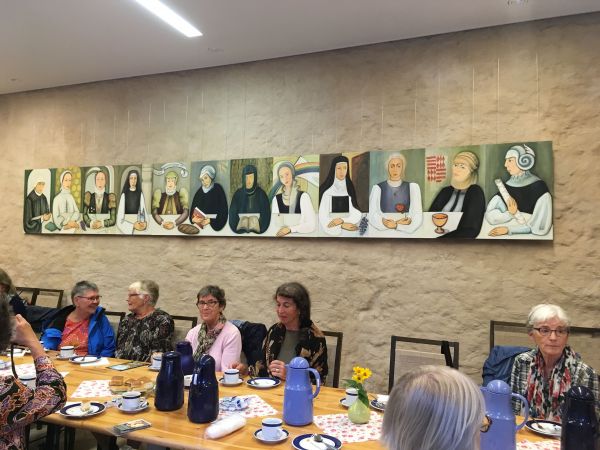
Felicitas von Selmnitz
Felicitas administered the sacrament of Holy Communion to her relative on his deathbed, for which the Archbishop of Halle intended to expel her from the city. Martin Luther sent her a letter of consolation…
Felicitas was born in 1488 in Liederstedt (Munich), Germany, into a noble family. Her father, and later also her husband Wolf von Selmnitz, were Saxon rulers at the fortress of Allstedt. Felicitas married in 1507; she gave birth to seven children, of whom only one son survived to adulthood. After 12 years of marriage, Felicitas’s husband was stabbed to death and his wife was left a widow, which also meant complete vulnerability. Duke George of Saxony helped the widow and gave her half of the Wittenberg fortress to administer, together with the village of Liederstedt. Her husband’s relatives, however, did not want Felicitas to keep anything, and tried by every means to drive her out of the widow’s holdings. Yet her husband’s brother Sebastian von Selmnitz (who had turned to Protestantism as early as 1521) helped Felicitas to establish herself as a widow in the city of Glaucha. Only at the age of 35 did Felicitas, together with her thirteen-year-old son, begin to learn to read and write. Felicitas heard much about the new faith from Thomas Muentzer, who for a time worked as a lecturer at the Cistercian monastery in Glaucha. At Christmas 1522, Thomas Muentzer gave Felicitas and her son Holy Communion. In this way Felicitas officially professed her confessional allegiance to the faith of the Reformation.
In 1528, when one of her relatives lay on his deathbed, Felicitas came to the dying man with both elements of the sacrament of Holy Communion (the bread and the wine). On learning of the event, Cardinal Albrecht (Archbishop of Halle) tried to force her to renounce her religious convictions and leave the city. Despite the fact that on 1 April 1528 Martin Luther wrote a letter of consolation to Felicitas, addressing her as “meiner lieben Freundin in Christo,” she nevertheless fled to Wittenberg in the spring of that year. In 1529 Felicitas’s son enrolled at the University of Wittenberg.
In Wittenberg, Felicitas maintained close contacts with the reformers and their families. Reading the writings of the Reformation, Felicitas von Selmnitz also took part in the reformers’ discussions and was a highly respected woman among her acquaintances. In her family library were found books with the personal inscriptions of Martin Luther, Johannes Bugenhagen, Caspar Cruciger and Justus Jonas “to the talented lady Felicitas von Selmnitz.” Felicitas also owned the “September Testament” – the first translation of Luther’s New Testament into German, completed in 1522. Martin Luther had also given her a complete German Bible, published in 1534, and other of his writings. These books contained underlinings in the text, from which one can deduce which themes were of particular interest to Felicitas as a widow, which questions of faith were especially interesting and significant to her. She had underlined in the biblical text all the places where the word “widow” or “orphan” occurs. Likewise, several passages about suffering, sorrow and love were underlined. In some places she had drawn a heart in the margin of the Bible page. In the community of reformers in Wittenberg, of which Felicitas was a part, this woman found support in difficult moments, as well as in caring for her only surviving son. In all, 362 books from Felicitas’s possession were handed over to the library in Halle, which testifies to what an intelligent and theologically educated woman she was, remembering that Felicitas only began learning to read at the age of 35. The inscriptions of the leading reformers in the books given to her, in turn, testify that this woman was respected and her opinion was esteemed. To this day, Felicitas von Selmnitz is honoured as one of the first Protestant women in Halle, Germany. Since 1998, one of the streets in Halle, near the Luther Church, has been named after Felicitas.
In the painting, Felicitas von Selmnitz is depicted with an open Bible and Latin letters in the background.
Ottilie von Gersen
Ottilie von Gersen, our eighth heroine, is a woman with an almost unknown fate. About Ottilie all that is known is that she was a nun who left the convent inspired by the Reformation and married Thomas Muentzer – a radical follower of Luther, a preacher, a theologian. Muentzer was influenced by Luther’s Reformation ideas, but soon chose to oppose Luther fundamentally and to criticise him for his tolerance of the feudal order. A sharp exchange of words developed between Luther and Muentzer; Luther regarded Muentzer as too fanatical and possessed a personality. Muentzer is considered one of the instigators and leaders of the so-called Peasants’ Revolt, for which he was also put to death.
Ottilie von Gersen and Thomas Muentzer (c. 1489-1525) married in the spring of 1523. One can only speculate that the surname von Gersen is a derivation of the surname Gerschen. In that case Ottilie von Gersen would be a representative of some old Central German aristocratic family whose lineage reaches back as far as the 12th century. However, these are only conjectures. Ottilie is said to have lived in the Augustinian convent in Hettstedt, but this too cannot be proven by documents. In any case, Ottilie is not among the 16 women who escaped from the convent in 1523. It may be that Ottilie became acquainted with eleven of the 16 escaped nuns in Allstedt, where they stayed for a time before arriving in Wittenberg. It is possible that Ottilie escaped from another convent, but the fact that Ottilie did indeed live in a convent is known from her letter of 19 August 1525 to Duke George. In the letter she asks the duke for permission to return to a convent. By that time Thomas Muentzer had already been executed.
As we have already mentioned, Ottilie was married to Thomas Muentzer. Muentzer was a priest at St John’s Church in Allstedt. It is not known where Ottilie and Thomas met. It is only known that Muentzer was acquainted with several nuns before his time of ministry in Allstedt, because before that Muentzer had lived in a Cistercian monastery near Weissenfels, where as a father confessor he was responsible for several religious sisters.
One son was born of the marriage of Ottilie and Thomas Muentzer. It is possible that at the time Muentzer was put to death, Ottilie was expecting a second child. In his letter of 1525, Luther mentions with sorrow that the vulnerable, pregnant widow Muentzer was raped.
While still alive, Thomas Muentzer had tried to provide for his wife materially, asking both his judges and other authorities to grant his property to his wife, but this request was ignored. It is very likely that the life of Ottilie Muentzer (von Gersen) was spent in poverty. One can only hope that Ottilie was taken back into a convent or onto monastery grounds, for the medieval convent was the only safe refuge for the unmarried women and widows of that time. For a woman, getting out of the convent meant far more than mere daring: women could not return to their families, because the families were for the most part far removed from the ideas of the Reformation. To their own families, such women (like Ottilie von Gersen, but also Katharina von Bora) were a disgrace. For women outside the convent there was no protection at all. The only solution beyond the convent walls was to enter into marriage. On top of all that, priests and nuns who married were scorned in their former confession and faced difficulties in having their marriage to each other recognised. Ottilie von Gersen is one of the women of the Reformation who personally and painfully experienced the family life of the first Reformation priests and became a widow early. The very little information about Ottilie reflects the historical tendencies of the time, in which the voice of women was practically inaudible. Yet if Ottilie had remained in the convent and never married Muentzer, perhaps we would never have learned of her.
In the painting, Ottilie’s background is adorned with the banner of the Peasants’ Revolt and a rainbow.
Photo: LLSTA
Related articles: Women of the Reformation in Central Germany, Part I