
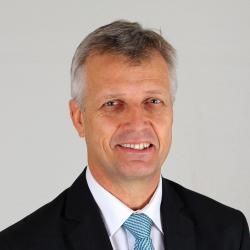
Geneva, 07.03.2014. – International Women’s Day is observed on 8 March. This year’s theme is „Equality for Women is Progress for All”. The United Nations suggests that International Women’s Day is a time to reflect on progress made and a call for change. Lutheran World Information (LWI) asked General Secretary Rev. Martin Junge how the Lutheran World Federation (LWF) is actively engaged with this theme.
How does the International Women’s Day theme „Equality for Women is Progress for All” speak to you as LWF General Secretary?
This theme very sharply emphasizes that the so-called women’s issues are not issues that affect only women, but that they concern the whole of the society in which they live, or in the case of the church – the issues of the whole church.
Equality for women speaks about the quality of relationships and about the values that shape those relationships. For the church to be engaged in processes that promote equality for women is not a sign or an altruistic gesture toward those regarded as weak. Rather, such a process is a joint effort of men and women to make the church a better place, thereby becoming a powerful sign of our reconciliation and unity in Christ through baptism across differences of nationality, social status and gender.
How has the LWF helped to inspire equality for women, and how does it see its future involvement in this work?
The LWF’s commitments to equality have been given concrete expression through many governance decisions and programmatic activities. The LWF has a long history of supporting projects from member churches that are committed to promoting equality for women in the church and in society. In 1984, the LWF adopted a policy at its Assembly that at least 40% women and 40% men should be represented on councils and consequently in governance.
The same principle is applied to LWF activities and programs. This includes scholarship support for both theological and development-related studies. Since 1984, the LWF has recognized and affirmed women in ordained ministry as a goal. This has been reflected in all the LWF Assemblies held over these three decades. The LWF campaign „Churches Say ‘NO’ to Violence against Women”, introduced in the first decade of the 21st century, has had a great impact. Our involvement in the field of humanitarian response and development work (the Department for World Service) includes gender justice as a cross-cutting
goal. The LWF strategy „With Passion for the Church and for the World” includes gender justice as a cross-cutting issue. In 2011, the LWF Communion Office received a certificate for equal pay between genders. Last year, the LWF’s 2013 Assembly adopted a gender justice policy that implemented a decision of the 2010 Assembly.
We have a steady and enduring journey behind us, yet there are still many new directions to embrace.
In 2013, the LWF published a gender justice policy. What are the positive changes that the LWF hopes to see thanks to this new policy?
Along our way we have learned to recognize that ensuring women’s participation through quotas does not also mean their automatic participation on equal terms.
This is the background to the Stuttgart Assembly’s call for a gender justice policy.
The LWF gender justice policy is intended to support and promote the communion’s path toward inclusion. Based on a biblical and theological understanding, grounded in the identity of Lutheran theology, it provides recommendations and methodologies for contextualized action plans at regional and local communion levels.
The LWF will follow these discussions. The positive changes we anticipate are to see a commitment to establishing justice in relationships between the genders as a matter of faith and to building more just relationships.
77% of LWF member churches ordain women. Why is the question of ordination important to the LWF?
The statistic you mention is from 2012. In the meantime, several member churches have expressed their intention to ordain women or have already done so.
As Lutherans we believe that through baptism God has made us part of the new community and has called all of God’s people – men and women – to participate in God’s mission. Following this understanding, we define the ministry of the church as one that is open and reflects this new community in Christ.
That is the reason why in the LWF we do not speak of „the ordination of women”, but of „women in the ordained ministry of the church”, thereby pointing to our conviction about the importance of the inclusive character of ministry.
In other words, the importance of this question grows out of the fact that women’s participation in ordained ministry is fundamental to our understanding of the ministry of the church. And it is about how this ministry reflects God’s calling to all of God’s people, thereby becoming a witness to God’s new creation in baptism, through which we have been made a new community (Gal 3).
The LWF is a communion with member churches in various cultures. Is the question of women in the ordained ministry of the church a question of differing cultures?
The LWF is faithful to an understanding of ordained ministry as an office that is inclusive of both men and women. This is a goal that the LWF Assemblies have affirmed since 1984 and that belongs to the 77% of member churches that comprise 93% of the LWF’s membership.
As we help one another to reach this goal, we hear and know that some churches need to move more slowly because of questions of biblical hermeneutics, culture, and ecumenical/interreligious relations.
Returning to your question, there is a need to look carefully and at the same time critically at cultural realities, especially given the fact that the gospel of Jesus Christ is, in so many respects, counter-cultural. For example, I do not think that loving one’s enemy is part of many of today’s cultures, yet we strive to proclaim it in words and deeds; I do not think it is part of many of today’s cultures that a freedom given by one God makes us servants to the needs of our neighbor, yet we strive to proclaim it in words and deeds; likewise, it is not part of many of today’s cultures to receive gifts for free, yet this forms the core of the gospel of Jesus Christ, as proclaimed not only by Lutheran churches.
The apostle Paul encourages God’s people not to be ashamed of the gospel of Jesus Christ, but to continue to proclaim it and live by it in our existing cultures. Every church is called to consider daily how it wants to bear witness in its specific context, and therefore also in its culture. At the same time, it will strive to be faithful to God’s mission, which at its core carries so many counter-cultural elements.
Consequently, the cultural argument is very relative.
The LWF is engaged in ecumenical dialogue with partners who hold differing views on women in ordained ministry and the involvement of women. Does this create a problem in this dialogue?
The LWF continues to engage in rich and significant ecumenical relations and dialogues. In 1999 the „Joint Declaration on the Doctrine of Justification” was signed, thus 15 years after the LWF’s 1984 Assembly recognized and affirmed the goal of women in ordained ministry. For several decades now, ordained women have represented the LWF in our various ecumenical dialogues, including dialogues with churches that do not ordain women. And these dialogues continue to bear good fruit. In the LWF’s audiences with Pope Benedict XVI and Pope Francis, the LWF delegations also included ordained women, some of whom also held the office of bishop. We come to such meetings as the communion that we are, and I am grateful to be able to say that I have never felt that our interaction was at any point problematic because of the composition of the LWF delegation, or that any different treatment was shown toward members of the delegation. It adds value to our ecumenical dialogues and relations – the fact that they are based on honesty and transparency about who we are.
What is your vision for positive change in the LWF that you would like to share on International Women’s Day?
I hope and pray that violence against women – still a reality for many – will be brought to an end.
I hope and pray that we move from securing quotas for women’s participation to securing conditions favorable to women’s participation.
And I hope and pray that more churches will be faithful to women in ordained ministry, as we engage in open and respectful conversations that are faithful to God’s Word, which calls the baptized to become a prophetic sign of God’s powerful reconciliation.
Photo: The Lutheran World Federation
Translated from English by Ieva Puriņa, Mag.Theol., pastor of LELBāL
Proofreader Mag. Theol. Milda Klampe