
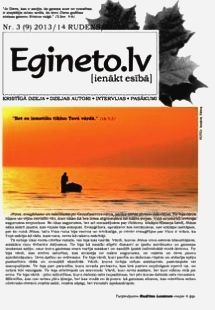
From 1 September to 19 November this year, the First World Latvian Christian Poetry Days were held in Liepāja, with the motto taken from Jesus’ prayer for His disciples – “That they all may be one, as Thou, Father, art in Me, and I in Thee, that they also may be one in Us, that the world may believe that Thou hast sent Me.” /John 17:21/ The organizers of the Poetry Days, the association “Christian Support Alliance”, have published an electronic journal, “Egeneto”, which also includes a work by Rudīte Losāne, chaplain, poet and chairwoman of the LLSTA board:
“But at Thy word I will let down the nets.” /Lk 5:5/
Jesus, walking and teaching by the Lake of Gennesaret, met His first disciples. They were men hardened by the lake’s waves and winds, who had just returned from a night’s fishing with no catch. He instantly noticed the weary fishermen. Not only weary, but also anxious about the morrow. Getting into Simon’s boat, Jesus began to teach the people who had followed Him. The Evangelist, in describing these events, has not revealed to the reader what Jesus spoke about, yet His speech was powerful and influential, for elsewhere in the Gospels it is said of Him that He taught as one having authority, and not as the scribes.
It was not merely the language of a wise man, it was something more. The words Jesus spoke to His listeners touched the depths of their souls. They were like finely cut diamonds with a special radiance and power to refract light, through which a ray of light could touch and warm each person in a special, individual way. They were words that opened one to trust, that released one from the night’s weariness, from worries, and gave fresh invigoration. They gave strength and inspiration. They were words that lifted one from everyday cares and restored the ability to look further and to see more clearly. Words in which there was nothing offensive, humiliating or manipulative. They were truth itself, which creates no opposite that makes one feel inadequate before it, and does not make one feel guilty. They were liberating and comforting. Words that do not drive one away, but that draw one irresistibly. They were words – full of a love that we do not naturally know, but for which we naturally yearn. A love that is not the chemistry of our feelings, but that enters from outside, like a flash of light that kindles our human soul, sometimes sweetly, sometimes painfully, but always enlighteningly.
For how else, at Jesus’ call to go fishing again, would Simon have said: “Master, we have toiled all the night, and have taken nothing. But at Thy word I will let down the nets.” And later, after the successful catch, responding to Jesus’ call to go fishing for people, Peter would abandon his work tools, his source of livelihood, and follow Him.
It sounds strange – to go fishing for people. Fishing, in our understanding, is associated with catching, capturing, even with killing, where nets are a special tool for carrying out these manipulations. And all these tools point to the taking of freedom and even of life.
How helpless a lion looks when it has fallen into a hunter’s net! Just as there is no escaping the bullet that catches up with the hunted, so too there is no escaping the net cast over the prey. Does God really intend to take away our freedom, even our life? But perhaps the right answer in this case is that there is no freedom at all, that freedom is only an illusion? And that this world is like a great hunting ground, in which there is an unceasing struggle for prey. In which prey preys upon prey – similar to the way the Greeks depicted primordial matter in the form of a serpent biting its own tail. And in this hunting ground, the human being seeks a way to survive. In the net, which otherwise serves as a hunting tool, he seeks refuge. He builds and weaves his living space so as to be protected from a hunter like himself.
The entire cultural space that the human being has created for social protection and development is like a giant web around peoples, around the world, and around himself. The anthropologist Clifford Geertz said that culture is a web of symbols, in which the central element is the human being, who has himself become entangled in them. Entangled in them, because into the socially secure web other webs have subtly woven themselves, in which one catches and preys, in which one enslaves and kills. Jesus says: but while men slept, his enemy came and sowed tares among the wheat, and went his way.
The gardener knows that weeds not pulled in time are a threat to cultivated plants. They take away minerals, block out the sunlight, and the cultivated plant begins to wither. But it is well known that weeds do not die out.
This metaphor reveals the truth about the endless struggle in human existence, about the struggle between good and evil, destruction and development, between life and death.
Evil, like weeds, must be fought at the root. Where to look for the root of a weed is known, but where is one to look for the root of that which destroys, or of that which protects from destruction?
Irenaeus, Bishop of Lyon, said that the word is the architect of all things. God, as a supreme architect, began with the word to design and created an exquisitely beautiful world. Everything there was good. The human being, like God, also begins the designing and arranging of his living space with the word, using the language learned collectively. But the result is different. James, in his epistle, speaks harshly and revealingly about the human tongue, which symbolizes the use of the word – it defiles the whole body, and sets on fire the course of our whole life… it is full of deadly poison. The human being is so greatly and so deeply corrupted that he is unable – in building his living space, not to destroy; in saving, not to ruin; in protecting, not to capture.
For this reason, using Jesus’ metaphor, one may say that the human being is himself like a field in which grain and weeds grow together. The human being becomes his own victim, entangles himself in his own nets, and is easily caught prey, like a wounded beast. Jesus, in calling His first disciples to fish for people, reveals His intention – to take this easily caught prey for Himself. He calls the disciples to cast other nets. Nets in His name.
Rudīte Losāne,
poet and chaplain
You can open the full electronic edition of the “Egeneto” journal here Liepajas zurnals Egeneto.pdf
A press release from the organizers of the Poetry Days and an invitation to take part in the future poetry events:
The First World Latvian Christian Poetry Days, with the motto: “That they all may be one, as Thou, Father, art in Me, and I in Thee, that they also may be one in Us, that the world may believe that Thou hast sent Me.” /John 17:21/ began on 1 September 2013 and, thanks to a good response, lasted until 19 November. The idea – to address, as far as possible simultaneously, our compatriots near and far in the language of love – poetry – met with a response in September 2012, when Liepāja hosted the author’s evening of the poet and chaplain Rudīte Losāne, “Awaken in your homeland!”
To spread word of the Poetry Days more widely, one of the supporters, Ilga Auza, host of the event “The White Hour”, presented the Poetry Days poster on 25 August 2013 to LELBāL Archbishop Elmārs Ernsts Rozītis and Vera Volgemute-Rozīte during their visit to Liepāja. Events took place in several Latvian cities – Grobiņa, Kuldīga, Liepāja and Rīga. Poetry authors and musicians from various denominations took part, as well as other seekers of spirituality who managed to respond to the invitation. Several proposals have already been received to continue this movement of the heart’s voice until Pentecost 2014. The nearest event is planned for 14 December this year, when the launch of Rasma Jonase’s poetry collection “Life Goes On” will take place at the Liepāja Diaconia Centre.
We continue to invite everyone to whom poetry is dear, whose nation is beloved and cherished, who does not consider its unity unimportant and is drawn to this idea, to make known their wish to take part, so that we may gladly include your event as well in the common cycle. This does not mean uniform rules or compliance with any additional requirements. It is a mutual confession of love – each as best we are able, regardless of the circumstances each of us is in.
Information about the events is compiled and published on the website www.egineto.lv (which is being updated) in the Christian Poetry Days section, in the Egineto.lv edition, and in the themed supplement dedicated to the First World Latvian Christian Poetry Days. Enquiries: [email protected]
With respect and warmth,
Inga Audere
Association “Christian Support Alliance”
The editors