
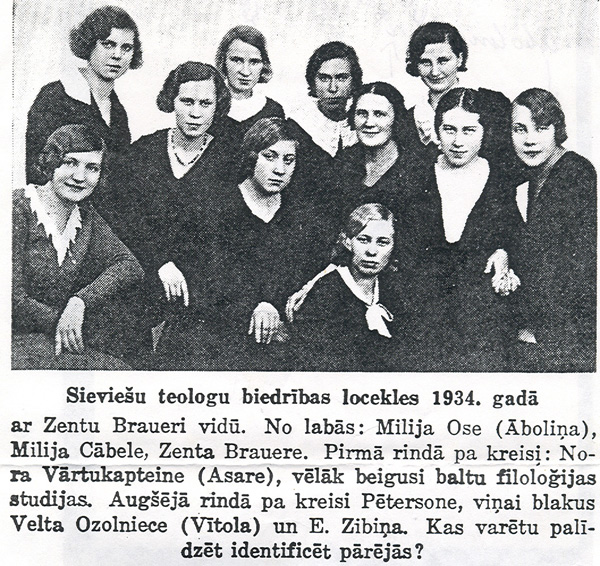
The Women Theologians’ Society was founded in 1931 to promote the significance and opportunities of women theologians’ work.
In a time when more and more women were obtaining higher theological education, and also in order to make it easier to stand up for their rights within the academic subculture, women joined together in professional societies. It was for these reasons that the Women Theologians’ Society came into being as well.
At the society’s meetings, members’ sermons were analysed, books were discussed, and strategies were developed for the work of women theologians in congregations and in society at large. Strikingly, among the topics examined at the WTS meetings, the question of women’s ordination was not discussed. At the society’s second meeting, on 24 October 1932, Zenta Bauere was elected to chair the assembly. (State Historical Archives of Latvia, fonds 2431, inv. 1, file 2, p. 5.) The society’s main aim was “to unite women who have studied or are studying theology”. (State Historical Archives of Latvia, fonds 2431, inv. 1, file 2, p. 7.)
At one of the meetings it was said that “theologians are the core of the university. For this idea to be justified among others, one must know how to behave properly: one must not speak loudly, smoke, flatter, ingratiate oneself, or gossip; one must maintain inner and outer purity. In society one must conduct oneself so as not to draw the attention of everyone present. One must learn to respect every speaker. A lack of social tact is to be explained by a lack of sensitivity.” (State Historical Archives of Latvia, fonds 2431, inv. 1, file 2, p. 45.) Although we no longer live in the society of that time, what these women are saying is something like a “grey mouse syndrome”. Perhaps their words sound noble, but they seem humiliating. If a woman has her own opinion, she should express it. Of course, one must also respect other speakers and regard everyone as an equal among equals, without losing one’s dignity. A woman’s attitude should be such precisely so that she comes to be respected.
On several occasions the question of “Mother’s Day” was raised at the meetings. “The mother is not only the core of the family but also the shaper of the life of faith. A mother’s heart is the first altar at which we learn the everyday, eternal values and truths for ourselves. It is thanks to a mother’s divine sensibility and religious upbringing that we have become believers.” The celebration of “Mother’s Day” is one of the noblest of holidays, and therefore the great response and willingness of all the workers who take part in it is also understandable. “On Mother’s Day there was great demand for women theologians. Then they were all at work: they preached, gave talks, and spoke in old people’s homes and at cemeteries,” recounts A. Pone. (Agnese Pone, Latvian Women Theologians, Ceļa Biedrs. 1977, No. 2, p. 41. Cited in: Anita Priedīte, The Latvian Theologian 1920-1940. Faculty of Theology bachelor’s thesis (Riga: University of Latvia, 2003), p. 26.)
In Latvia, Mother’s Day began to be celebrated in 1922. Some organisations and congregations celebrated it in late autumn or winter, others on the first day of spring. The Ministry of Education set up a special Mother’s Day commission. Its task was to draw up a Mother’s Day programme and offer advice to those organising the day, while also leaving them free rein. The committee decided to celebrate the day each year on the second Sunday of May. By means of this day, women theologians demonstrated their abilities in this field of work and also gained wider recognition. In 1938, at the suggestion of Kārlis Ulmanis, Mother’s Day was renamed Family Day. The rationale was that the role of the man in the family should not be forgotten either. This by no means implies that a woman’s role in the family is diminished; rather, a complete family is one in which responsibility rests on both the woman’s and the man’s shoulders. There is no indication that renaming Mother’s Day as Family Day narrowed the field of activity for women theologians. (Anita Priedīte, The Latvian Theologian 1920-1940. Faculty of Theology bachelor’s thesis (Riga: University of Latvia, 2003), p. 27.)
At the WTS meetings it was held that women theologians must learn to speak freely and practise preaching, since in the practical field of work each of them would have to deal with it. (State Historical Archives of Latvia, fonds 2431, inv. 1, file 2, p. 4.) The women also took advantage of this opportunity, and their fellow colleagues were able to analyse one another’s skill. The first call to recognise women’s right to all offices in the Church was voiced in the WTS. In 1930 it became a member of the Council of Women’s Organisations.
During the authoritarian government of K. Ulmanis, the WTS faced difficulties with re-registration. In October 1937, the then chairwoman Agnese Pone (in 1936 she had replaced Z. Bauere in this post) reported that she had obtained information about the planned closure of the WTS, which she linked to “the pushing aside of women from society and scholarly work”. After almost two years the WTS managed to re-register, and Zenta Bauere again became its head.
On 20 September 1940, the final official session of the WTS took place, at which, yielding to the dictatorship of Soviet power, its dissolution was decided. “Taking into account the present circumstances and the small number of members, we resolve to terminate the activity of the WTS. With this meeting we consider the Women Theologians’ Society to be dissolved as of 20 September of this year.” (State Historical Archives of Latvia, fonds 2431, inv. 1, file 2, p. 53.)
Sources:
1) Priede Ž. University of Latvia Faculty of Theology bachelor’s thesis “Women’s Ordination in Latvia in the Time of Archbishop Jānis Matulis” (2007, Riga)
2) Dr. phil. Tēraudkalns V. “The Path to the Ordination of Lutheran Women in Latvia” (University of Latvia Faculty of Theology publication Ceļš No. 57)