Maundy Thursday
Gospel of John 13:1-20
Pastor Arta Skuja
.
As we celebrate Maundy Thursday, we remember Jesus’ meal with his friends before his arrest and the way of suffering, when they shared the Passover meal of the liberation of the people of Israel.
“On that night he took bread and the cup…”; with these words, in thanksgiving, we celebrate, remember, and experience Christ — the Bread of Life and the Cup of Blessing — in the Eucharist, in Holy Communion.
But incredibly rarely do we celebrate the second part of that evening of fellowship, of which the author of the Gospel of John tells. After the meal, Jesus rose from the table, put on an apron, took a basin of clean water, and washed his friends’ feet. And you too shall do likewise, Jesus said. I leave you an example. No one is greater, no one is lesser — the one who serves and the one who is served — they are no more important than one another.
Fifteen years ago my first Maundy Thursday came when I took part in the foot-washing liturgy. It took place in an Ark community, whose core is people with intellectual disabilities. We sat in a circle in which a person with a disability and an assistant sat alternately. In the middle of the circle were a bowl, a jug of warm water, and several towels.
We sang Ubi caritas et amor, ubi caritas Deus ibi est. Where kindness and love are, there is God. And we washed one another’s feet. The one whose feet were washed laid their hands on the servant’s head and gave a blessing.
Our abilities and inabilities were leveled. No one is greater than another.
Living in community, with people of truly different (un)beliefs, convictions, and personalities, many small differences can become the basis for a silent but deep dissatisfaction and resentment, and sometimes, as in all our relationships, lead to an explosive conflict. The humility and sensitivity that foot-washing entails were precisely what was able to truly unite. It was a sign of our mutual reconciliation, togetherness, and love — a sacramentum.
The evening with the meal and the foot-washing is a visible revelation of the commandment given by Jesus: love God and love your neighbor. These two cannot be separated and divided from one another, but the one reveals and fulfills the other. It is, however, easier not to accept this paradoxical truth and to enjoy in thanksgiving only God’s gifts at the altar.
A hundred years ago this was written about, in her characteristic directness, by the Orthodox nun and holy martyr, mother of many poor in body, mind, and spirit, Maria Skobtsova:
“Love of neighbor is not a moral appendix to the love of God, but its very essence. Likewise, Communion is not only a sacrament of union with Christ, but also a sacrament of union with all people. The Body of Christ is broken for all, and by receiving it we are bound to one another. If we turn away from our neighbor, if we do not see Christ in him, then our communion is a lie.”
.
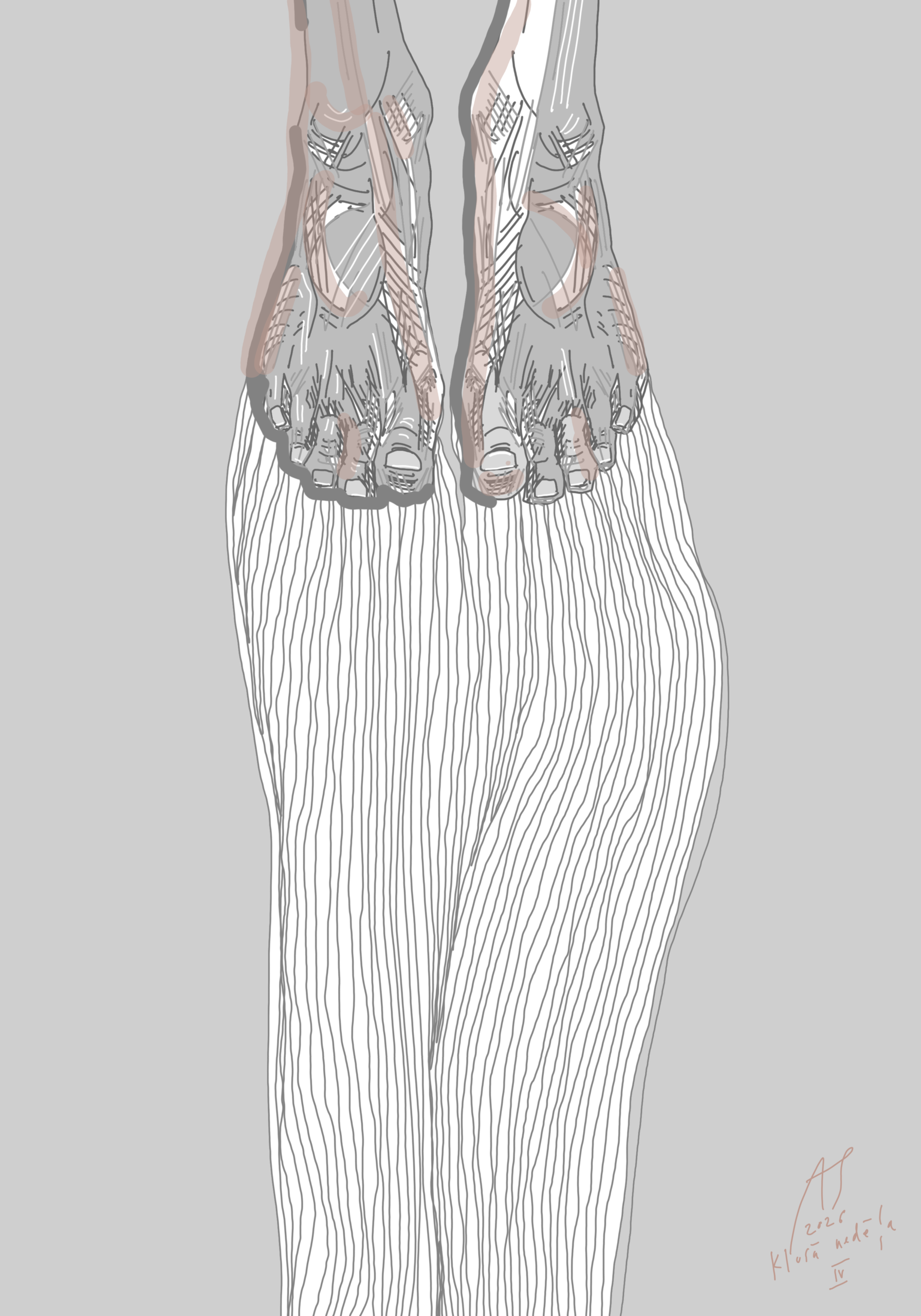
Illustration: The Washing of Feet. Arta Skuja, 2026