
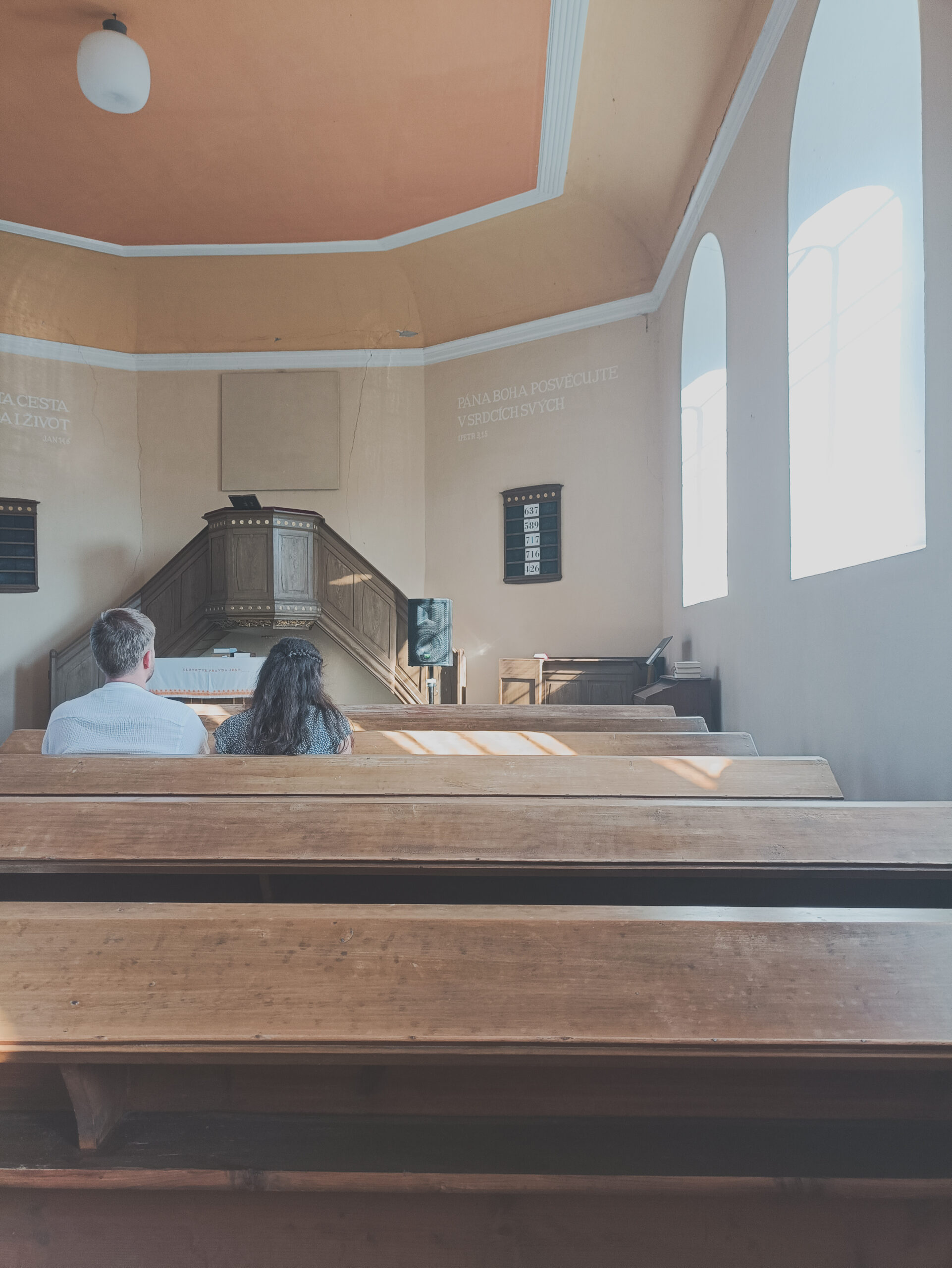
Anežka Junová is a Czech theologian of the younger generation, who is continuing her studies at Charles University in Prague. She is actively involved in the Evangelical Church of Czech Brethren, the largest Protestant church in the Czech Republic, leading youth work at the regional level. Anežka sees her future in church work and is preparing for ordained ministry. In her conversation with LLSTA, Anežka talks about her studies, current issues in the local church, and her research on pastoral theology and youth mental health.
LLSTA: Tell us – what do you do at the Old Testament department at Charles University in Prague?
Anežka Junová: I have started working as a student assistant in the Old Testament department. It is a combination of various duties, but the main task is to support the professors in their academic work. I edit articles and hope that there will be relatively little dusting and serving coffee. (laughs) Each department has one such student assistant position, which is usually entrusted to more experienced students. Since there are not so many of us, everything possible is done to involve every master’s student in some assistant work in one of the faculty’s departments.
Within the theology program we have eight departments, and there is also a department of social and pastoral studies and the Ecumenical Institute. We have departments of the Old Testament, the New Testament, philosophy, theological ethics and others.
Is there anything shared with the other two faculties – the Catholic and the Hussite?
AJ: No, they have completely different departments, but the Ecumenical Institute offers collaboration. Our faculty is the smallest, if we are talking about the number of students. The other two faculties have more programs, including historical programs, and there are more students there.
Most of the students at the Protestant faculty – what do they do in life? What still draws them to study theology?
AJ: It seems to me that right now more and more people are coming to the Faculty of Theology with the goal of becoming pastors. That was not the case before, even in the recent past. This is only my own observation, though; I do not know whether it would be confirmed statistically.
Thinking about the Evangelical Church of Czech Brethren – there are probably several theological educational institutions that serve as a place of education and formation for future pastors?
AJ: Actually, for the church this faculty is the only professional option for those who want to become a pastor. Even studying abroad is to some extent problematic, and if you complete the entire educational program abroad, it is not easy to convince congregation leaders that the education you have received is similar to what is done at the faculty in Prague. Usually you need to obtain a master’s degree here, at the Protestant faculty, in order to begin the ordination process. There are also several other churches that send their candidates to our faculty, because they do not have their own seminaries or faculties. These are students from the Church of the Brethren, as well as people from the evangelical milieu, sometimes from the Apostolic Church or the Adventist Church.
Do most students enter the faculty thinking about future ministry in the church? What about the rest – do they find a place in the academic world?
AJ: Some stay in the academic world, but bachelor’s students often simply choose to focus on the biblical languages, because our faculty is known for very high standards; in fact, in the field of ancient languages it is the best option in the Czech Republic. But in that case, after the bachelor’s program, they usually stop their studies. There are also those who choose a teaching career or work in kindergartens, which then does not maintain a direct connection with the education they received. Still others choose the chaplaincy course, which the faculty also offers, and they work as chaplains in various contexts.
So there are not many students who are “entirely from outside”, that is, people who enter the faculty of theology without any experience of a religious community or without a religious vocabulary, but who want to broaden their understanding of, for example, the phenomenon of religion?
AJ: That is very rare. I remember that in our group of ten people there was one person who had no experience of church and of the Christian environment in general. More often such students join the Ecumenical Studies program, which is a program intended for people who study in another field. Perhaps they are already working, and therefore study in the evenings. For someone to continue their studies after the bachelor’s program, going through a serious biblical languages program, they have to have a great interest in theology – say, to become a pastor or perhaps to work on something else connected with the church. It is interesting, though, that the faculty itself officially has nothing to do with the church; it is a faculty at a state university, completely independent of any religious affiliation, but at the same time the church requires education specifically at this institution, so this strange connection exists – both connected and unconnected with the church.
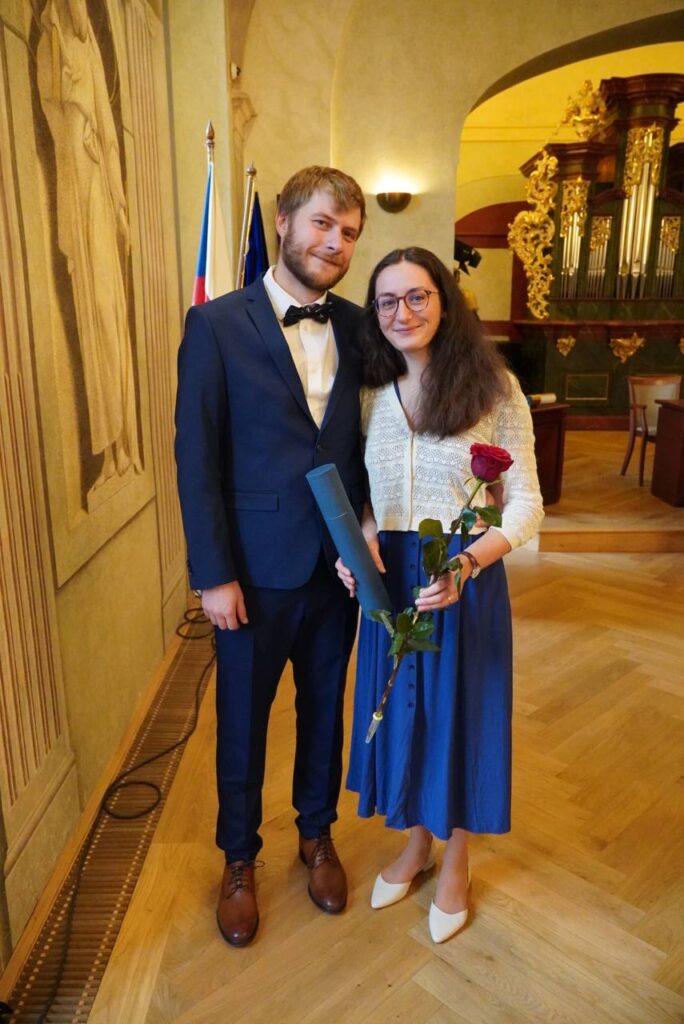
How would you describe your theological interests, and do you see your future connected with ministry in the church?
AJ: I have to say that I do not have a very clear vision of my future in theology, but previously I focused in depth on the field of pastoral and practical theology. I feel that right now I am more interested in biblical theology, perhaps because at the faculty this field is at an especially high level. It seems that it is the best I can get locally; other fields I could study abroad, but the tradition of biblical theology here in Prague is very rich. My interest in the Old Testament probably comes from here, but it may not be the focus of my future research. Yes, and I would like to become a pastor in the church one day. But this path is not easy.
How much time has to pass before that could become your reality?
AJ: After my studies it would be another year. After obtaining a master’s degree, you have to enter a year-long practical program, where you are sent to a congregation and, under the guidance of an experienced pastor, ministry is begun. The internship has different stages – at one point it is more connected with homiletics, then catechesis, but there are also other stages that address various aspects of ministry. After the internship year a final examination is taken, after which the candidate is ready for ordained ministry in the church.
Is it a popular choice? At your place of study and in the church it would probably be regarded as a normal path, but outside this circle – do you feel support and understanding in your calling? Perhaps the attitude in different contexts is very different?
AJ: Oh, yes, there are very big differences. The church community is very supportive. Although the overall trend shows a decline in the number of people, congregations still lack pastors. People in congregations understand that it is necessary to be supportive and to invite more young people to study theology. Usually, when I say that I study theology and intend to become a pastor, people are very supportive of me. As for wider society, in my opinion the Czech context is specific in that it is perhaps the most secular country in Europe. People are not interested in church life, regardless of denomination. For most of society it is simply not a relevant topic. Usually, when I talk about studying theology, people are curious and want to learn more. It is something so rare and special that they find it interesting to learn what it means.
How do you explain theology and the need for the church to people who have no knowledge of it?
AJ: Usually they have very specific questions. Often there is great surprise that I can marry and start a family, or even that I am a woman and can become a pastor in the church. If there are any notions about the church at all, they are usually about the Catholic Church.
What do you think about the role of the clergy – many things in a pastor’s calling and tasks have not changed, but others, in today’s multilayered contexts, are changing? Will the foundation of the church still be people who are familiar with church tradition?
AJ: That used to be the case, and certainly at the beginning of the 20th century, when the church came into being, it was something that was passed down from generation to generation, and the pastor mostly served the people of the congregation. Of course, nowadays that is no longer so. Caring for faith in today’s families is not a given, and that means there is greater pressure to care for people outside the church, for example, in the field of charity or education. Now we have a new gymnasium run by the church, which began operating a few months ago – it is very possible that this is something that could be developed further in the future. And charity – it is quite separate from the direct mission of the church, because it is not an integral part of congregational life and takes place quite independently of congregational work.
In recent years interest in church weddings has been growing. Even people outside the church want pastors to perform their weddings. So that is another new point of contact for clergy with the outside world. Schools can also invite a pastor to come regularly and teach religion, but that does not happen often.
Returning to the origins of your church – it does not have a particularly long history, only a little more than a century. Perhaps you can tell us how it came into being? How did people arrive at the idea of uniting traditions and creating the Evangelical Church of Czech Brethren?
AJ: The history of the church is short, and it began in 1918 with the founding of the republic. It was the merger and new creation of two existing churches – the Lutheran church in the Habsburg monarchy and the church of the Helvetic Confession. It was quite a long process that began at the very beginning of the 20th century, when the founding of the republic also took place, and this atmosphere created suitable conditions to unite the two churches as well. You can still see the most influential tradition – the Calvinist confession, because most of the churches before that belonged to this branch. Even today there are certain differences in our congregations – those that used to be Lutheran and those that practiced the Helvetic confession of faith.
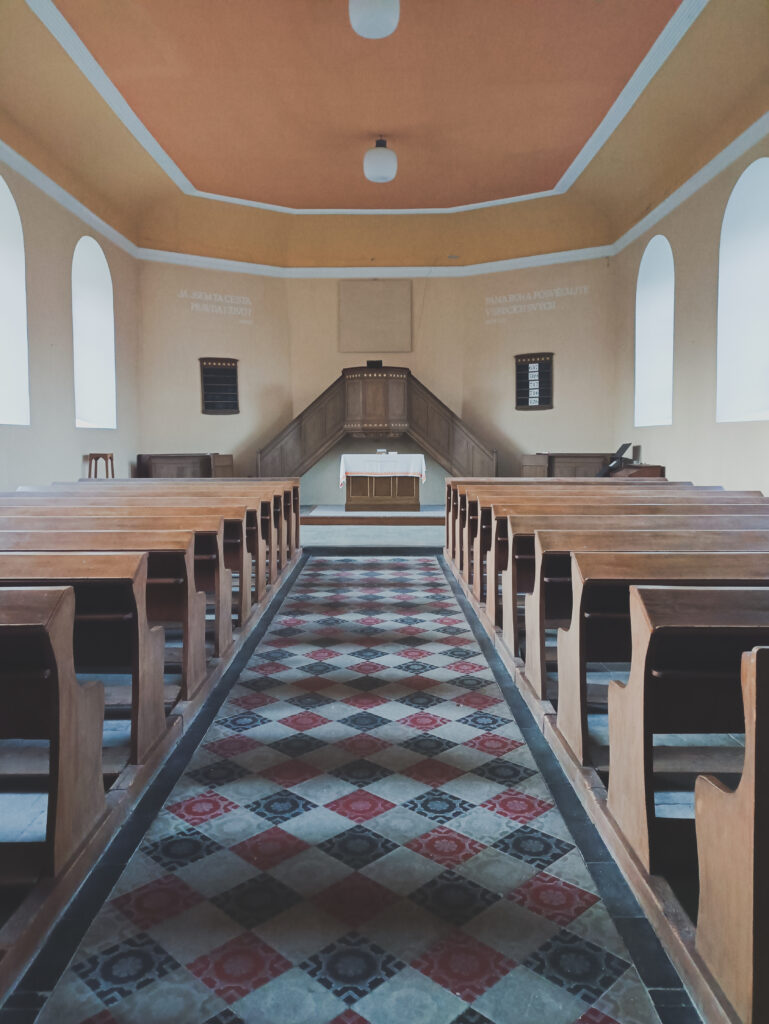
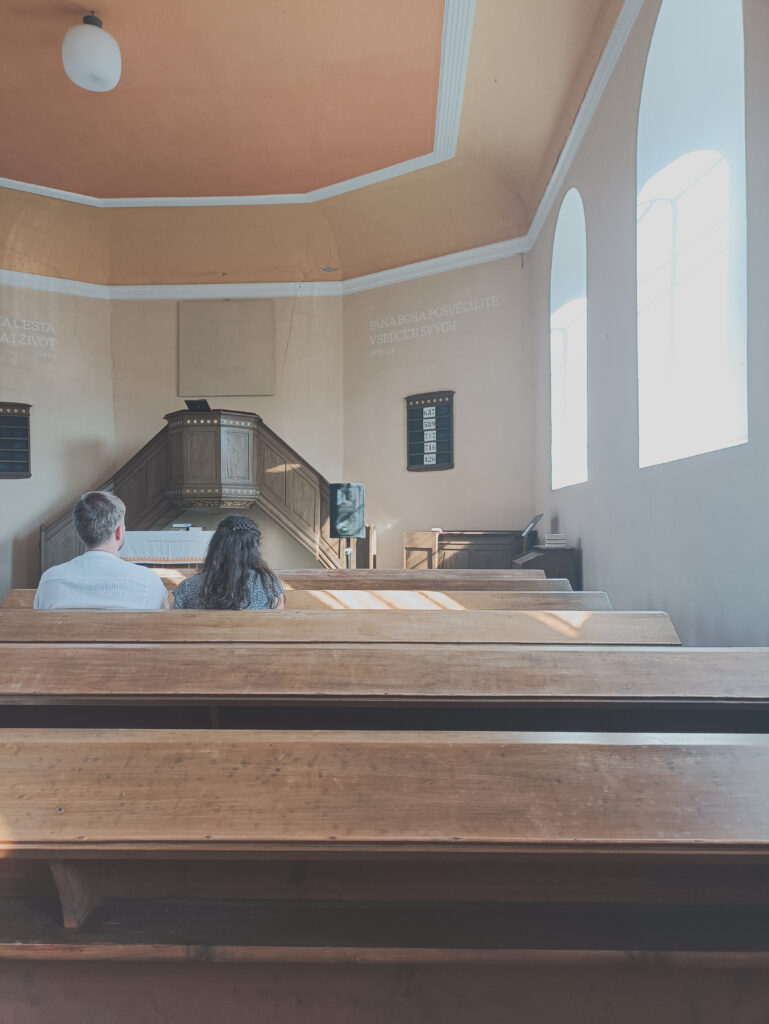
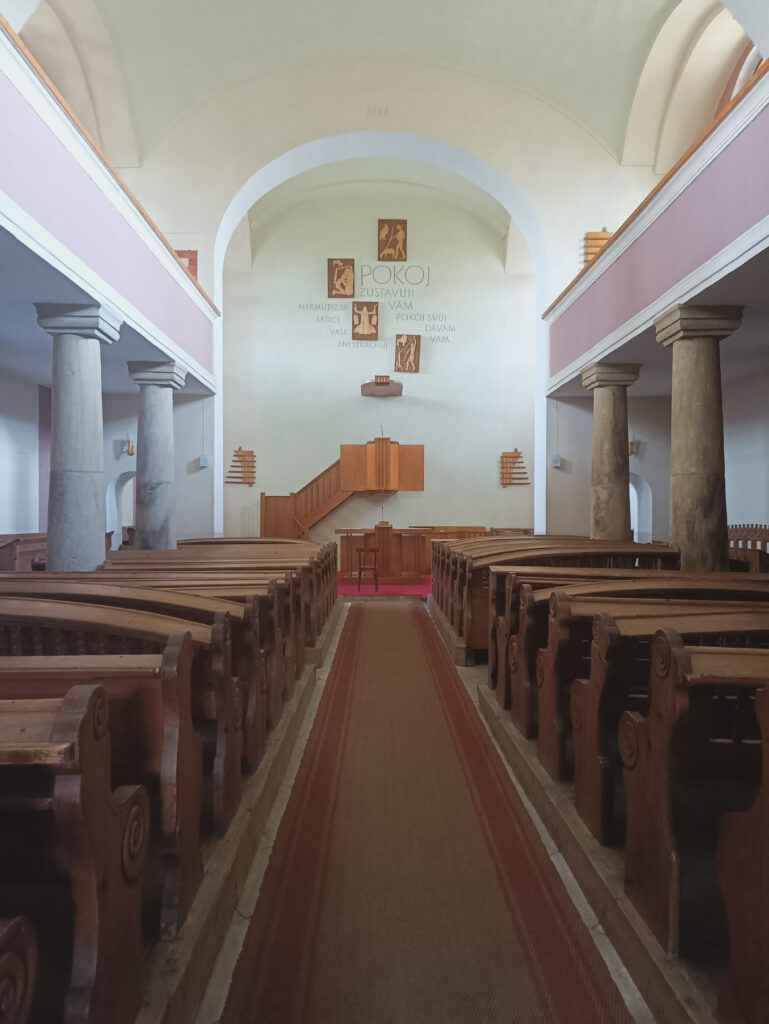
Where can these differences be seen?
AJ: In the liturgy, for example. There are still congregations in which the liturgy is richer, and the interior of the liturgical space is also different. Congregations of Helvetic influence practice a very simple liturgy, and even though so much time has passed since the churches united, you can still feel it in the atmosphere. For example, in the Czech highlands, where I come from, the Helvetic confession is much more present – even a few years ago we encountered a situation where lighting a candle on the altar caused problems for some members of the congregation.
Some ritual elements are perceived as unnecessary, ostentatious?
AJ: Yes. It is not very common, but in some congregations you can still come across it.
For most people, is the church tradition a family matter, or do new people join you?
AJ: Most congregational communities are indeed made up of families that keep the tradition alive, but more and more often people are joining who may have some church roots, but who, for various reasons, have lost the connection, and then they return and join.
What attracts them?
AJ: Among the other churches in the Czech Republic, perhaps the fact that our church is the most liberal. That is one of the appealing aspects for people who are looking for a spiritual home.
Liberal – how does that manifest itself in practice?
AJ: For example, on questions such as homosexual couples and the ordination of women, which in other churches in the Czech Republic are still not common topics. Even in the sense that the church adds its voice to discussions about the ecological crisis and other important topics in the public sphere of thought.
One of the growth formulas that is voiced when thinking about the future of the church is that there must be a living combination of community and mission, evangelization. How do you think about these aspects in the context of the Czech evangelical church tradition; how are they present?
AJ: Of these two aspects, our church definitely cares more about community. I have to say that evangelization is still not a popular word in our congregations, even though we have no colonial history. Influenced by the fact that in Protestant churches, also with the wider flourishing of the evangelical and Pentecostal movements, and the fact that these communities care more about evangelization, the traditional churches are afraid of the idea of evangelization. In our church there are no discussions about evangelization, but then again – it depends on how it is defined. For example, opening church schools can also be called evangelization.
Right now, I believe that we have problems defining the church’s mission. In recent years and decades, a process of separation of state and church has been taking place in the Czech Republic, so at the moment we are more concerned with the economic issues connected with this separation than thinking about a concrete mission of the church. And this is the biggest reproach to the church leaders, that they think too much about money and about what we will do with buildings that are no longer used, how we will solve the problem of the shortage of people in congregations, but the leadership and the whole church – we do not discuss the future mission of the church.
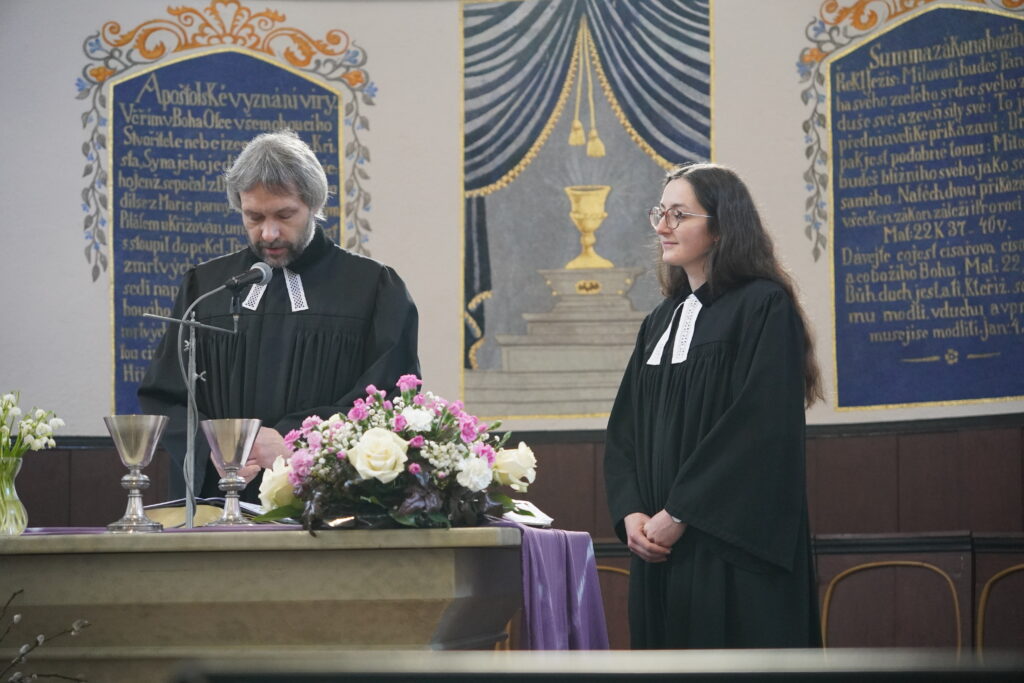
Everything connected with youth is part of the future, and you are involved in work in this field; what are your observations?
AJ: In each region there is a group of volunteer young people who organize the church’s youth work in the region. There are places that have pastors ordained specifically for youth work. Youth work is decentralized and largely independent of the church’s higher leadership, and as a result there is a lot of room for experimentation and creativity.
Work with young people in different regions varies, but the standard approach is that weekend gatherings are organized regionally each month. A group of volunteer leaders decides what the program will be. In some regions there are more specific programs with dances and festivals. But weekend gatherings with some lectures, games, hikes – that is a customary and widely practiced format. Once a year the church centrally organizes a gathering, when young people come together from all the regions.
Music is very important. An interesting phenomenon is a songbook that was published in the 1970s. It is a product of the underground movement during the communist regime, and most of the songs in this edition are protest songs written in a particular context. So it is very interesting that it is still so influential and widely used, and young people like it very much, even though the context now is completely different.
Your recent research is also connected with the topic of youth – can you share some findings, insights, conclusions?
AJ: The research topic is about young people with depression and anxiety, in the context of pastoral care. I was interested not only in people in the church, but rather in what pastoral care can offer young people with mental health challenges. I have to say that for me personally, at that time, this was quite a difficult question. I was involved in work with young people and saw that in church communities there are more and more young people experiencing mental health challenges, and some of them were even hospitalized. That was a big question for me – what can the congregation, the pastors and pastoral care offer them? How can they be helped? This question was not only my own personal observation; right now there is state-funded research, and the data obtained shows that the number of young people whose mental health is not stable is increasing. A worrying study carried out among 9th-grade students indicated that around 30% of young people struggle with anxiety and around 40% experience depression, so almost half of the youth population, in one way or another, struggles with their mental health. That really worries me a great deal. I think – if pastoral care is to respond and resonate with the needs of society, then the topic of mental health should be there. While researching, I realized that there is no practical theology publication that addresses mental health problems in the local context. As a result, I mainly worked with articles and publications from other countries.
One essential question that arises, when thinking about the figure of the pastor – the spiritual care provider – and the young person with mental health challenges, is the potential for the topic of pastoral abuse to enter here. There is also the question – what should the image of the pastor and caregiver be, the one that is helpful in the conversation process? In many places, including the Czech context, the customary image of pastoral care is that the pastor is like a shepherd who leads people, those who come for counseling. This image seems problematic to me, especially when viewed from other perspectives in this regard.
One of the big points I drew attention to in my research is that in practical theology in the Czech Republic we have one very influential book, translated from German, whose title is “Short Conversation and Pastoral Care”, and my goal was to show that the author’s concept of the short conversation does not work in situations with people who have mental health challenges or illnesses. The book’s main argument is that the pastor must be able to help the people who come to him in the shortest possible time and be able to find a solution to their situation in the most effective way. I do not want to say that this is not an adequate concept in pastoral care; in many cases it can be useful, but in caring for people who have mental health problems, it must be taken into account that this is always a long-term process, and it cannot be solution-oriented. There has to be something more than just solving the problem.
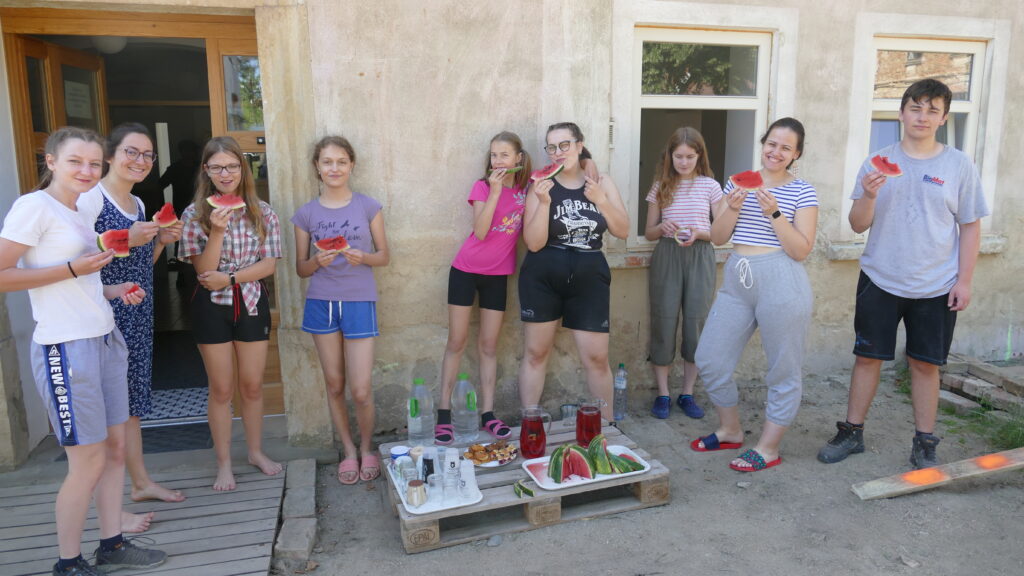
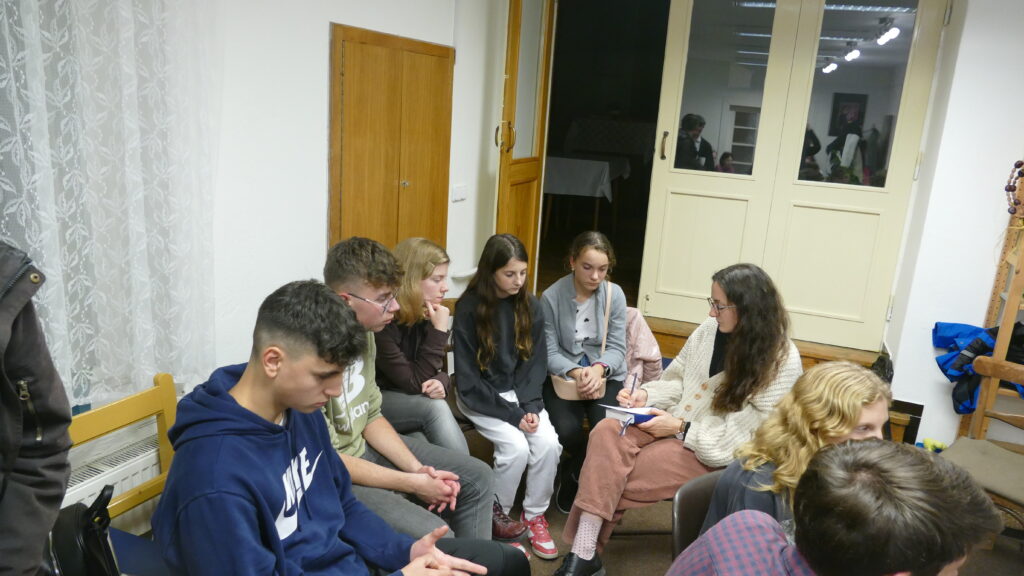
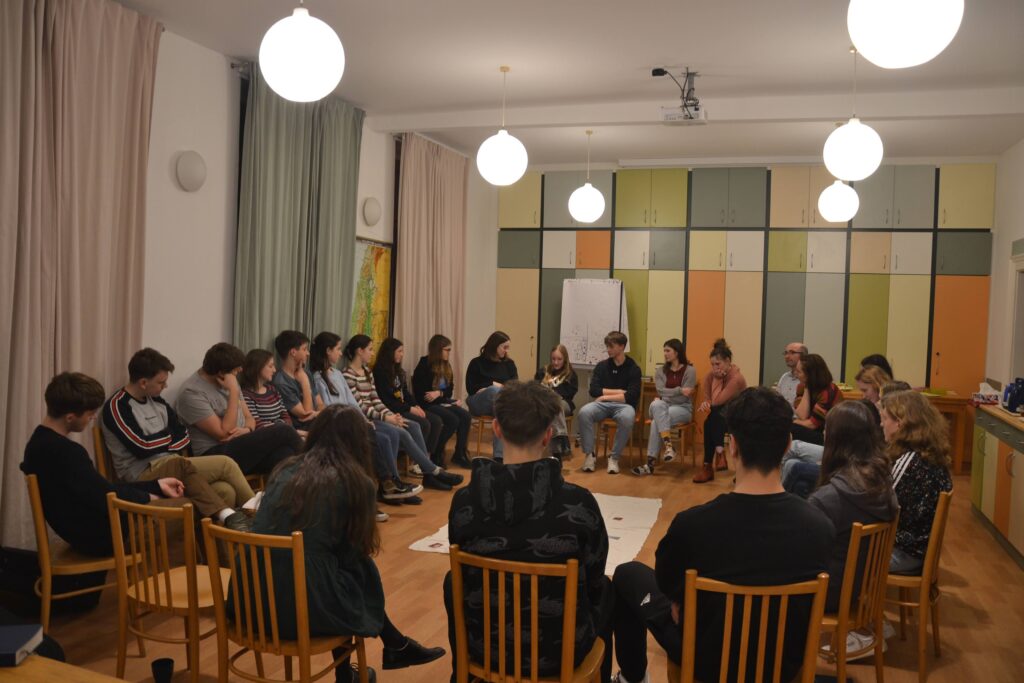
You mentioned that your church is quite liberal – what is the climate in the field of mental health; is it a topic that is easy to talk about?
AJ: In my opinion, the discussion about mental health in a way mirrors the process in wider society, which means that, on the whole, these topics were still taboo ten years ago, but since in society it is becoming an increasingly discussed topic, in the church too more and more people are concerned about it and try to reflect on it, through theological discussion and pastoral care. It was interesting for me to read the most recently published book – a kind of handbook on pastoral care in our church, and therefore also significant at our faculty, which was published only two years ago, and there was a very short chapter on pastoral care and mental health. Much more space should be devoted to discussions about it. I think the situation in many countries is pressing and urgent.
The worst thing that can happen, and it has already happened in the past, is that mental health is “spiritualized” and a not very helpful, even harmful, theology is used as a means in the struggle.
AJ: True. It is a difficult question – mental health as a punishment for some spiritual sin. There are not many people who truly believe that, but although it is not talked about often, this feeling, this conviction, exists among people, that a person who suffers mentally might have done something wrong or has not lived their life of faith successfully enough. It is hard to address these topics. I think pastors should clearly say that there is no connection between mental health and anything that this person might have done wrong.
In your practice and research, is there room for conversations with young people? What do young people say about what helps them when they are going through a mental health crisis?
AJ: The research itself was theoretical, but in the process and in volunteer work with young people, there have been many conversations. One of the things that was shared and frequently mentioned – what helps young people with mental health difficulties is that people in their youth group repeatedly try to reach out to them. When it was not possible to follow or take part in the gatherings, but group members tried to visit them at home or in the hospital, it was precisely this human contact that made the difference. It was mentioned that it is important to be assured that they still have a place in the group, even if they are not taking part in it. For many, in the hardest period, it helped to know that there are people who count on them and keep in contact. But community cannot be organized centrally; it simply has to come into being among people. It is necessary to build community consciously.
What real practices could church communities take up to support people with mental health problems?
AJ: I think there is a growing need and also an understanding that pastors and those who work with young people must be better educated, at least with basic knowledge of psychology and psychopathology, so that they are able to distinguish what the risks are, in which cases further care by professionals might be necessary. This is connected with the fact that pastors should be well aware of their competences and be able to adequately assess whether meeting with a young person is enough, even if it is ongoing, or whether the situation requires medical help. In the church, attempts are already beginning to educate pastors and other people involved in ministry.
I also see progress at the Protestant faculty; a few years ago there was no psychology course for those who study theology to become pastors, and now we can sign up for basic courses in psychology and psychopathology, as well as crisis intervention practice. Such courses are also offered as continuing education for pastors in congregations.
Is continuing education mandatory for pastors?
AJ: It is mandatory. I cannot say right now what the related policy is and what the penalty might be if a person does not continue their education, but every year week-long courses are organized for pastors. It is recommended to be there, and besides those, other courses are also offered to clergy. And then, from time to time, professional leave is granted, a sabbatical, which can last up to 4-5 months, to continue studies abroad or to rest from ministry for a longer time and refresh one’s vision.
Many new topics are entering the church; looking at the practice of congregations and what is being discussed – do you see that something is changing?
AJ: There are several levels at which discussions take place – first, if there is an impulse from society or perhaps from some particular congregations, there is a long process of discussion before it can actually bring about change in the church. For example, in parliament a rather tense topic is same-sex marriage. It was the same in the church, both at the level of individual congregations and at the synod level, and afterward a declaration of the church leaders was adopted. This is closely intertwined with theological discussions – many of our faculty’s professors are members of church and congregational councils, who carry out research and can thus provide information to the church leaders. For example, the question of homosexual couples and marriage was also significant in the theological argumentation. A few months ago our church leaders announced that congregational pastors can officially give a blessing to same-sex partners, because the state legally regards it not as marriage but as a partnership. In the church the possibility is already being discussed of not only blessing couples but also performing the entire ceremony of beginning a partnership in the church, in the congregation, similar to the marriage ritual.
The question of women as pastors in your church is most likely a thing of the distant past, since in many congregations women have been serving for a good while now; however, are men and women currently in equal positions?
AJ: Since the first ordinations, 70 years have already passed, now 71 years. In the church, the ordination of women really is no longer a current issue, but it should be noted that exceptions exist, similar to what I mentioned earlier, that in some places there are different views and traditions, also about women who preach and lead services. Problematic situations are rare, but they can still arise. And it must be admitted that there are still things we have to talk about in the church.
About a third of the pastors in our church are women, and, as is the case in other professions, there are restrictions regarding maternity leave, and this can affect women’s further career and ministry opportunities. On the whole, though, there is a sense that when questions are raised and the situation is laid out, then the church leaders try to address these questions. I have a specific case in mind – there is a scholarship granted by the church to those who are theology students and have marked their name on a list saying that they would like to become a pastor. One of the conditions for obtaining the scholarship is that immediately after studies you have to begin a year-long internship, and after the internship you have to commit to serving in a congregation for five years. If I were in such a situation, I would not choose it, because I might want to think about starting a family, but that is not possible either before beginning the internship or before beginning ministry in a congregation, and these six years after studies without a break is quite a long time. If a break were taken during these six years, the scholarship money would have to be returned. Also if the reason for the break is having children. However, I have to say that changes have just begun in the scholarship’s terms, and at the moment the condition mentioned no longer exists, and maternity leave is counted within these six years. In many situations of inequality, great progress has been made, but there are still many things to resolve.
Perhaps, in the past, not enough women took part in decision-making?
AJ: That, of course, is true. 70 years is a long enough time for women to be in various positions in the church, and that third of pastors who serve in our church is not proportionally reflected, is not visible in the church’s top-level leadership. Perhaps, as in other fields, women choose not to take on such positions. The overall climate could change if more women were involved, and that would encourage other women to respond to new callings and tasks.
The website of the Evangelical Church of Czech Brethren: https://e-cirkev.cz/en/
interview and translation, Arta Skuja