
Did Paul also address his letter to women?
Were women allowed to learn anything during the service?
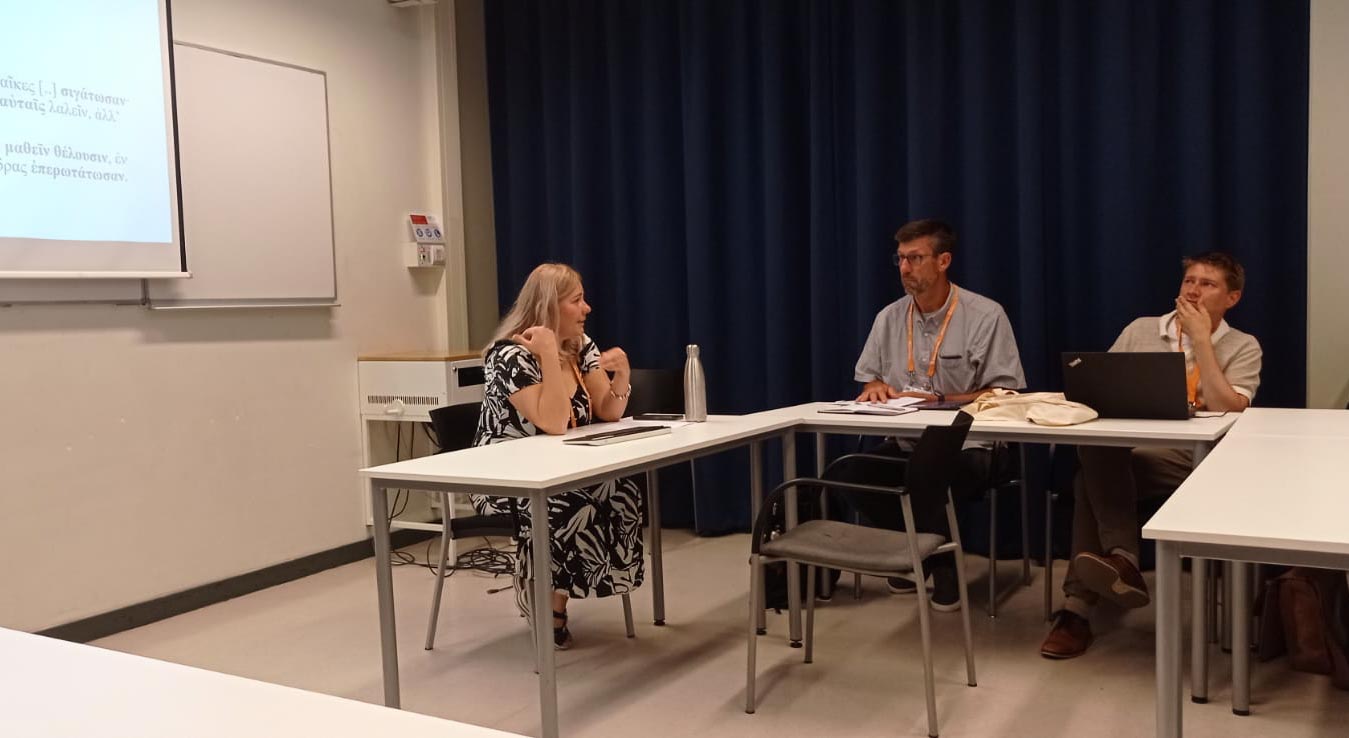
These are some of the questions that Aļesja Lavrinoviča, doctor of theology and member of the Latvian Lutheran Women Theologians’ Association, examined in her paper at the international biblical scholars’ conference (Society of Biblical Literature), which this year took place in Amsterdam from July 28 to August 1.
Are women in Corinth among the addressees of the apostle Paul at all? Could only men prophesy and learn, as well as encourage one another, in the Corinthian congregation?
In 1 Cor 14:31 Paul writes that:
“For you can all prophesy one by one, so that all may be instructed and encouraged” (bibele.lv). Note: in the new 2012 translation, the first “all” has been removed, so the impression arises that prophets are being addressed, which is one of the popular ways of interpretation, but is characteristic both of a later time and of a later Greek text. In the older manuscripts the word ‘all’ in this sentence is used three times, including before the encouragement – ‘so that all may be encouraged.’
The question arises: if in verse 31 all can prophesy, so that all may be instructed and all may be encouraged, then why, in verse 35, can women learn something only at home and not in the congregation? Who are the ‘all’ in the Corinthian congregation? Are ‘women,’ semantically analyzing the text of this letter, part of the category ‘all the Corinthians,’ whom Paul in this letter also addresses as ‘brothers’ and ‘all of you,’ or are they not?
In reading 1 Cor chapter 14, especially verses 34 and 35, women are spoken of in the third person, as ‘them’. In Latvian they are designated by “tām” [those]:
“Let the women keep silent in the congregational assemblies, as is customary in all the congregations of the faithful; for they are not permitted to speak, but must be obedient, as the law also prescribes. But if they want to know something, let them ask their husbands at home; for it is a shame for a woman to speak in the congregational assembly.” (bibele.lv)
Later manuscripts, especially the Latin-language New Testament texts and bilingual codices (Greek and Latin), add a possessive pronoun to the women – ‘your women,’ in this way specifying that the matter concerns women in Corinth, but at the same time making it understood that those being addressed here are men, who will hear or read these texts.
These questions and this analysis are part of Aļesja Lavrinoviča’s broader study of the addressees in ancient Corinth to whom Paul wrote his letters. In 2023, Aļesja Lavrinoviča defended her dissertation at the University of Zurich, titled “Mulier Taceat: A Study of 1 Cor 14:34–35,” in which she examines the silencing of women in the church using the methods of textual criticism (manuscript analysis) and linguistics (syntax, formal semantics, pragmatics).
Semantic analysis reveals that everywhere else in Paul’s first letter to the Corinthians, the ‘all’ Corinthians whom Paul addresses are also ‘all of you,’ ‘you’ and ‘brothers’ (in the vocative case). The text of the letter in verse 31, in which it is emphasized three times that ‘you all can prophesy,’ so that ‘all may learn’ and ‘all may receive encouragement,’ is in logical and semantic contradiction with the text we read just a few lines later, namely, that ‘women’ (in Greek ‘wives’ and ‘women’ are one and the same word) can learn at home and only if they ask their husbands (or men, e.g., brothers, fathers). Likewise, women are not permitted to speak in congregational assemblies, which means that they are also forbidden to prophesy. Any other creative interpretation that women may prophesy (because 1 Cor chapter 11 provides for it) but not converse, read a sermon, lead a service or weigh prophecies, does not take into account that the semantic field of the verb ‘to speak’ includes absolutely all forms of verbal communication. This means that there exists a logical and semantic contradiction within a single chapter, in the context of 5 verses, but also a contradiction between 1 Cor chapter 11 and chapter 14 regarding women’s prophesying or keeping silent.
In view of the above, as well as Aļesja Lavrinoviča’s broader study with more detailed linguistic analysis, Lavrinoviča made the following proposal to those present at the conference:
If Paul is also the author of the lines 1 Cor. 14:34–35 (let the women keep silent in the congregation…), then women most definitely (as a group addressed as 3rd person plural – “them”) are not among the addressees of Paul’s first letter to the Corinthians. In that case, the addressees of the letter to the Corinthians, who are addressed as “you,” “all of you” and “brothers,” are solely and exclusively men.
Consequently, all those modern Bibles that wish to make the language of the Bible more inclusive and thus translate the brothers (Greek – adelfoi) addressed in Paul’s first letter to the Corinthians as “brothers and sisters” do so contrary to the semantics, because women, according to the principium contradictionis, which in formal semantics and logic is represented as Aristotle’s square of opposition, do not fall within the category ‘all of you.’
The paper was received positively and with interest.
Aļesja Lavrinoviča’s dissertation has not yet been published, but will soon be on its way to the Mohr Siebeck publishing house in Germany.
The Society of Biblical Literature, founded in 1880, is the largest and oldest society that brings together Bible scholars from all over the world. It brings together more than 7,000 scholars from all over the world. In recent years, scholars of other Abrahamic religions, who work with the Holy Scriptures of Judaism and Islam, have also joined.
Aļesja Lavrinoviča (Dr. Theol.) for the Latvian Lutheran Women Theologians’ Association