
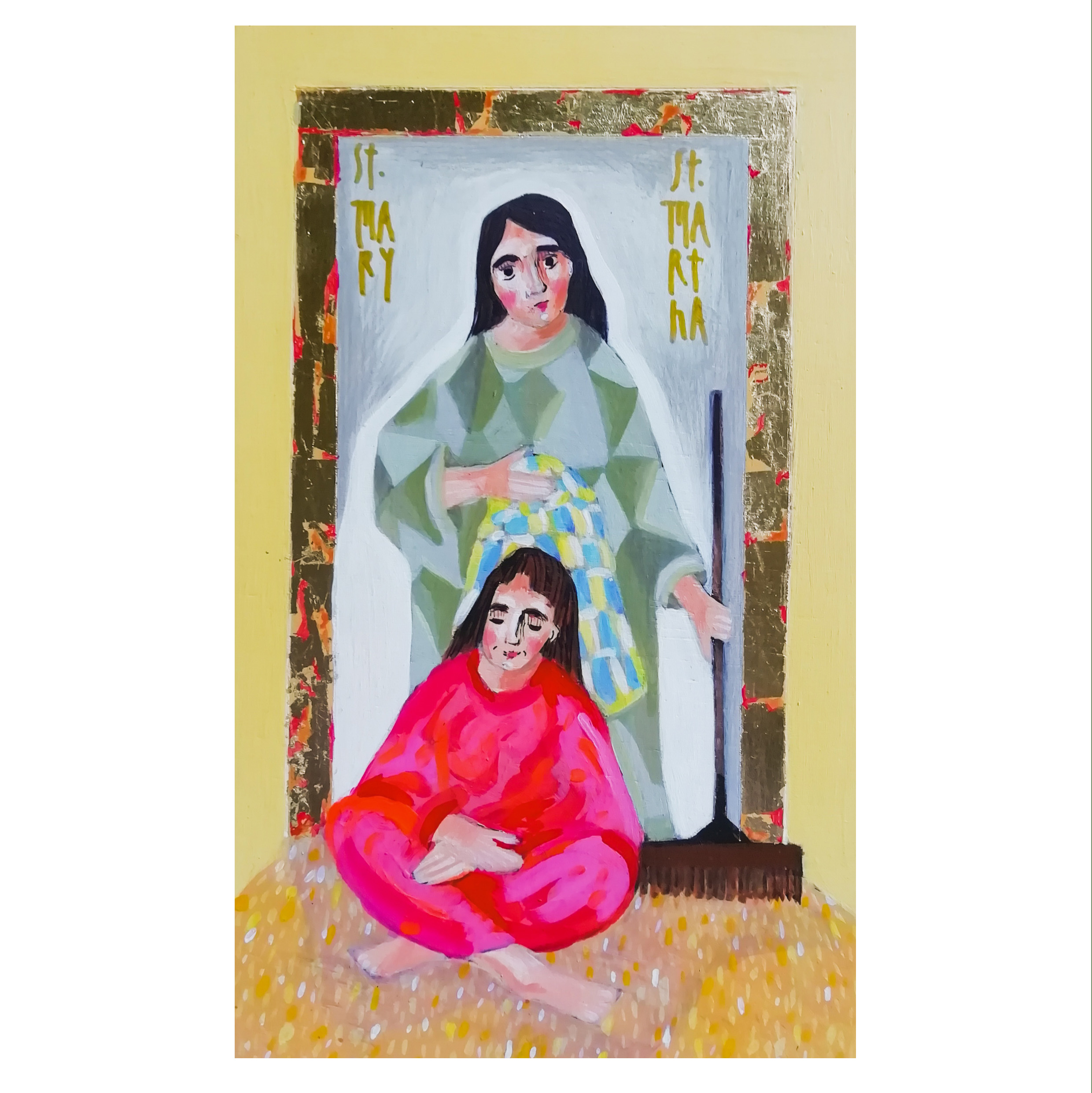
A contextual-hermeneutical essay on undervalued and unpaid household labor in the light of Luke 10:38-42
ANNE WHYTE
The essay’s author, Anne Whyte, writes about herself: “I was born in the area of Birmingham, in the English Midlands. I grew up in the Methodist Church, where as a young woman I was a lay preacher. Later, my husband from Ireland and I moved to live in Belgium, where we have now lived for 25 years. We have three grown children, two of whom have severe intellectual disabilities. At present I have returned to theology and am continuing master’s studies in theology and religious studies.
The Bible is a collection of various stories and accounts, so we can use our imagination and picture ourselves as participants in these events, get to know different points of view and perspectives, and seek new ideas in these so well-known texts. Of course, not all thoughts and ideas are equally good, but usually there is more than just one good way of thinking about a text. The deeper we search, the more we find.”
…
The contextual-hermeneutical approach to the Bible is a method developed by the theologians Reimund Bieringer ( Reimund Bieringer, KU Leuven, Belgium) and Ma Marilou Ibita ( Ma Marilou S. Ibita, De la Salle University Manila, Philippines). The first point of departure in looking at a biblical text is the assumption that the text dwells in three “worlds” – the historical, the literary, and the theological world, in which “faith seeks understanding.”[1] With the contextual-hermeneutical method the biblical text is examined and explored by weighing various perspectives – a feminist perspective, an eco perspective, a liberation perspective, etc. By setting the task of seeing this text in the light of the researcher’s/reader’s concrete environment and circumstances, the biblical narrative is set against one of the points of the UN Universal Declaration of Human Rights and the UN Sustainable Development Goals set for the future. By developing several perspectives of interpretation of the text, an answer is sought to the question of the future normativity intended by God. What does the Holy Spirit want to reveal today; what, in the light of the Holy Scriptures, must change in our assumptions and convictions, also in our personal context and life?
The biblical text
“As they went on their way, they entered a village. A woman named Martha welcomed Jesus into her home. She had a sister named Mary. She sat down at the Lord’s feet and listened to his words.
But Martha, worn out with much serving, stood before him and said: “Lord, do you not care that my sister has left me alone to serve? Tell her, then, to help me!”
The Lord answered her: “Martha, Martha, you are worried and troubled about so many things, but only one thing is necessary. Mary has chosen the better part, and it will not be taken away from her.” [2]
UN Universal Declaration of Human Rights Article 23. “Everyone has the right to work, to free choice of employment, to just and favourable conditions of work and to protection against unemployment.”[3]
UN Sustainable Development Goal no. 5. Gender equality[4]
The contextual problem in a socio-cultural, political-economic context
From the end of WWII onwards, Western European welfare was structured on the assumption that almost all men aged 16 to 65 would work full-time jobs and almost all women would be full-time homemakers. The majority of women were economically dependent on their spouse and had to take full responsibility for the household. Such an arrangement allowed employers to count on men being available all day, rather than taking regular breaks during paid working hours to go and perform care work at home.
Gradually women gained broader rights, including legal protection against discrimination at work, as well as the right to divorce. In the modern Western world it is assumed that men and women will do paid work from the completion of their studies until retirement. Women work in all professions, including the most influential positions — they are the CEOs of large companies and government ministers. Women, of course, now have greater options for choice, and they more often choose to form small families or to remain without children. Women can choose to end a marriage that makes them unhappy.
However, women’s success in taking up better-paid work has not been matched by men perhaps beginning to do household work to a similar extent. The majority of employers still expect employees to be available all day, to work 38–40 hours a week, often with an unpaid number of overtime hours. Preference is given to employees who have no career breaks. People who break these unwritten rules end up trapped in low-paid jobs. As a result, many couples have an economic need that, when they have children, one partner (almost always the man) concentrates their energy on their career, while the other (almost always the woman) moves to part-time or less demanding paid work in order to have time for raising the children, and, logically, this partner earns much less.
Well-off couples not infrequently employ someone — possibly a poor woman with immigrant roots — to do the housekeeping. In this way, well-off women can escape the burden of housework not because men take part in performing household tasks, but because well-off women can afford to employ poor women and receive their help. In the majority of households women still do far more household work than men, even if the women work full-time jobs. Meanwhile, full-time homemakers — mostly women with immigrant roots — have very few economic rights, and politicians tend to accuse them of unfairly exploiting the rights granted to them.[5]
Article 23 of the UN Human Rights is formulated on the assumption that work is paid contract work. In it, as in most public discourse, unpaid household labor remains invisible. Yet free choice of employment, just and favourable working conditions, and equal pay for equal work also apply to women who spend long hours doing unpaid and unrecognized, but indispensable, housework.
“Recognize and value unpaid care and domestic work through the provision of public services, infrastructure and social protection policies and the promotion of shared responsibility within the household and the family as nationally appropriate.”[6]
This point clearly indicates a global problem related to unpaid care and domestic work, which continues to foster gender inequality. Public services could include properly regulated paid childcare and paid care for people with disabilities and seniors. Social protection policy could include improvements to social security and financial support for people who do lower-paid work because of the hours spent on housework. The promotion of shared responsibility can take place through public awareness campaigns. A more complex approach to promoting shared responsibility would be changes in labor law, including more equal provisions on paternity leave.
Text and context
The passage about Mary and Martha follows the story of the Good Samaritan, which shows that practical care is more important than religious status. It is followed by teaching on prayer: first the Lord’s Prayer and then the promise that God answers our prayers (“Ask, and it will be given to you,” Lk. 11:9).
The broadening of the literary context can be found already at the beginning of the Gospel of Luke, in which we read about a joyful and hope-filled meeting of two women, and the proclamation of the good news to the humble and the hungry (Lk. 1:39-56).
The story of Martha and Mary is part of the so-called “travel narrative” of the Gospel of Luke. It begins at Lk. 9:51: “When the time was being fulfilled for him to be taken up to heaven, Jesus firmly set his face toward Jerusalem, to go there.” In the background of all the subsequent narrative is the road leading to the crucifixion. Luke’s reader or listener is repeatedly reminded of the journey to Jerusalem (13:22; 13:33; 17:11; 18:31; 19:11; 19:28). The culmination of the travel narrative is Jesus’ triumphal entry into Jerusalem (19:29-44), followed by the cleansing of the temple (19:45-48). The broader context of the Martha and Mary story is that Jesus is on the way to his death and resurrection.[7]
Liberation perspective
The liberation perspective[8] illuminates situations of oppression and seeks out those elements of the text that can inspire a practice leading to social change.
In this passage we encounter three figures: Mary, Martha and Jesus. We are not given information that would allow us to understand whether or not Mary and Martha are poor. Martha has a home in which she can receive Jesus; but if she were well-off, she would surely have had enough servants to do the work of hospitality in her place. Martha, very possibly, is not particularly well-off; most likely her living conditions could be similar to those of most people in her time and place.
Mary, Martha’s sister, says nothing. We know only that she “sat down at the Lord’s feet and listened to his words.” To sit at someone’s feet means to learn from this person, to be their disciple. Mary’s listening could be interpreted as passive and submissive, but it can also be regarded as the listening of a disciple, someone who actively thinks and, giving all her attention, learns.
Martha shows Jesus hospitality, but then asks Jesus to tell Mary to come and help Martha do the necessary work. The words that denote work, busyness, service in this text are the Greek noun διακονία and the related verb διακονέω. These words, which are the root of the word deacon, are often used in describing Christian ministry, and there is a tradition of interpreting Martha’s work as a model of active Christian ministry.[9] Service, caring can denote the work of Christians, or the serving of food and drink, and the Greek διακονία is also used to describe the work of hospitality performed, for example, by the healed Simon’s mother-in-law (Lk. 4:39).
It is interesting to see that Martha came and stood before Jesus (10:40). This gives the impression that the work she was occupied with kept her from being in the place where Jesus and Mary were sitting, and that Martha could not take part in the conversation while she worked. It is also striking that Martha turned to Jesus rather than simply asking her sister for help.
Why was Martha’s attention diverted by her many tasks? The text suggests that only Jesus entered Martha’s house (10:38), but it is very possible that some disciples arrived together with him (cf. John 12:1-8). How much effort did it take Martha to be able to receive Jesus worthily in her home? This is an essential question, because Jesus does not answer the request in the way Martha asks him to.
A reading of this text from a liberation perspective would want to free Martha from her excessive burden of work and from the injustice of having to do this work alone. Does Jesus free her from unnecessary work? Or does Jesus merely graciously hear out her worries and trivialize Martha’s work?
The Roman Empire background and postcolonialism
In the text itself there is nothing that would point to the presence of the Roman Empire. On the other hand, the literary context is that Jesus will be crucified, and at the center of this narrative is the violence, cruelty and injustice of the Roman occupation.
Martha and Mary live in a village somewhere in Palestine, at a time when Palestine is part of the Roman Empire. One can only imagine that the cultural norms of that time combined elements of the imperial culture, the influences of earlier periods of oppression that existed alongside local customs.
With a postcolonial approach we can ask the question of whether we are interpreting the narrative in accordance with cultural norms familiar to us. How many people are present at this event? What foods and drinks are being prepared and brought to the table? Is it expected in this society that guests should be offered something especially fine and elaborate to prepare? Who usually works in Martha’s house, and where is this work done? Is Martha’s complaint shockingly rude, or only slightly direct?
The Bible does not erase the problem, and yet it also offers a resolution, although the text does not envisage liberation. Most importantly, the postcolonial perspective warns that one must not forget the looming background of peril and threat that shapes and influences the lives of all three of the text’s protagonists.
Feminist perspective
Martha’s complaint resonates with every woman in the world who is stuck doing undervalued housework. Meanwhile, there are other women who, benefiting from the work of those (homemakers), can escape household cares in order to do more interesting, better-paid, higher-status work with others (men). If the story is read from such a perspective, then Martha’s train of thought seems complicated — choosing to speak with Jesus rather than with her sister, expecting help precisely from her rather than from someone else present. Jesus’ answer seems dismissive of Martha’s work, which resembles the attitude of modern politicians and other well-off people who characterize homemakers as people who give no contribution to society, and, like many people who have never had to clean a house or cook their own food, they do not value the great effort involved in work at home.
A feminist interpretation could be text-rejecting or liberationally feminist. A rejecting reading would criticize the biblical text, whereas the liberation feminist approach reveals and rejects the constraining potential of the text, while continuing to seek liberating themes in the Bible as a body of texts as a whole.[10]
The story of Martha and Mary has sometimes been interpreted in a way that subordinates women: women should do housework just like Martha, but unlike Martha they should not be anxious about it and should certainly not complain about it to men; instead they should cultivate a calm spirituality and the capacity to listen, as Mary does.[11] Such a reading of the text supports patriarchal structures and undermines feminism. The theologian Elisabeth Schüssler Fiorenza argues that the evangelist Luke’s intention was to object to the active ministry of women represented by διακονία. In that case, the story is not about household work, but about women in leadership.[12] Such an approach is a liberation feminist hermeneutic, in which she illuminates and stands against Luke’s ideological opposition to women’s leadership.[13]
However, a more positive reading highlights the fact that Jesus supports Mary’s choice to listen and learn just as male disciples would. Jesus also does not indicate that Mary should focus on housework.
Another positive element in the text is that Martha’s effort and work do not remain in the shadows. When we read in the gospel about events in which Jesus and his disciples travel from one place to another, it might seem that they live on thin air. Yet at Lk. 8:3 there is a brief but important note about the women who traveled together with Jesus and the twelve disciples, and the text states that “many others” women provided for them out of their own means. Similarly, in the narrative about Martha and Mary, the evangelist directs our attention to the indispensable and continuous practical work that goes on in the background of the narrative.
Trauma perspective
In the background of this text lies the inevitable event of the crucifixion. Jesus is going to Jerusalem. In the hearts of the original readers or listeners of the text also dwells the pain of the loss of Jerusalem, the persecutions by the Roman authorities, and conflicts with the Jews.
In the foreground we meet Martha, whose attention is diverted by cares and anxiety. Zenger points out that the Church makes a mistake in censoring and rejecting all the negative emotions that we often encounter in the psalms.[14] In the lament-filled words of the psalmist we recognize our own pain, which helps us move from disorientation to reorientation.
This same principle can be applied to the Martha and Mary narrative. At the center of attention is Martha’s complaint. The situation where preparing food for loved ones becomes stressful is so very recognizable. It is a shameful feeling — there is so much absurdity and hardship in the world, yet I am upset only because the milk has boiled over the saucepan. It can happen that a person who finds enormous resources of patience and courage to keep calm in the face of an enormous catastrophe releases their stuck and unprocessed emotions in reaction to something utterly trivial and banal.
Jesus names Martha’s feelings in neutral words – worried and troubled (10:41), yet not all biblical translations are so forbearing. The words often used point to a disproportion in Martha’s emotions, which irritates those around her, and interpret their expression as something unacceptable, so that one must ask whether the translators are not projecting their own judgmental attitude and preconception about human (feminine) emotions.[15]
Trauma in a biblical reading carries positive, but also dangerous potential. It can be read in a way that inspires Christians to accept and transcend inevitable suffering, but it can also be read as an encouragement to take on unnecessary suffering rather than resist injustice.[16] It is important to resist interpretations that suggest Martha was wrong to ask for help, or that Jesus judged her because she should not have felt anxiety or worry.
Ecological perspective
An important theme in the Gospel of Luke is judgment on excessive consumption and the lavish lifestyle of rich people, as well as good news for the poor.[17] Traditionally, in the context of the history of the Christian church, this text is not read from an ecological perspective. Inequality and injustice were considered sinful in a purely human sense, because of the harm they do to human well-being. However, in the 21st century, it is perfectly clear that the excessive consumption of the rich is destroying the environment. Recent studies reveal that we have exceeded six of the nine planetary boundaries.[18] In the case of carbon emissions, half of all consumption-related emissions are produced by the richest 10% of the world’s population.[19] The call for the well-off to live more simply is more relevant than ever before. It is not only a call to enact justice for the poor, but is also a call to honor and protect all of creation.
Jesus’ answer to Martha can be read as a call to simplicity. If, instead of saying that “only one thing is necessary,” Jesus says: “a little, or only a little, is needed,” then a resulting interpretation could be that these “things” are the dishes that Martha is preparing. In the shortened version, “one thing” could be Mary’s choice to listen, as opposed to the “many things” that divert Martha’s attention. In that case, Jesus seems to consider Martha’s work entirely unnecessary, and he critically compares her with her sister. The longer version allows for a gentler interpretation. Jesus tells Martha that she has already prepared enough food. Now she can join Mary and sit down.[20] Such a reading of the text is consistent with other passages of the Gospel of Luke in which the contribution of women is valued, and with other gospel passages that condemn excessive consumption. It is a reading that supports the idea of a well-being economy: no one takes too much, and there is enough for everyone.
The perspective of future normativity
In thinking about the inclusive and exclusive dimension of the passage, it is important to keep in mind that there is no explicit comment in the text about what a woman’s role is. Martha and Mary are two disciples of Jesus. Jesus does not say that Mary has chosen the better part for a woman, but rather that she has simply chosen the better part. The text in itself is not exclusive. The reader has the opportunity to project assumptions about women onto the text. The perspective of future normativity challenges these settled assumptions.
Many interpreters propose viewing Martha and Mary as ideals of active and contemplative discipleship. The difficulty of treating both women this way arises at the moment when we turn our attention to Jesus’ admonition that Martha’s many cares are not necessary. The idea that active ministry is not necessary is in direct contradiction with the story of the Good Samaritan (Lk. 10:29-37). When Jesus says “Go and do likewise!” (10:37), he is answering the question: “What must I do to inherit eternal life?” (10:25). So, active discipleship is not secondary or unnecessary.
The positive vision of the future offered by the text is to sit at Jesus’ feet and listen to what he says. This “better part” is available to everyone, and if we choose it, it “will not be taken away” from us. It is a vision of a shared life and friendship with God. In this worldview, an ethical approach is indicated, in which everyone has enough time not only to learn by observing, but also by reflecting deeply. It is a vision of a world in which no one would have to be reproached for the time spent looking out the window.
For such a world to become a reality for everyone, we would all have to do an honest and fair share of the absolutely necessary work; and we should resist the tendency to create unnecessary work for ourselves or for other people.
The interpretation of future normativity allows us to perceive a vision in which the people who do the everyday necessary housework receive the honor and respect due to them, and they too sit at Jesus’ feet and listen.
Conclusion
Although the story of Martha and Mary is so very familiar, it is multilayered and mysterious. Several points in the text are open to interpretation. What exactly was Mary doing? What work did Martha do? What did Jesus say about Martha’s work? What did he mean by saying that Mary had chosen the better part? Why did this saying lodge itself in the memory of the early Christians? Why did Luke include it in his gospel? What does it mean for us today?
The problem of gender inequality and injustice connected with household work is at once a matter of private, personal choice and a reflection of the problems lying at the foundation of our economic system. The ideology of meritocracy[21] is exposed as a lie by the reality of low pay and the conditions connected with the work that we value so highly, namely, the care of our children. Who, in this situation, has the “better part,” and who has the opportunity to choose it freely?
We can imagine that Martha has already prepared far more than is needed for a meal with guests. Jesus frees her from the internalized social pressure to do more than is necessary. Martha will join Mary so that, sitting at Jesus’ feet, she may listen to him. Perhaps later all three of them together will wash the dirty dishes and tidy the kitchen.
And yet, it seems that it is precisely Martha’s complaint that is the power of this gospel event. We too should be dissatisfied and perplexed. We must search and consider alternatives more carefully, in order to understand why the world is the way it is. And then ask courageously: how can we be part of the change we wish to see.
(translation of the text and illustration: Arta Skuja)
[1] https://ncec.catholic.edu.au/faith/scripture-resources/foundations/the-three-worlds-of-the-text/
[2] Lk. 10: 38-42. Bible, 2012 translation.
[3] https://www.ohchr.org/sites/default/files/UDHR/Documents/UDHR_Translations/lat.pdf
[4] https://www.unesco.lv/lv/ilgtspejigas-attistibas-merki
[5] Valerie Droeven, “Waarom huismoeders het nieuwe politieke mikpunt vormen”, De Standaard, August 16, 2023, https://www.standaard.be/cnt/dmf20230816_91240136
[6] UN Sustainable Development Goal 5.4. https://www.pkc.gov.lv/lv/attistibas-planosana-latvija/ano-ilgtspejigas-attistibas-merki
[7] Michael Wolter, The Gospel According to Luke, vol.2, translated by Wayne Coppins and Christoph Heilig (Tübingen: Mohr Siebeck, 2016), 40-45.
[8] Here are meant Liberation Theologies, such as Latin American liberation theology, Afrocentric theology, the theology of the region’s indigenous peoples, etc.
[9] Jennifer S. Wyant, Beyond Mary or Martha: Reclaiming Ancient Models of Discipleship, (Atlanta: SBL Press, 2019), 9.
[10] Carolyn Osiek, “The Feminist and the Bible: Hermeneutical Alternatives”, Hervormde Teologiese Studies 53/4 (1997).
[11] Wyant, Beyond Mary or Martha, 2-5.
[12] Elizabeth Schüssler Fiorenza, “A Feminist Critical Interpretation for Liberation: Martha and Mary, Lk 10:38-42”, Religion and Intellectual Life 3(1986), 32, cited in Wynant, Beyond Mary or Martha, 6.
[13] Osiek, “The Feminist and the Bible”, 965.
[14] Erich Zenger, A God of Vengeance: Understanding the God of Divine Wrath, 1996, 1.
[15] See also the 1965 translation “is caring and fretting.” “To fret” – to show dissatisfaction, to grumble, to complain.
[16] David M. Carr, Holy Resilience: The Bible’s Traumatic Origins, (New Haven and London: Yale University Press, 2014), 239-243.
[17] for example, Luke 1:52-53; 3:11; 4:18; 6:20-21, 24-25; 7:22; 14:12-14, 21; 16:19-31; 18:22-25; 21:1-4.
[18] J. Richardson et al., “Earth beyond six of nine Planetary Boundaries.” Science Advances 9, 37 (2023), https://www.science.org/doi/10.1126/sciadv.adh2458
The planetary boundaries concept offers a set of nine planetary boundaries within which humanity can continue to develop and flourish for generations to come. So, at present, six of the nine planetary boundaries have been reached.
[19] Khalfan et al., Climate Equality: A Planet for the 99%, (Oxfam International, 2023), https://makerichpolluterspay.org/climate-equality-report/
[20] Tommy Wasserman, “Bringing Sisters Back Together: Another Look at Luke 10:41–42.” Journal of Biblical literature 137, no. 2 (2018): 439–461.
[21] Meritocracy is a system of power in which the ruling class is made up of people with the greatest achievements and merits.