
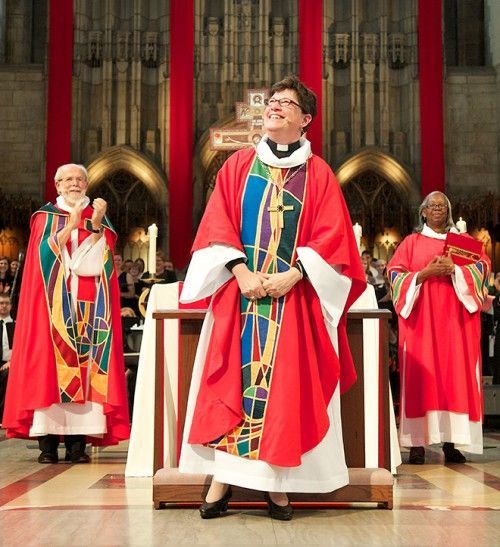
People gathered for “Holy Communion with the Installation of the Presiding Bishop of the Evangelical Lutheran Church in America” – the installation of Elizabeth A. Eaton at the University of Chicago’s Rockefeller Chapel. 5 October 2013 was a historic day, but it felt more than joyful, “of course”.
Hundreds watched the live broadcast as the ELCA Church Council, bishops, and ecumenical and global partners processed in, to the sound of mighty organ music by Bach and Britten and a piper’s rendition of “St Patrick’s Breastplate”. And then Paris Brown sang Dottie Rambo’s beloved hymn of praise “I Go to the Rock”.
The bells of the great chapel rang out. The time was now. The choirs, many singers from Augustana College in Rock Island, the grand piano and the drums, all sang: “Come, all you people, come…” The Lutheran church is a global church.
Then the still-serving presiding bishop Mark Hanson greeted everyone in the chapel and the viewers of the live broadcast in the name of Christ and said: “We have come together from many places to mark a new stage of ministry in the life of this church… Let us begin these celebrations with the conviction that, through the Holy Spirit, Christ is now present with us, as we pray that this servant may fulfil God’s purpose in her life and in her ministry among all of God’s people.”
Of course!
I was invited to write these reflections in a personal historical context. Many stories were interwoven in this one day. I invite you to reflect on your own.
Hearing these church-wide words of greeting, I remembered that my pastor once said in confirmation class, when as a young girl I was in the Lutheran church: “Of course, women cannot be pastors,” adding in a hushed voice, “they bear children.” But that same pastor helped me get into college.
Less than ten years after the first “of course”, studying at Concordia Seminary in St Louis as one of two women among 800 men, I heard from my homiletics professor: “Of course you cannot preach, you are a woman. Your task will be – an inspirational talk.”
But I received an “A” in that course (before the Lutheran Church – Missouri Synod turned radically “to the right” in theology) and in 1964 graduated with a Master of Arts in Religion.
I served as a deaconess in St Louis and then for more than twelve years with our family in inner-city ministry in Detroit (I once preached at Concordia College in Ann Arbor while pregnant) and in New Haven, Connecticut. The Master of Arts in Religion provided the Lutheran foundation for later earning a Master of Sacred Theology at Yale Divinity School (and, later still, a doctorate) and an invitation to teach at Yale.
Meanwhile, in the early 1970s, we were expelled from the Lutheran Church – Missouri Synod for too open an interpretation of Scripture and too inclusive a mission and ministry. Although I served on the Seminex board, I heard the implied “of course, only a few of us are free” when, regarding the ordination of women, it was said: “Can’t you wait a few more years?”
The American Lutheran Church and the Lutheran Church in America began the ordination of women in 1970, and the Association of Evangelical Lutheran Churches followed a few years later. Women continued to respond to God’s call, even though the churches said throughout the ages: “Can’t you wait a few more years, decades, centuries?”
In those years there were various fears and barriers in response to the ordination of women as pastors in the Lutheran and other churches: “Jesus was a man; women cannot represent Jesus; if we ordain women, all the men will leave the church; what will happen to our children? (They grew up just fine, thank you.) These women are communists.”
Of course, there were fears, but they were unfounded. Women did not want to take over the church or push men aside. The aim of women was inclusion and partnership, not hierarchical power.
On 5 October, with the words of greeting from Bishop Mark Hanson and the whole ELCA, to the sound of French horns, a procession with candles and the cross went out along the central aisle to receive Bishop Elizabeth Eaton at the chapel doors.

Red banner streamers swirled overhead. The singers sang. Everyone proclaimed: “Christ has laid a sure foundation.” In the crowd I saw the face of the historian Martin Marty.
The vice-president of the ELCA Northeastern Ohio Synod, Rodney Sprang, and the secretary, John Sleasman, said: “We bring before you Pastor Elizabeth Eaton, who has faithfully served among us as our bishop, lead pastor and sister in Christ… We send her on to serve as presiding bishop in the Evangelical Lutheran Church in America.” There were tears in my eyes.
In thanksgiving for baptism, we, as sisters and brothers, were reminded that “God frees us from the bonds of sin, unites us into one body, and calls us forth into new life and mission in the world”.
To the sound of a hymn of praise, Elizabeth was led into the chapel, and the presiding pastor Mark Hanson, the preacher Jessica Crist and the assisting pastor Yolanda Tanner, vice-president of the ELCA Delaware–Maryland Synod, sprinkled the assembly with baptismal water.
The first reading, from Isaiah 42:5–9, was read by Rev. Chienju Jaida Lee in Chinese: “I have given you as a covenant to the people, a light to the nations… to bring out the prisoners from the dungeon, those who sit in darkness…”
The soloist led the singing of Psalm 121, “My help comes from the Lord”.
Of course, of course.
“The Lord will keep you… from this time forth and for evermore.”
The second reading, from 2 Corinthians 4:1–12, was read by Dina Tannous Vega in Arabic: “Therefore, since it is by God’s mercy that we are engaged in this ministry, we do not lose heart…”
In the Gospel procession and proclamation, women of the world sang: “Alle, alle, alleluia, how pleasant to hear in the mountains the footsteps of the one who brings good news – who proclaims peace, who brings good tidings, who proclaims salvation.”
Of course, of course.
Conrad Selnick, an Episcopal priest and the husband of Bishop Elizabeth Eaton, read from the Gospel of Mark 4:1–9.
Of course. An ecumenical partner and a marriage partner, he represented the ecumenical and full-communion guests and Bishop Eaton’s family, on this day also distributing Holy Communion.
At my ordination in 1977 in the chapel of Yale Divinity School, in a very ecumenical arrangement, my husband, Pastor Burton Everist, preached. Various people from all three founding churches of the ELCA had tried to hinder or stop my ordination. Roger Fjeld of the American Lutheran Church prevailed and led the rite of ordination.
Only a few years earlier, on 29 July 1974, Burton and I had taken part in a service in which 11 women were “irregularly” ordained as priests in the Episcopal Church at the Church of the Advocate in Philadelphia, in the presence of 2,000 people.
The ordination was declared “invalid”, but one of the four bishops who took part said that the ordination event “remains as a prophetic witness both to the oppressed and on their behalf”. The service was interrupted by those who were in opposition.
One of these 11 women took part in solidarity in my ordination at Yale three years later.
Two years later, Wartburg Seminary invited me to be a professor, the first of the three seminaries of the American Lutheran Church to risk inviting a woman.
In 1979, when one woman after another was becoming a pastor, other people were still using the Bible to prove that women cannot be teachers of theology to men and cannot take on any leadership role, because Eve led Adam into sin and “it is clearly stated in the Bible that women can never rule or lead”. And “we cannot use inclusive language, because God is a man”. Of course!
But one young woman, in the autumn of 1979 at an alumni gathering, came up to me after I had spoken, and said: “I have waited for years for you to come.” Her name was Andrea DeGroot Nesdahl. Now, 35 years later, I continue to teach at Wartburg Seminary. We all still have the challenge of being the kind of church God has called us to be.
This October, at the University of Chicago’s Rockefeller Chapel, the sermon was preached by the bishop of the ELCA Montana Synod and chair of the ELCA Conference of Bishops, Jessica Crist.
“A sower went out to sow.” She said that this simple story can be reshaped, amplified, contextualized, but added that everyone is present here today because someone sowed seeds.
“Look at the plants that have grown.” She told those present that obstacles to success do not matter to Jesus. She challenged them: “You may be tired of the rocky soil.” “You may be irritated by the thorns that accompany every effort of yours. What about those thorns? Why is there evil? Pain? Just keep on sowing. The fact that we sow is what matters.”
And Crist added that “we do not sow alone. We are part of a community. We are here to install, to sow in a wider field. Each one is given strength. Each one is sent. Go and sow!”
The ELCA has come a long way since its beginning in 1988. Look at all these seedlings that have grown.
The principles of representation adopted at that time, ensuring the representation of laypeople, people of colour and those whose first language is not English, ensured an equal presence of women and men on councils and committees, at synod and churchwide assemblies. After a far more threatening stage of signs, in a single moment our ELCA assemblies looked, so to speak, normal – like the fellowship God intended.
But the Conference of Bishops began merely as an exclusively male group. I happened to be one of three theology faculty members who addressed the first Conference of Bishops in 1988, and I told them that it was not healthy (perhaps I said “dangerous”) for the church and for themselves that there were no women among them. I also spoke about other issues, of course, about leadership as partnership and about the liberation of both men and women, and about the calling of all the baptized to go out into the public world.
At that time there was concern that women might gain too much power. Whenever two or three of us were sitting together, almost always some man would come up and say: “We have to separate you.” There was fear about “letting all those people in”, who would change the proceedings and make decisions.
But what were those fears about? Inclusion was not about breaking things, not even about breaking the “stained-glass ceiling”, but about new, healthy ways of being partners. That is why I was so glad to see, in the September 2013 issue of the journal “The Lutheran”, the man, Bishop Mark Hanson, and the woman, Bishop Elizabeth Eaton, hand in hand.
Full partnership will come slowly, but it will come.
In the spring of 1992, Maria Jepsen, a pastor in Hamburg, Germany, became the first woman to be elected a Lutheran bishop.

On 11 October 1992, in La Crosse, Wisconsin, April Ulring Larson was installed in the office of bishop of the ELCA La Crosse Area Synod. Andrea DeGroot Nesdahl became the second woman elected to the office of ELCA bishop, serving in the South Dakota Synod.
Susan Johnson was elected national bishop of the Evangelical Lutheran Church in Canada on 29 September 2007.
This past weekend she was among the global and ecumenical partners – Lutheran churches from Canada, Nicaragua, Sweden, South Africa, from the United Church of Christ, the Moravian, the Reformed, the United Methodist, the Episcopal, the U.S. Presbyterian, the Christian Church, Thailand and the Lutheran World Federation – and led the jointly recited Nicene Creed, and laid hands on the installation of the fourth ELCA bishop, Elizabeth Eaton.
“We believe in one holy, catholic and apostolic church…”
“Elizabeth Amy Eaton has been elected and called by the church to be installed in the office of presiding bishop.”
No objections are raised. No interruptions of the service. Nothing is called irregular or invalid. No obstacles. Historically speaking, it was much more than “of course”.
After the Bible readings from the Gospels of John and Matthew, the Acts of the Apostles and 2 Timothy, Elizabeth was asked: “Into your care are entrusted the bishops, pastors, deaconesses, deacons in diaconal ministry and ministry partners; the synods, congregations and other communities of this church. I ask you in the presence of God and of this assembly: will you accept the office of presiding bishop?”
Elizabeth Eaton answered: “I accept, and I ask God to help me.”
More questions to her and then to us: “People of God, do you accept Elizabeth as a servant of God and a Shepherd of the church of Jesus Christ?”
“We accept.” The assembly joined in a prayer of thanksgiving to God: “By your Holy Spirit you sustain the church… Strengthen and sustain your bishop Elizabeth with patience and understanding… Pour out your grace, that she may love and care for your people and teach the faith…”
Hearing the words “the office of presiding bishop is now entrusted to you”, everyone was invited to raise their hands in blessing. Even miles away, people raised their hands, some with tears in their eyes, seeing what only a few could have imagined a few years earlier, but towards which the Spirit had been leading all this time. Women have always been present – from the time of the empty tomb, even though at first their words were not believed.
The intercessions were in many languages. It was clear that we are a worldwide church. Bishop Eaton was presented with a cross: “Rekindle anew the gift of God that is in you.”
Loud approval. Applause. Smiles! She shared the greeting of peace: “La paz de Cristo sea siempre con ustedes.”
And then: “Let us go to the feast.”
Bishop Eaton and the assisting pastor Tanner were at the altar. We had always been so careful that there should not be two women together at the altar, but today it was good. Of course, most bishops are still men. But women and men served Holy Communion together today. Phyllis Anderson, the first and only woman seminary president in the ELCA, represented them. There were Beth Lewis and Caleb Miller, and Carina Grady, and Carlos Peña and others. The oldest and the youngest congregations of the ELCA were represented.
We do not have to be a threat to one another. “Taste and see, taste and see that the Lord is good” – sang Larry Clark and Paris Brown.
When everyone had been fed, the assembly began to sing “Blessed Assurance”, an age-old hymn in new tones, clapping hands and swaying even at the altar – not too much, of course. “This is my story, this is my song.”
The blessing of sending forth was in Spanish: “May the God of steadfastness and encouragement grant you to live in harmony with one another, in accordance with Jesus Christ…”
Having voiced their conviction loudly in just under two hours, the assembly went forth. God calls us into a calling once again in the public world. The recessional was long, the Church Council and bishops came out of the pews two by two, many leaders together, not just one at the head, to the sound of bagpipe music, “Highland Cathedral”. When the newly installed ELCA presiding bishop Elizabeth Eaton walked last, smiling, calm and confident, people waved. Applause. The organ in mighty resounding. “Now thank we all our God.” Of course!
________________________________
Norma Cook Everist is professor of church administration and educational ministry at Wartburg Theological Seminary. She holds a Doctor of Philosophy from the University of Denver and the Iliff School of Theology, a Master of Sacred Theology from Yale Divinity School, a Master of Arts in Religion from Concordia Seminary and a Bachelor of Arts from Valparaiso University.
The article in English is available at http://www.livinglutheran.com, photo: ELCA from the website http://episcopaldigitalnetwork.com
Translated from English by Ieva Puriņa, Mag.Theol., LELBāL deacon
Proofreader Mag. Theol. Milda Klampe