

Wittenberg, Germany/GENEVA
15/8/2017
A gathering of bishops and leading women of the church in the LWF network ‘Women in Church and Society’ (WICAS)
Lutheran World Information (LWI)[1]: “We show deep respect for the women who were the first to take up leadership positions.” Such was the unanimous view of the women bishops and church leaders regarding those who had taken steps along this path two or three decades ago. One of these women is, for example, Maria Jepsen of the Evangelical Lutheran Church in Northern Germany, who in 1992 was the first woman in the world to be elected bishop in a Lutheran church – that was 25 years ago.
One of the events of the 2017 Reformation summer in Wittenberg was a gathering of women bishops and leading women in the church. The event was organised by ‘Women in Church and Society’ and the LWF German National Committee at the initiative of Ilse Junkermann, Bishop of the Evangelical Church in Central Germany. From 10 to 14 August, women from Germany, Greenland, Indonesia, Latvia, Norway, Suriname and Zimbabwe took the opportunity to share their experiences, taking into account their respective contexts – both the opportunities and the difficulties faced by women in leading church positions – and gave one another advice and support.
Regardless of their country of origin, women who are church leaders often find themselves in confrontational situations that bring them face to face with objections directed against them. The first women in leading positions in their churches have the hardest task, especially where there is no female role model of leadership. Yet gradually it becomes easier and easier, says Bishop Anne Helene Fjeldstad Jusnes of Norway: “Today it is nothing unusual for a woman to be a bishop. But forty years ago we women had to fight even to be ordained.”

Maria Jepsen is a former bishop of the Evangelical Lutheran Church in Northern Germany, who was ordained in 1972 and in 1992 became the world’s first woman Lutheran bishop. Photo: LWF/Marko Schoeneberg
The challenge for women in leading positions
In her keynote presentation, retired bishop Maria Jepsen spoke about colleagues and journalists who at the time followed her every step with a critical eye and commented accordingly. Jepsen acknowledged that there were situations in which she was aware of a lack of help and public support. She advocated for transparent administration in contentious matters, as well as for bringing the leadership style closer to the level of grassroots organisations. When Jepsen worked on draft decisions proposed by state institutions, she consulted the people who might be affected by certain decisions. This often drew criticism from central church officials. Jepsen emphasised that she always gave preference to open and honest communication and a transparent style of leadership.
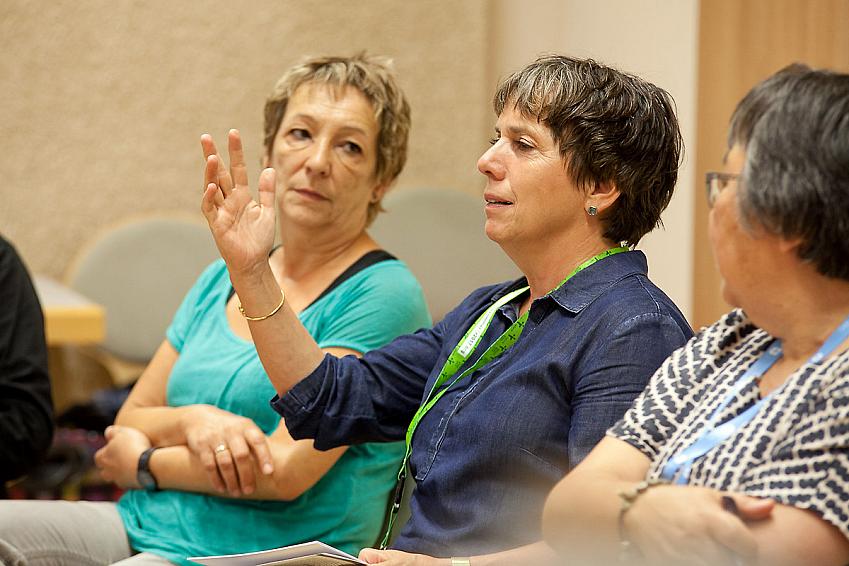
In 2009, Margot Kaessmann was the first woman to be elected chairperson of the Evangelical Church in Germany. In 1999 she was ordained as the first woman bishop of the Evangelical Lutheran Church in Hannover. Photo: LWF/Marko Schoeneberg
A few years after Maria Jepsen took office, in 1999 Margot Kaessmann was elected the first woman bishop of the Evangelical Lutheran Church in Hannover. She revealed that, unlike her male colleagues, she first of all had to answer questions about how she would manage and find time to care for family life and raise her four daughters. It was encouraging, she says, that these changes were nonetheless accepted – when a person proves herself, is able to acquire the necessary skills to move forward and carry on. In 2009, in addition to her core duties, she became chairperson of the Evangelical Church in Germany (EKD). The Russian Orthodox Church, which does not ordain women and does not allow them to hold leading positions, began to question whether to continue the dialogue with the EKD that had been ongoing since 1959. In 2012, when Kaessmann no longer held this office, the dialogue with the Orthodox Church was resumed.
Kaessmann noted that the Lutheran distinction between the office and the person was a helpful concept and a relief to her personally. It allowed her to be true to herself without an “order of power,” she said.
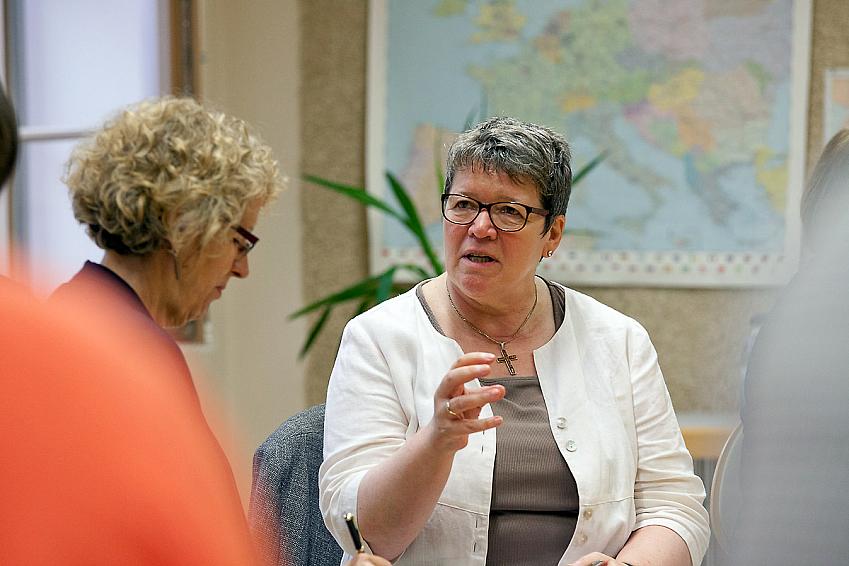
Ilse Junkermann is currently bishop of the Evangelical Church in Central Germany, which since 2009 was formed from the Evangelical Church of the Province of Saxony and the Evangelical Lutheran Church in Thuringia. Photo: LWF/ Marko Schoeneberg
Then Ilse Junkermann addressed the gathering. She comes from West Germany and since 2009 has served as bishop of the Evangelical Church in Central Germany, which was formed from the Evangelical Church of the Province of Saxony and the Evangelical Lutheran Church in Thuringia. “In East Germany the churches are in the minority,” she stated. This means that the concept of the ‘official church’, that is, the notion of the ‘state church’, has died out, and the church has had to “redefine itself anew.” Junkermann said she was convinced that traditionally feminine skills and arts could be decisive for the church on this new path, just like those of a midwife.
“This would be the main task of pastors and congregational educators of both sexes: to be a support to the baptised, so that the gifts within them can be born and flourish. To be with them while this gift begins to take a definite form and crystallises. To encourage them to endure the experiences and the pain that come with every change. As well as to strengthen them in life’s situations and to be present and reachable when they are going through hard times.”
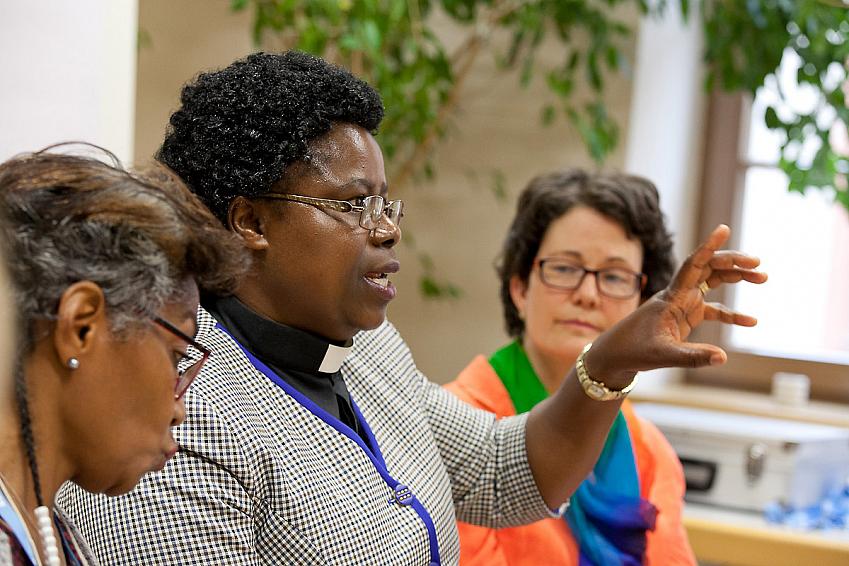
Chiropafadzo Moyo is a dean in the Evangelical Lutheran Church in Zimbabwe, the only woman with a doctoral degree. Photo: LWF/Marko Schoeneberg
Searching in the Bible
Focusing on the theme of ‘family’ and ‘women in leadership’, Chiropafadzo Moyo, who is a dean in the Evangelical Lutheran Church in Zimbabwe, led a Bible study on 1 Samuel 1:1-23 (Hannah’s prayer and the birth of Samuel). Hannah was a woman who made her own decisions and persistently carried them out in practice, and who was not deterred by the behaviour and mockery of Elkanah’s other wife Peninnah over Hannah’s barrenness, and in communicating with her husband Hannah was clear and open.
What qualities characterise Hannah? “She was aware of her weakness,” said Moyo, “most people, when you ask them about their weaknesses, talk about their strengths, but to succeed in a leadership role it is very important to be aware precisely of one’s weakness.”
[1] Lutheran World Information (LWI) is the information service of the LWF, which has served as its main news source for more than 50 years. https://www.lutheranworld.org/content/lwi-2014
Source: Lutheran World Federation