
Ž. Priede, bachelor’s thesis “Women’s Ordination in Latvia in the Time of Archbishop Jānis Matulis”, University of Latvia Faculty of Theology, 2007.
In the late 1960s and in the 1970s, Helēna Valpētere, Berta Stroža, Aleksandra Dombure, and Vaira Bitēna studied at the Theological Courses, all of whom were serving students at the rank of deaconess.
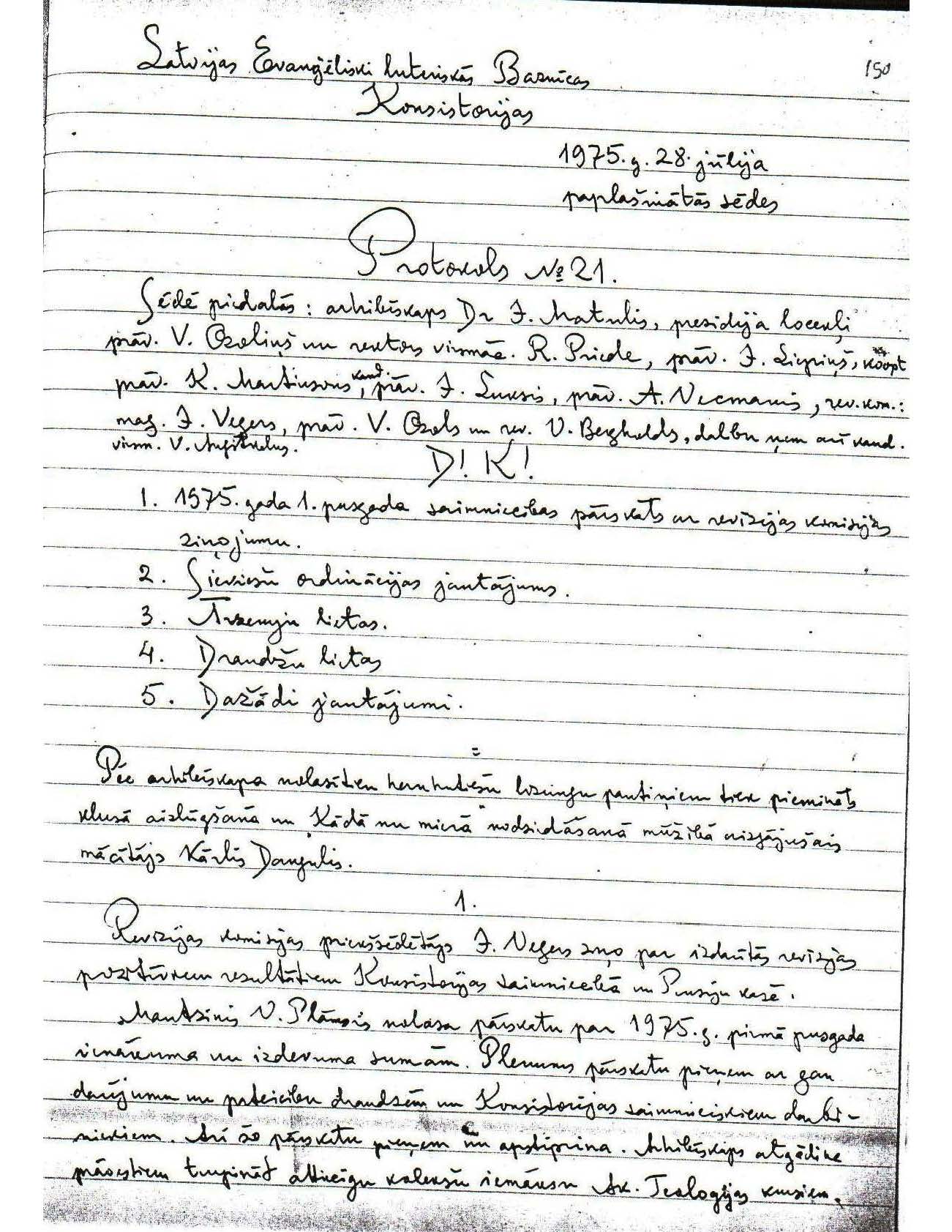
On 28 July 1975, at an extended session of the Consistory, Archbishop J. Matulis raised the question that all the Churches already had women’s ordination. He may have meant that women were already being ordained in the larger Lutheran countries such as Germany and Sweden. Our neighbours the Estonians had also already begun ordaining women. But the most important argument may have been that the Evangelical Lutheran Church of Latvia outside Latvia had already begun to ordain women. In 1974 Agnese Pone had already been ordained, the first woman ordained in the ELCL Abroad. Another Latvian woman was ordained in the Church of Sweden in 1974, but was only received into the ELCL Abroad in 1975. Although there is no written historical evidence, Ēriks Mesters reveals in an interview that Archbishop J. Matulis met with the ordained women. I allow for the possibility that, on one of his trips abroad, J. Matulis met with one of these or other ordained women. On that basis he expressed the idea that the Latvian Church too needed such an ordination. The voters were the members of the presidium of the plenary session of the Consistory: V. Ozoliņš, R. Priede, J. Liepiņš, K. Martinsons, J. Luksis, A. Vecmanis, J. Vēgers, V. Ozols, V. Begholds, V. Augstkalns.
After the question had been raised, everyone had the right to speak. The discussion was begun by the rector of the Academic Theology Courses, Roberts Priede. Judging by all the evidence received both from literary sources and from V. Bitēna, the rector R. Priede was in favour of women’s ordination. This gives the conviction that he also sought to persuade the members of the commission in favour of women’s ordination. Afterwards, Professor V. Augstkalns and Assoc. Prof. A. Vecmanis, treasurer V. Plamsis, provost V. Ozols, J. Liepiņš, and V. Ozoliņš spoke.
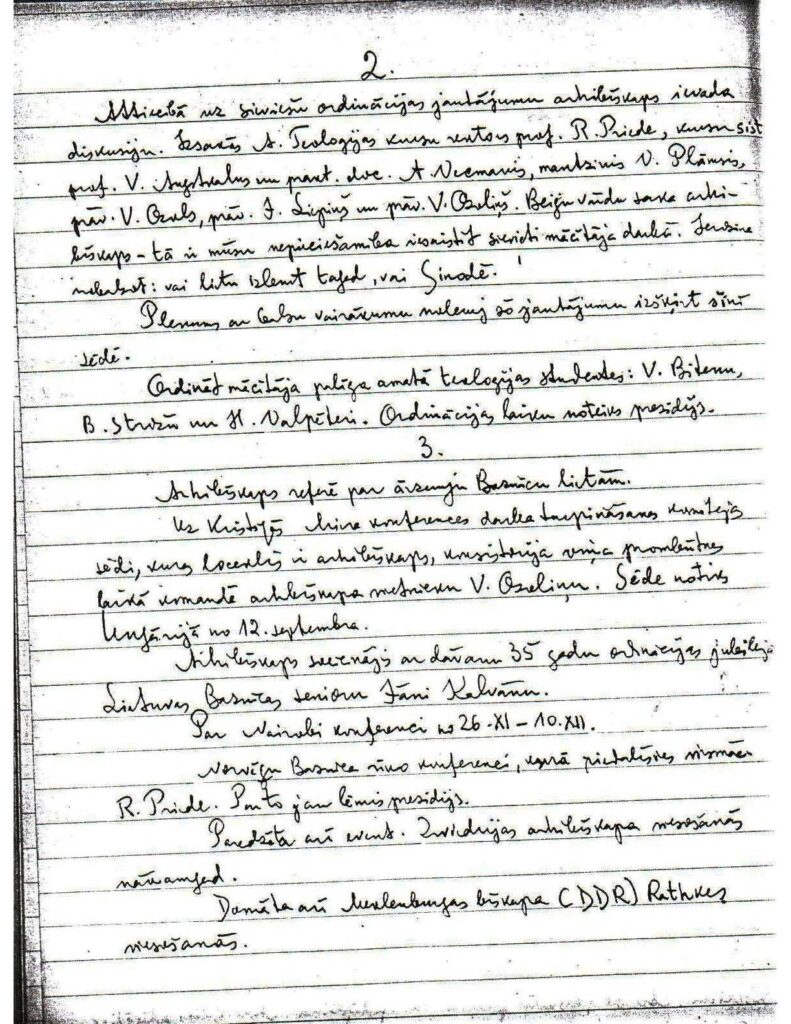
When everyone had expressed their views on this topic, the closing words were spoken by Archbishop J. Matulis: “If you are against it, then I will call an extraordinary General Synod, and the Synod will grant permission for women’s ordination.” Permission for a General Synod could be granted by the Council for the Affairs of Religious Cults in Moscow.
Before the vote, J. Matulis said: “Such is our necessity – to involve women in pastoral work.” Here, however, J. Matulis does not explain what that “necessity” is. This word can be interpreted here in various ways. Perhaps the motivation was that the ELCL Abroad had already begun to ordain women and J. Matulis needed to accept this in Latvia too, in order to preserve unity. Perhaps it was a fairly simple explanation, that it was a real opportunity to solve the shortage of pastors. It was a solution in any case, but why could things not have stayed as they were, since these very students H. Valpētere, B. Stroža, and V. Bitēna were already serving in congregations. Although he says “involve women in pastoral work”, it is not said that they were to be ordained. The words “ordain” and “involve” are not synonyms.
“I propose that we vote: whether the matter will be decided now or at the Synod.” These last words of Archbishop J. Matulis specifically indicate that he would see to it that the women were ordained. Both sentences that he spoke before the vote show that he had a firm aim for the resolution of this question. Since he says this before the vote itself, it sounds like pressure on the voters or even blackmail. I think that he himself was convinced that no one wanted to take this matter as far as the General Synod, because then Moscow would be involved and that would cause additional inconvenience. It is possible that the participants of the plenary session also did not want Moscow to begin examining whether the ELCL was not united and unable to resolve its own questions by its own efforts. As Ē. Mesters recounted, at that time there was no particular correspondence with the Commissioner for the Affairs of Religion and Cults about women being ordained. If we analyse these words in connection with what was said earlier, then, since they did not seek to present the matter too emphatically to the head of the Department for the Affairs of Religion and Cults of the Latvian SSR, still less would they have wished to involve the central administration in Moscow in this question. Neither the archbishop nor the staff of the Consistory sought to “carry it outside”. I think that J. Matulis was convinced that if this question was not adopted at this session, then in the Synod vote he would ensure that the vote was as he wished. Judging by all the characterisations of the archbishop written by people close to him and not so close, such as his friend Ē. Mesters and the commissioner for cult affairs A. Saharovs, he was clever, gifted, and certain of what he was doing.
After the words spoken by the archbishop, the vote took place. “The plenum, by a majority of votes, resolves to decide this question at this session.” As Ē. Mesters recounted, the vote took place without incident; they voted “for” women’s ordination, for the most part out of a wish to keep this reinforcement of ordination quiet, and out of the great respect they felt for Archbishop J. Matulis. From Ē. Mesters’s words, however, it did not sound as though the commission had done so out of conviction that ordination was necessary, but rather that entirely different aspects had driven it. But the decision was adopted: the theology students V. Bitēna, B. Stroža, and H. Valpētere would be ordained to the office of assistant pastor.
The state’s attitude towards what was happening within the Church was neutral. It did not seek to resolve the Church’s own internal problems, so long as they did not touch upon the interests of the state. The state intervened only at the moment when the state and power were at issue. As V. Bitēna recounts, the state was not opposed “and prided itself on the fact that in the Soviet Union there was equality in spiritual matters, and as proof of this – I was sent in a delegation to Czechoslovakia, where it was specifically the secular side that demanded that there be one woman. Ten of us pastors went, and the state side stipulated that there be women as well, so as to display it. Mesters said it was an order – ten Catholic pastors and me from the Lutheran Church; in Moscow the Orthodox, pastors of all denominations, and us. It seems to me that at that time there was no resistance to women, because they prided themselves on us having equality. [..] It was state policy. They needed to show the world that there was equality. They perhaps thought that we as women would be weaker and that the Church would therefore be weaker. But in reality it was the opposite. Both Berta Stroža and Helēna Valpētere were very strong pastors. At the time there were pastors of the old generation who were already tired and well on in years… And everyone is only human… But we were young and went with new zeal. God had called us, and we had something to say. And now they saw that we were building up the Church.”
V. Bitēna recalls: “I was requested in the countryside, in Viļķene, by one congregation, and there it was like this: either they would let me in and they would keep the keys, or, if they did not let me in, they would hand the keys back to the state and dissolve, because the church was in a state of disrepair. The man pastor refused and said: there is nothing to be done here – there is neither a congregation nor a church.” Since Archbishop J. Matulis fought for the preservation of every church, placing a student as the congregation’s pastor was a way out. Thus, in 1972, V. Bitēna was assigned a congregation in Viļķene parish, Limbaži district. The church was in a catastrophic state and required major restoration work. With energetic action and the support of many friends and of the congregation, Vaira Bitēna carried out this work.
1 Ēriks Mesters, History of the Evangelical Lutheran Church of Latvia 1944-1990, (Riga: Klints, 2005), p. 149.
2 Ed. Zilgme Eglīte, Mary’s Songs and Stories, (Riga: Klints, 2005), p. 190.
3 Minutes of the plenary sessions of the Consistory No. 21, p. 150.
4 Ibid.,
5 Ēriks Mesters’s recollections in a personal interview, 18 May 2007
6 Ēriks Mesters’s recollections in a personal interview, 18 May 2007
7 Minutes of the plenary sessions of the Consistory No. 21, p. 150.
8 Minutes of the plenary sessions of the Consistory No. 21, p. 150.
9 Ēriks Mesters’s recollections in a personal interview, 18 May 2007
10 Ibid.
11 Minutes of the plenary sessions of the Consistory No. 21, p. 150.
12 Ēriks Mesters’s recollections in a personal interview, 18 May 2007
13 Minutes of the plenary sessions of the Consistory No. 21, p. 150.
14 Ēriks Mesters’s recollections in a personal interview, 18 May 2007
15 Vaira Bitēna’s recollections in a personal interview, 7 May 2007
16 Ēriks Mesters’s recollections in a personal interview, 18 May 2007