

Some time before Easter, the following inscription appeared on both Twitter and Facebook:
In the interest of biblical accuracy, on this Easter Sunday the resurrection will be preached by women.
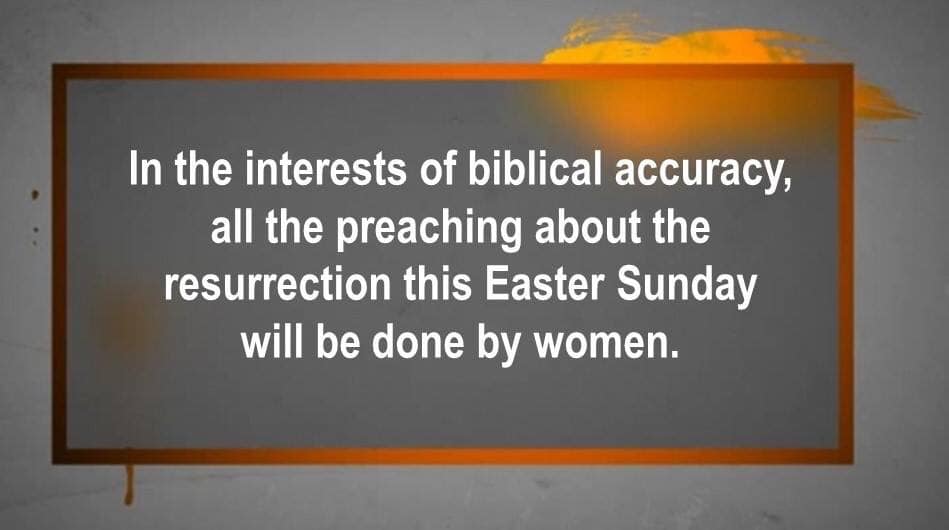
Text author: @pastormelissa [?]
If we want to be correct, it is worth remembering that the risen Jesus chose to appear first not to Peter, nor to John, nor even to his mother Mary, but to a woman, Mary Magdalene. And Jesus sent her, Mary Magdalene (the Greek word apostellein means “to send”, from which, as we see, the spiritual title “apostle” was formed), to preach to the men.
Mary Magdalene was at the cross with Jesus’s mother Mary at the time when the men had fled. Did she risk being captured and, possibly, beaten and imprisoned, nailed to a cross? In ancient society, as we gather, women were not treated more gently than men, especially if the women followed a troublemaker, an inciter of crowds, and heard calls to establish an alternative to the Roman government – the Kingdom of God here and now. It would have been safer for Mary Magdalene to follow the example of Peter and the other men, but no, she was at the cross according to the accounts of Matthew (27:56), Mark (15:40), and the Gospel of John (19:25).
Mary was present at Jesus’s burial, which means that she took part in the washing, anointing, and wrapping of Jesus’s body. How could she not, if both Mark (15:40) and Matthew (27:61) mention it? Hardly anything so profane would be conceivable in the doctrines of modern moral theology or even ecclesiology! A woman touched Jesus’s body? One can only conclude that at that time there was no such theology; nor were there the doctrines derived from it that a woman can under no circumstances consecrate the Holy Communion and distribute (touch) the Sacrament. Wait – Mary Magdalene took part in the burial of the dead Jesus and the activities connected with it, which nowadays are understood only by those who work in morgues or perform forensic examinations.
Mary Magdalene was present at the central events connected with the spread of Christianity.
She was an eyewitness to Christ’s death, burial, and resurrection. She was not present at the moment of Jesus’s birth, but first-century Christians were little interested in the date of Jesus’s birth, and so no specific date was ever recorded. We all know that December 24 was borrowed into Christianity from the pagan celebration of the winter solstice.
Mary was always in the right place at the right time. And the right time was also the morning of the first day of the week (Sunday) at the tomb, which all four canonical Gospels report (Mt 28:1, Mk 16:1, Lk 24:10, and Jn 20:1,11)! The Gospels of Mark and John highlight that Jesus appeared to her first.
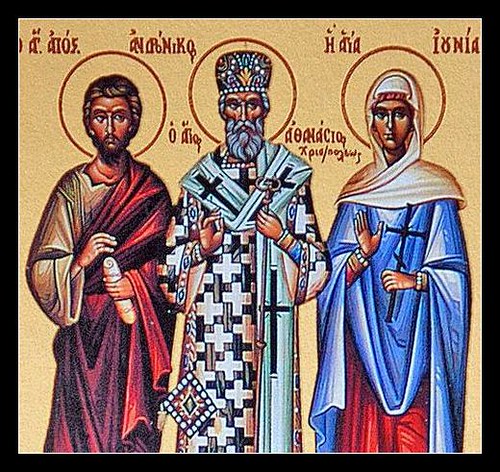
Since Jesus sent (apostellein) Mary to the disciples, it becomes clear to us why Mary Magdalene has been called the apostle of the apostles. Quite simply, it means that Mary was sent by Christ to “those who were sent”. In other words, Mary Magdalene was an apostle in early Christianity. Just like the apostle Junia (Rom 16:7), whose name was distorted in the Middle Ages and written in the masculine right up until the recent year 1994 (which is why in the Latvian Bible, in the 1965 revised text, we still read about a man, Junias).
Junia remained the nonexistent man Junias, whose abbreviated name was the equally nonexistent Junias, companion of Andronicus.*
What happened to Mary Magdalene? In the sixth century, Mary Magdalene was turned into a sinner with a capital letter, a prostitute, a harlot, a temptress. One need only type the name “Mary Magdalene” into an internet search engine and look at medieval works of art – Mary Magdalene is half-naked or completely nude, with a tempting gaze, a representative of the profession of loose conduct. An ideal way to ruin the reputation of a woman sent by God.
The evangelist Luke does mention that Jesus cast several demons out of Mary Magdalene. But nowhere does Luke specify that any of the demons was a “demon of prostitution”. As is known, in the ancient world all kinds of illnesses were blamed on demons. New Testament theologians are in agreement – if Mary Magdalene was freed from the power of demons, an equals sign is to be drawn with illness and weakness.
In the sixth century (in 591), Pope Gregory the Great of the Catholic Church, in his homily, mentioned Mary Magdalene as a woman who is, firstly, the sister of Lazarus (Mary of Bethany) and, secondly, a former sinner who used her body for forbidden acts, in other words, lived a sexually licentious life. Pope Gregory the Great also emphasized the positive aspect, that this woman repented of her sins and devoted herself to serving God. However, here too he confused Mary Magdalene with the sinful woman in chapter 7 of the Gospel of Luke, in which an anonymous woman in the house of a Pharisee anointed Jesus’s feet with costly oil and washed them with her tears; Jesus pointed out to the Pharisee that this woman loves much, because she has been forgiven much. Well, if so, then so. Add to this an (anonymous) adulteress in chapter 8 of John, and Mary Magdalene’s portrait is complete – in her own person she combines all these sinful women. Mary Magdalene had a name and a high standing among the followers of Jesus, and her name and renown were merely stripped from her, just as her garments of virtue were torn off, making her a woman of loose conduct.
The fall of the apostle Mary Magdalene’s reputation is to be associated with the sixth century.
The Eastern Orthodox Church has never ascribed to Mary Magdalene the role of a former prostitute! Two churches, two traditions, two diametrically opposed Mary Magdalenes…
Rehabilitation came.
If we believe God’s words, then sooner or later God’s justice manifests itself. In our time God’s justice often touches our minds, enlightens, convinces, presents facts, and prompts us to re-evaluate entrenched beliefs, inherited assumptions, prejudices, and to formulate anew our perception of the world, in which God is much greater and better than we thought Him to be.
During the Council of Trent (Tridentum, today – Trento) (1545–1563), the Roman Missal (the prayer book of the Mass) was written in the Catholic Church, in which Mary Magdalene was mentioned as a penitent. With the description of Mary Magdalene was cited the biblical passage from chapter 7 of the Gospel of Luke – Jesus and the sinful woman in the house of the Pharisee.
The Second Vatican Council (1962–1965) issued a new Roman Missal, in which the designation “penitent” was removed from the characterization of Mary Magdalene. The Roman Missal was published in 1970. Worthy of note is the fact that Mary Magdalene was granted a feast day, such as is granted to the saints of the Catholic Church – July 22. The biblical passage was changed to the event in chapter 20 of the Gospel of John about Mary’s encounter with the risen Lord Christ.
A louder rehabilitation of Mary Magdalene came quite recently – in 2016.
On June 10, 2016, Pope Francis of the Catholic Church announced that Mary Magdalene is the first witness of Christ’s resurrection and a “true and authentic evangelist”. On that same June 10, the Pope promulgated a decree and an explanatory note, in which he described how Gregory the Great had identified Mary Magdalene with other sinful women in the New Testament. In the explanatory note (download here) it is mentioned that it was Thomas Aquinas (whom the Catholic Church calls “Doctor Angelicus”) who ascribed to Mary Magdalene the title “apostolorum apostola”, because she was sent to the apostles. At the end of the note it is said:
“For this reason it is right that the liturgical veneration of this woman should be on the same level as the veneration of the apostles in the general Roman [Catholic Church] calendar, and that the special mission of this woman should be emphasized – she who is the example and model of all women in the church.”
Several documentary films about Mary Magdalene have been released, both feature films, such as “Mary Magdalene”, released in 2018, in which the leading role is played by Rooney Mara, and academic accounts featuring professors and researchers of the New Testament and of the history of Christianity. In the spring of 2018, the Vatican’s minister of culture, Cardinal Gianfranco Ravasi, said the following:
It is important to find the true face of Mary Magdalene, who is a woman that reflects the essential nature of the feminine aspect at Christ’s side.
In recent years, in the age of multimedia, God has, before the whole world, begun to rehabilitate two women apostles, princesses of God – Mary Magdalene, who was dragged through the mud and despised for nearly fifteen centuries, and Junia, a woman who was a believer a good while before Paul and who was held in great honor among the apostles (Rom 16:7).
Some of us believe that we live in a corrupt age overtaken by liberalism, feminism, and Marxism. I will dare to say that it is exactly the opposite: we live in the age of the approaching Kingdom of God, in which God’s justice is revealed and poured out, a justice that includes the recognition of the worth of woman in both the temporal and the spiritual sphere. For two thousand years believers have prayed “Our Father in heaven .. Thy Kingdom come, on earth as it is in heaven ..”.
Do we really think that God has not heard this prayer and has not begun to fulfill it? God reveals Himself every day – more, more clearly, and beyond our comfort zone. After all, He is able to raise the dead! Also the good name of the dead, dead dreams, dead hopes, buried callings of God. Moreover, if the Spirit of Him who raised Christ from the dead dwells in us, then He who raised Christ from the dead will also give life to our mortal bodies through His Spirit who dwells in us (Rom 8:11).
Christ is risen!
Aļesja Lavrinoviča (editor)
* For more on this question, see the book: Eldon Jay Epp. Junia: The First Woman Apostle. Minneapolis: Fortress Press, 2005.