
This article is republished from the portal “Vēstis Adventistiem”, where it was posted on May 4, 2019.
In chapter 16 of Paul’s Epistle to the Romans we read: “Greet Andronicus and Junia, my kinsmen and fellow prisoners, who hold an honored place among the apostles and who were in Christ before me.” (Rom 16:7 – the 1965 revised Bible text in Latvian. The Latvian Bible Society: http://www.bibele.lv.).
Junia, together with Andronicus, were Paul’s kinsmen, and, reading the cited passage, we unfortunately have no inkling that Junia is a woman and not a man named Junias.
Let us get acquainted with the woman apostle Junia found in the Bible, a contemporary of Paul, who, in a mysterious way, thanks to the interpretation of theologians, existed in the New Testament as a man for the last 8 centuries. For us who read the Latvian Bible, this name does not bring to mind a woman’s name, because Junia has been turned into a man who is a companion of the apostle Paul. How could something like this be allowed to happen?
For 1300 years she was a woman
For the first 13 centuries of Christianity, the sources of the Church Fathers were in agreement that the apostle Junia was together with Andronicus. The two were often regarded as a married couple. In history Junia’s name was recognized as a woman’s name; it has been mentioned in more than 250 places in ancient documents and inscriptions.
There is a series of authors who wrote of Junia as a woman. These were Origen (c. 185–253, whose works were translated by Rufinus (345–410)), John Chrysostom (c. 350–407), Jerome (c. 345–419), Theodoret of Cyrus (bishop, c. 393–458), John of Damascus (c. 675–749), Hraban of Fulda (780–856), the Greek theologian and bishop Atto of Vercelli (10th c.), the influential medieval theologians Peter Lombard (12th c.) and Peter Abelard (12th c.), among others.
It must be said that the statements of the Church Fathers that have come down to us (mostly in the form of medieval manuscripts) are sharply negative in their views of women in general. Against this misogynistic (hatred of women) background, Chrysostom’s commentary on the Epistle to the Romans provides an all the more powerful testimony:
‘Greet Andronicus and Junia… who hold an honored place among the apostles’: To be an apostle is something great. But to be honored among the apostles – just think what a wonderful song of praise that is! They were worthy because of their works and virtuous deeds. Indeed, how great must this woman’s wisdom have been, that she was even worthy of obtaining the title of apostle. (ep. ad Romanos 31.2; PG 60.669-670).
Later the Church Father John of Damascus wrote in his commentary on Paul’s epistles: “To be called ‘apostles’ is a great thing… but to be singled out, think what great praise that is!”
Facts and figures
What do the New Testament manuscripts attest about the woman apostle Junia?
JUNIAN (Gr. Ἰουνιᾶν – a feminine name in the accusative) is found in all the Greek manuscripts that contain the text of Rom 16:7 (except for five variants, which read Julian, from the name Julia – also a typical woman’s name), including Aleph, A B* C Dp * Fp Gp Lap Parp Ψ 049 056 0142 0150 0151, and 571(!) in minuscule scripts (script in which all words without exception were written in small letters), as well as in four manuscripts that contain minor copying errors: 337, 618, 1738, and 1267.
Among these minuscules are some valuable sources, such as the manuscript group 33 (9th c.), 1739 (10th c.), and 1881 (14th c.). The reason these manuscripts are singled out is that until the seventh century the New Testament manuscripts in Greek were written only in capital letters and without any accents or punctuation marks. If, in addition to the testimony of the Church Fathers, in the latest, very late documents, which contain the accent marks of words, the name Junia has been accented as the name of a female person in the accusative case, this indicates, firstly, that Paul undoubtedly referred to a woman who “holds an honored place among the apostles” (Jeff W. Childers and D.C. Parker. Transmission and reception: New Testament text critical and exegetical studies. Piscataway. NJ: Gorgias Press (2006), 128), and secondly, that every copyist (by the 4th century, copyists were already professional, paid scribes) understood this name in the accusative as the female personal name Junia.
The masculine personal name Junias not only does not occur in any ancient Greek or Latin New Testament manuscript, but it also does not occur in any archaeological object of that era, e.g., a tomb engraving, unlike the widespread female name Junia, which occurs in both Greek and Latin.
Erasmus of Rotterdam, the greatest text critic of the Renaissance era, when publishing his Greek New Testament in 1516, in the accompanying commentary on Rom 16:7 referred to the text of the Vulgate (in which Julia was mentioned) – Andronicum et Iuliam – and wrote: “that is, ‘Junia’. He [Paul] gives Julia her own place later [in the letter, Rom 16:15]”. Then in 1527 Erasmus supplemented his commentary as follows: “A very ancient codex found in a church in Constance agrees with the Greek manuscripts.” We see that the Latin text of the Vulgate that Erasmus of Rotterdam used in 1516 wrote Iuliam, Erasmus understood it as the female personal name Julia, while at the same time identifying it with the reading “Junia” found in the Greek manuscripts.
How a woman was turned into a man
The notion that “Junia” should be changed to a man’s name appeared in the thirteenth century, when Aegidius of Rome ((or Giles) c. 1243–1316) read this name as masculine without any basis or explanation. Later, in 1512, Jacques Lefèvre (Jacques LeFevre) also read it as the masculine personal name “Junias”. Later Martin Luther wrote “Junias” in his German New Testament, likewise without any historical evidence. We know how great a role Luther’s translation of the Bible played in the spread of Protestantism. It is almost needless to add how far-reaching the consequences were of Luther’s choice to write Junia’s name as masculine. The view that the text of Rom 16:7 refers to a man, Junias, has, since Luther’s time, become thoroughly and uncritically entrenched in Western Europe. It should be added that from antiquity to the present day the Orthodox Church has indeed honored Junia as a holy woman.
Joseph Barber Lightfoot, who prepared the materials for the Revised Version of the English Bible (Revised Version – 1881), already in 1871 expressed a view that spread with lightning speed and influenced almost a century of New Testament editions in various languages:
… [I]t would seem that we ought to change the name Ἰουνιᾶν [Junian], one of St. Paul’s kinsmen, who was ‘of note among the apostles’ (Rom. xvi.7) to Junias (that is, Junianus), rather than Junia. (Ibid., 126.)
In this way, as a result of human reasoning about the personal name “Junia” in the accusative, decisions were made that influenced not only the views of the ordinary Bible reader concerning Paul’s Epistle to the Romans, but also the ecclesiology (doctrine of the church) of the larger church denominations, partly or wholly excluding women from ministry in the church, arguing that in the New Testament there is not a single woman to whom God entrusted the authority of a disciple of Christ, not to mention the calling of an apostle.
The contradictions of the 20th century
In all editions of the Greek New Testament, beginning with the time of Erasmus (1516), when methods of mechanical copying developed, up to Erwin Nestle’s 13th edition, “Andronicus and Junia” (fem., – Ibid., 124.) was written. However, the 13th Nestle edition of the Greek New Testament, published in 1927, became a turning point – changing the name from the woman “Junia” to a nonexistent man “Junias”. Nestle’s Novum Testamentum Graece amendments were followed by all the other publishers, which, without exception, rewrote the personal name with masculine accents.
In the translation of the German pastor Ernst Glück, who in the 17th c. translated both the New and the Old Testament into Latvian, we read a correct translation of verse 7 of chapter 16 of the Epistle to the Romans – “Greet Andronicus and Junia, my kinsmen and fellow prisoners, who are honored among the apostles, and who were in Christ before me” (Rom.16:7 – The book of the Holy Apostle Paul to the Romans. 7th edition of Ernst Glück’s Bible translation. https://docs.google.com/View?id=dcgvpcr4_244cm3n77dp).
The revised Latvian Bible edition, published in 1965, in turn “revised” the wording of verse 7 as well, and in Latvian there appears Junias, who is Paul’s kinsman. Reading this edition of the Bible, we would hardly ever suspect that Junia was a woman.
In 1998, unnoticed by anyone, the woman “Junia” appeared again in the anniversary edition of Nestle and Aland’s Novum Testamentum Graece (and in later editions), as well as in the third and later editions of the United Bible Societies (abbreviated UBS in English). It should be noted that any changes and new findings in the Nestle (and Aland) text of the Greek New Testament always appear in the so-called critical apparatus (in a footnote with a reference to previous variants and new manuscript research); however, in the case of the woman Junia, no changes were shown, they happened anonymously, contrary to Nestle and Aland’s own claims and the standards of biblical research. This is a fact that shocked one of the world’s most famous and influential New Testament text critics, Eldon Jay Epp, who in 2005 published a book entitled “Junia: The First Woman Apostle”. The information provided in the book is the basis of this article.
One can only conclude that this kind of manipulation of the text was “entirely justifiable,” because the apostle Junias (a man) was an image created by specific male theologians (exegetes, lexicographers, and grammarians, and – church representatives in Europe, Great Britain, and North America), who, as can be seen, had difficulty accepting that a woman in early Christianity could be an apostle, all the more one who was outstanding among others. (Jeff W. Childers and D.C. Parker. Transmission and reception, 125)
The arguments of those who dislike Junia
It should be added that adherents of the modern complementarian view cite all sorts of reasons to explain the appearance of the woman apostle Junia in the list of persons greeted by the apostle Paul. I will mention two or three of the most widespread views:
1) Junia was not in fact a woman
Although no manuscript from earlier centuries contains the masculine personal name Junias, there are some late medieval manuscripts, such as B2, D2, Y, in which “Junias” is written. The problem is that most of these manuscripts were written in the 13th–14th century. (Dennis J. Preato. Junia, A Female Apostle: Resolving the Interpretive Issues of Romans 16:7 http://www.godswordtowomen.org/juniapreato.htm)
In biblical exegesis, practically nothing can be proven or asserted with such late manuscripts. These are documents that have been copied from all the earlier ones. World-renowned Bible scholars and exegetes such as Bruce Metzger, Philip B. Payne, and Gilbert Bilezikian hold that the masculine reading “Junias” is supported by neither history nor the biblical manuscripts.
(Gilbert Bilezikian, “A Challenge for Proponents of Female Subordination To Prove Their Case from The Bible”, http://bilezikian.com/gbilezikian/publications/challenge.html. A reader to whom G. Bilezikian’s name is unfamiliar may perhaps have heard of Bill Hybels, who is the founder of the Global Leadership Summit and the leader of a Protestant megachurch. Bilezikian was Hybels’s teacher in theology and his partner in founding the church, and also the shaper of Hybels’s egalitarian views. In the church, where several tens of thousands of people gather each week, women have been encouraged to lead and to hold any positions of church leadership, such as elders, teachers, preachers. Bilezikian himself, in an interview with the magazine “Christianity Today” (Lauren F. Winner, The Man Behind the Megachurch, Christianity Today, November 13, 2000), had said that the church had received criticism because a potential church member, before being admitted to the church, must be able “to gladly listen to the teaching of a woman teacher at Willow Creek [Willow Creek Community]” and “to gladly submit to the leadership of women in the various positions at Willow Creek”.)
Daniel B. Wallace and Michael H. Burer, in their efforts to find any evidence that Junia was not a woman apostle but rather a man apostle, cite the bishop of the city of Salamis in Cyprus, Epiphanius (c. 315–403), who in his work “Index of Disciples” (Index discipulorum) is said to have written as follows: “Junias, whom Paul mentions, became bishop of Apameia in Syria”. These men point out that Epiphanius’s form of expression for the word “whom” (Greek – ou) is masculine, which, contrary to all other sources, points to a man, Junias. At the same time, Wallace and Burer admit that Epiphanius only indirectly refers to Rom. 16:7 (since he does not cite the specific passage in the New Testament). At the same time, both scholars say that Epiphanius’s statement about a man, Junias, should not be taken too seriously, because in the preceding sentence this bishop also called Priscilla (unmistakably a woman in the list of Paul’s addressees) a man! Possibly, the masculine was the only gender in which Epiphanius had chosen to express himself, since this Church Father said:
[T]he female sex is easily seduced, weak, and without much understanding. The devil seeks to vomit out disorder through women… We wish to apply masculine reasoning and destroy this folly of women. (Epiphanius, Adversus Collyridianos, Migne, Patrologia Graeca, Volume 42, Column 740 f)
Even such an explicit context and the features of Epiphanius’s personality do not prevent theologians such as John Piper and Wayne Grudem from nevertheless holding on to the word “whom” found in the masculine in Epiphanius’s work and claiming that evidence has been found for a man, “Junias”.
Likewise, Piper and Grudem offer their computer-search results for the name “Junia” and conclude that no one can claim that Junia was a common woman’s name in the Greek-speaking world, since in ancient Greek literature only three known examples are found”. From this follows their conclusion – Junia was not a common woman’s name. Wallace and Burer even say that in their computer search they found Junia mentioned only once outside the Bible, in a text by Plutarch. Although other sources note that the woman’s name Junia has been found in 250 records, engravings, and documents, even in place of their 3 found cases, Grudem and Piper did not find a single instance where anyone had mentioned the man’s name “Junias”.
It is indeed possible to render the name “Junia” as the man’s name “Junias”, which would be an abbreviation of the man’s name “Junianus”; however, no evidence has been found that the name “Junianus” was ever abbreviated to “Junias”.
2) Junia was not an apostle
One of the versions cited by those who object to women as biblical teachers and pastors is the phrase “among the apostles” mentioned in chapter 16 of Romans. In their view, this means that Junia and Andronicus were not apostles, but that the real apostles honored them.
Discussions about the phrase “who hold an honored place among the apostles” can be read in almost every New Testament commentary on Romans, most of which arrive at the conclusion that Paul calls both persons apostles. A natural and simple reading of the preposition “among” [the Greek preposition en means “in”, but if several nouns are listed, then the meaning is “among”] means that Andronicus and Junia were members of this group.
Everyone agrees that this matter would not be discussed at all were it not about a woman. Among those who interpret this passage differently are both Wallace and David Jones.
It must be admitted that grammatically it really could be understood either way. But what is important is precisely the testimony of history. The aforementioned Chrysostom, Archbishop of Constantinople, a 4th c. Church Father and an Orthodox saint, even though he himself shared his era’s skeptical attitude toward women in general, nevertheless wrote unhesitatingly that Junia was a woman and an apostle, and his words are hard to misunderstand.
Likewise, John Chrysostom wrote about and marveled at another woman whom Paul mentions in the preceding verse (Rom 16:6) – Mary. Chrysostom’s quotation reveals quite a lot to us about the possible motives for altering or supplementing the text of the Holy Scriptures so as to exclude and belittle women:
How is this? Again a woman is honored and proclaimed victorious! Again we men are put to shame. Rather, we are not to be put to shame, but honor is even due us. The honor that is ours is that there are such women among us. But we are shamed, because we men are so far behind them… For the women in those days had more spirit than lions. (Migne, Patrologia Graeca, Vol. 51, cols. 668f)
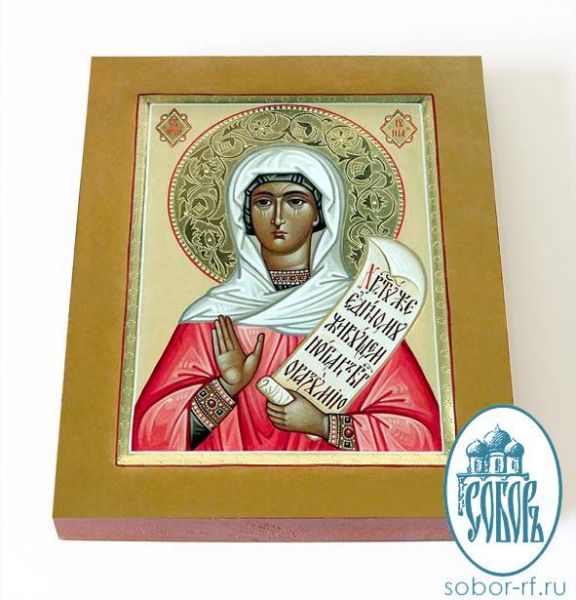
An interesting argument, in my opinion, is the fact that in the patriarchal Orthodox Church there is no doubt about Junia as a woman apostle. In the Orthodox calendar of saints, May 17 is the feast day of the apostle Junia.
3) Apostles without authority
Yet another version among those male theologians who cannot come to terms with Junia’s apostolic office: they explain that the Greek word “apostle” does not automatically imply authority, because it means “one who is sent”. According to this view, even if Junia was an apostle, that does not at all mean that she had any kind of authority to teach or to lead or to found congregations. However, it must be admitted that the New Testament uses the word “apostle” mainly to describe a person’s work for God, associated with the founding of new congregations, the teaching of Christian doctrine, and the preservation of correct teaching.
Of course, the apostle Paul does not mention either Junia or Andronicus as apostles among the twelve apostles of Christ, but let us remember that Paul himself is not counted among the twelve who were with Jesus. Nevertheless Paul, although not physically present with Christ, was called an apostle and founded congregations, and even, by his apostolic authority, dared to rebuke Peter (one of Christ’s twelve apostles and the most prominent of the twelve, see Gal 2:11-21). Likewise Paul writes that “God has appointed in the church, first apostles, second prophets, third teachers, then miracles, then gifts of healing, helping, administrating, and various kinds of tongues” (1 Cor 12:28). In this passage Paul mentions apostles “first”, before prophets and teachers.
Conclusion
The fact that Junia was imprisoned together with Paul ought to indicate that this woman was a person well known in society, one who was reckoned with as a church leader. All Roman activity was directed at arresting and killing the most courageous and influential Christians, with the aim of deterring other Christians – so that they would not end their lives similarly. If it had befitted this woman to be “silent” in church assemblies and never to dare to preach/teach the gospel to men, she would hardly have ended up behind bars. History attests that most of the Christians who were captured, imprisoned, and killed were leaders well known in society in the early church – both men and women.
Additional information and a comprehensive study of the woman Junia in the ancient manuscripts can be found in the book: Epp, Eldon Jay. Junia: The First Woman Apostle. Minneapolis: Fortress Press, 2005.
Image: Icon of St. Junia “Мученица Иуния, супруга и помощница Апостола Андроника, Юния” (https://sobor-rf.ru)
Aļesja Lavrinoviča