
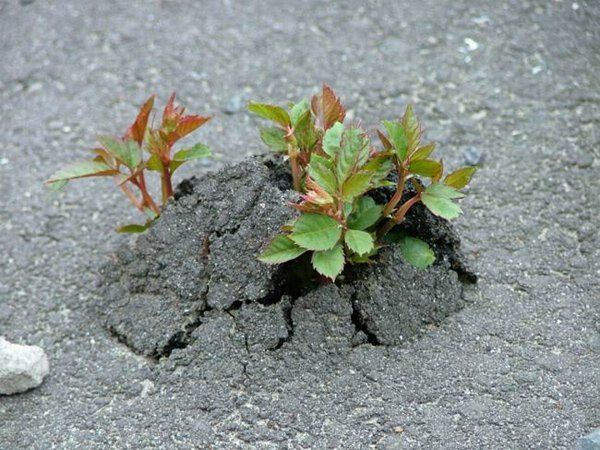
Grass is able to grow up through asphalt! All it needs is a single source of water from which to draw supernatural strength.
I remember the yellow asphalt roller that my grandfather used to drive. It compresses the hot asphalt mass thoroughly. Once the asphalt cools, even trucks carrying heavy loads can drive over its surface. To cut out a section of laid asphalt, a spade and determination are not enough – you have to use an asphalt cutter. As time goes on, in some places blades of grass break through the asphalted mass, stretching upward with a force that is incomprehensible given the thin and fragile blades of grass.
In science, this phenomenon, which fascinates many, is explained by the term “turgor”. Turgor is the internal pressure of plant cells that ensures the resilience and rigidity of plants. Turgor is also called hydrostatic pressure, the strength of which depends on the amount of water in the plant cell. If enough water accumulates, growth occurs, and nothing, not even asphalt, can halt the manifestations of turgor.
Water is at the root of this strength, persistence and upward drive.
But at the root of a believer’s strength, persistence and forward drive is the Holy Spirit.
It is no secret that in the Bible the Holy Spirit and the giving of the Holy Spirit are repeatedly described using terminology associated with water, e.g., “I will pour out My Spirit” (Joel 3; Acts 2).
In chapter 3 of the Gospel of Matthew we read about John the Baptist, who preaches and baptizes in the Jordan River those who have repented of their sins. After some time, John points out that he is not the last prophet, and that God’s work of renewing humanity has not ended with the forgiveness of sins. Looking to the future, John proclaims:
“I indeed baptize you with water unto repentance from sins, but He who comes after me is mightier than I, whose shoes I am not worthy to carry; He will baptize you with the Holy Spirit and with fire.”
To “baptize” with the Holy Spirit literally means to “immerse” in the Holy Spirit.
In the Gospel of John (Jn 4:13-14), Jesus meets a Samaritan woman at a well where she has come to draw water. Jesus promises her something more than ordinary water, which serves to quench thirst only briefly. He promises the woman living water that wells up to eternal life. Jesus’ theological discussion with the woman at the well is the most profound theological revelation of the kind of religion God expects from those who worship Him – to worship Him in spirit and in truth. For some, the still more essential question of on which mountain (read – congregation) one may and may not worship God, from which well one may and may not draw water, was resolved long ago there – at Jacob’s well. The foundations of orthodox liturgy and the principles of ecumenism were proclaimed to the woman at the well, who, moreover, was not a Jew but a Samaritan. To none of His male disciples did Jesus give such a master’s-level private lecture in theology. After receiving this revelation, the Samaritan woman felt empowered to evangelize in her town and, very likely, turned many souls to God.
Further on, in the text of chapter 7 of the Gospel of John, we read:
“On the last and greatest day of the feast, Jesus stood and cried out: ‘If anyone thirsts, let him come to Me and drink! He who believes in Me, as the Scripture has said, out of his body shall flow streams of living water.’ This He said about the Spirit, whom those who believed in Him were later to receive; for the Spirit was not yet given, because Jesus had not yet entered into His glory” (Jn 7:37-39).
The Holy Spirit possesses the force of hydrostatic energy, potentially available to every believer.
Strength is needed to overcome resistance and hardship. But it was the power of the Holy Spirit, like flowing water, that enabled believers in times of persecution to stand firm, to prevail and to bear witness. Some bore witness with their lives, some with their deaths. The Holy Spirit is given to believers so that they may stand firm in difficult times. The Holy Spirit is given from on high to men as well as women. Moreover, the gifts of the Holy Spirit that God gives, He Himself chooses, and He asks no one’s opinion.
Today marks exactly one year since the Synod of the Evangelical Lutheran Church of Latvia took the decision (03.06.2016) to exclude women from the ministry of pastors, thereby assuming the role of judge over the gifts God has given to women and the calling God has given them.
But…
The forgotten factor is the Holy Spirit and the power of the Holy Spirit, which is promised to believers regardless of gender. The Bible states clearly that the letter kills but the spirit gives life, for the text of the Bible must be read with the help of the Holy Spirit and bearing in mind the revelation of God’s approaching kingdom, rather than hiding behind the black letters.
Catherine Booth, the wife of William Booth, founder of the Salvation Army movement, who preached the Gospel in the face of her era’s patriarchal social notions about women, as well as the passages of Scripture 1 Tim. 2:12 and 1 Cor 14:34 (which, according to scholarly research, were not in Paul’s manuscripts but were added only in the second century), used to say:
“The Holy Spirit is the supreme law!”
Catherine Booth knew nothing of biblical manuscript research or exegesis, nor was she an expert in fundamental or systematic theology. She sensed it. The Holy Spirit had revealed to her what was what. The Holy Spirit had given her the gift and the responsibility to preach the Gospel.
The power of the Holy Spirit, like turgor, takes no notice of an artificially imposed barrier, even if that barrier is hot asphalt pressed down on top, which at first scorches the grass. But faith is strengthened in the fire (see 1 Pet. 1:6-7). The energy of life and the ability to break through, given from on high, will sooner or later realize itself. Water is needed, the Holy Spirit is needed! The streams of water will gather, the peg will give way, the Holy Spirit will be poured out and will set women free to serve in Latvia.
Come, Holy Spirit!
A blessed feast of the outpouring of the Holy Spirit (Pentecost)!
Your LLSTA editorial team