
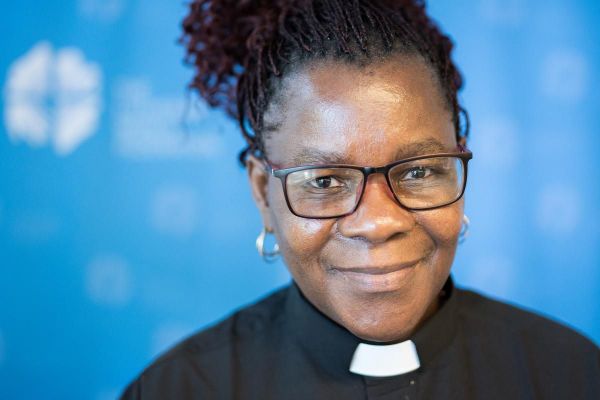
Voices from the communion: the Rev. Elitha Moyo
The Rev. Elitha Moyo of the Evangelical Lutheran Church in Zimbabwe (ELCZ) believes that the genders must work together to put an end to forced and child marriage, teenage pregnancy and gender-based violence. Moyo, the ELCZ’s gender justice coordinator and a member of the LWF Council, says that violence can be ended and growth shared through cooperation between the genders.
Moyo, together with three ELCZ diocesan and local officials, observed a rise in violence against women and children when communities were hit by the coronavirus (COVID-19) pandemic. These observations led Moyo and the ELCZ Gender Justice project (a project funded by the Lutheran World Federation since 2012) to travel to the eastern, western and central districts of Zimbabwe, combining the provision of information on sanitary standards during COVID-19 with a gender-equality campaign.
Her passion and her calling to leadership and gender equality have allowed Moyo to witness positive change on gender issues even in Zimbabwe’s most conservative communities.
You are the gender justice coordinator of the Evangelical Lutheran Church in Zimbabwe. How has your work become harder of late?
The ELCZ is not spared in this crisis caused by COVID-19; its members are suffering too, including those who support the church financially. Since our local financial supporters have been affected, the church is in crisis and unable to support its staff and members.
The number of cases of sexual exploitation and other gender-based violence (GBV) rose and worsened in connection with COVID-19, because there was limited access to resources — water, food — and limited access to health care facilities due to restricted movement.
What is health care like in Zimbabwe?
We hope the Minister of Health will improve the health facilities, whose condition is deteriorating. Most people seek medical care at mission and private hospitals, but unfortunately only a few can afford to go to private hospitals, and the mission hospitals are not located in cities and other areas where people can reach them. The mission hospitals also have difficulty obtaining medicines and personal protective equipment.
There is a shortage of testing kits, which means that people are not being tested, so the actual number of people infected with COVID-19 is not known.
What strategies does the ELCZ have to help women at this time?
Given COVID-19 and the restrictions on movement, GBV was a major cause for concern, because we know that the perpetrators are usually close relatives and trusted persons. During COVID-19 we have seen a rise in the number of teenage pregnancies, as well as cases of GBV in which women were killed or injured. Poverty also fuels violence.
The ELCZ stepped in, helping women and children through activities funded by sister churches or partners. These activities include empowerment projects in schools and seminars for young mothers, as well as training in entrepreneurship and various skills.
During some of the seminars it was observed that, in the presence of leaders, people can speak freely and share their experiences of GBV in their families and communities. This shows that at the seminars women and children felt safe enough to talk about GBV.
You said that men and boys are active participants in gender justice. Can you explain why?
Men and boys must be addressed, because they can often be an obstacle or put up resistance when it comes to women. If we do not engage men and boys effectively, society’s efforts will be disrupted or simply ignored. It is not just a matter of women; rather, it is a matter of men and women working together so that relationships can be equal and both men and women can live to the fullness of their potential and the dignity that God has given them.
Has there been positive engagement from men?
Yes. There are several men who received the program very well and talk about how they have changed. Some men have spoken publicly about harmful cultural practices, both in the church and in their communities, such as child marriage and forced marriage.
Church members advise the staff of the ELCZ Gender Justice project when there are cases that require intervention. Change, however, is a process, and it takes time.
Someone at a seminar said: “Your program is different from other organizations, because you involve men in the discussions and go deeper into these issues,” by which he meant teenage pregnancy and child marriage.
Progress is evident, because most traditional leaders can now organize gender-equality meetings and appoint leaders who understand gender equality. They are now the main driving force for gender equality in their communities, although the issue of gender justice has not yet been fully resolved. The journey to freedom is long.
What inspired you to take on a leading role in the church and in the field of gender equality?
I could not refrain from advocating for gender justice in the church and in the communities. I feel that God has called me as a pastor to this kind of ministry. I must leave a mark that will encourage other women.
I used to have, and still have, the sense that whatever men can do in terms of opportunities and roles, women can do too, because they are people, just like men. We are all created for a greater purpose, and we must value one another regardless of gender.
Under God’s guidance I have managed to reach even the most conservative communities – communities that are deeply rooted in traditional and cultural practices that do not acknowledge the worth of women.
Under God’s guidance I have observed these communities open up and voluntarily give up violent cultural practices.
What does it mean for your work that the ELCZ is part of the LWF communion?
The ELCZ plays an essential role in the LWF communion of churches. As part of the LWF, we carry out the communion’s mission by doing the work of gender-equality ministry.
BULAWAYO, Zimbabwe/GENEVA
| 2/10/2020
Source: Lutheran World Federation
Photo: LWF/Albin Hillert